AI Large Language Model Learning Roadmap: A Systematic Path from Zero to Project Implementation

A systematic guide to learning AI large language model development from fundamentals to enterprise projects.
This article presents a comprehensive learning roadmap for AI large language model development, structured in three phases: foundational knowledge (Transformer architecture, Tokens, Prompt Engineering), skill advancement (RAG, Agent development, model fine-tuning with LoRA), and enterprise practice (smart customer service, intelligent Q&A agents). It also offers practical advice on pacing, staying current with rapid tech evolution, and prioritizing hands-on projects over passive learning.
As AI large language model (LLM) technology continues to boom, more and more people are looking to break into this field. However, faced with an overwhelming amount of fragmented learning resources, beginners often find themselves stuck in the dilemma of "having watched tons of tutorials but still unable to build real projects." A tutorial series on Bilibili (China's leading video platform) claiming 748 episodes covering the full AI LLM curriculum has attracted widespread attention. Its course design philosophy and knowledge architecture provide us with an excellent lens to examine "how to systematically learn AI LLM development."
What Are the Pain Points of Current AI LLM Learning Resources?
Before creating the course, the author spent a month reviewing AI LLM development tutorials across all major platforms and identified several common problems: The content isn't systematic or comprehensive enough. Most tutorials only cover basic operations of individual tools, while the critical engineering and deployment processes are glossed over.
This observation is quite accurate. Current AI LLM tutorials on the market generally fall into three categories: first, entry-level API calling content that teaches you how to use ChatGPT or domestic LLM APIs; second, operational demos of specific frameworks (like LangChain); and third, academically-oriented paper reviews. However, systematic content that connects all this knowledge into a complete development capability is indeed scarce.
Especially the core areas that frustrate beginners the most — model fine-tuning, private deployment, and Agent development — are rarely covered thoroughly in any tutorial. This is why many people accumulate scattered knowledge but can't independently complete an enterprise-level project.
Three-Phase Learning Path: From Foundational Knowledge to Enterprise Practice
This course adopts a three-phase structure of "Foundational Knowledge → Skill Advancement → Enterprise Practice," a design philosophy worth referencing for all AI learners.
Phase 1: Building a Solid Foundation for LLM Learning

The foundational phase covers several key modules:
- LLM Fundamentals: Understanding core concepts like what large language models are, Tokens, context windows, etc.
A Token is the basic unit that large language models use to process text, but it's neither equivalent to a word nor a character. In English, one Token corresponds to roughly 4 characters or 0.75 words; in Chinese, one character is typically encoded as 1–2 Tokens. Models use a Tokenizer to split input text into Token sequences, with common tokenization algorithms including BPE (Byte Pair Encoding) and SentencePiece. The Context Window refers to the maximum number of Tokens a model can process in a single pass, directly determining how much information the model can "see." GPT-3.5 has a context window of 4K/16K Tokens, GPT-4 Turbo extends to 128K, and Claude 3 supports 200K. The size of the context window directly impacts RAG system design strategies and long-document processing capabilities.
- Transformer Architecture: This is the technical foundation of all large models. Understanding attention mechanisms and encoder-decoder structures is crucial for subsequent learning.
Transformer is a deep learning architecture proposed by Google in the 2017 paper Attention Is All You Need, which fundamentally changed the technical paradigm of natural language processing. Its core innovation is the Self-Attention mechanism, which allows the model to attend to all positions in the input simultaneously when processing sequential data, rather than processing step-by-step like traditional RNNs. This parallelized design not only dramatically improves training efficiency but also enables the model to capture long-range dependencies. All current mainstream large models — the GPT series, LLaMA, Claude, ERNIE Bot, etc. — are built on variants of the Transformer architecture. Understanding how components like multi-head attention, positional encoding, and feed-forward networks work is a prerequisite for diving deep into LLM development.
- Prompt Engineering: Including key techniques such as zero-shot prompting, few-shot prompting, and Chain of Thought (CoT).
Many beginners rush to write code, skipping over understanding the Transformer architecture. But in reality, only by understanding the underlying principles can you know how to optimize when problems arise, rather than blindly guessing.
Phase 2: Mastering Core Tech Stacks Like RAG and Agents

The advanced phase is the most critical part of the entire learning path, covering a comprehensive technology stack:
RAG (Retrieval-Augmented Generation) is currently the most mainstream technical approach in enterprise applications. By combining external knowledge bases with large models, it addresses model "hallucination" and knowledge timeliness issues. Mastering the complete RAG pipeline — from document parsing, vectorization, and retrieval to generation — is an essential skill for LLM developers.
RAG (Retrieval-Augmented Generation) was first proposed by Meta AI in 2020. Its core idea is to retrieve relevant information from an external knowledge base as contextual input before the large model generates a response. The complete RAG engineering pipeline includes: document loading and chunking, text vectorization (converting text into high-dimensional vectors via Embedding models), vector storage and indexing (using vector databases like Milvus, Pinecone, or FAISS), semantic retrieval (finding the most relevant document chunks based on cosine similarity or ANN algorithms), and finally prompt assembly and generation. RAG has become the preferred approach for enterprise applications because it allows injecting domain knowledge without retraining the model, while improving answer traceability and trustworthiness through source citations.
Agent Development has been the hottest direction in the past two years. The course covers integration practices with mainstream frameworks like LangGraph and LangChain, tools that help developers build AI agents capable of autonomous decision-making and tool invocation.
The concept of AI Agents originates from classical artificial intelligence theory but has gained entirely new implementation paths in the LLM era. The core capabilities of modern AI Agents include: environment perception, autonomous planning, tool invocation, and memory management. LangChain was one of the earliest development frameworks to connect large models with external tools, while LangGraph builds on this by introducing directed-graph workflow orchestration capabilities, supporting more complex multi-step reasoning and conditional branching. Since 2024, the Agent framework ecosystem has expanded rapidly, with projects like AutoGPT, CrewAI, and MetaGPT emerging one after another. In enterprise scenarios, Agents typically need Function Calling capabilities (i.e., the model can identify when to call external APIs or tools) and implement alternating cycles of reasoning and action through the ReAct (Reasoning + Acting) pattern.
Model Fine-tuning and Deployment represents the dividing line between being a mere "API caller" and becoming a true "developer." Topics like LoRA fine-tuning, full fine-tuning, local deployment, and high-concurrency inference optimization directly determine whether you can actually deploy models into production environments.
LoRA (Low-Rank Adaptation) is a parameter-efficient fine-tuning method proposed by Microsoft in 2021 and has become the most mainstream LLM fine-tuning technique today. Traditional full fine-tuning requires updating all model parameters, which demands extremely high computational costs and GPU memory for models with billions of parameters. LoRA's core idea is to freeze the pre-trained model's original weights and only inject low-rank decomposition matrices at specific layers for training. For example, for a 4096×4096 weight matrix, LoRA might only train two small 4096×16 matrices, reducing the number of trainable parameters by hundreds of times. This makes it possible to fine-tune 7B or even 13B parameter models on a single consumer-grade GPU. Its variant QLoRA further combines 4-bit quantization technology to compress memory requirements to even lower levels.
Phase 3: Validating Learning Outcomes Through Enterprise Projects
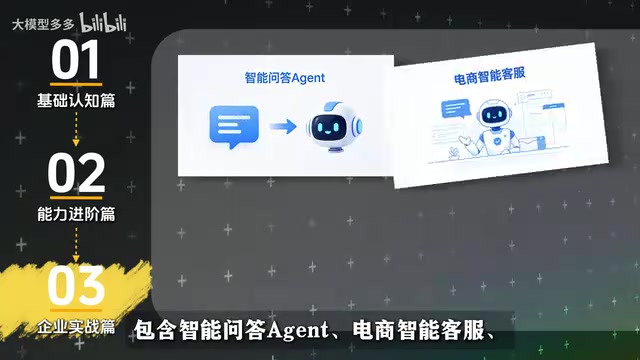
The selection of practical projects is quite representative:
- Intelligent Q&A Agent: The most fundamental RAG application scenario
- E-commerce Smart Customer Service: Involves multi-turn dialogue, intent recognition, and business process orchestration
- Enterprise-level AI Agent: The most comprehensive, requiring integration of multiple technical capabilities
- Intelligent Teaching Assistant: A vertical application in the education domain
These projects cover the most mainstream commercial deployment directions for AI LLMs today, and completing them builds reusable project experience. It's worth noting that the core difference between enterprise-level projects and personal demos lies in engineering requirements: you need to consider system scalability, high-concurrency processing capabilities, error tolerance mechanisms, and continuous iteration through data flywheel design. For example, the e-commerce smart customer service project requires not only basic Q&A functionality but also handling multi-turn intent clarification, API integration with order and inventory systems, and automated evaluation and monitoring of conversation quality.
A Rational View of the 748-Episode Course: Three Learning Recommendations
Although the course system is designed quite comprehensively, we need to approach a few issues rationally:
First, 748 episodes means a massive time investment. At 10–15 minutes per episode, the total duration could exceed 100 hours. For working professionals, it's important to plan your learning pace wisely. We recommend progressing module by module in phases rather than trying to binge-watch everything.
Second, technology in the AI field iterates extremely fast. New frameworks and tools appear in the LLM space almost every month. Take 2024 as an example: OpenAI released GPT-4o and structured output capabilities, Anthropic launched the Claude 3.5 series, and the open-source community's LLaMA 3, Qwen 2, DeepSeek, and other models continuously set new performance benchmarks. Learners need to maintain sensitivity to new technologies while mastering fundamental principles. Knowledge at the principle level (such as Transformer architecture, attention mechanisms, and training paradigms) has a long shelf life, while specific framework and tool APIs may change at any time.
Third, "watching" doesn't equal "learning." LLM development is an extremely practice-oriented skill — watching videos alone is far from enough. We recommend hands-on practice after completing each module; encountering errors and problems is where real learning begins. You can start by setting up a local development environment, deploying open-source models using Ollama or vLLM, and then gradually building your own RAG systems and Agent applications. Open-source projects on GitHub and model resources on Hugging Face are excellent materials for practice.
Path Planning for AI LLM Beginners
Regardless of whether you choose this particular course, the following learning path is worth referencing:
- Build a global understanding first: Spend 1–2 weeks getting an overview of the LLM technology landscape and clarifying your learning goals. We recommend reading survey articles or watching overview lectures to understand the various roles in the LLM ecosystem — foundation model providers, middleware developers, application-layer developers — and determining which level you want to focus on.
- Solidify your Python fundamentals: If your programming foundation is weak, start by building up your Python and basic data processing skills. Focus on mastering asynchronous programming (asyncio), HTTP request handling, JSON data manipulation, and basic vector operations (NumPy) — these are high-frequency skills in LLM development.
- Start with API calls: Learn to call mainstream LLM APIs first to quickly gain a sense of accomplishment. OpenAI's API documentation is well-designed, and domestic platforms like Tongyi Qianwen and Zhipu AI also offer free quotas suitable for practice.
- Dive deep into RAG and Agents: These are the two directions with the highest demand in the current job market. According to data from multiple recruitment platforms, over 70% of AI application development positions in 2024 require RAG or Agent development experience.
- Let projects drive your learning: Start building projects as early as possible. Discover knowledge gaps through projects, then circle back to fill them in.
AI LLM development is in a period of rapid growth, and a systematic learning path is far more valuable than fragmented knowledge accumulation. What matters is not how many tutorial episodes you've watched, but whether you can transform what you've learned into deployable development capabilities.
Related articles

A Three-Month Roadmap to LLM Development: A Deep Dive into the Learning Path from Zero to Freelancing
A deep dive into the three-step LLM development learning path: from prompt engineering and RAG knowledge bases to AI Agent development, with realistic timelines for beginners and experienced developers.
Struggling to Deploy AI Agents? Engineering Is the Key to Going from Demo to Product
57% of projects have deployed AI Agents, but 40% will be killed. This article analyzes the engineering methodology for taking AI Agents from Demo to enterprise product, covering the full process from requirements to deployment.
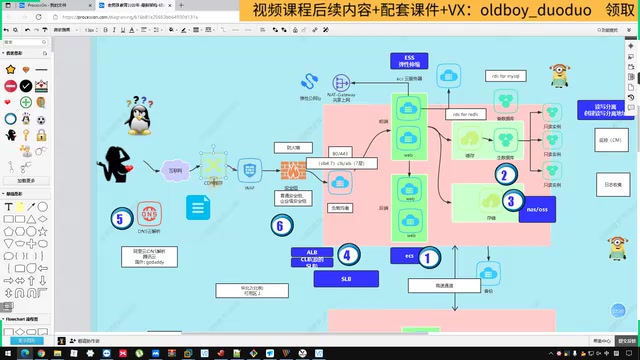
Complete Guide to Alibaba Cloud Website Architecture: The Full Request Path from DNS to Auto Scaling
A systematic guide to Alibaba Cloud website architecture covering DNS, CDN, WAF, CLB/ALB, ECS, Redis, NAS/OSS, and auto scaling along the full user request path.