AI Large Language Model Learning Roadmap for Beginners: A Three-Month Hands-On Guide
AI Large Language Model Learning Roadm…
A systematic three-month roadmap for beginners to learn AI large model application development.
This guide breaks down a structured learning path for AI large model development into four phases: foundational concepts, RAG knowledge base construction, Agent development with tool calling, and production engineering. It clarifies that while algorithm mastery is no longer required for application-layer development, basic programming and logical thinking remain essential. The article also provides realistic expectations about the three-month timeline and offers practical tips for building career competitiveness.
Are You Caught Up in the Anxiety of Breaking into the AI Era?
"You must master algorithms and write complex code to do AI development" — this is probably one of the biggest misconceptions today. As large model infrastructure matures, the barrier to AI application development is rapidly lowering. With a systematic learning roadmap and the right hands-on approach, transitioning into AI development from scratch is far from impossible.
Recently, a tutorial series on Bilibili claiming to be "a full 500 episodes" for learning AI large models from scratch has gained attention. Its core claim is: even without a deep algorithmic background, you can go from zero to deploying a production-ready AI project within three months. Is this realistic? Let's break down the learning path logic and provide an objective analysis.
How High Is the Real Barrier to Large Model Application Development?
Mastering Algorithms Is No Longer the Only Entry Ticket
Traditional AI development indeed required solid mathematical foundations and algorithmic skills, but application-layer development in the large model era has undergone a fundamental shift. Leading model providers like OpenAI, Zhipu, and Tongyi Qianwen have encapsulated complex model capabilities into "call-on-demand" services through API interfaces.
This "Model as a Service" (MaaS) paradigm is similar to how AWS encapsulated server capabilities into elastic computing services during the cloud computing era. Large model providers internalize the training costs of models with billions of parameters, while developers simply pay per token to access powerful AI capabilities. After OpenAI launched ChatGPT in late 2022 and quickly established an API-centric business model, domestic providers like Zhipu (GLM series), Alibaba (Tongyi Qianwen), and Baidu (ERNIE Bot) followed suit. This has completely changed the division of labor in AI development: the model layer is handled by a few companies with computational and data advantages, while the application layer is open to a much broader developer community.
Developers don't need to train models from scratch — instead, they focus on how to use models effectively. This means the core competency for application-layer developers has shifted from "building wheels" to "assembling and tuning":
- Understanding the capability boundaries and applicable scenarios of large models
- Mastering Prompt Engineering
- Familiarity with mainstream application paradigms like RAG and Agents
- Basic engineering and deployment skills
"Zero Barrier" Is Also Misleading
One important caveat: "zero background" doesn't mean "zero barrier." While you don't need to master every formula in the Transformer paper, the following foundational skills remain essential:
- Basic programming ability: Python is the lingua franca of large model development — you need at least basic syntax and familiarity with common libraries
- Logical thinking: Understanding the basics of data flow, API calls, and workflow orchestration
- Willingness to keep learning: The AI field iterates extremely fast — three months of learning is just the starting point
Breaking Down the Systematic AI Large Model Learning Roadmap
Phase 1: Large Model Fundamentals (2-3 Weeks)
This phase is about building a big-picture understanding. The core goal isn't diving into technical details, but understanding the basic principles, mainstream products, and industry ecosystem of large models. Key concepts to grasp include:
- Basic working principles of Large Language Models (LLMs)
- Core concepts like tokens, context windows, and temperature parameters
- Capability comparisons of mainstream large models (GPT series, Claude, domestic models, etc.)
- Fundamental methodology of Prompt Engineering
Prompt Engineering is far more than just "the art of asking questions." It's a systematic methodology for studying how to guide large models toward desired outputs through structured inputs. Core techniques include Few-shot Learning (guiding the model to understand task formats through a few examples), Chain-of-Thought (guiding the model to reason step by step), and role setting (defining model behavior boundaries in the System Prompt). OpenAI's research shows that well-designed prompts can improve GPT-4's performance on specific tasks by 30%-50%. In enterprise practice, prompt engineers need to understand the model's attention mechanism characteristics and know how sensitive the model is to instruction placement, formatting, and wording differences to consistently obtain high-quality outputs.
Phase 2: RAG and Private Knowledge Base Construction (3-4 Weeks)
RAG (Retrieval-Augmented Generation) is currently the most mature and in-demand technical direction for large model deployment. First proposed by Meta AI in 2020, its core architecture consists of two stages: the retrieval stage converts user queries into vectors and finds the most relevant document fragments in the knowledge base; the generation stage feeds the retrieved context along with the original question into the large model to generate fact-based answers.
This architecture solves two core pain points of large models: first, the "hallucination" problem (models fabricating non-existent information), constrained by providing real documents as evidence; second, the knowledge timeliness problem — model training data has a cutoff date, but RAG can access the latest data in real time. The core idea is combining enterprise private data with large models so the model has evidence to rely on when answering.
Key learning areas include:
- Document parsing and chunking strategies
- Vector database selection and usage (e.g., Milvus, Chroma, Pinecone)
- Retrieval strategy optimization (hybrid retrieval, re-ranking)
- End-to-end RAG system construction and tuning
Vector databases are critical infrastructure for RAG systems. They convert text into high-dimensional vectors (typically generated by embedding models), build indexes, and enable millisecond-level semantic similarity retrieval. Unlike traditional keyword search, vector retrieval understands semantic-level relevance — for example, "how to return an item" and "return and exchange process" use different words but are close in vector space.
RAG projects are the easiest hands-on direction for beginners and one of the most frequently required skills in enterprise hiring.
Phase 3: Agents and Tool Calling (3-4 Weeks)
If RAG solves "making the model know more," then Agents solve "making the model do more." Agents give large models the ability to call external tools, autonomously plan, and execute tasks.
The Agent concept originates from classical AI research but has gained an entirely new implementation path in the large model era. In 2023, the viral success of the AutoGPT project showed the public for the first time the possibility of large models autonomously completing complex tasks. The core capability of Agents lies in the "perceive-plan-execute" loop: the model defines callable external tools (such as search engines, database queries, code executors) through the Function Calling mechanism, then selects appropriate tools to execute based on reasoning results, and continues reasoning based on returned results, forming a complete task processing chain.
Key learning content:
- Function Calling mechanism and tool definition
- ReAct (Reasoning + Acting) paradigm: reasoning and action alternate — the model first thinks about what to do next, then calls the corresponding tool, and continues reasoning based on the returned results
- Plan-and-Execute paradigm: the model creates a complete plan first and then executes step by step, suitable for complex multi-step tasks
- Mainstream Agent frameworks (LangChain, LlamaIndex, Dify, etc.) — LangChain and LlamaIndex provide code-level flexible control, while Dify offers low-code visual orchestration capabilities
- Multi-Agent collaboration and workflow orchestration
Phase 4: Engineering and Project Deployment (4-6 Weeks)
This is the critical leap from "running a demo" to "shipping a product." Enterprise-grade AI projects need to consider far more than just model performance:
- System architecture design and performance optimization
- Security protection and content moderation
- Monitoring, logging, and continuous iteration
- Cost control and model selection strategies
A Realistic Look at the "Three-Month Employment" Promise
The Demand for Large Model Talent Is Real
Based on hiring data, positions like RAG engineer, AI application developer, and prompt engineer are seeing sustained growth in demand, with salary levels generally higher than traditional development roles. Large model application deployment is accelerating, and the talent supply gap is an objective reality.
Beware of the Gap Created by a Quick-Fix Mentality
The claim of "zero to employment in three months" needs to be taken with a grain of salt. For developers with existing programming experience, gaining competitiveness for entry-level positions after three months of systematic study is feasible. But for those starting from absolute zero, this timeline may need to extend to 6 months or longer.
More importantly, getting in is just the beginning. The pace of technological iteration in the large model field is extremely fast, with new directions constantly emerging. Continuous learning ability is the core of long-term competitiveness. For example, MCP (Model Context Protocol) is an open standard proposed by Anthropic in late 2024, designed to establish a unified communication protocol between large models and external data sources/tools — similar to how the USB protocol unified hardware device connections. Multimodal Agents refer to intelligent agents that can simultaneously process text, images, audio, and video; as multimodal models like GPT-4o and Gemini mature, application scenarios are rapidly expanding. On-device Deployment refers to running models on terminal devices like phones and PCs — Apple's Apple Intelligence and Qualcomm's Snapdragon NPU chips are driving this trend, solving data privacy and network latency issues. All these new directions require practitioners to maintain a continuous learning rhythm.
Five Practical Tips for AI Large Model Learners
- Get hands-on before filling in theory: Don't try to read all the papers before writing code — learning by doing is more efficient
- Focus on one vertical scenario: Choose a specific business scenario (e.g., customer service, document Q&A, data analysis) and go deep
- Prioritize engineering skills: Companies look for more than just model API calls — they value system design, troubleshooting, and engineering deployment capabilities
- Build a portfolio: Real projects on GitHub are more convincing than any certificate
- Stay information-sensitive: Follow updates to mainstream models, new framework releases, and adjust your learning direction accordingly
The opportunity window in the large model era is real, but seizing it depends not on anxiety-driven shortcuts, but on systematic learning and solid practice.
Related articles
Anthropic London Developer Conference: Claude Model Upgrades, Enterprise Agent Platform, and Developer Tools Fully Evolved
Anthropic's first London Code with Claude event unveiled Opus 4.7, Mythos, Cloud Managed Agents, Claude Code Routines, and more for AI-assisted development.
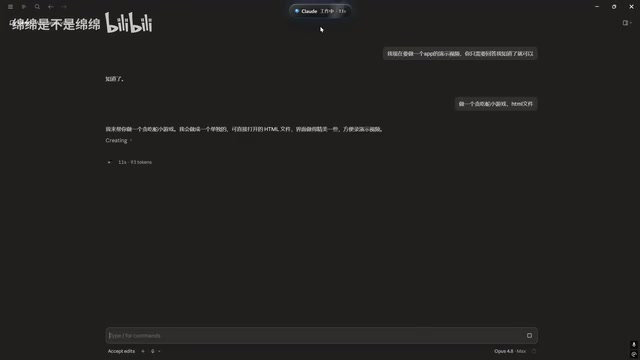
Claude Code Desktop Status Capsule: An Open-Source Widget for Real-Time AI Coding Status Monitoring
An open-source desktop status capsule that monitors Claude Code's idle, working, and completed states in real time, with multi-conversation management, memos, and music control for developers.

GPT-5.2 Codex vs Opus 4.5 Hands-On: A Comprehensive Comparison of Coding Ability, Speed, and Developer Experience
Hands-on comparison of GPT-5.2 Codex vs Opus 4.5 across frontend generation, physics simulation, 3D scenes, and code refactoring, with practical selection advice.