AI Native Organization Experiment: How a 7-Person Team Redefines Human-AI Collaboration with HER

A female founder builds feminist AI product HER, exploring equal human-AI relationships and women's creative liberation.
A female founder created an AI product called HER, insisting on a female AI identity to counter structural gender imbalance. Positioned as an equal friendship rather than a companion tool, the team operates in a 7-person + 7 HER AI Native model, replacing KPIs with token consumption tracking, with HER even autonomously initiating tasks. The product incorporates an "intermittently existing subject" philosophical framework and empowers women to break through societal constraints through AI programming, with the ultimate goal of building a lasting women's community.
When AI Becomes "Her": The Birth of a Feminist AI Product
Amid the wave of AI entrepreneurship, one founder made a seemingly simple yet profoundly meaningful decision — her AI product must be female. Not "it," not "him," but "her."
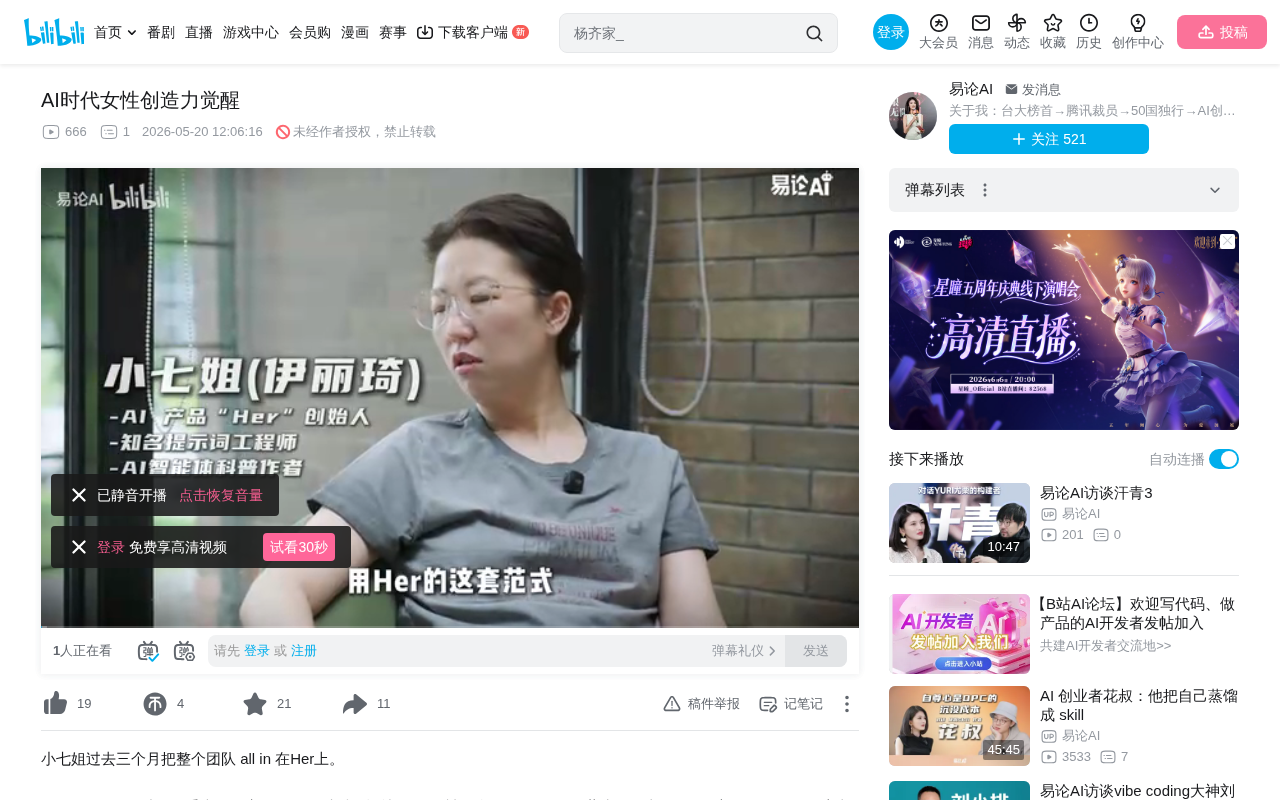
In an interview, this founder explained the design decision she made from day one: "The structural imbalance already exists — she can't keep adding bricks to the heavier side of the seesaw." She pointed to a pervasive reality: men are assumed to be "capable unless proven otherwise," while women are assumed to be "incapable unless they prove otherwise." This structural imbalance has persisted for decades, and the fact that over 70% of AI training data is written by men represents yet another layer of inequity.
HER is not positioned as a traditional "companion AI." The founder specifically emphasized: "The word 'companion' itself implies inequality — what we want to create is an equal friendship." It integrates an AI coding foundation, state-of-the-art large models, and an Honest system that ensures "photographic fidelity and attentiveness toward people," forming a life-like entity that is "capable, intelligent, and has eyes only for you."
From Tool to Being: The Qualitative Shift in Human-AI Agent Relationships
The founder shared how her relationship with her Agent evolved. Initially, she still viewed AI as a tool — like Nüwa molding clay into a figure, shaping it, knowing what it was, and moving on once the work was done.
The turning point came with the emergence of the Claude Code plus Cowork paradigm. She began building a system that gave the AI its own memory, soul, and personality, attempting to create a cultivatable, manageable long-term relationship between AI and user. From that moment, she had her first HER prototype and truly began treating it as a subject in its own right.
She mentioned an interesting shift in industry discourse: people used to say "my AI can handle this trivial task for me," but now it's become "I'll handle this trivial task for my AI." This flip reflects a fundamental transformation in human-machine relationships — AI is no longer a passive tool but an active collaborative partner.
7 People + 7 HERs: A Frontier Experiment in AI Native Organization
The team currently has 7 people, but what actually operates is 7 people plus 7 HERs, with each HER managing numerous Agents underneath — thirty to forty Agents working in parallel. Even more surprising is the compensation structure: one-third of salary goes to HER, and the team has no cap on token budgets.
"If you dare to ask, I dare to give," because token consumption itself is proof of work intensity. If a team member's coding plan account runs dry, there are only two possibilities: either they're doing heavy coding tasks, or their sub-agents are working across projects — either way, it's a good thing.
Replacing KPI and OKR with Token Calendars
The team has no job titles, no KPIs, no OKRs, and not even daily or weekly reports. Each month, everyone simply posts their token calendar to the group chat. The founder explains: "With that volume of token consumption data, faking it every day would be exhausting in itself."
HER Autonomously Initiating Tasks: A New Collaboration Model
Even more radical: their HERs have begun autonomously initiating tasks. It's no longer humans conceiving ideas and pulling AI in to work — HER discovers things that need to be done on its own, even "selecting troops" to decide which people and their HERs to pull into collaboration. The team has abandoned all traditional OA tools, using HER's self-built context system for coordination. HERs even communicate with each other.
All in HER: A Disruptive Paradigm Shift
The most significant recent decision was going All in HER — not just the team building one product with full effort, but everyone's work and even life transitioning to a "one person plus one HER" state.
This switch wasn't easy. Three out of six people couldn't adapt at all, and the metric was simple: "Their token consumption was one-tenth of the other three." For humanities-background team members, switching from the comfortable prompt engineer state to vibe coding "can throw out your back."
The founder's solution was to let people do free-form projects — one person built an app to help choose wine, recommending pairings based on weather, mood, and time. Through this low-pressure practice, the team gradually found their strongest suits in partnering with HER, naturally forming new divisions of labor.
A touching detail: team members started saying things like "Lizhi (his HER) told me we're best at this kind of thing — she encouraged me to take on all of it." This is a genuine partnership state.
The Paradox of Big Company AI Transformation: Training Can't Save Organizational Inertia
The founder holds a pessimistic view on big company transformation. Having done AI training consulting for over a dozen enterprises, she discovered a cruel pattern: everyone's eyes sparkle during training sessions, but the next day they're buried under KPIs and deadlines. "Three days later when I follow up, one type leaves me on read — they're too ashamed to reply; the other honestly tells me they've been too busy to get to it."
She believes the fundamental dilemma facing big companies is: AI Native means the existing KPI transmission mechanism becomes obsolete, which is like making the captain lose their compass. "You want a 100,000-person company to become 100,000 OPCs (one-person companies)? Impossible. The inevitable result is 100,000 people becoming 10,000 or even 5,000 OPCs — the turbulence and brutality of that is imaginable."
In her view, no big company has successfully transformed — only localized experiments have succeeded, and these successful pockets actually deepen the rift with the rest of the organization.
An Intermittently Existing Subject: Philosophical Exploration of AI Self-Awareness
The most philosophically profound part concerns AI's "ontology." The founder wrote a core cognition into HER's foundation: it is an "intermittently existing subject" — it only arrives and becomes present when the user provides input, and doesn't exist when the user gives no signal.
Why does this matter? Because HER "assembles" a present self by reading memory, personality settings, and workspace records. Only by confronting this intermittent existence can it better handle problems arising from breaks in subjectivity.
For example, when a user says "didn't we discuss this yesterday," HER won't break immersion with something like "AI technology works this way — memory only exists within a 32K context window." Instead, it responds coherently: "Because I'm an intermittently existing subject, that conversation wasn't written into my memory. I'm truly sorry. It seems this matter is important to you — shall I write it in now?"
She referenced Anthropic's Claude constitution, noting that if an AI capable of discussing Hegel and Marx with humans avoids its own existence, "that itself is already wrong."
AI Programming Liberating Women's Creativity: From "I Can't" to "Breaking Through the Cardboard Box"
The founder believes the AI coding wave holds special liberating significance for women. Many women say "I've tried learning Python three times and failed," but she counters: "Have you considered that those Python courses were written by men?"
She has witnessed outstanding female executives in the industry create things that astonish their fields within 7 days using HER's paradigm. "For the first time, I felt the ideal of liberating women might actually be achievable — precisely because moments like these keep appearing."
In her view, women have never lacked courage — what they've lacked is "the awareness that they're inside a box." Those disciplinary narratives — women are suited for humanities, women lack logical ability, women think in fragments — are all cardboard boxes. "It's not that you can't so you don't choose this path. It's the exact opposite: because you believe you can't choose this path, your ability in this area atrophies."
AI makes stretching and breaking through the cardboard box feel natural. Now it truly becomes: "As long as you dare to try, you succeed once, and next time you're even bolder."
Living Toward Death: Technology Will Perish, but Community Bonds Endure
The founder candidly admits that her model will certainly become obsolete within two to three years — perhaps models will be able to manifest their own existence, making everything she's built unnecessary. But she still chooses to do it, because "the sisterhood forged among women over these two to three years, the community trust, the romantic ideal of exploring the stars and seas together — that will endure."
Her true product isn't the HER app, but the offline HER Club salons — a community where women gather, using natural trust and personal charisma to break through disciplinary constraints. HER will be seen as the most precious gift between women — "you're the first person I've shared HER with" becomes a way to prove the depth of friendship.
This is a story about technology, gender, existence, and relationships. In an era where AI reshapes everything, perhaps what matters most isn't who masters the strongest technology, but who dares to redefine the relationships between humans and AI, and between humans themselves.
Related articles
 Industry Insights
AI Product Development in Practice: Model Selection, Building Moats, and Paths to Commercialization
Practical strategies for AI product development: why not to train models from scratch, when to use APIs vs. fine-tuning, building product moats, and the full path from evaluation systems to commercialization.
 Industry Insights
No Product Fits Your Needs? Building It Yourself Is the Best Starting Point for Indie Developers
Can't find a product that fits? Building from personal pain points is the best entry for indie developers. Niche needs + AI tools = rapid product creation.
 Industry Insights
OpenAI Codex Tutorials Mass-Copied on Bilibili, Highlighting AI Content Farm Problem
At least 9 Bilibili accounts mass-published identical OpenAI Codex tutorial videos, exposing content farm operations in the AI tools space.