AMD MI355X Beats B200: Full-Stack Optimization Breakdown for 5% Lower TCO on DeepSeek-R1 Inference

AMD MI355X beats NVIDIA B200 on DeepSeek-R1 inference TCO through full-stack optimization
AMD Instinct MI355X leverages the SGLang framework and MoRI full-stack optimization to achieve 5% lower TCO and 1.25x higher per-GPU throughput versus NVIDIA B200 in DeepSeek-R1 disaggregated inference. Core technologies include FP4/FP8 asymmetric quantized communication for 2.56x bandwidth compression, MoRI-IO KV Cache backend optimization, SDMA zero-overhead async transfer overlap, plus speculative decoding and CPU streaming co-optimizations—signaling AMD's genuine competitiveness in large model inference.
Overview
AMD Instinct™ MI355X has beaten NVIDIA B200 in total cost of ownership (TCO) for DeepSeek-R1 disaggregated inference, achieving 5% lower cost than B200 TRT-LLM and 1.25x higher per-GPU throughput than B200 SGLang. This result was achieved through full-stack optimization combining the SGLang framework with MoRI (Mixture of Routed Inference) technology, marking a significant breakthrough for AMD in large model inference.
Disaggregated Inference Architecture Background: Disaggregated inference is an architectural paradigm that assigns the prefill and decode stages of large model inference to different hardware nodes. Traditional inference mixes both stages on the same GPU, causing compute-intensive prefill and memory-bandwidth-intensive decode to compete for resources. Disaggregated architecture allows independent hardware scaling tailored to each stage's computational characteristics, dramatically improving overall throughput and resource utilization. It is the mainstream approach for deploying ultra-large-scale models today.
Industry Significance of TCO: Total Cost of Ownership (TCO) in AI infrastructure evaluation encompasses the full lifecycle cost including hardware procurement, power consumption, operations, software licensing, and depreciation. In large model inference scenarios, TCO is typically measured as "cost per million tokens" or "cost per unit of throughput." Since NVIDIA GPUs are generally priced higher than AMD's same-generation products, AMD only needs to achieve a certain performance threshold to gain a TCO advantage—which is precisely why software stack optimization holds strategic importance for AMD.
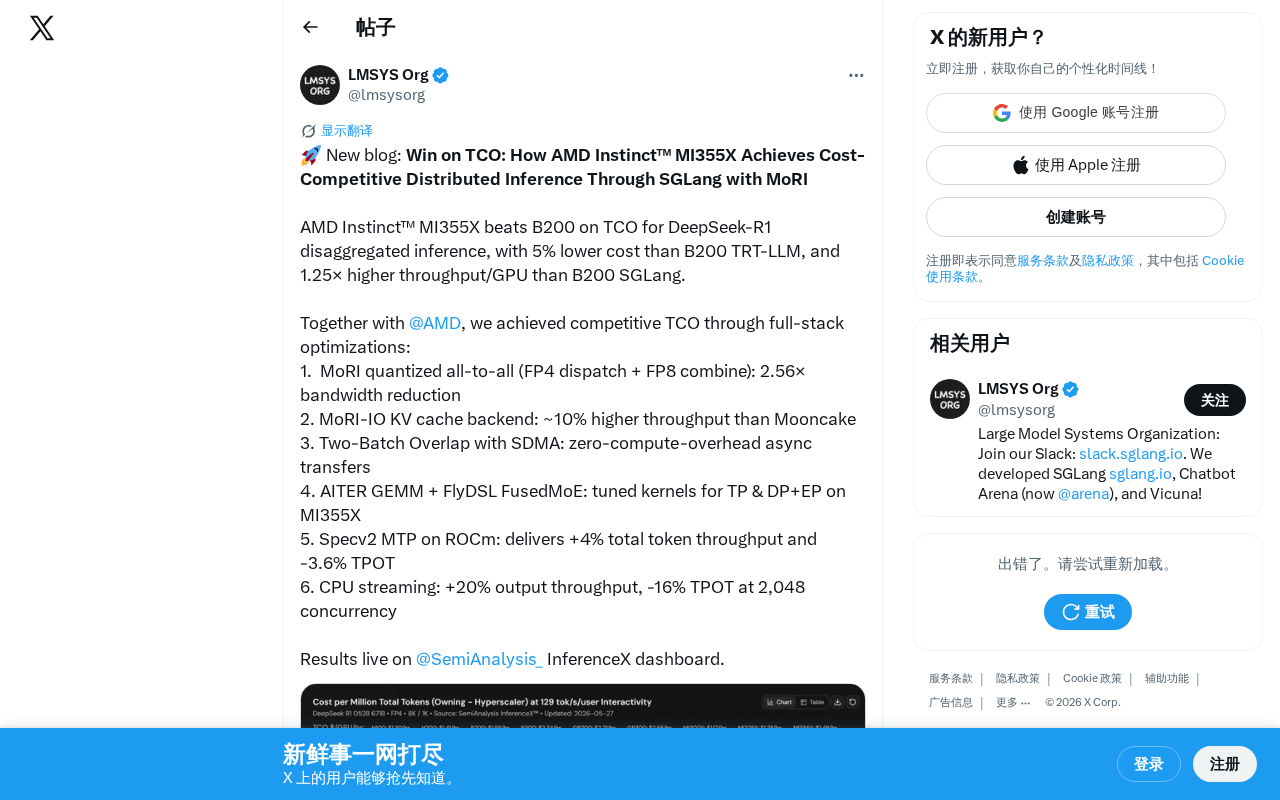
MoRI Full-Stack Optimization: Core Technical Breakthroughs Explained
MoRI Quantized All-to-All Communication
In distributed inference, inter-GPU communication bandwidth is often the performance bottleneck. This problem is particularly acute in MoE architectures—Mixture of Experts models like DeepSeek-R1 employ sparse activation mechanisms where each token is routed to only a few expert sub-networks. In multi-GPU distributed deployments, different experts reside on different devices, and tokens must be dynamically routed between GPUs via All-to-All collective communication—a process that easily becomes a bandwidth bottleneck under high concurrency.
MoRI employs an innovative quantized communication strategy: FP4 precision for the dispatch stage and FP8 precision for the combine stage. This asymmetric quantization scheme achieves 2.56x bandwidth compression, dramatically reducing All-to-All communication overhead while maintaining acceptable inference accuracy.
The design philosophy is quite elegant—the dispatch stage has higher data redundancy and can tolerate more aggressive compression, while the combine stage requires higher precision to ensure final output quality. FP4/FP8 quantized communication specifically targets the MoE routing communication pain point, trading reduced transmission data precision for bandwidth savings while leveraging the two-stage asymmetric precision strategy to balance accuracy loss.
MoRI-IO KV Cache Backend Optimization
Traditional KV Cache management solutions easily become bottlenecks under large-scale concurrency. KV Cache (Key-Value Cache) stores key-value pairs from historical tokens in the Transformer attention mechanism, avoiding redundant computation and serving as a core component for long-context inference. Mooncake is an open-source distributed KV Cache management system from Moonshot AI, designed specifically for large-scale inference clusters with support for cross-node cache sharing and intelligent scheduling—it is an industry-recognized high-performance baseline solution.
MoRI-IO provides a purpose-built KV Cache backend that further optimizes memory access patterns and transfer scheduling strategies for AMD hardware beyond the Mooncake approach, achieving approximately 10% throughput improvement. This means the system can serve more concurrent requests on the same hardware, demonstrating the value of deep customization for specific hardware architectures.
Two-Batch Overlap with SDMA: Zero-Overhead Asynchronous Transfer
SDMA (System Direct Memory Access) is a dedicated data transfer engine in AMD's GPU architecture that operates independently of compute units, capable of executing memory copy operations asynchronously without occupying Shader Processors. By leveraging AMD hardware's SDMA engine, the Two-Batch Overlap technique fully parallelizes batch N+1 data prefetching with batch N matrix computation, eliminating data wait bubbles (Pipeline Bubbles) in traditional serial pipelines and achieving zero-compute-overhead asynchronous transfer. This is one of AMD's CDNA architecture's hardware differentiation advantages over some competitors, and the fundamental reason why this hardware-software co-optimization can fully exploit the MI355X architecture's strengths.
Compute Kernel and Inference Performance Optimization
AITER GEMM + FlyDSL FusedMoE Kernel Tuning
Targeting MI355X's compute unit characteristics, the team specifically tuned GEMM (General Matrix Multiplication) kernels and implemented fused MoE computation through FlyDSL. These kernels support both Tensor Parallelism (TP) and Data Parallelism + Expert Parallelism (DP+EP) parallel strategies, providing flexible options for different deployment scenarios.
Specv2 MTP Speculative Decoding for Throughput Improvement
Speculative Decoding introduces a lightweight draft model to predict multiple candidate tokens, which are then verified in parallel by the main model, generating multiple tokens in a single forward pass and breaking through the serial bottleneck of autoregressive decoding. Multi-Token Prediction (MTP) is an advanced variant that allows the model to learn multi-step prediction capabilities during training, reducing dependence on a separate draft model. The Specv2 implementation on the ROCm platform required specific adaptation for AMD GPU's wavefront scheduling mechanism, ultimately delivering +4% total token throughput improvement and -3.6% TPOT (Time Per Output Token) reduction. While individual improvements may seem modest, at large-scale deployment these optimizations accumulate to have a very significant impact on TCO.
CPU Streaming Optimization: Performance Leap Under Concurrency
In a 2048-concurrency scenario, CPU streaming technology achieved +20% output throughput improvement and -16% TPOT reduction. This optimization fully leverages CPU-side processing capability to assist the GPU inference pipeline, reducing GPU idle time. It is one of the most impactful single optimizations in the overall full-stack optimization approach.
AMD MI355X vs NVIDIA B200: Industry Competitive Landscape Analysis
These results have been publicly displayed on SemiAnalysis's InferenceX dashboard, lending third-party verification credibility. Notably, the SGLang framework used in this comparison is itself an important dimension for understanding the competitive landscape—SGLang (Structured Generation Language) is an open-source LLM inference framework led by UC Berkeley and other institutions, known for aggressive system-level optimizations including RadixAttention (prefix cache reuse), Continuous Batching, and efficient CUDA/ROCm kernel integration. Compared to NVIDIA-dominated TensorRT-LLM, SGLang's open-source nature enables faster integration of new features from AMD's ROCm ecosystem, and allows third-party optimization solutions like MoRI to seamlessly plug in.
From an industry perspective, this means:
Breaking the NVIDIA Monopoly Narrative: NVIDIA has long been considered to hold an unassailable advantage in large model inference. MI355X's TCO victory proves that through deep software stack optimization, AMD hardware can absolutely achieve competitiveness.
Maturation of the SGLang Open-Source Ecosystem: As an open-source inference framework, SGLang's deep support for AMD hardware demonstrates that the open-source community is actively embracing a diversified hardware ecosystem, forming an open, hardware-agnostic inference ecosystem.
Full-Stack Optimization Determines Real-World Deployment Outcomes: Pure hardware spec comparisons are no longer sufficient to determine actual deployment effectiveness. Full-stack coordinated optimization—from quantized communication and cache management to kernel tuning—is the decisive factor for TCO.
Conclusion
AMD MI355X has achieved a TCO advantage over NVIDIA B200 in DeepSeek-R1 disaggregated inference through the SGLang + MoRI full-stack optimization approach. This is not merely a technical validation but a signal of shifting competitive dynamics in the AI inference market. For enterprises planning large model inference infrastructure, the AMD solution has become an option worthy of serious evaluation.
Key Takeaways
- AMD MI355X beats NVIDIA B200 in DeepSeek-R1 disaggregated inference TCO, with 5% lower cost and 1.25x higher per-GPU throughput
- MoRI quantized All-to-All communication (FP4 dispatch + FP8 combine) achieves 2.56x bandwidth compression, specifically designed for MoE routing communication bottlenecks
- Full-stack optimization spans six major areas: communication, caching, kernel tuning, speculative decoding, and CPU streaming
- MoRI-IO KV Cache backend achieves ~10% higher throughput than the Mooncake approach, demonstrating the value of hardware-specific optimization
- SDMA async engine and Two-Batch Overlap technology represent AMD CDNA architecture's hardware differentiation advantages
- Results are publicly verified on the SemiAnalysis InferenceX dashboard, providing industry reference value
Related articles
 Industry Insights
AI Product Development in Practice: Model Selection, Building Moats, and Paths to Commercialization
Practical strategies for AI product development: why not to train models from scratch, when to use APIs vs. fine-tuning, building product moats, and the full path from evaluation systems to commercialization.
 Industry Insights
No Product Fits Your Needs? Building It Yourself Is the Best Starting Point for Indie Developers
Can't find a product that fits? Building from personal pain points is the best entry for indie developers. Niche needs + AI tools = rapid product creation.
 Industry Insights
OpenAI Codex Tutorials Mass-Copied on Bilibili, Highlighting AI Content Farm Problem
At least 9 Bilibili accounts mass-published identical OpenAI Codex tutorial videos, exposing content farm operations in the AI tools space.