Andrej Karpathy Joins Anthropic: A Top AI Researcher Returns to the Frontier
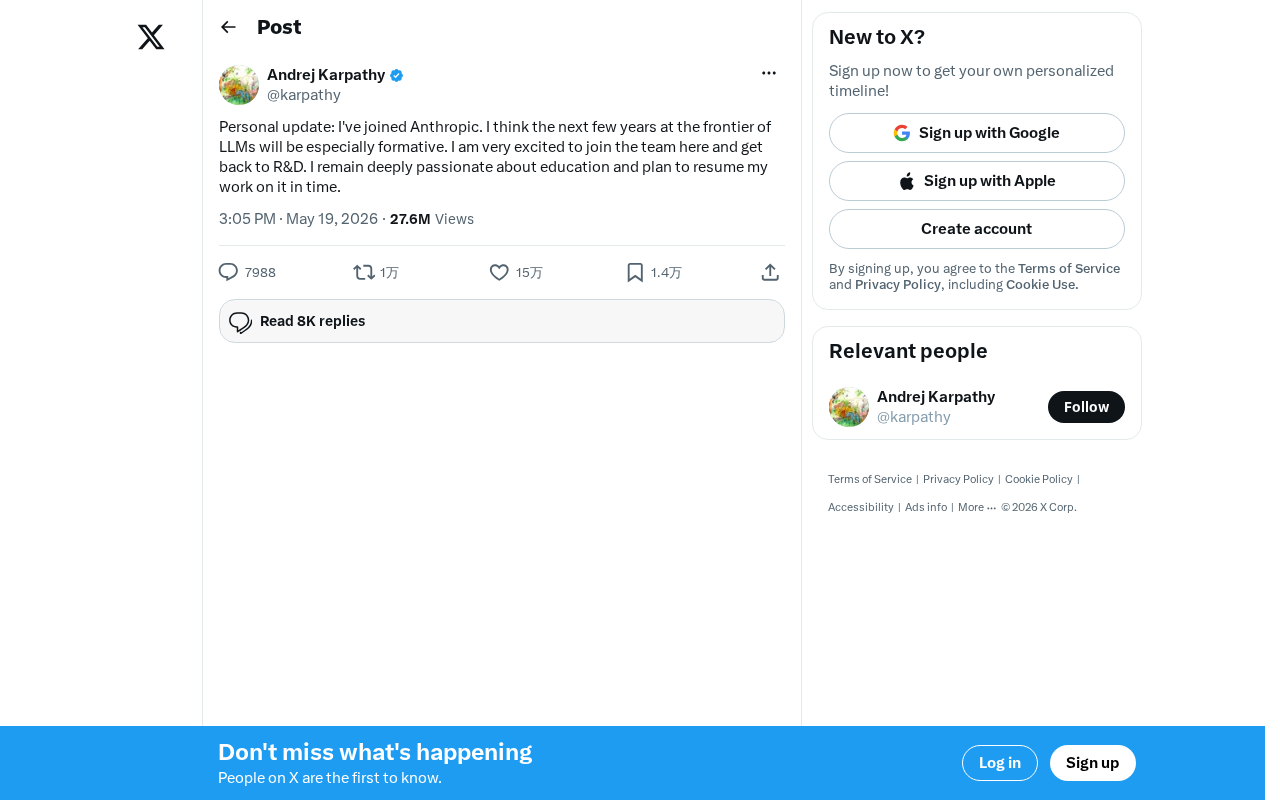
Andrej Karpathy joins Anthropic to return to frontier LLM research at a critical moment for AI.
Andrej Karpathy, former OpenAI founding member and Tesla AI director, has officially joined Anthropic. He described the next few years as especially "formative" for frontier LLMs. The move highlights Anthropic's growing talent magnetism and signals that the AI industry is entering a critical window for technological breakthroughs, as the field evolves beyond scaling laws toward diverse new approaches.
Major Personnel Move: Karpathy Joins Anthropic
Recently, prominent AI figure Andrej Karpathy announced on social media that he has officially joined Anthropic. This AI researcher, who previously held core technical roles at OpenAI and Tesla, has chosen to return to the frontlines of large language model R&D at this critical juncture.
In his post, Karpathy wrote: "I think the next few years will be especially formative at the frontier of LLMs. I'm very excited to join the team here and get back to work on R&D."
Why Karpathy Joining Anthropic Is a Big Deal
Karpathy's Industry Stature Cannot Be Overlooked
Andrej Karpathy is one of the most influential researchers and engineers in the deep learning field. His career trajectory traces nearly the entire arc of modern AI development: Stanford PhD (under Fei-Fei Li), founding team member at OpenAI, Director of AI and Autopilot Vision at Tesla, then a return to OpenAI before eventually going independent to focus on AI education. Each of his career moves has been seen by the industry as a bellwether of sorts.
It's worth noting that during his PhD at Stanford, Karpathy studied under Fei-Fei Li, a pioneer in computer vision. His doctoral research focused on combining Convolutional Neural Networks (CNNs) with Recurrent Neural Networks (RNNs) to achieve cross-modal understanding between images and natural language, laying important groundwork for the field of Image Captioning. During his tenure as Director of AI and Autopilot Vision at Tesla, he spearheaded the strategic transition from a multi-sensor fusion approach (radar + cameras) to a pure vision-only approach. This decision was highly controversial at the time but was ultimately proven to be a viable technical path, demonstrating his ability to make critical technical judgments in large-scale engineering systems.
His decision to join Anthropic signals that this top-tier talent believes Anthropic is in a position worth fully committing to. His use of the word "formative" to describe the coming years of LLM development suggests we may be standing at a pivotal inflection point in large model technology paradigms. The industry is currently evolving beyond pure pretraining scale expansion (Scaling Laws) toward more diverse technical approaches: test-time compute scaling, multimodal fusion, long context window processing, tool use and Agent architectures, and synthetic data training, among others. OpenAI's o1/o3 series models have demonstrated the potential of chain-of-thought reasoning to enhance model capabilities, while Anthropic's Claude series has shown unique strengths in long-text comprehension and code generation. The competition and convergence of these technical approaches may determine the fundamental architecture of next-generation AI systems within the next 2–3 years — this is the deeper meaning behind what Karpathy calls a "formative" period.
Anthropic's Talent Magnetism Continues to Grow
Founded by former OpenAI core members Dario Amodei and Daniela Amodei, Anthropic has long been known for its emphasis on AI safety and the impressive performance of its Claude model series. Karpathy's addition further solidifies Anthropic's competitive edge in the battle for top AI talent.
In recent years, Anthropic has demonstrated unique competitive strengths in its technical approach — the Claude model has consistently earned user praise for its programming, reasoning, and long-text processing capabilities, while its "Constitutional AI" and other safety alignment methods have had a broad impact in academia. Constitutional AI is an innovative AI alignment methodology proposed by Anthropic. Its core idea is to have AI systems self-evaluate and self-correct their outputs based on a predefined set of principles (the "constitution"). Unlike traditional RLHF (Reinforcement Learning from Human Feedback), Constitutional AI introduces RLAIF (Reinforcement Learning from AI Feedback) — the model first generates a response, then critiques and revises it according to the constitutional principles, and finally uses this revised data for reinforcement learning training. This approach dramatically reduces dependence on human annotators while making the AI's behavioral guidelines more transparent and auditable, embodying Anthropic's "safety-first" technical philosophy.
The ability to attract talent like Karpathy — someone with both deep research expertise and large-scale engineering experience — speaks volumes about the appeal of Anthropic's technical vision and team culture.
Karpathy's Education Mission: Paused but Not Abandoned
Interestingly, Karpathy specifically mentioned in his announcement: "I remain very passionate about education and plan to resume that work at the appropriate time."
Prior to this, after leaving OpenAI, Karpathy had devoted himself fully to AI education. He founded Eureka Labs and published a widely acclaimed series of deep learning tutorials on YouTube (such as the "Neural Networks: Zero to Hero" series), which helped countless developers and students get started in AI. Eureka Labs is dedicated to exploring new paradigms in AI-assisted education, with a vision of making AI the core engine for personalized learning. His YouTube tutorial series starts from hand-coding the backpropagation algorithm from scratch and progressively builds up to GPT-level language models, all implemented in pure Python without relying on any deep learning frameworks. This "first principles" teaching approach enables learners to truly understand the mathematical principles and engineering implementation behind each layer of abstraction, rather than merely learning to call APIs. Another well-known project of his, minGPT/nanoGPT, reproduced the GPT architecture in minimal code and became one of the most widely cited open-source educational projects in the global AI education space, earning tens of thousands of stars on GitHub.
The fact that he said "paused" rather than "abandoned" shows that Karpathy views education as a long-term mission, but at this stage, he judges that returning to the R&D frontlines is more urgent. This shift in priorities itself sends a signal: the LLM field is entering a period of dense technological breakthroughs, and the opportunity cost of being away from frontline R&D is rising sharply.
Subtle Shifts in the AI Industry Landscape
From a broader perspective, Karpathy's move to Anthropic reflects several trends in the current AI competitive landscape:
- Accelerating movement of top AI talent: The flow of elite AI researchers between major labs is becoming increasingly frequent. This reflects both the vitality of the industry and the deepening differentiation in technical approaches and culture across companies. Notably, Anthropic itself is a product of this talent movement — core founders like Dario Amodei chose to start their own company precisely because of diverging views on AI safety with OpenAI. This "ideology-driven" talent flow is reshaping the entire industry's competitive map.
- Anthropic's strong momentum: In the competition among giants like OpenAI, Google DeepMind, and Meta AI, Anthropic — as a relatively young company — is proving its industry standing through technical prowess and talent magnetism. To date, Anthropic has secured massive investments from tech giants including Google and Amazon, with a valuation that ranks among the top in the AI space. Its Claude model has also become one of the most formidable competitors to ChatGPT.
- Rising urgency in frontier R&D: Karpathy's decision to set aside his education work and return to the R&D frontlines suggests that industry insiders widely sense that now is a critical window for technological breakthroughs. From a technical standpoint, the large model field currently faces multiple potential breakthrough directions — how to overcome the efficiency bottlenecks of the existing Transformer architecture, how to achieve more reliable reasoning capabilities, and how to enable models to truly learn continuously and self-improve. The answers to these questions may gradually emerge over the next few years.
Whether for Anthropic or the AI industry as a whole, Karpathy's decision deserves continued attention. His research direction and achievements in his new role may become a significant driving force in the future development of LLMs.
Key Takeaways
Related articles
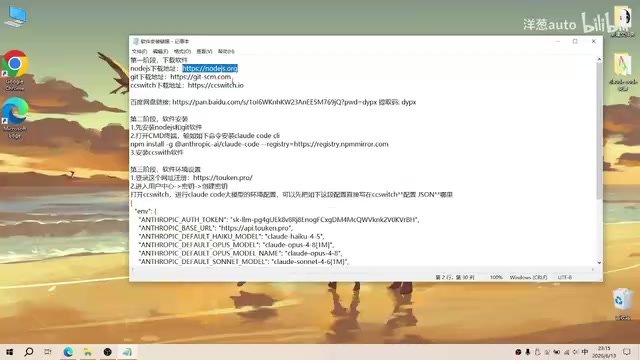
Complete Guide to Installing Claude Code CLI in China: Four Simple Steps
Step-by-step guide to installing Claude Code CLI in China using Node.js, Git, CC Switch, and an API relay service to bypass Anthropic's access restrictions.

The Compute Crisis: Why Google and Anthropic Are Paying SpaceX a Premium to Rent GPUs
Microsoft, Google, and Anthropic face severe compute shortages. Anthropic pays SpaceX $1B/month for GPUs. From TSMC capacity to HBM, storage, and power, the AI supply chain is in full crisis.
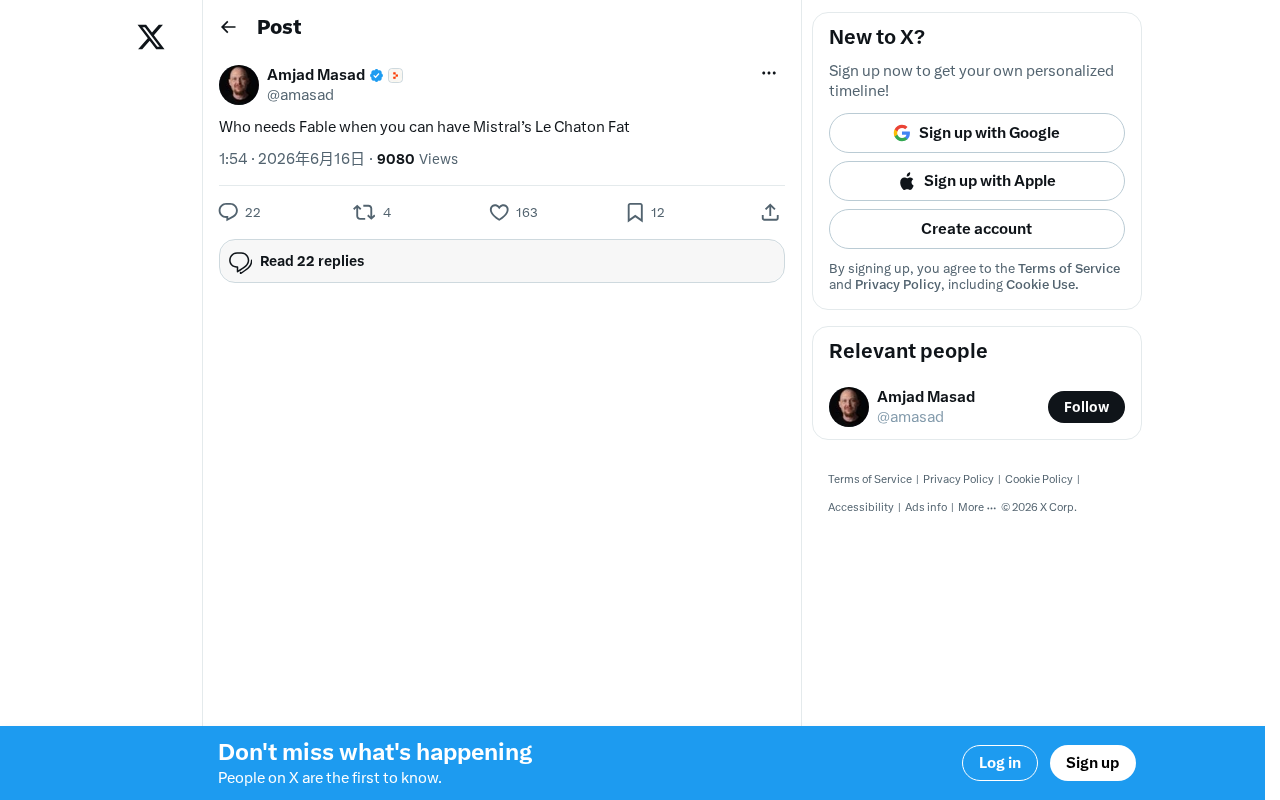
Mistral Le Chat Image Generation Review: Can It Replace Fable?
Mistral AI launches image generation in Le Chat, dubbed Le Chaton Fat. We analyze its capabilities, compare it with Fable, and explore the trend of AI chat platforms integrating image generation.