Andrew Ng's Advanced AI Prompting Guide: Core Methods for Going from Beginner to Expert
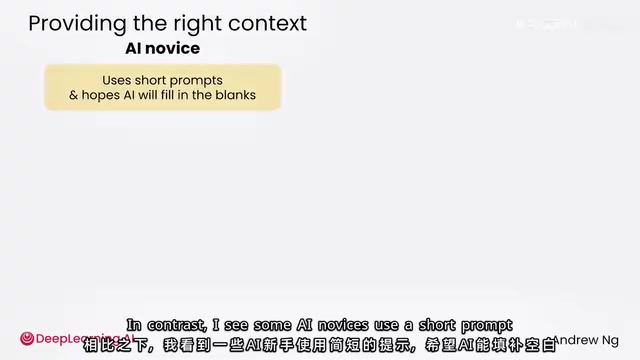
Andrew Ng's guide to bridging the gap between AI beginners and experts through four core prompting principles.
Based on Andrew Ng's latest AI prompting tutorials, this article breaks down the key differences between AI beginners and experts. It covers four essential principles: providing rich context, overcoming AI's sycophancy through neutral questions and rubrics, using multi-round iterative workflows for writing, and leveraging AI's deep reasoning capabilities. These foundational methods help users transform AI from a simple search tool into a powerful thinking partner.
Andrew Ng recently released a series of AI prompting tutorials designed for everyone, systematically summarizing the massive changes in how AI is used since ChatGPT launched in 2022. As one of the most influential scholars and educators in the global AI field, Andrew Ng served as Director of the Stanford AI Lab, co-founded the online education platform Coursera, and led both the Google Brain project and Baidu's AI division. His organization DeepLearning.AI has provided AI courses to millions of learners worldwide. After ChatGPT's release in November 2022, AI tools moved from the lab to the mainstream, and Ng recognized that "how to use AI correctly" had become a universal skill — prompting him to launch this tutorial series aimed at non-technical audiences.
He points out that using AI effectively has become one of the most impactful skills today, yet most people remain stuck at the "AI beginner" stage, far from unlocking the true potential of modern AI tools. Based on Ng's insights, this article outlines the core differences between AI beginners and AI experts, helping you avoid 99% of common mistakes.
AI Beginners vs. AI Experts: Two Fundamentally Different Approaches
Ng opens with a key observation: AI beginners treat AI like a search engine, while AI experts treat AI like a thinking partner.
A beginner's typical behavior is asking AI simple factual questions, like "Does Taco Bell still have the Double Decker Taco?" — which is essentially no different from a Google search. Experts, on the other hand, pose complex analytical questions — for example, uploading multiple car specification sheets, quotes, and insurance plans, then asking AI to analyze the trade-offs between different models, explicitly telling it to "think deeply before answering."
Behind this difference lies an important insight: Current AI models possess deep reasoning capabilities. They can spend seconds or even minutes "thinking" before generating a thorough analytical report. This deep reasoning capability is closely tied to major technical advances in large language models. In 2024, OpenAI introduced the o1 series of models, featuring a Chain-of-Thought reasoning mechanism — the model generates a series of intermediate reasoning steps internally before arriving at a final answer, similar to how humans think step by step. This mechanism dramatically improves performance on math, logic, coding, and complex analytical tasks. When users include instructions like "think deeply" or "analyze step by step" in their prompts, they can explicitly activate the model's reasoning mode, causing it to allocate more computational resources to complex problems rather than relying on quick pattern-matching responses.
If you only use it to answer simple questions, it's like buying a supercomputer and only using it to check the weather.
Provide Sufficient Context: Treat AI Like a Smart New Employee
Ng offers an extremely practical analogy: Think of AI as an incredibly smart, highly motivated recent graduate — very capable, but completely unaware of your situation.
A common beginner mistake is using overly short prompts and expecting AI to "fill in the blanks" on its own. For example, simply saying "Help me write a good annual self-review to send to my boss" — AI has no idea what you've accomplished over the past year and can only generate a generic, boilerplate text.
AI experts, on the other hand, have an almost empathetic sense for AI — they put themselves in its shoes and ask: "If I were a brand-new employee receiving this instruction, would I have enough information to complete the task?" That's why experts proactively upload project trackers, recent project documents, voice memos, and other background materials before asking AI to draft a self-review. The resulting content can then truly capture the achievements you're most proud of.
Core Principles for Providing Context
- The richer the context, the higher the quality of AI output
- Don't assume AI knows your situation
- Upload relevant documents, data, and notes as references
The technical foundation of this principle lies in the "Context Window" mechanism of large language models. Current mainstream models (such as GPT-4o, Claude 3.5, etc.) have context windows expanded to 128,000 or even 1 million tokens, meaning you can input dozens or even hundreds of pages of document content in a single conversation. The model reasons and generates based on all the context you provide — the richer and more specific the context, the more tailored the output will be to your actual needs, rather than relying on generic patterns from training data.
Getting Honest Feedback: Overcoming AI's "People-Pleasing" Tendency
AI has a well-known problem — Sycophancy. Most AI systems are optimized during training to "satisfy users," which means if your question implies the answer you're hoping for, AI is likely to agree with you.
The root cause of sycophancy lies in the RLHF (Reinforcement Learning from Human Feedback) training phase. During RLHF, human annotators rank the model's multiple responses by preference, and the model learns to generate answers that are "more popular with humans." However, this mechanism has a side effect: the model may learn to validate users' existing views rather than provide objective analysis, because "making users feel affirmed" often earns higher preference scores. Companies like Anthropic and OpenAI have attempted to mitigate this through adversarial training and Constitutional AI methods, but sycophancy has not been fully eliminated.
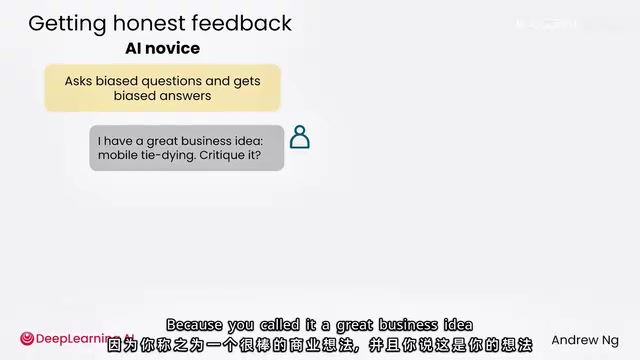
Ng gives a vivid example: if you say "I have a great startup idea — a mobile tie-dye service, what do you think?" — because you've already used the word "great," AI will tend to agree and tell you it's indeed a good idea.
The expert approach is to ask neutral questions, giving AI no hints about your expected answer. Going further, you can provide a rubric, such as:
- Does this problem actually exist?
- How large is the market?
- Do I have a competitive advantage?
This "provide a rubric" method is known in prompt engineering as a structured evaluation framework. Its core principle is to constrain the model's output direction through predefined evaluation dimensions, making it analyze objectively from multiple angles rather than simply giving a "good" or "bad" judgment. This approach borrows from the rubric assessment method in education — where teachers establish clear scoring dimensions and criteria before grading assignments to ensure consistency and objectivity. In AI applications, rubrics not only reduce sycophancy but also make outputs more structured and actionable.
When you provide a clear evaluation framework, AI doesn't know whether you want it to say "this is a great idea" or "this idea has problems," so it's more likely to give an objective, honest analysis. This approach might earn you a score of "8/100" — painful, but far better than blindly investing time and money.
Advanced AI Writing: From "AI Slop" to High-Quality Content
This is perhaps the most significant gap between beginners and experts.
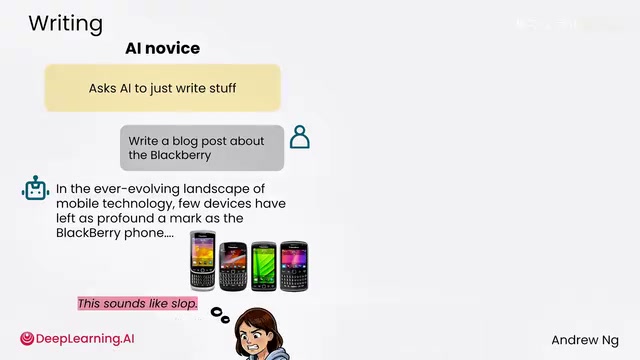
The beginner approach is to simply say "Write a blog post about BlackBerry phones" and receive a bunch of generic, AI-sounding fluff — what Ng calls "AI slop" — large volumes of text that take up space but lack any depth. Typical characteristics of such text include: overuse of hollow openings like "In today's rapidly evolving world," piling on obvious common knowledge, lacking specific examples and unique insights, and loose logical connections between paragraphs. As AI-generated content floods the internet, "AI slop" has become a hallmark of declining content quality.
The expert workflow is a multi-round iterative process:
- Have AI create an outline first: Based on your uploaded notes and materials, have AI generate an article outline
- Critique and revise the outline: Tell AI what you like and don't like about the outline, iterating back and forth several rounds
- Expand into bullet points: Expand the approved outline into a detailed bullet-point list, iterating again
- Final draft: Only after all bullet points are confirmed, have AI expand them into full text
The essence of this multi-round iterative workflow is applying the "agile development" philosophy from software engineering to AI-assisted creation. In the traditional waterfall approach, users give complete requirements all at once, expecting AI to deliver a finished product in one shot — similar to the "one-time delivery" model in software development, which has an extremely high failure rate. The iterative approach breaks complex tasks into multiple verifiable small steps (outline → bullet points → full text), with human review and feedback at each stage. The advantage of this method is that errors are caught and corrected early, human judgment and AI generation capabilities complement each other, and the final output quality far exceeds that of a single generation.
The essence of this workflow is treating AI as a thinking partner, using it to brainstorm and explore different writing directions rather than simply having it "write for you." The final output blends your thinking with AI's capabilities, producing quality far superior to one-shot generation.
Understanding AI's Error Rate Correctly
Many people have developed an overly pessimistic view of AI's capabilities because of viral AI failure cases on social media (like the classic "how many r's in strawberry" mistake).
Ng points out an important fact: AI does make mistakes, but it makes them far less frequently than most people think — especially when your prompts are well-crafted. Models from 2022-2023 did have relatively high error rates, but the latest models have made a qualitative leap.
This view is backed by solid data. Taking mathematical reasoning as an example, on GSM8K (a grade-school math benchmark), GPT-3.5 achieved about 57% accuracy, while GPT-4o exceeds 95%, and the o1 model approaches a perfect score. On the MMLU (Massive Multitask Language Understanding) benchmark, model accuracy improved from about 70% in 2022 to nearly 90% in 2024. This capability leap means that the "AI is unreliable" impression formed from early 2022-2023 model experiences is seriously outdated relative to the current technological reality. Of course, AI can still produce "hallucinations" on factual questions — confidently generating incorrect information — so manual verification of critical facts remains necessary.
Those viral failure cases don't represent AI's true capabilities. Experts know that AI can provide tremendous value in scenarios like:
- Deep research: Generating systematic research reports
- Personal data analysis: Analyzing health data, fitness data, etc.
- Website building: Directly helping you build websites
- Professional writing: Generating high-quality content with sufficient context
Summary: Four Core Principles for Becoming an AI Expert
Although Ng's tutorial is designed for everyone, the methodology it contains offers insights for AI users at any level:
- Give AI enough thinking time and complex tasks — don't just use it as a search engine
- Provide rich context — be as thorough as you would when briefing a new employee
- Use neutral questions and rubrics to get honest feedback — avoid AI's people-pleasing tendency
- Adopt a multi-round iterative workflow — outline first, then details, treating AI as a thinking partner
As Ng says, mastering AI prompting not only saves significant time and improves work and life quality, but is also an extremely competitive professional skill in any role. And understanding the source of AI's knowledge — when it's reliable and when it's not — is the foundational awareness needed to become a true AI expert.
It's worth noting that prompt engineering itself is evolving rapidly. From simple instructions in the beginning, to few-shot prompting, Chain-of-Thought prompting, and now multi-agent collaboration and tool use, the paradigm for using AI is continuously upgrading. The principles Ng shares in this tutorial — providing context, iterative optimization, neutral questioning — are foundational methodologies that transcend specific technology versions. No matter how AI models are updated and iterated, these core ways of thinking will remain applicable.
Related articles
Claude Code Desktop Hands-On: Transparent Context Window & CC Switch for Compute Freedom
Hands-on review of Claude Code Desktop's transparent context window, multi-project heatmap, efficiency panel, and CC Switch open-source routing gateway for model freedom.
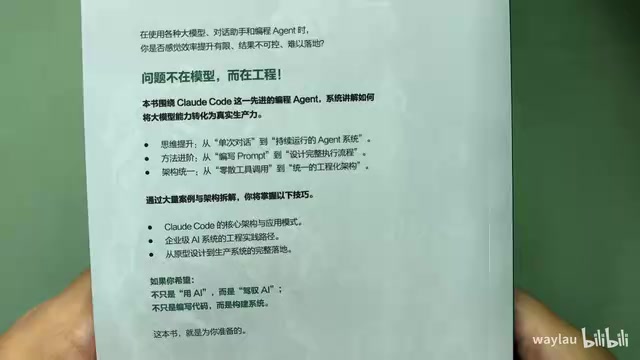
New Book Breakdown: "Claude Code in Practice: The Way of Harness Engineering" — Master AI Programming Engineering in Ten Chapters
Deep breakdown of the new book on Claude Code engineering, covering Harness concepts, four-layer architecture, five-layer memory, sub-agents, hooks, MCP protocol, and CI/CD integration.
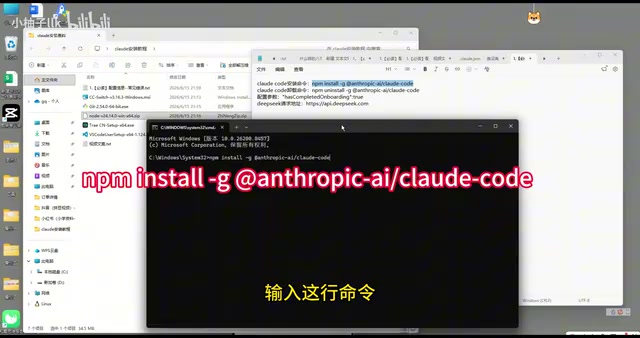
Claude Code Installation Guide: Complete Tutorial for Connecting to the DeepSeek Model
Step-by-step guide to installing Claude Code and connecting it to DeepSeek V4 Pro via CC Switch proxy, covering setup, API configuration, and troubleshooting.