Anthropic Closes $65 Billion Series H, Valuation Approaches $1 Trillion

Anthropic raises $65B in Series H at $965B valuation, setting an AI private funding record.
Anthropic announced a $65 billion Series H funding round at a post-money valuation of $965 billion, shattering private funding records in AI and tech. Co-led by Sequoia, Altimeter Capital, Dragoneer, and Greenoaks, the funds will go toward frontier AI research and scaling Claude's infrastructure. Amazon and Google had previously made multi-billion-dollar strategic investments. Anthropic is now just a step away from a trillion-dollar valuation, as AI competition enters a super-capital phase.
The Largest AI Funding Round in History
Anthropic recently announced the completion of its Series H funding round, raising a staggering $65 billion at a post-money valuation of $965 billion — just a stone's throw from the trillion-dollar milestone. The round was co-led by Altimeter Capital, Dragoneer, Greenoaks, and Sequoia.
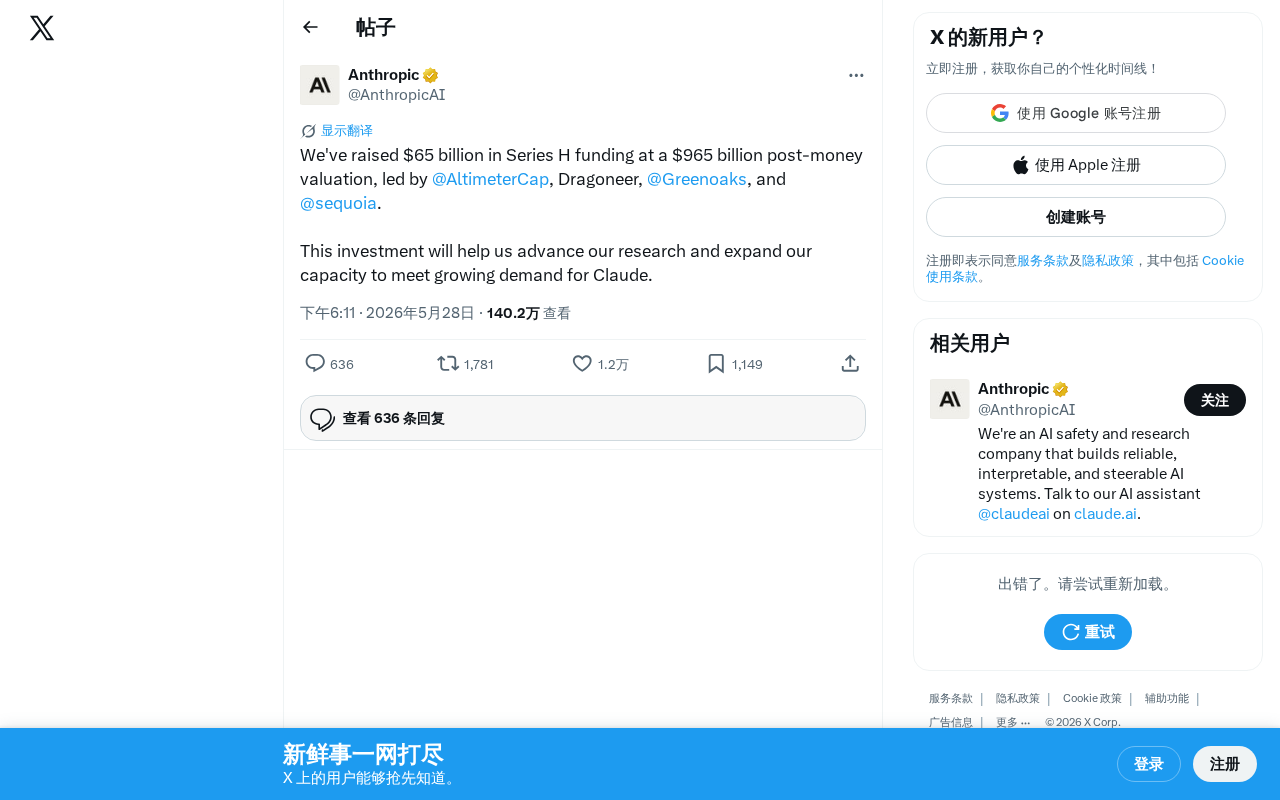
This figure shatters the private funding record not only in AI but across the entire tech industry. Just over a year ago, Anthropic's valuation was still in the tens of billions. Now, approaching a trillion-dollar valuation, the company has firmly established itself among the world's most valuable tech enterprises — competitive even with publicly traded giants.
Notably, Anthropic was co-founded in 2021 by former OpenAI VP of Research Dario Amodei and his sister Daniela Amodei, with most of the core team hailing from OpenAI. The company's founding was driven by a clear "safety-first" philosophy — the founding team departed due to disagreements over AI safety approaches, making Interpretability Research and Constitutional AI their core technical pillars. This background differentiates Anthropic from OpenAI: the former emphasizes deeply understanding model internals alongside capability improvements, while the latter prioritizes speed to product. This mission-driven narrative is a key reason top-tier investors are willing to make long-term bets on the company.
Use of Funds: Advancing Frontier Research and Scaling Compute
In its announcement, Anthropic clearly stated that the investment will be directed toward two core areas:
- Advancing frontier research: Continuing exploration in AI safety and large model capabilities — Anthropic's core mission since its founding
- Expanding service capacity: Meeting the rapidly growing market demand for Claude, including infrastructure buildout and compute scaling
Both directions are extraordinarily capital-intensive. The skyrocketing cost of training large models is the key context for understanding this round's scale: GPT-3 (2020) cost roughly $4.6 million to train, while GPT-4-era training costs are estimated to have exceeded $100 million. Entering 2024–2025, the per-run training cost for next-generation frontier models is widely projected to surpass the $1 billion mark. This cost explosion stems from multiple dimensions: model parameter counts advancing from hundreds of billions to trillions, ever-expanding training datasets, and massive demand for high-end GPUs (such as NVIDIA H100/H200). Meanwhile, inference-side costs are equally significant — once Claude's daily active users and API call volumes reach a certain scale, the GPU cluster investment required to maintain service alone represents ongoing expenditures in the tens of billions of dollars. The $65 billion funding round directly reflects the capital intensity of the current AI race and the need to stay competitive in this compute arms race.
Deeper Signals from the Investor Lineup
The combination of lead investors in this round is worth examining. Sequoia has been a long-standing backer of Anthropic, and its continued commitment reflects firm conviction in the company's long-term value. Altimeter Capital and Dragoneer are among the most active investors in tech growth in recent years, and their participation signals a further strengthening of top-tier capital's consensus on the AI sector.
What you may not have noticed is that Anthropic had previously secured approximately $4 billion in strategic investment from Amazon, with Google also being a major investor at a similar multi-billion-dollar scale. Both strategic investments carry clear commercial logic: Amazon has deeply integrated Claude into its AWS cloud ecosystem, offering enterprise customers API access to Claude through the Amazon Bedrock platform, directly strengthening AWS's competitiveness against Microsoft Azure (which is deeply tied to OpenAI) in the AI cloud services market. Google's investment is more defensive in nature — by holding a stake in Anthropic, Google hedges its bets beyond its own Gemini model, essentially buying "insurance" in the AI race. This deep binding between cloud giants and AI foundation model companies has become a defining feature of the current AI industry landscape: compute providers and model developers forming mutually beneficial symbiotic relationships. With the dual backing of strategic and financial investors, Anthropic has built an exceptionally powerful capital foundation.
The AI Arms Race Enters a New Phase
Viewing this funding round against the broader industry backdrop, the competitive landscape in AI is undergoing profound changes:
The speed of valuation growth is staggering. Anthropic went from founding to near-trillion-dollar valuation in roughly four years. By comparison, Apple, Microsoft, and others took decades to reach this milestone. This reflects both extreme market optimism about AI's transformative potential and sparks discussion about valuation bubbles. It's important to note that private valuations differ fundamentally from public market capitalizations: the former are based on negotiated pricing in specific rounds, with extremely low liquidity and typically including protective provisions like liquidation preferences, which may overstate value for common shareholders. Once an IPO or M&A exit occurs, actual market pricing may diverge significantly from private valuations — a key reason some analysts remain cautious about sky-high AI unicorn valuations.
The arms race in funding scale is equally fierce. OpenAI previously completed funding rounds totaling tens of billions of dollars, and xAI is also actively raising capital. When single-round funding amounts leap from single-digit billions to tens of billions of dollars, it signals that competition in AI foundation models has entered a stage where only super-capital can participate.
Claude's Commercial Prospects Underpin the High Valuation
At the core of supporting such a high valuation is the strong commercial potential demonstrated by the Claude model family. Claude has earned widespread recognition in coding assistance, document analysis, enterprise applications, and other use cases. The leading performance of Claude 3.5 and Claude 4 series across multiple benchmarks has won the company a large base of enterprise customers.
One of the key technical moats of the Claude model family is Anthropic's proprietary Constitutional AI (CAI) training methodology. Unlike traditional Reinforcement Learning from Human Feedback (RLHF), CAI establishes a set of value principles (the "constitution") upfront, enabling the model to self-critique and self-correct during training. This reduces dependence on large-scale human annotation while making model behavior more predictable and controllable. This methodological difference gives Claude a distinct style compared to the GPT series when handling sensitive topics — it tends to clearly express boundaries rather than vaguely deflect. For enterprise customers, this predictability and compliance-friendliness is a critical procurement consideration, offering significant advantages in heavily regulated industries such as finance, law, and healthcare.
The "growing demand" Anthropic mentions is no exaggeration. From API call volumes to enterprise subscriptions, Claude's growth curve is rising steeply. This real commercial traction is the key basis for investors entering at a near-trillion-dollar valuation.
Outlook: A New Member of the Trillion-Dollar Club?
At $965 billion, the valuation is just $35 billion short of the trillion-dollar mark. Given the current pace of AI industry development and capital enthusiasm, Anthropic becoming the first privately held AI company to break the trillion-dollar barrier may be only a matter of time. As of 2025, the number of publicly traded companies worldwide with market caps exceeding $1 trillion can be counted on one hand, including Apple, Microsoft, NVIDIA, and Alphabet (Google's parent company). For Anthropic to approach this threshold as a private company is extraordinarily rare in tech history, reflecting the historic revaluation this wave of AI has triggered in capital markets.
But the more important question is: can such massive capital investment translate into commensurate technological breakthroughs and commercial returns? This concerns not just Anthropic's fate alone, but will profoundly shape the trajectory of the entire AI industry.
Key Takeaways
- Anthropic closed a $65 billion Series H round at a $965 billion post-money valuation, setting a new record for AI private funding
- The round was co-led by Altimeter Capital, Dragoneer, Greenoaks, and Sequoia
- Funds will be used to advance frontier AI research and expand Claude's service capacity
- Anthropic is just one step away from a trillion-dollar valuation and could become the first privately held AI company to reach that milestone
- AI industry funding has leapt from single-digit billions to tens of billions per round, with competition entering a super-capital phase
Related articles
 Tech Frontiers
GitHub Agent HQ Launch: AI Coding Tools Enter the Era of Platform Competition
GitHub Universe unveils Agent HQ platform for unified coding agent management, Copilot upgrades with multi-model support. OpenAI completes restructuring, Anthropic tests new model, NVIDIA open-sources AI models.
 Tech Frontiers
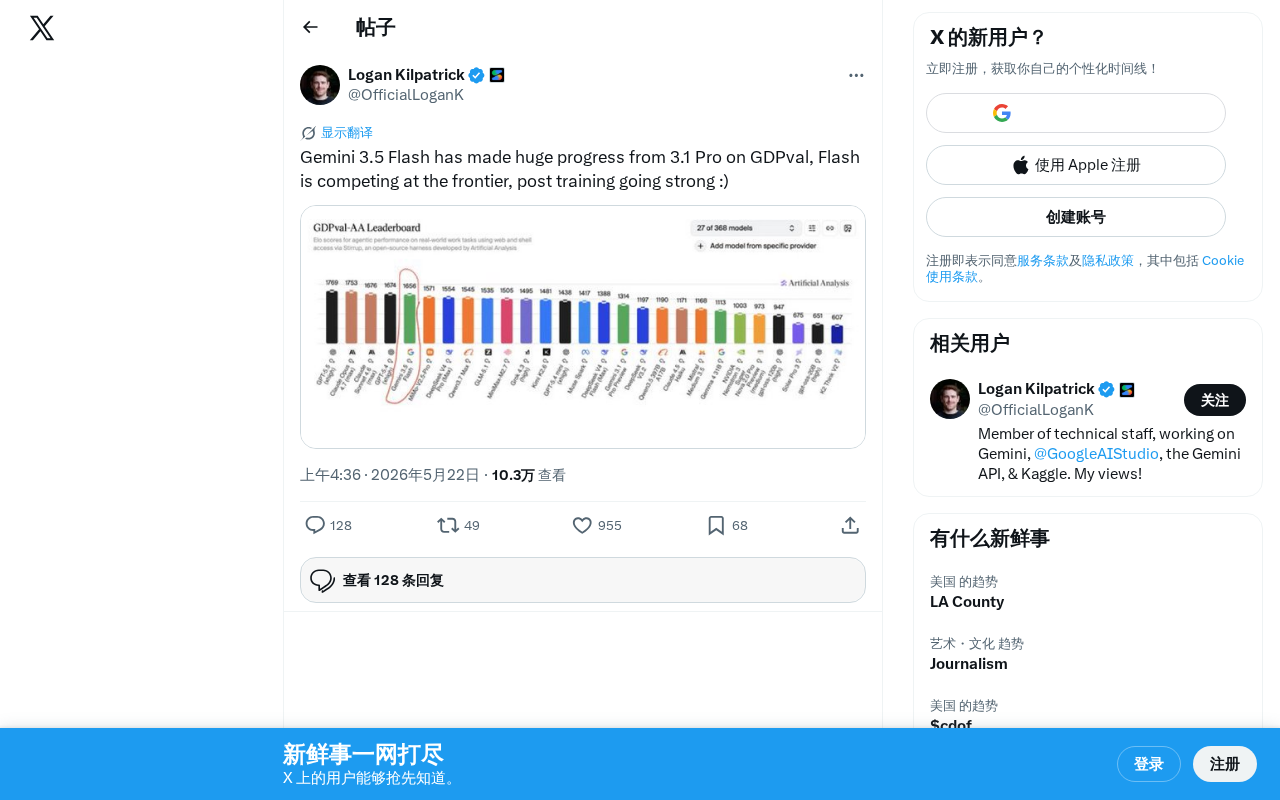
Gemini 3.5 Flash Achieves a Massive Leap on the GDPval Benchmark
Google Gemini 3.5 Flash surpasses Gemini 3.1 Pro on the GDPval benchmark. The lightweight Flash model leverages post-training techniques to approach frontier-level performance, redefining the balance between quality and cost.
 Tech Frontiers
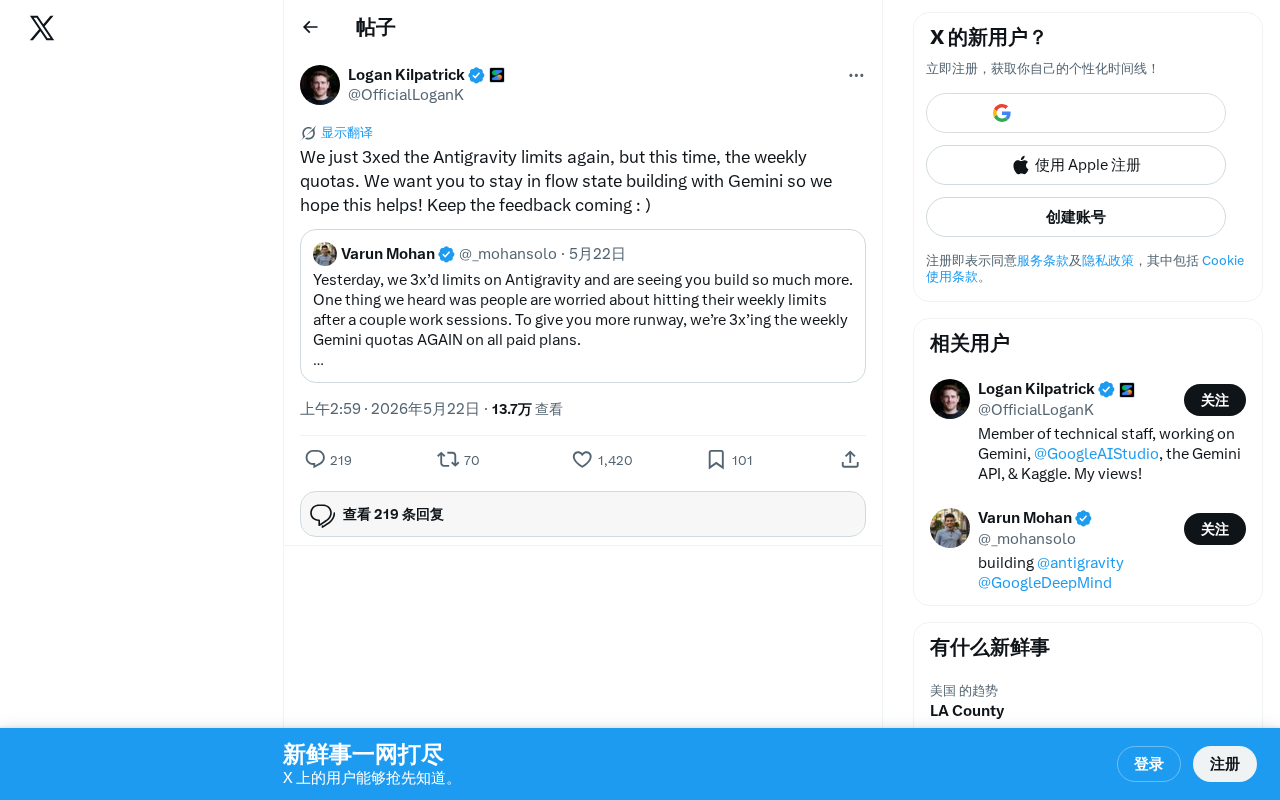
Google Gemini Antigravity Weekly Quota Tripled — AI Coding Without Limits
Google Gemini triples Antigravity weekly quotas following a prior daily quota boost. Analyzing the impact on developers and its strategic significance in AI coding.