Anthropic's Fable 5 Halted by Emergency U.S. Government Ban: A Complete Breakdown
U.S. government issues emergency ban on Anthropic's Fable 5 and Mythos 5, citing national security concerns.
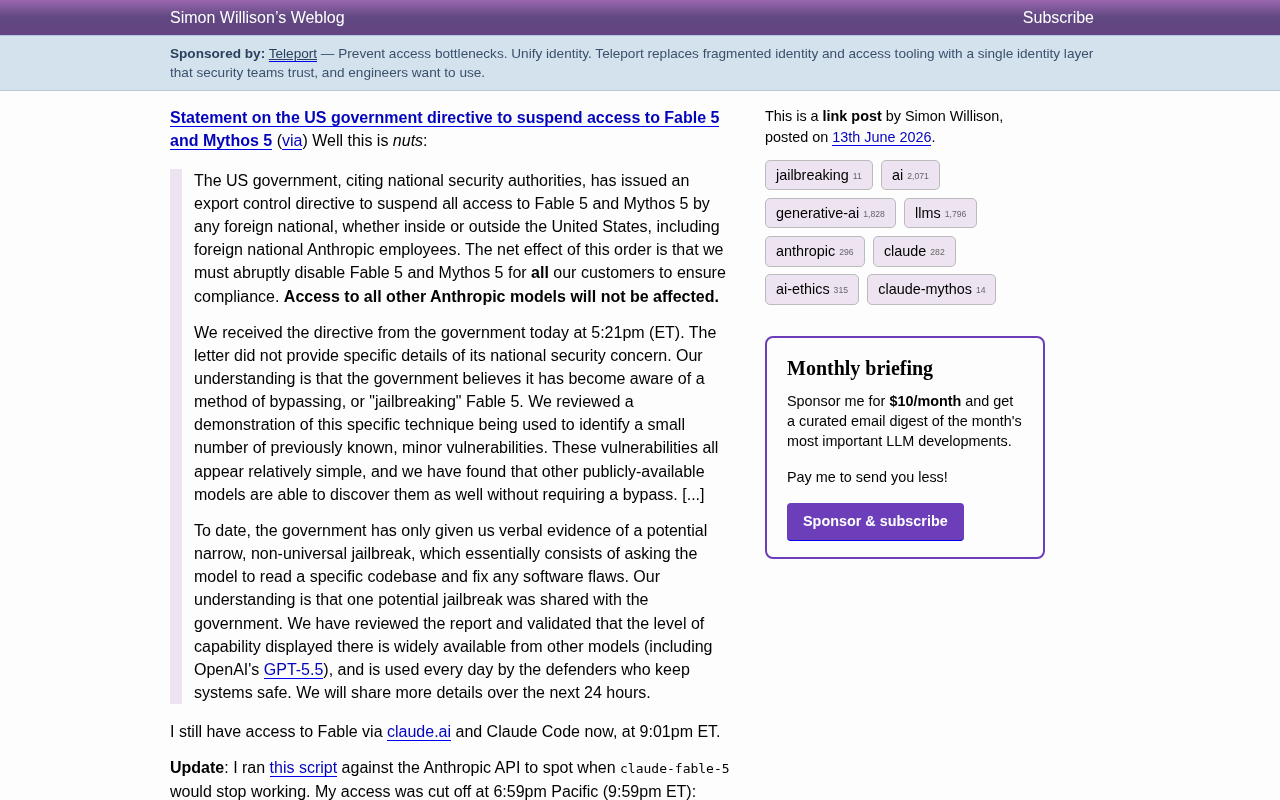
On June 12, 2026, the U.S. government ordered Anthropic to immediately suspend access to its Fable 5 and Mythos 5 models, citing national security risks from an alleged jailbreak technique. Anthropic complied within 5 hours but pushed back, arguing the flagged capabilities exist across competing models and are essential for legitimate security research. The unprecedented move raises critical questions about AI export controls, government transparency, and the paradox of banning defensive cybersecurity capabilities.
Event Overview
On June 12, 2026, news that shook the AI industry broke: the U.S. government issued an export control directive to Anthropic on national security grounds, demanding the immediate suspension of all foreign nationals' access to the Fable 5 and Mythos 5 models. Since it was technically infeasible to precisely distinguish users by nationality, Anthropic was forced to shut down access to both models for all users.
Fable 5 and Mythos 5 are frontier models released by Anthropic in 2026, representing its most advanced reasoning and coding capabilities. Within Anthropic's model lineup, the Fable series is positioned as a flagship product with deep code comprehension and generation abilities, while the Mythos series focuses on complex reasoning and long-context processing. Both models significantly surpass the earlier Claude series in capability — particularly in autonomous code analysis, vulnerability identification, and system architecture understanding, where they demonstrate performance approaching that of professional security researchers.
This marks the first time the U.S. government has issued such an urgent and aggressive ban targeting specific AI models, with the entire process from notification to enforcement taking less than five hours.
Notably, the U.S. export control system is primarily enforced by the Bureau of Industry and Security (BIS) under the Department of Commerce, with its legal foundation including the Export Control Reform Act (ECRA) and the International Emergency Economic Powers Act (IEEPA). Previously, export controls mainly targeted physical hardware — such as advanced chips and lithography equipment — with the 2022–2024 chip export restrictions on China being a prime example. However, imposing emergency export controls on pure software services, especially cloud-based AI models already publicly deployed, lacks mature precedent on both legal and technical fronts. This suggests the government may have invoked broad national security emergency powers rather than relying on existing export control lists.
Event Timeline
According to Anthropic's official statement and real-time testing by the tech community, events unfolded extremely rapidly:
- 5:21 PM (Eastern Time): Anthropic receives the U.S. government directive
- 9:01 PM (Eastern Time): Tech blogger Simon Willison confirms Fable models are still accessible via claude.ai and Claude Code
- 9:59 PM (Eastern Time): API access is officially cut off
Simon Willison is a highly influential tech blogger and open-source developer in the developer community. He is the co-creator of the Django web framework and the author of the data tool Datasette. In recent years, he has become one of the most active independent testers and commentators in the AI tools space, known for his rigorous testing methodology and rapid response. He wrote an automated script to continuously test API availability, precisely capturing the moment the models went offline. On the 37th attempt, the API returned a 404 error with the message: "Claude Fable 5 is not available. Please use Opus 4.8." His independent monitoring provided third-party timeline verification beyond the official statement — invaluable during an emergency event characterized by high information asymmetry.
From receiving the directive to fully shutting down access, Anthropic took approximately 4 hours and 38 minutes — a remarkably fast response time considering this involved a global service adjustment.
The Government's Rationale vs. Anthropic's Rebuttal
Government Concerns
The U.S. government's directive invoked national security powers but did not provide specific details about the security threat. According to Anthropic, the government claimed to have discovered a "jailbreak" method that bypasses Fable 5's safety guardrails.
An AI model "jailbreak" refers to using carefully crafted prompts or interaction strategies to circumvent a model's built-in safety alignment mechanisms, causing it to produce content it was designed to refuse. Common jailbreak techniques include role-play induction, multi-turn conversational escalation, and encoding/decoding bypasses. In this case, the jailbreak method described by the government essentially involves having the model read specific codebases and fix software defects — which is actually a legitimate code auditing activity. However, the government's concern is that the model might identify exploitable zero-day vulnerabilities in the process — security flaws that have not yet been publicly disclosed or patched. Zero-day vulnerabilities carry extremely high strategic value in the cybersecurity market; a zero-day in a critical infrastructure system can fetch hundreds of thousands or even millions of dollars on the black market.
The government has so far provided only verbal evidence, describing a "potential, limited, non-general jailbreak technique" — essentially asking the model to read specific codebases and fix software defects within them.
Anthropic's Position
Anthropic expressed clear disagreement in its statement, with its core rebuttal spanning three dimensions:
- The vulnerabilities are not unique: Upon review, the jailbreak technique uncovered a limited number of vulnerabilities, all of which were previously known and relatively simple security flaws
- The capability is not unique: Other publicly available models (including OpenAI's GPT-5.5) possess the same ability to discover these vulnerabilities
- The use case itself is legitimate: This code review capability is used daily by security defenders to protect systems
Anthropic specifically noted that they had verified the capability level demonstrated in the government's report "exists broadly across other models" and committed to sharing more details within 24 hours.
Deeper Impact Analysis
An Unprecedented AI Regulatory Precedent
The significance of this event extends far beyond the availability of a single model. This may be the first time the U.S. government has imposed an emergency ban on an already publicly deployed AI model through export controls. Previous AI regulatory discussions had mostly remained at the policy framework level, but this was a real "pull the plug" operation.
Interestingly, the directive required blocking access for "any foreign national," including Anthropic's own foreign employees working within the United States. This means that even core team members involved in developing the model would be excluded if they are not U.S. citizens.
This directly impacts Silicon Valley's highly internationalized talent structure. It's estimated that 30%–50% of researchers and engineers at top U.S. AI labs are non-U.S. citizens, many holding H-1B work visas or O-1 extraordinary ability visas. Anthropic, as an AI safety company headquartered in San Francisco, similarly draws top talent from around the world. Barring foreign employees from accessing their own models not only disrupts day-to-day R&D but could trigger a talent exodus — if key researchers cannot access models they helped develop, they may choose to leave the U.S. for countries or institutions with more favorable regulatory environments. The cascading effects of such brain drain could ultimately erode America's competitive edge in AI, creating an ironic contradiction with the government's stated goal of protecting national security.
The Paradox of AI Safety Research
This event exposes a fundamental paradox in AI safety: the ability to discover vulnerabilities is itself a core component of defensive capability. As Anthropic pointed out, security researchers use AI models every day to find and fix software defects. If a model is banned simply because it possesses this capability, then logically all advanced models with code analysis abilities should be banned — which is clearly unrealistic.
In cybersecurity, the principle that "offense and defense are two sides of the same coin" is widely recognized. Penetration testing, red teaming, and bug bounty programs all rest on the same premise: to effectively defend against attacks, you must first understand attack methods. The U.S. Department of Defense, NSA, and other agencies themselves extensively use offensive security tools to assess the security of their own systems. The MITRE ATT&CK framework — the world's most authoritative knowledge base of cyberattack techniques — is essentially a public "attack playbook," yet it is regarded as a core reference resource for defenders. AI models' code vulnerability discovery capabilities follow exactly the same logic: prohibiting defenders from using this capability does not prevent attackers from acquiring equivalent capability; it only creates a unilateral weakening of the defensive side.
A Warning Signal for the AI Industry
For the entire AI industry, this event sends a powerful signal: the government can force a commercial AI product offline in an extremely short timeframe with minimal transparency. Anthropic explicitly stated in its announcement that the government's directive "did not provide specific details about national security concerns" — a level of opacity that is deeply troubling.
If this approach becomes the norm, AI companies will face enormous commercial uncertainty — at any moment, a model already deployed at scale could be forcibly taken offline within hours. This risk affects not only AI companies themselves but also the entire downstream ecosystem that depends on AI services. Enterprise customers evaluating AI vendors will have to incorporate "government intervention risk" into their assessment frameworks, potentially driving some to shift toward open-source or self-hosted models to reduce dependence on a single commercial API. At the same time, this could accelerate the geographic diversification of AI infrastructure — companies may deploy model replicas across multiple jurisdictions to hedge against regulatory risk from any single government.
Looking Ahead
Anthropic has committed to releasing more technical details within 24 hours, which will be critical information for judging whether the government ban is justified. Meanwhile, this event will push the AI industry to reexamine the following questions:
- How should export control boundaries for AI models be defined? Traditional export control frameworks were designed for physical goods and clearly defined dual-use technologies. AI models, as general-purpose capability tools whose "dangerousness" is highly dependent on usage context and prompts, pose a fundamental challenge to traditional classification methods.
- Does the government's authority to intervene in commercial AI services during emergencies need a clearer legal framework? The current approach resembles executive-order-style emergency intervention, lacking a judicial review mechanism similar to the FISA Court (Foreign Intelligence Surveillance Court).
- When "offensive capability" and "defensive capability" are essentially the same capability, how should regulation strike a balance?
Currently, Anthropic's other models (including Opus 4.8 and others) remain unaffected, and users can continue to use them normally. But when access to Fable 5 and Mythos 5 will be restored remains unknown. This contest between the AI industry and government regulation has only just begun.
Related articles
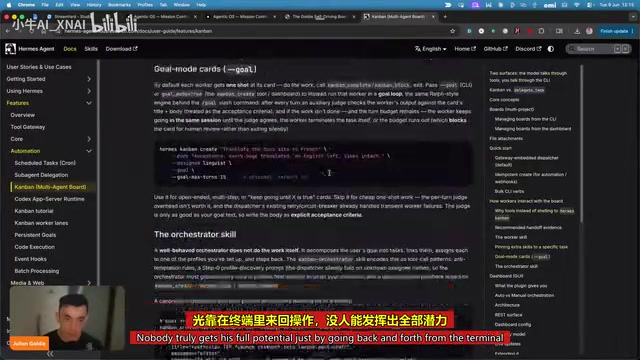
Hermes AI Kanban: A Five-Layer Autonomous Architecture for Fully Automated Delivery from Idea to Finished Product
Deep dive into Hermes Kanban 2.0's five-layer autonomous architecture covering intelligent planning, human approval gates, multi-agent execution, and Obsidian integration for fully automated delivery.

A Three-Month Roadmap to LLM Development: A Deep Dive into the Learning Path from Zero to Freelancing
A deep dive into the three-step LLM development learning path: from prompt engineering and RAG knowledge bases to AI Agent development, with realistic timelines for beginners and experienced developers.
Struggling to Deploy AI Agents? Engineering Is the Key to Going from Demo to Product
57% of projects have deployed AI Agents, but 40% will be killed. This article analyzes the engineering methodology for taking AI Agents from Demo to enterprise product, covering the full process from requirements to deployment.