Apple Executives' Secret Meeting Exposed: Admitting AI Lag, WWDC Counterattack Plan Emerges
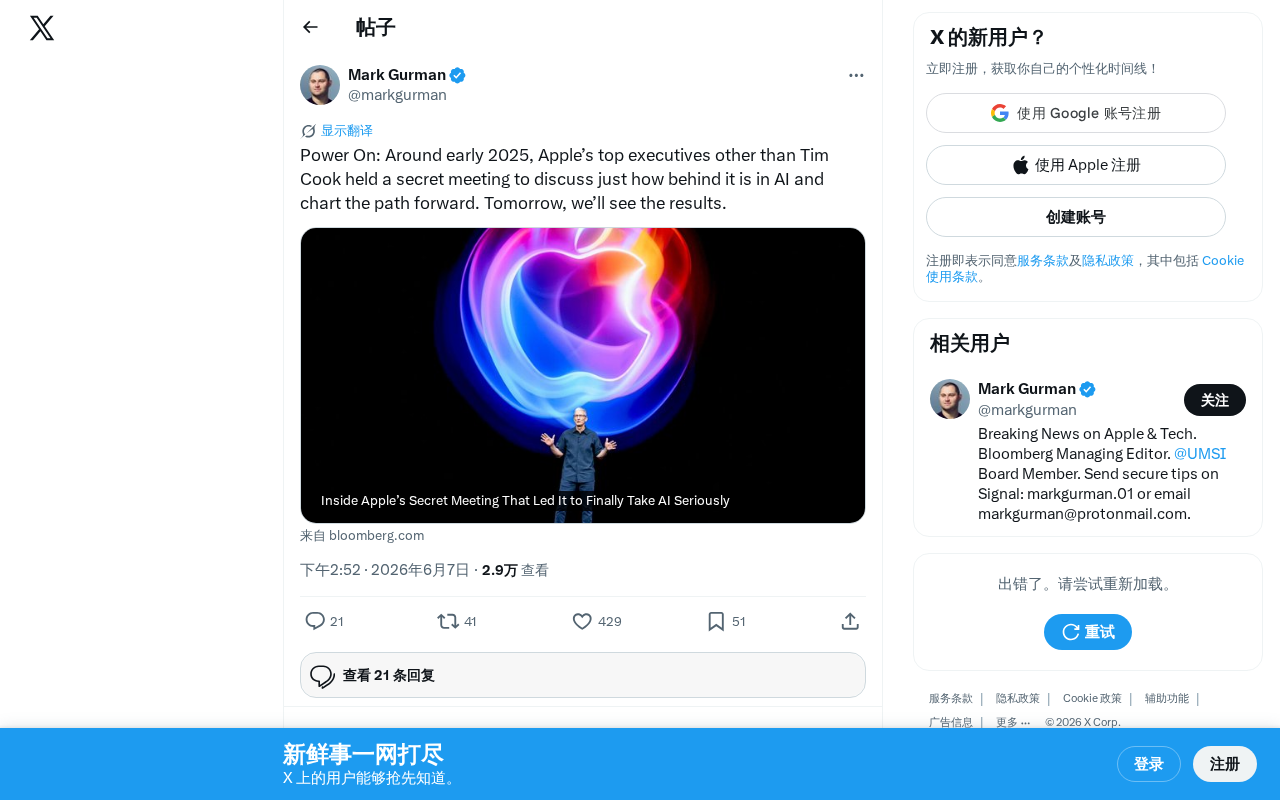
Apple executives secretly met without Cook to confront their AI lag and plan a WWDC 2025 counterattack.
Bloomberg's Mark Gurman reveals that Apple's executive team held a secret meeting in early 2025 without CEO Tim Cook, candidly acknowledging the company has fallen behind in AI. Facing rapid advances from OpenAI, Google, Microsoft, and Meta, Apple grapples with structural challenges including privacy constraints, on-device computing limits, and organizational culture inertia. The meeting's outcomes are expected to be unveiled at WWDC 2025 as Apple's AI counterattack strategy.
A Secret Meeting Without Tim Cook
According to Bloomberg reporter Mark Gurman's Power On newsletter, in early 2025, Apple's executive team—excluding CEO Tim Cook—held a secret meeting. The meeting had one central agenda: just how far behind Apple has fallen in AI, and how to chart a path for a counterattack.
Mark Gurman is a senior technology reporter at Bloomberg and widely recognized as one of the most reliable sources on Apple. Since launching his Power On newsletter in 2021, he has accurately predicted Apple product launches and internal strategic shifts on multiple occasions, with a track record that stands out among tech media. When he discloses information about an internal meeting like this, the industry typically treats it as highly credible intelligence.
The revelation itself is striking. As one of the world's most valuable technology companies, Apple's executives had to internally confront a harsh reality—they have clearly fallen behind in the AI race.
The Deeper Signal Behind Cook's Absence
The most intriguing detail of this meeting is that Tim Cook did not attend. Apple's core executive team beyond Cook includes: Craig Federighi (Software Engineering), John Ternus (Hardware Engineering), John Giannandrea (Machine Learning and AI Strategy), Eddy Cue (Services), and CFO Kevan Parekh, among others. Notably, John Giannandrea joined Apple from Google in 2018, where he had led Google's Search and AI divisions—his very presence demonstrates that Apple recognized AI's importance long ago, but execution-level progress has clearly fallen short of expectations.
This arrangement may convey multiple signals:
- The need for candid communication: Without the CEO present, executives may have been more willing to confront problems head-on without worrying about how things are phrased
- Execution-level focus: This was more of a pragmatic discussion at the technology and product strategy level, rather than a corporate governance decision
- A reflection of crisis awareness: When the executive team needs to privately discuss "just how far behind are we," it indicates that internal anxiety about the current situation has reached a point requiring collective confrontation
Apple's AI Predicament: Competitors Surging Ahead While Apple Falls Behind
Looking back at the AI race over the past two years, Apple's position is indeed precarious.
Competitors' Comprehensive Lead
-
OpenAI's ChatGPT has continued to iterate and has become embedded in the daily lives of hundreds of millions of users. Since its November 2022 launch, ChatGPT has undergone rapid iteration from GPT-3.5 to GPT-4, GPT-4o, and GPT-4.5, with weekly active users surpassing 400 million—making it one of the fastest-growing consumer applications in history. OpenAI has also launched the o-series models with deep reasoning capabilities, along with multimodal interaction abilities, expanding AI assistants from text conversations to voice, image, and video understanding.
-
Google has fully integrated Gemini into its core products including Search, Gmail, and productivity tools. The Gemini model family employs a multi-tier architecture from Ultra to Nano, corresponding to heavy cloud computing and lightweight on-device inference scenarios respectively. Google has deeply embedded it into Gmail, Google Docs, Google Search, and other products with billions of monthly active users, achieving seamless AI penetration where users barely need to actively seek out AI features—it has naturally merged into daily workflows.
-
Microsoft has embedded AI capabilities into the Windows and Office ecosystem through Copilot. Microsoft's Copilot strategy covers the full stack from operating system to office suite to development tools. Through investments exceeding $13 billion in OpenAI, Microsoft has secured priority commercial access to GPT-series models. GitHub Copilot now has over 1.9 million paid users, while Microsoft 365 Copilot targets hundreds of millions of enterprise users globally, pushing the commercialization of AI productivity tools to unprecedented scale.
-
Meta has open-sourced the Llama model series, building a developer ecosystem. From Llama 1 to Llama 3.1 to Llama 4, Meta has taken an open-source approach diametrically opposed to OpenAI's. Llama models have been downloaded over 1 billion times cumulatively, and by lowering the industry's AI barrier to entry and establishing technical standards influence, Meta has gained enormous voice in the AI infrastructure layer.
Apple Intelligence Falling Short of Expectations
Apple Intelligence, announced at WWDC 2024, showcased Apple's AI vision, but actual deployment has progressed far below expectations. From a technical architecture perspective, Apple Intelligence employs a hybrid computing approach: simple tasks are processed on-device by Apple's custom Neural Engine, while complex tasks run on Apple's own cloud servers through Private Cloud Compute, with promises that data won't be stored or made visible to Apple. Additionally, Apple partnered with OpenAI to allow ChatGPT to handle specific requests with explicit user authorization.
However, Siri's intelligence upgrades have been repeatedly delayed, and many promised features have yet to be delivered to users. For a company renowned for "experience above all," this gap is particularly glaring.
Three Structural Challenges Facing Apple
What Apple faces in AI is not simply a technical gap, but multiple structural challenges:
Privacy-first approach constraints: Apple has long positioned privacy as a core selling point, which to some extent limits its ability to collect and leverage large-scale user data for training AI models. Training modern large language models depends on massive datasets, including user interaction data for RLHF (Reinforcement Learning from Human Feedback) alignment optimization. Companies like Google and Meta can leverage billions of users' search histories, social interactions, and content consumption data to continuously improve their models. While Apple's Differential Privacy technology allows statistical learning without exposing individual data, its information density is far lower than using raw data directly. When competitors can extensively use cloud-based data, Apple's privacy commitments—while earning user trust—create a structural disadvantage in the data flywheel effect.
Physical limitations of on-device computing: Apple favors running AI models on-device, but on-device AI inference faces physical bottlenecks in memory bandwidth and computational density. Take the A18 Pro chip in the iPhone 16 Pro as an example: its Neural Engine delivers approximately 35 TOPS (trillion operations per second) with 8GB of memory. Meanwhile, a single NVIDIA H100 GPU in the cloud can provide approximately 4,000 TOPS of AI inference performance, paired with hundreds of GB of high-bandwidth memory. This means on-device models are typically limited to billions of parameters, while cloud models can reach hundreds of billions or even trillions of parameters—a generational gap in comprehension and generation quality. The computing power of iPhones and Macs still has an enormous gulf compared to large data centers, directly constraining model scale and capability ceilings.
Organizational culture inertia: Apple excels at polishing hardware and closed ecosystem experiences, but the AI era demands rapid iteration and open collaboration in R&D—a natural contradiction with Apple's longstanding culture of secrecy. AI model advancement heavily depends on open academic research, open-source community collaboration, and a "ship fast, break things" culture of rapid release and iteration. Apple's decades-old tradition of product secrecy and its philosophy of only releasing when perfect feels out of place against the speed demands of the AI race.
WWDC 2025: Apple's AI Counterattack Is About to Launch
Gurman hints that the results of this secret meeting will be revealed at WWDC 2025. WWDC has historically served as the stage for Apple's major strategic pivots: the 2005 announcement of switching from PowerPC to Intel chips, the 2014 launch of the Swift programming language, and the 2020 announcement of transitioning from Intel to Apple Silicon. Each turning point profoundly reshaped Apple's technology roadmap and competitive landscape. If WWDC 2025 truly carries the mission of Apple's AI counterattack, its historical significance could rival any of these previous pivots.
How will Apple respond to criticism of its AI lag? Will it aggressively catch up or forge a different path?
What's foreseeable is that Apple won't simply copy competitors' playbooks. Its advantages remain: a massive ecosystem of over 2 billion active devices, deeply integrated hardware-software synergy, and long-term user trust in the brand. The key question is whether Apple can convert these unique advantages into differentiated AI experiences—for example, leveraging on-device sensor data to create truly personalized AI assistants, or using hardware-level optimizations to enable on-device models to outperform general cloud solutions in specific scenarios.
This secret meeting without Cook may well be the true starting point of Apple's AI strategic awakening. The upcoming WWDC will be the critical moment to test the substance of this awakening.
Key Takeaways
Related articles
OpenAI Investor Innovation Day: How Co…
OpenAI Investor Innovation Day: How Codex Is Reshaping Enterprise Workflows
OpenAI Investor Innovation Day reveals new enterprise AI trends: from asking to doing mode, how Codex and ChatGPT Enterprise drive workflow transformation through contextual decision support, data processing acceleration, and organization-wide GPTs ecosystems.
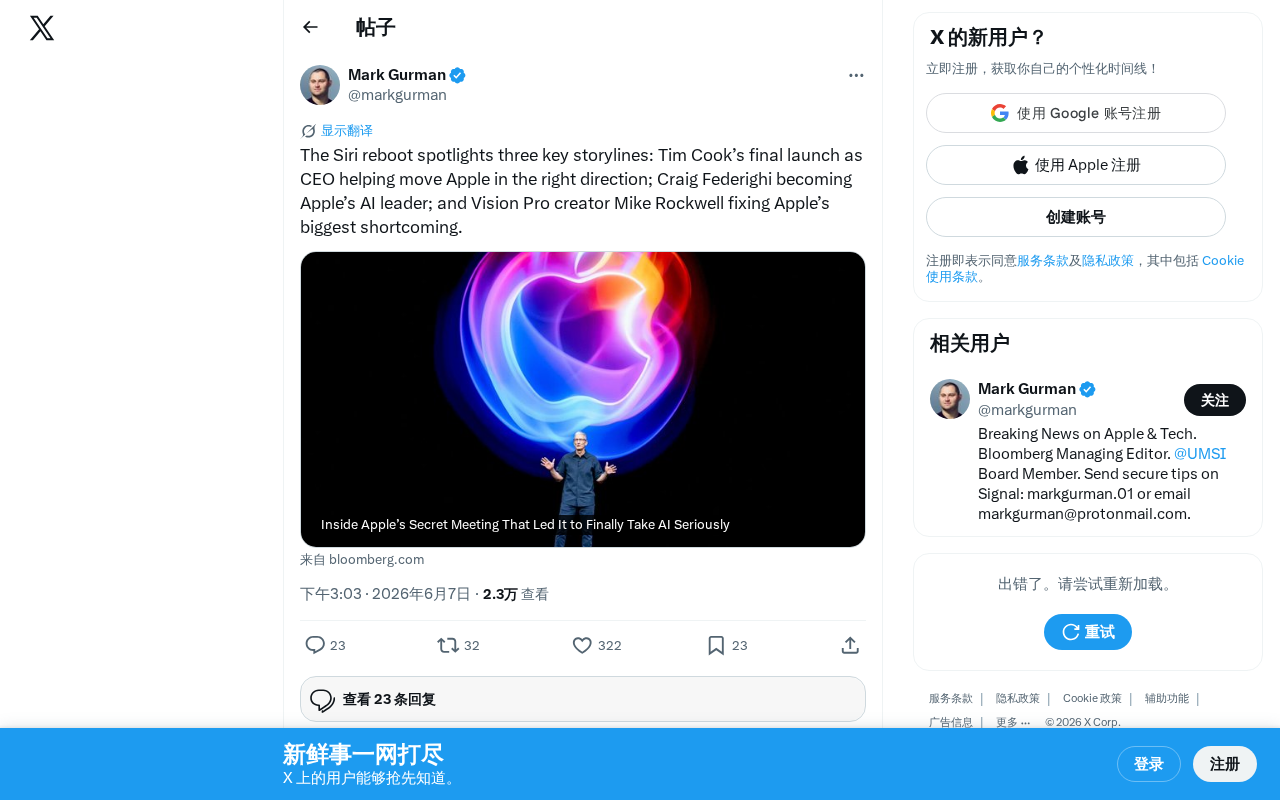
Three Key Narrative Threads Behind Siri's Reboot
Apple's Siri is undergoing its biggest reboot ever. Tim Cook sets AI strategy, Craig Federighi leads integration, and Mike Rockwell rebuilds Siri from the ground up.
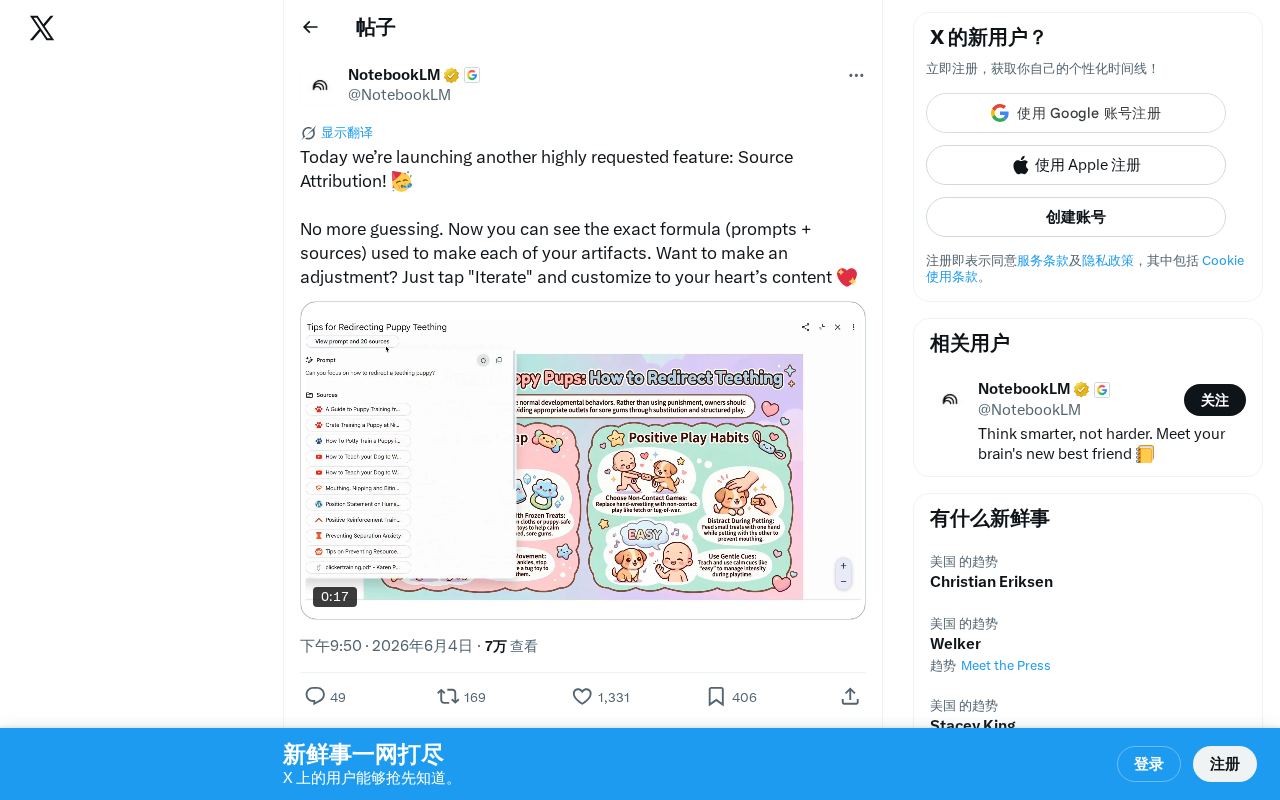
Exa Launches Source Attribution: A New Benchmark for AI Content Traceability and Transparency
Exa launches Source Attribution, letting users view prompts, cited sources, and full recipes behind AI-generated content, with one-click iteration support.