Apple iOS Opens Third-Party AI Chatbot Switching Feature
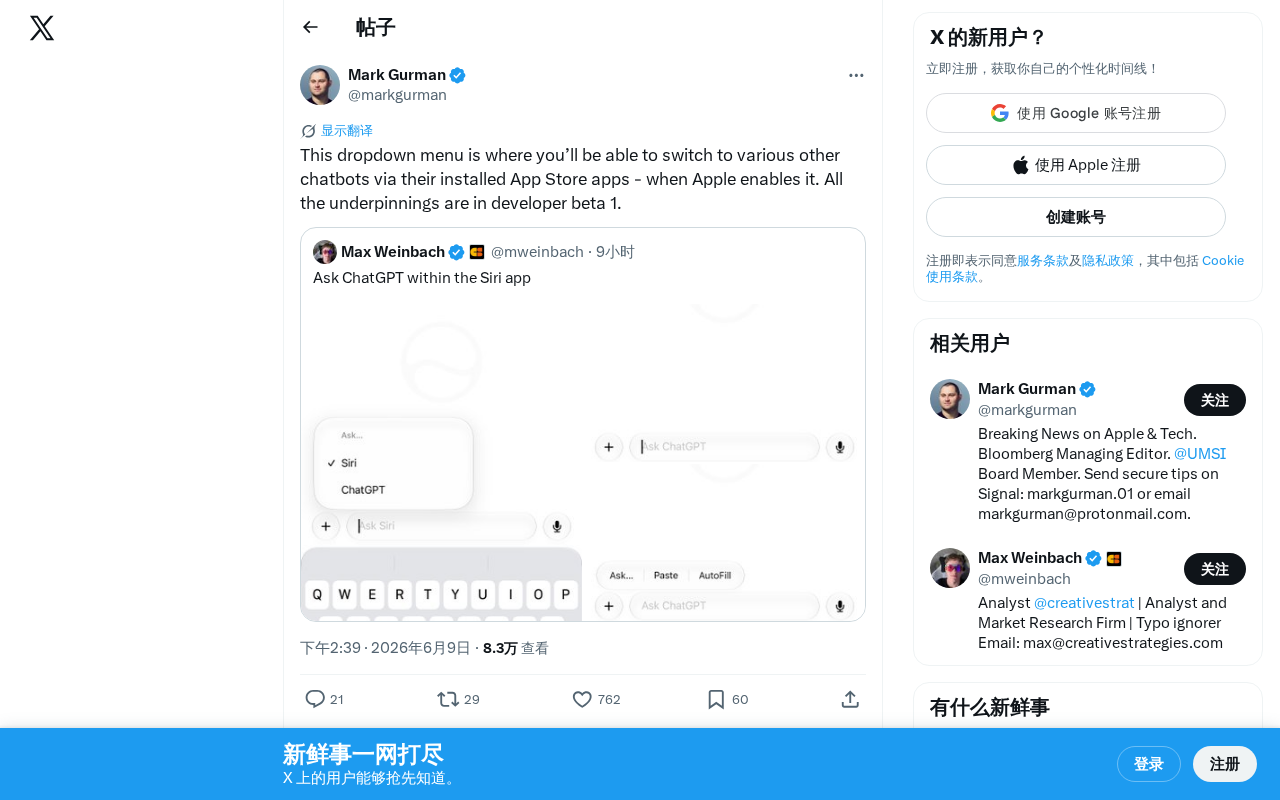
Apple iOS beta reveals a dropdown menu for switching between third-party AI chatbots like ChatGPT and Gemini.
Apple's latest iOS developer beta reveals that Siri will soon support switching between third-party AI chatbots through a system-level dropdown menu. The underlying architecture is already complete, allowing users to choose from services like ChatGPT, Gemini, and Claude installed via the App Store. This open ecosystem strategy extends Apple Intelligence's layered approach and positions the iPhone as an AI aggregation platform.
Apple Siri Set to Open Access for Third-Party AI Chatbots
According to discoveries by developers in the latest iOS developer beta, Apple is building a new dropdown menu interface for its system-level AI assistant that will allow users to freely switch between different AI chatbots. These third-party chatbots will be integrated into the system through apps installed via the App Store.
Developer Beta Reveals Underlying Architecture Is Ready
According to developers, all the underlying technical architecture for this feature has been fully implemented in Developer Beta 1. Apple's developer Beta versions are preview systems provided to registered developers before the official iOS release. After each year's WWDC (Worldwide Developers Conference), Apple releases the first developer Beta of the new iOS generation, followed by months of iterative testing to gradually fix bugs and refine features, ultimately shipping the official version alongside new iPhones in the fall. By analyzing code, resource files, and hidden interfaces in Beta versions, developers can often discover new features Apple hasn't publicly announced yet — this has become an important channel for tech media to obtain Apple product intelligence.
This means Apple has completed the technical preparation work and simply hasn't officially opened the feature to users yet. From screenshots, you can see that the system interface already includes a dropdown selector for switching between different AI services.
This design philosophy aligns with the Apple Intelligence strategy Apple demonstrated at WWDC — Apple doesn't rely solely on its own AI capabilities but actively introduces third-party AI services (like ChatGPT) to enhance the user experience. Apple Intelligence is the system-level AI framework Apple announced at WWDC 2024, with a core design philosophy of "layered processing": simple tasks are handled directly by small on-device models, complex tasks are sent to Apple's own Private Cloud Compute servers, and the most complex or specialized requests can be forwarded to third-party AI services. This three-tier architecture both protects user privacy (on-device processing doesn't upload data) and ensures AI capabilities aren't limited by local computing power. Apple's partnership with OpenAI's ChatGPT was the first implementation of this third-tier architecture. Now, opening up third-party AI chatbot switching is a natural extension of this layered strategy.
Far-Reaching Impact of an Open AI Ecosystem on the Industry Landscape
Strategic Significance of an Open Ecosystem
Apple's decision to open AI chatbot interfaces rather than keeping them closed within its own ecosystem carries significant strategic importance:
- User choice: Users can select the AI assistant best suited to their preferences and needs, rather than being locked into a single service
- Competition drives innovation: Multiple AI service providers competing on the same platform will push each to continuously improve service quality
- App Store ecosystem expansion: AI chatbots distributed through the App Store add a new dimension to Apple's app ecosystem
From a business model perspective, the concept of an AI aggregation platform is similar to early search engine aggregation or streaming content aggregation. Apple's strategy of turning the iPhone into an AI aggregation gateway delivers commercial value on multiple levels: first, distributing AI apps through the App Store allows Apple to collect commissions (Apple typically takes a 15%-30% revenue share); second, controlling AI service traffic distribution makes Apple the "gatekeeper" for users accessing AI services; third, the right to choose default AI services can generate licensing fees from partners, similar to how Google pays Apple tens of billions of dollars annually to be Safari's default search engine. This strategy allows Apple to reap enormous commercial returns from the AI wave without needing to compete head-on with OpenAI or Google in AI model development.
Potential Third-Party AI Partners
Currently, ChatGPT is known to be Apple's first third-party AI service partner. With this open framework established, Google Gemini, Anthropic Claude, Meta AI, and other major AI services could all become future integration partners. This would make the iPhone a true AI aggregation platform.
The current global AI chatbot market features multiple strong players. OpenAI's ChatGPT holds a leading position thanks to its first-mover advantage, with its GPT-4o model excelling in multimodal understanding. Google Gemini leverages its search engine and Android ecosystem for a massive potential user base. Anthropic's Claude is known for safety and long-context processing capabilities, gaining widespread recognition in the enterprise market. Meta AI achieves rapid penetration through Facebook, Instagram, and WhatsApp's social networks. Each model has distinct strengths across dimensions like reasoning ability, creative writing, code generation, and multilingual support — the optimal choice for users often depends on the specific use case. After Apple opens multi-AI access, users will for the first time be able to flexibly switch to the most suitable AI service based on task type within a unified system-level interface — an experience never before achieved on any platform.
Official Launch Timeline Remains Unknown
Although the technical foundation is ready, it remains uncertain when Apple will officially enable this AI chatbot switching feature. Following Apple's typical approach, the feature may be gradually rolled out in subsequent iOS updates, or it may need to wait until more third-party developers complete their integrations before officially launching. Notably, Apple has always been cautious with feature release timing — Apple Intelligence itself went through multiple versions from iOS 18.1 to 18.4 before all features were fully realized, so a phased rollout of the AI chatbot switching feature is well within expectations.
For developers, now is a good time to start researching relevant APIs and integration specifications to gain a first-mover advantage when the feature officially opens.
Key Takeaways
Related articles

Five Common Claude Code Mistakes — How Many Are You Making?
Five common Claude Code mistakes developers make: copy-pasting code, skipping CLAUDE.md, inefficient prompting, ignoring docs, and poor context management — with fixes.
Andrew Ng's New Course Explained: A Practical Guide to Using OpenAI's O1 Reasoning Model
Deep dive into Andrew Ng and OpenAI's Reasoning with O1 course covering test-time scaling, new prompting paradigms, multi-model orchestration, and practical applications for developers.

Learning AI After College Entrance Exams: A Complete Path from Zero to Freelancing
How to efficiently learn AI skills during summer break after exams? A complete path from mastering prompts and hands-on projects to freelancing on platforms.