Apple Rarely Labels New Siri as Beta — What's Behind the Decision?
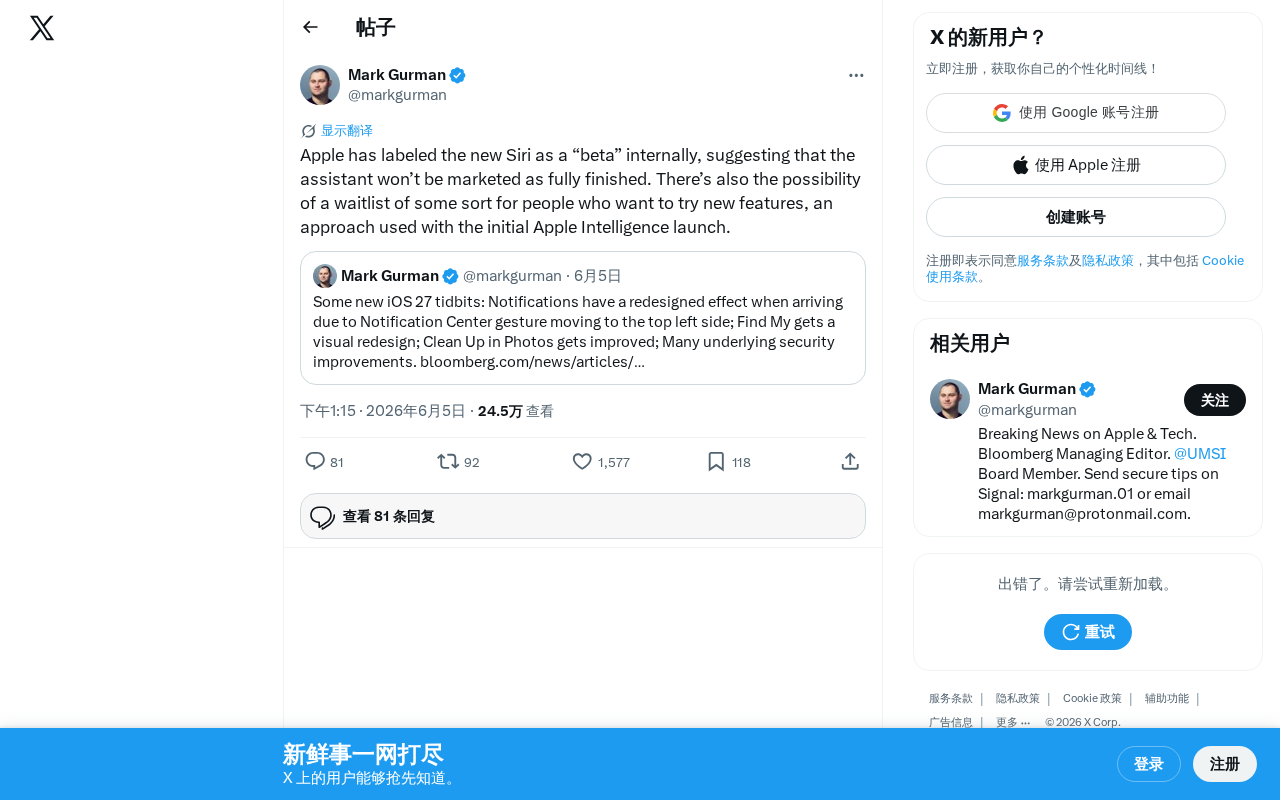
Apple labels new Siri as Beta, signaling a rare shift from its "perfect at launch" philosophy under AI competition pressure.
Apple has internally marked the upcoming new Siri as Beta — an unprecedented move for a company known for polished launches. Driven by LLM challenges like hallucinations and latency, plus competitive pressure from ChatGPT and Gemini, Apple is shifting from perfectionism to iterationism. A waitlist mechanism will control rollout, manage server load, and gather feedback, marking Apple's pragmatic adaptation to the AI era.
New Siri Labeled as Beta: Apple's Rare Admission of an Unfinished Product
According to tech leaks, Apple has internally labeled the upcoming new version of Siri as "Beta," meaning this highly anticipated AI assistant won't be marketed as a fully mature product when it reaches users. This approach is extremely rare in Apple's product launch history and reflects both the fierce competition in the AI assistant space and the complexity of bringing AI technology to market.
Why Did Apple Choose the "Beta" Label?
Realistic Considerations Around Technical Maturity
Apple has long been known for highly polished products and excellent user experiences, rarely using the "Beta" label on consumer-facing products. In Apple's product launch history, consumer-facing Beta labels are extremely rare. The most notable instance was the iChat AV video calling feature launched in 2003, while Apple Maps in 2012 wasn't labeled Beta but was essentially riddled with issues, ultimately leading to a public apology from Tim Cook. Apple's product philosophy is deeply influenced by Steve Jobs — products should "just work" at launch. In contrast, Google has long been comfortable releasing products in Beta form (Gmail maintained its Beta label for 5 years), reflecting the fundamentally different product cultures of the two companies.
This rare exception likely indicates that the new Siri hasn't met Apple's internal launch standards in core capabilities such as LLM-driven conversational ability, multi-turn interactions, and cross-app operations. A Large Language Model (LLM) is a deep learning model based on the Transformer architecture that learns statistical patterns and semantic relationships in language through pre-training on massive text datasets. Unlike the traditional Siri, which relies on rule-based and intent-recognition dialogue systems, an LLM-driven assistant can engage in more natural multi-turn conversations, understand contextual nuances, handle ambiguous instructions, and even perform reasoning. However, LLMs also introduce inherent challenges such as "hallucinations" (generating plausible-sounding but factually incorrect information), higher latency, and significant computational resource consumption — problems that no company has fully solved to date.
Under pressure from rapidly iterating competitors like ChatGPT and Google Gemini, Apple faces a dilemma: either continue polishing until perfection and risk being left behind by the market, or release a "functional but unfinished" version early, using the Beta label to manage user expectations. Clearly, Apple chose the latter. This marks Apple's shift from the deterministic thinking of a hardware company to the probabilistic thinking required in the AI era.
Possible Waitlist Mechanism
Reports also indicate that Apple may implement some form of waitlist for users who want to try the new features. This strategy isn't unprecedented — Apple adopted a similar phased rollout approach when Apple Intelligence first launched.
Apple Intelligence is Apple's AI framework announced at WWDC 2024, featuring a hybrid architecture: simple tasks are handled by on-device small models (powered by Apple's custom silicon Neural Engine), while complex tasks are sent to Apple's proprietary cloud servers via Private Cloud Compute. The core selling point of Private Cloud Compute is that even when data is uploaded to the cloud, Apple cannot access user data, and data is immediately deleted after processing. This architecture reflects Apple's effort to balance AI capabilities with privacy protection, though it also somewhat limits the scale and capability ceiling of its models.
Waitlist mechanisms have become an industry-standard strategy for AI product launches. OpenAI used a waitlist system when releasing the GPT-4 API, and Google's Bard similarly limited access numbers initially. The technical reason behind this mechanism is that LLM inference requires substantial GPU compute power — each user interaction demands real-time computation, unlike traditional software that can simply distribute static content via CDN. Phased rollouts allow engineering teams to monitor system stability, observe real usage patterns, and optimize inference efficiency.
The waitlist mechanism offers multiple benefits: it controls server load to avoid performance issues from large-scale launches, while also enabling rapid iteration and bug fixes through real feedback from a smaller user base. For a product labeled as Beta, this gradual rollout strategy is a reasonable risk management approach, while also objectively creating a scarcity-driven marketing effect.
Industry Trend: AI Assistants Enter the "Continuous Iteration" Era
The Shift from Perfectionism to Iterationism
Apple's move actually reflects an important transformation across the entire AI industry. Unlike traditional software, AI products based on large language models are inherently uncertain — their outputs aren't fully predictable, and their capability boundaries are continuously expanding. Google's Bard (now Gemini) launched with an "experimental" label, and OpenAI's products are also in constant iteration.
As of 2025, the AI assistant market has formed a multi-player competitive landscape: OpenAI's ChatGPT holds a leading position through first-mover advantage and continuous iteration, with its latest models excelling in reasoning, code generation, and multimodal understanding; Google Gemini follows closely, leveraging its search engine's massive data and DeepMind's research capabilities, with a natural distribution advantage in the Android ecosystem; Apple, with over 2 billion active devices globally, possesses the largest potential user base. Additionally, Meta's Llama series of open-source models and Anthropic's Claude are also rising rapidly. The key to this competition lies not only in model capabilities themselves but also in deep OS integration, privacy protection strategies, and developer ecosystem building — precisely the areas where Apple excels.
For Apple, acknowledging that a product is in Beta state is both honest with users and creates space for frequent subsequent updates and feature adjustments. This marks Apple adjusting its longstanding product philosophy in the AI era — shifting from "perfect at launch" to "continuously evolving after launch."
What Beta Siri Means for Users
For everyday users, the Beta label means several things to keep in mind:
- Features may be incomplete: Some advanced features may roll out in phases — complex capabilities like cross-app operations and deep personalization recommendations may take longer to stabilize
- Experience may fluctuate: AI response accuracy and consistency may not be as stable as traditional Siri, especially when handling complex queries or scenarios requiring multi-step reasoning
- Patience required: Not all users will be able to experience all new features immediately — the waitlist mechanism means features will gradually open by region and device
- Feedback channels matter more: Apple will likely be more proactive in collecting user feedback to improve the product, with Beta users effectively serving as large-scale testers
Summary and Outlook
Apple labeling the new Siri as Beta is a deeply meaningful signal. It speaks both to the difficulty of bringing AI technology to market and Apple's pragmatic attitude under market pressure. In the AI assistant race, no company can claim its product is "finished" — the essence of this competition is an endless iteration marathon.
What's worth watching next: How will Apple communicate this Beta positioning to the public at WWDC? What will the waitlist rollout pace look like? And can the new Siri narrow the gap with competitors like ChatGPT and Gemini in actual user experience? The answers to these questions will determine Apple's competitiveness in the AI era.
Related articles

Building a Cold Chain Logistics Optimization Research Project with Codex: A Complete Workflow from Scratch to PDF Paper
Learn how to use OpenAI Codex to build a complete cold chain logistics optimization research project from scratch, including simulated annealing implementation, experiments, figures, and LaTeX paper compilation.

Codex Beginner's Practical Guide: Master Core AI Programming Skills in One Weekend
OpenAI Codex beginner's practical guide covering environment setup, code generation, bug fixing, and project refactoring. Includes efficient learning tips and Prompt techniques for fast AI programming mastery.

AI Agent Systematic Learning Path: From Zero to Independent Development
A systematic AI Agent learning path covering core principles, Prompt engineering, RAG, multi-Agent collaboration, and hands-on projects for beginners.