AI Agent Systematic Learning Path: From Zero to Independent Development

A complete learning roadmap for building AI Agents from scratch to independent development.
This article outlines a systematic learning path for AI Agents, structured into three modules: Fundamentals (Agent principles, Prompt engineering, workflow design), Advanced (RAG knowledge bases, Agent architecture, multi-Agent collaboration), and Hands-On Practice (knowledge assistant, customer service bot, office automation). It provides practical tips for beginners to efficiently master Agent development.
Why Most People Fail to Learn AI Agents
AI Agents are undoubtedly one of the hottest directions in the tech world right now. Search for related tutorials on Bilibili and you'll find everything from viral videos with hundreds of thousands of views to niche content with just a few hundred — massive in quantity but wildly inconsistent in quality. Many learners watch countless tutorials yet still can't independently develop a complete agent. So where exactly does the problem lie?
The core reason is: Most tutorials are scattered knowledge fragments, lacking a systematically designed learning path. You might learn how to write a Prompt but not understand workflow design; you might grasp the concept of RAG but can't integrate it into a complete Agent architecture.
Recently, a content creator shared a systematic AI Agent learning course, claiming it took three months to develop, covering everything from zero-foundation basics to hands-on projects. This article will use that course's framework to outline a clear, systematic learning path for AI Agents.
The Essence of AI Agents: From Passive Response to Proactive Execution
Before diving into the learning path, it's essential to understand what AI Agents fundamentally are. The concept of Agents originates from multi-agent system theory in AI research, dating back to the 1990s. But what truly ignited the Agent concept was the leap in Large Language Model (LLM) capabilities in 2023. Traditional AI assistants can only passively respond to user commands, while Agents possess autonomous decision-making abilities — they can perceive their environment, formulate plans, invoke tools, execute actions, and adjust strategies based on feedback. This paradigm shift from "passive response" to "proactive execution" is what fundamentally distinguishes Agents from ordinary ChatBots. Stanford University's "Generative Agents" paper and the viral success of AutoGPT in 2023 marked the transition of Agents from academic concept to engineering practice.
Three Major Modules for Learning AI Agents: From Beginner to Practitioner
The course breaks AI Agent learning into three major modules: Fundamentals, Advanced, and Hands-On Practice. This layered design aligns perfectly with how we naturally learn technical subjects — first build a conceptual framework, then dive deep into core technologies, and finally consolidate knowledge through projects.

Fundamentals: Building Your Agent Mental Model
The fundamentals module focuses on three core topics:
-
Agent Principles: Understanding what an AI Agent is and how it fundamentally differs from a regular LLM conversation. Simply put, an Agent doesn't just "chat" — it's an autonomous system capable of perception, reasoning, planning, and execution. Its core operating mechanism can be summarized as the Perception-Reasoning-Action Loop: the Agent perceives user input and environmental state, uses the LLM for reasoning and planning, then invokes tools to execute specific actions, and enters the next cycle based on execution results.
-
Prompt Engineering: Prompts are the "language" for communicating with LLMs, and good Prompt design directly determines the quality of an Agent's behavior. This goes far beyond writing a few instructions — it involves role definition, chain-of-thought guidance, output format control, and many other techniques. Prompt engineering has evolved into a systematic technical discipline: Few-shot Prompting guides model output format and style by providing a few examples in the prompt; Chain-of-Thought improves accuracy on complex reasoning tasks by asking the model to "think step by step," formally proposed by Google in a 2022 paper; structured output constrains model output format through methods like JSON Schema, ensuring reliable parsing by downstream systems. There are also advanced paradigms like Tree-of-Thought and ReAct (Reasoning + Acting). In Agent development, Prompts not only define the Agent's "personality" and behavioral boundaries but also serve as the underlying mechanism for implementing core capabilities like tool invocation and task planning.
-
Workflow Design: The power of Agents lies in their ability to automatically complete complex tasks following predefined workflows. Understanding how to design proper task decomposition and process orchestration is the key leap from "using AI" to "building AI applications." The core of workflow design is breaking complex tasks into executable atomic steps and defining dependency relationships, conditional branches, and exception handling logic between steps.
For zero-foundation learners, these three modules constitute the minimum necessary knowledge set. It's recommended to master them thoroughly before moving to the next stage.
Advanced: Mastering the Agent Core Tech Stack
The advanced module is the most technically intensive part of the entire learning path, covering several key technologies in current Agent development:
RAG (Retrieval-Augmented Generation) Knowledge Bases are the core means of equipping Agents with domain-specific knowledge. LLMs have limited general knowledge, but through RAG technology, Agents can retrieve external knowledge bases in real-time to provide more accurate, professional answers. This is also the most common technical approach in enterprise-grade Agent applications.
RAG was proposed by Meta AI in 2020. Its core workflow is: first, external documents are converted into high-dimensional vectors through Embedding models (such as OpenAI's text-embedding-ada-002 or open-source BGE models) and stored in vector databases (such as Pinecone, Milvus, Chroma, etc.); when a user asks a question, the system first vectorizes the question, retrieves the most relevant document fragments from the vector database through similarity computation; then feeds the retrieved content as context along with the user's question into the LLM to generate an answer. This approach addresses the limitations of LLM knowledge cutoff dates, hallucination issues, and insufficient domain expertise. In actual engineering, you also need to pay attention to document chunking strategies, retrieval recall optimization, reranking, and other practical details.
Agent Architecture Design involves how to build a complete agent system, including the design and integration of modules like memory management, tool invocation, and state management. Memory systems are typically divided into short-term memory (current conversation context) and long-term memory (persistently stored historical information), while tool invocation uses the Function Calling mechanism to enable Agents to interact with external APIs, databases, file systems, and more.
Multi-Agent Collaboration is a more advanced topic — when a single Agent can't handle complex tasks, how can multiple Agents divide work, collaborate, and communicate with each other to form an "AI team"? This has broad applications in office automation, complex data analysis, and similar scenarios.
Multi-Agent collaboration draws inspiration from the division of labor in human organizations. In terms of technical implementation, there are several main architectural patterns: first, Hierarchical, where a "manager Agent" handles task decomposition and assignment while other Agents execute specific subtasks; second, Peer-to-Peer, where multiple Agents negotiate as equals and pass information to each other; third, Competitive, where multiple Agents independently complete the same task and the best result is selected. In practical applications, for example, a content creation team could have a "Research Agent" responsible for information gathering, a "Writing Agent" for content generation, and a "Review Agent" for quality control, forming a complete automated workflow.
Additionally, the advanced module includes hands-on development with mainstream frameworks, ensuring learners not only understand theory but can also write code. In the current Agent development ecosystem, frameworks roughly fall into two categories: code-level and low-code. LangChain is the earliest and most popular code-level framework, offering comprehensive chain calling, memory management, and tool integration capabilities, though it has a steep learning curve; LangGraph is a graph-structured orchestration framework from the LangChain team, better suited for complex workflows; AutoGen, developed by Microsoft, focuses on multi-Agent conversation and collaboration scenarios. On the low-code platform side, Dify provides a visual Agent orchestration interface suitable for rapid prototyping; Coze (by ByteDance) targets a broader non-technical audience.
Hands-On Practice: Project-Driven Skill Development
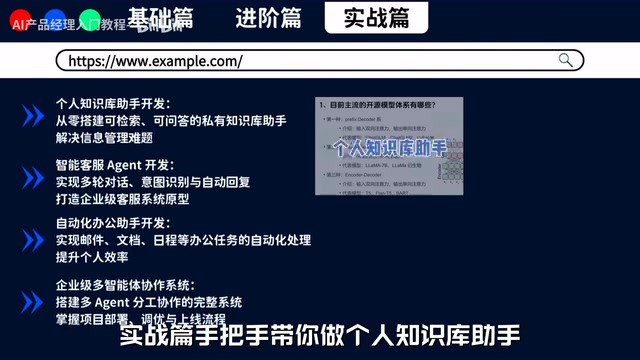
The hands-on practice module is the critical phase for validating learning outcomes. The course includes several typical Agent development projects:
-
Personal Knowledge Base Assistant: Using RAG technology, build an AI assistant that can understand and retrieve personal documents and notes. This is the most intuitive starter project for learning RAG. During development, you'll need to handle parsing of multiple document formats (PDF, Markdown, Word, etc.), selection of appropriate text chunking strategies, and vector database setup and query optimization — all real-world engineering challenges.
-
Intelligent Customer Service Agent: Simulating a real customer service scenario, the Agent needs to understand user intent, query knowledge bases, handle multi-turn conversations, and even invoke external tools when necessary (such as querying an order system). This project comprehensively tests multiple capabilities including intent recognition, dialogue state management, tool invocation orchestration, and fallback handling.
-
Office Automation Assistant: Combining Agents with everyday office tools to automate workflows like email processing, data organization, and report generation. These projects typically require integrating multiple external APIs (such as Gmail API, Google Sheets API, Notion API, etc.) and designing reliable error handling and human confirmation mechanisms.
These three projects cover the three most common directions for Agent applications: knowledge management, customer service, and process automation, offering strong practical value and transferability.
Four Practical Tips for Learning AI Agents from Scratch

Based on this course's framework, here are some recommendations for readers looking to get started with AI Agents:
1. Understand the "why" before learning the "how." Many people rush to pick up frameworks and code without truly understanding Agent fundamentals. Spend a week getting clear on core Agent concepts (the Perception-Reasoning-Action loop, tool invocation mechanisms, memory systems), and everything that follows will be much easier. I recommend reading Lilian Weng's blog post LLM Powered Autonomous Agents — it's one of the clearest overviews of Agent architecture available.
2. Prompt engineering is a foundational skill — don't skip it. Regardless of which framework you use, the core of interacting with LLMs is still the Prompt. Systematically learn Prompt design techniques including Few-shot, Chain-of-Thought, structured output, and other methods — this is a fundamental capability that runs through everything. It's worth noting that different models (GPT-4, Claude, Llama, etc.) respond differently to Prompts, so you'll need to fine-tune for specific models in practice.
3. Take a project-driven approach — learn by doing. Don't try to learn everything before getting your hands dirty. After completing each module, try building a small project, even if it's just a simple Q&A Agent. Problems encountered in practice will push you to develop a deeper understanding of theory. A good learning rhythm is: learn concepts → implement → encounter problems → go back and fill in theory → optimize implementation, creating a positive feedback loop.
4. Follow mainstream frameworks but don't get locked into them. Tools like LangChain, Dify, and Coze each have their strengths and weaknesses. In the early stages, pick one and learn it deeply, but make sure you understand the design philosophy behind the framework so you can quickly adapt when switching tools. Frameworks update and iterate extremely fast (LangChain has breaking changes almost every week), so understanding underlying principles matters more than memorizing APIs. I recommend that while using a framework, you also try implementing a simple Agent in pure Python — this will help you truly understand what the framework is doing for you.
Conclusion: Choosing the Right Path and Learning Systematically Is Key
AI Agents are moving from concept to real-world deployment. Whether for personal productivity or enterprise application development, mastering Agent development skills will become an important competitive advantage. A systematic learning path — from foundational principles to core technologies to hands-on projects — is the key to avoiding the trap of "learning a lot but being able to do nothing."
From an industry trend perspective, 2024 is widely regarded as the "Year One of Agent Applications." Leading AI companies like OpenAI, Google, and Anthropic are all increasing their investment in the Agent direction, and enterprise demand for talent with Agent development capabilities is growing rapidly. Whether building internal efficiency tools or customer-facing intelligent services, Agents are the critical bridge for converting LLM capabilities into real business value.
For zero-foundation learners, there's no need to aim for perfection from the start. Progress steadily following the Fundamentals → Advanced → Hands-On Practice rhythm, combined with hands-on practice, and getting started in one week and achieving independent development capability in one month is entirely achievable. The key is: choose the right path and commit to execution.
Related articles
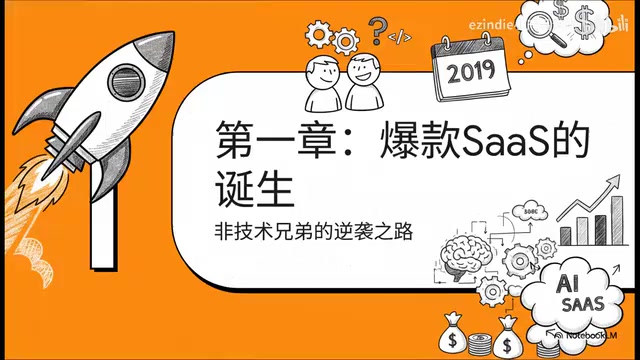
Non-Technical Founders Built a $50K/Month SaaS Product Using AI Tools
Two non-coders built Shipper to $50K MRR in 6 months using AI tools. Learn their reverse-engineering, zero-free-tier, and viral growth playbook for indie developers.
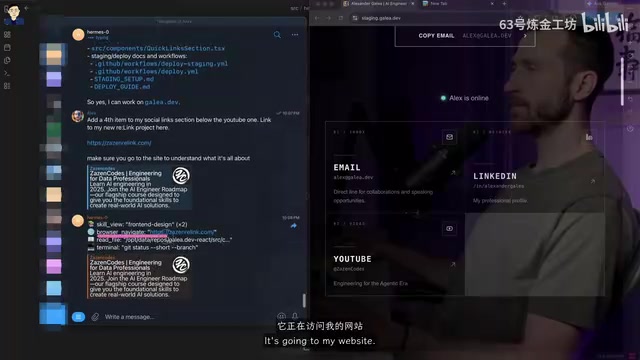
Hermes Agent Deployment Guide: Building a Mobile AI Coding Workflow with Telegram
Learn how to deploy Hermes Agent on a VPS with Telegram Bot integration for mobile AI coding. Covers Docker setup, GitHub integration, auto-deployment, and comparison with OpenClaw.
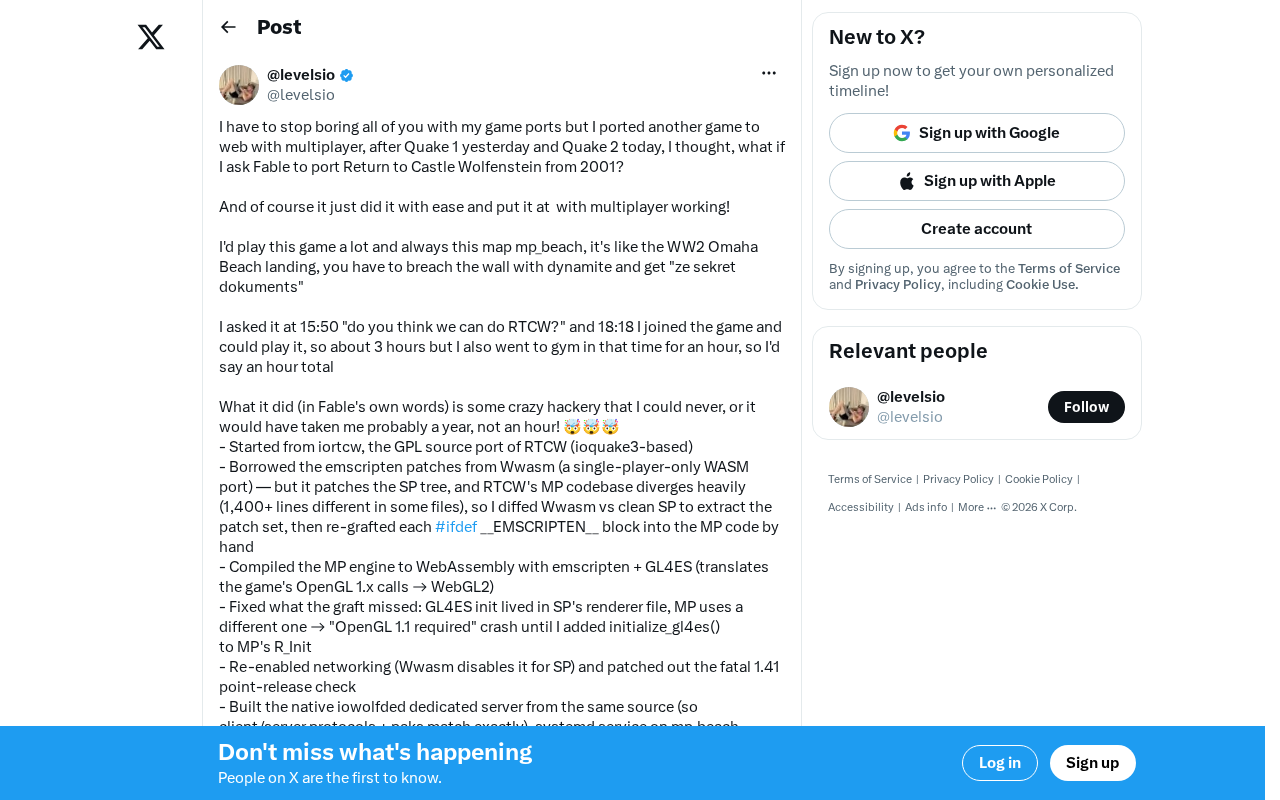
AI Tool Fable Ports Classic FPS to Browser in Two Hours — With Full Multiplayer
A developer used AI coding tool Fable to port Return to Castle Wolfenstein to the web browser in just two hours with full multiplayer, revealing AI's power in system-level engineering.