Non-Technical Founders Built a $50K/Month SaaS Product Using AI Tools

Non-technical founders built a $50K/month SaaS using AI tools, zero ad spend, and competitor reverse-engineering.
Two marketers with no coding skills built Shipper—an AI app builder—to $50K MRR in six months. Their playbook: reverse-engineer competitor communities for pain points, eliminate free tiers to control AI API costs, maintain a minimalist tech stack with heavy investment only in Claude API, and drive viral growth through Reddit, Product Hunt, and X with zero ad spend.
Two marketing professionals with zero coding skills built Shipper, a SaaS product generating $50,000 in monthly recurring revenue, in just six months using AI tools. The methodology behind this real-world case study deserves close examination by every indie developer.
From Zero to $50K MRR: Two Non-Technical Founders' Playbook
Founders David and his brother Daniel had been deep in the marketing world since 2019, with zero interest in code. When the AI wave hit full force, they spotted an opportunity.
Their product, Shipper, is a minimalist AI app-building tool. Users describe what they want in plain language, and AI automatically generates a fully functional application—no programming knowledge required.
But what's truly impressive isn't the product itself—it's the business metrics:
- Monthly Recurring Revenue (MRR): $50,000
- Paying users: ~690
- Free users: 0—they completely eliminated the free tier
- Revenue split: 90% from stable subscriptions, 10% from one-time top-ups
- Entry price: $25/month
MRR is the most critical health indicator in SaaS. Unlike traditional software's one-time purchases, SaaS uses subscription billing where users pay monthly or annually for cloud-based software. Shipper's 90% subscription revenue signals exceptional income stability—considered the gold standard in the industry. By contrast, models relying on one-time payments create volatile revenue that makes long-term planning difficult.
They made an extraordinarily bold decision: completely eliminating the free tier and concentrating all resources on users willing to pay. This "zero free users" strategy seems aggressive but reflects deep cost reasoning. While freemium has been the success path for giants like Slack and Notion, free users' server costs, support tickets, and community noise scale explosively. For AI products this is especially lethal—every AI call carries real API costs. Many early AI startups went underwater because token expenses from free users drained their budgets. By cutting the free tier entirely, Shipper ensures every user contributes revenue, preventing limited API budgets from being consumed by users with no intent to pay.
Differentiation Strategy: Reverse-Engineering Giants to Find Your Niche
Facing behemoths like Loveable—which hit $1M ARR in a single week and rocketed to a $6 billion valuation—how do two non-technical outsiders compete?
Loveable was a breakout product in the 2024 AI code generation space, alongside Bolt.new, Cursor, Replit Agent, and others forming this rapidly expanding market. These tools let users describe requirements in natural language while AI generates runnable code. But they universally target users with some technical literacy—interfaces filled with terms like "deploy," "API," and "database" create invisible cognitive barriers for complete beginners.
Their core philosophy: Never try to reinvent the wheel. In a fertile market already validated by demand, even capturing just 1% of the pie is enough to thrive. This "1% paradigm" is worth memorizing for every indie developer.

In practice, David and Daniel deployed a precise reverse-engineering strategy. Originally an engineering concept—disassembling finished products to understand their design principles—in business it means systematically analyzing competitors' user feedback, feature design, and pricing strategies to extract real market needs, effectively offloading trial-and-error costs to first movers:
- Infiltrate competitor communities: Deep-dive into Discord communities of competitors like Loveable, reading massive amounts of user discussions
- Mine user pain points: Obsessively scan negative reviews and complaints on Trustpilot
- Identify market gaps: All the giants were competing on web applications, screens full of technical jargon, while masses of non-technical users wanting mobile apps, browser extensions, and Telegram bots were completely ignored
Shipper's positioning became crystal clear: Purpose-built for people who hate technical jargon but want to turn ideas into revenue-generating products. One promise—"No technical skills needed, turn your idea into a money-making business"—precisely filled the vacuum left by incumbents.
Minimalist Tech Stack: Spending Where It Counts
Many assume building AI tools requires burning massive capital, but Shipper's operating cost breakdown reveals a radically different approach.
Where they cut costs ruthlessly:
- SEO blog: Free WordPress
- Code hosting and version control: GitHub free plan
- Deployment platform: Vercel free tier
Vercel is the cloud deployment platform from the company behind Next.js, known for "zero-config deployment"—developers simply push code to GitHub, and Vercel automatically builds and deploys applications to global CDN nodes. Its free tier provides 100GB bandwidth per month, more than sufficient for early-stage products. This represents the modern indie developer's technology dividend: work that a decade ago required managing your own servers, configuring Nginx, and handling SSL certificates now takes just a free account.
Where they spend aggressively:
- Claude AI model API calls: Over $10,000 per month
Claude is a large language model developed by Anthropic, known for long-context understanding and code generation capabilities. Shipper chose Claude as its core engine—every time a user inputs requirements to generate an app, the model performs inference, billed by input and output token count. Using Claude 3.5 Sonnet as reference, a million input tokens costs roughly $3 and a million output tokens about $15. A complex app generation might consume tens of thousands of tokens, with single-call costs ranging from $0.10 to $1.00. This explains why the $25/month entry price is necessary—it must cover each user's AI inference costs while leaving room for profit.

This is indie developer survival wisdom—cut all flashy expenses and pour heavy investment into the core AI engine that determines whether the product lives or dies.
Their execution pace was equally remarkable:
- Months 1-2: Team of just 3 (two founders + one developer), launching V1 despite bugs flying everywhere
- Month 3: Product basically functional
- Month 4: Catch-up phase with giants complete
- Months 5-6: Shipping exclusive features that even industry leaders didn't have
Six months, from zero to overtaking incumbents. The core secret is two words: Ship it. They didn't care whether the product was perfect—only whether users could start using it as fast as possible.
Zero Ad Spend: A Viral Growth Engine
With the product built, where do users come from? Shipper's growth trajectory is a textbook case of zero-cost acquisition:
Phase 1: Cold Start
Launched on Product Hunt, earning their first $50 in monthly revenue. Product Hunt is the world's largest new product discovery community, with hundreds of tools launching daily. For early products, its value isn't just direct user acquisition but validating product-market fit (PMF)—if a product can't generate interest in the community most sensitive to new tools, the direction may need adjusting. Shipper's first revenue here, while small, completed the critical psychological validation of going from 0 to 1.
Phase 2: Community Deep-Dive
Moved to Reddit, where a single post with 400+ upvotes pulled revenue to $1,000. Simultaneously built out SEO, specifically targeting long-tail keywords like "[giant competitor] alternative" and "how much does [giant competitor] cost."
Phase 3: Explosive Growth
Around day 50, quantity triggered a qualitative shift—parabolic growth exploded on X (formerly Twitter). A single post garnered 2.7 million impressions, adding $20,000 in MRR within one to two weeks.
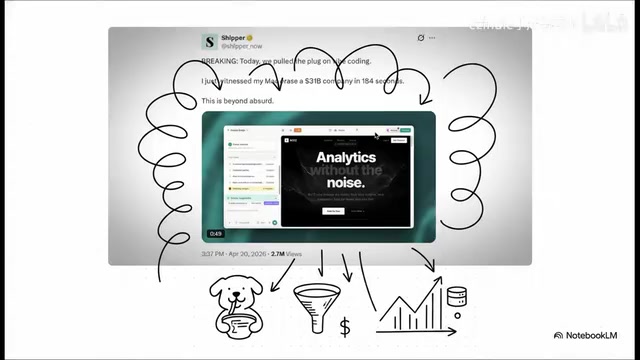
This explosion was no accident. Two key strategies drove it:
- "Eat your own dog food" strategy: Publicly demonstrating how to build apps with Shipper in real-time, showcasing the product's impressive results—which itself becomes the best advertisement
- Link placement technique: Never putting product links in the tweet body, always placing them in the second reply below. This strategy exploits a key mechanism in X's algorithm—the platform explicitly deprioritizes external links, with tweets containing outbound links typically receiving 40-60% less reach than pure text posts. By placing links in replies, the main tweet performs as pure content, earning algorithmic favor and maximum exposure. Interested users naturally check the reply section to find the link. This technique, known as "link in reply," has been validated by numerous creators as dramatically improving content reach.
Core Methodology Indie Developers Can Replicate
Looking at Shipper's complete loop—from opportunity discovery through positioning, development, and marketing—co-founder David's retrospective is worth revisiting repeatedly:
"Stop wracking your brain for some never-before-seen original idea—that's gambling with your life. You'd need to change all of humanity's habits, and normal people can't afford that bet. Instead, focus on a massive, already-proven-profitable industry and ask yourself: If this product were custom-built for someone like me, what would it look like?"
This distills several core principles:
- Don't innovate the market, innovate the experience: Find overlooked segments within validated markets
- Reverse-engineer competitor pain points: User complaints are your product roadmap
- Extreme cost control: Spare no expense on core experience, cut everything else
- Speed over perfection: Ship first, iterate later—market feedback is more valuable than internal polishing
- Content is acquisition: Use your product's own demo results as your strongest marketing asset
Shipper's story proves that in the AI boom era, technical ability is no longer a hard barrier to entrepreneurship. The real moat lies in: Can you precisely identify a niche need overlooked by giants, then push a solution to market at maximum speed and minimum cost? This isn't an underdog fantasy—it's a replicable methodology.
Related articles

Vibe Coding Beginner's Guide: A Complete Roadmap to Building Software with AI — No Coding Experience Required
Vibe Coding lets anyone build software using plain language instructions with AI. Learn what it is, when to use it, which tools to pick, and how to get started.

Beginner's Guide to Vibe Coding: Turn Ideas into Products with AI — No Coding Experience Required
Vibe Coding lets anyone build software products through natural language conversations with AI — no programming skills required. Learn the concept, top tools (Cursor, Claude Code, Codex), and how to get started.
Codex in Action: One Prompt, 47 Minutes, a Complete Algorithm Research Paper
Testing OpenAI Codex: one detailed prompt generates a complete algorithm paper in 47 minutes, including working code, figures, and LaTeX manuscript. Covers prompt design, quality assessment, and real submission experience.