Attachment Style Test: Are You Anxious, Avoidant, or Secure?

A deep dive into attachment styles and practical strategies for building secure relationships.
This article explores the four attachment styles — anxious, avoidant, secure, and fearful avoidant — drawing on psychiatrist Amir Levine's research. It challenges the overemphasis on childhood trauma as the sole cause of insecure attachment, explains why social exclusion triggers pain responses in the brain, and offers practical frameworks like the CARP principle and "Wall Tennis" strategy for cultivating secure attachment patterns.
Are You Anxious, Avoidant, or Secure?
Have you ever experienced this: after sending a message, the other person takes forever to reply, and your brain goes into overdrive — "Did I say something wrong?" "Do they not like me anymore?" This seemingly trivial social interaction actually touches on one of the deepest mechanisms in human psychology — the attachment system.
Columbia University psychiatrist and author of Attached and the new book Secure, Amir Levine, explored on Vox's The Gray Area podcast how attachment styles shape our relationships and how we can shift from insecure to secure attachment patterns. This conversation is backed by solid neuroscience research and offers refreshingly practical methods.
Four Attachment Styles: Which One Are You?
Attachment theory was originally discovered through infant research, but science has proven that these attachment patterns follow us throughout life. The theory was first proposed by British psychiatrist John Bowlby in the 1950s, then empirically validated by developmental psychologist Mary Ainsworth through her famous "Strange Situation" experiment — where she observed how 12-18 month-old infants reacted when their mothers left and returned, establishing the original attachment classification system. In 1987, social psychologists Cindy Hazan and Phillip Shaver first extended attachment theory to adult romantic relationships, demonstrating that adults' behavioral patterns in intimate relationships significantly correspond to infant attachment patterns. Building on this foundation, Levine categorizes adult attachment styles into four types:
Anxious Attachment: Craves intimacy but has a highly sensitive internal "danger radar." A partner not answering the phone or a friend not replying to a message triggers intense anxiety. "Where did they go? Why aren't they responding? Is the relationship over?" These thoughts flood in relentlessly.
Avoidant Attachment: Wants relationships but feels suffocated once in one. "This person is too close to me — go away." They construct a life script of "I must be independent and self-sufficient."
Secure Attachment: Enjoys intimacy without being overly sensitive to potential threats. Partner wants alone time? No problem. Friend hasn't replied yet? Tomorrow is another day.
Fearful Avoidant Attachment: The rarest type — a combination of anxious and avoidant. One hand says "come here," the other says "go away." They crave relationships but can't bear being in them.
But Levine particularly emphasizes a key new finding: attachment style is not a fixed category but a spectrum. We can display different attachment styles with different people. This means change is entirely possible.
Is the Impact of Childhood Trauma on Attachment Style Overestimated?
"Because my parents did this or that, I turned out this way" — this is perhaps the most common narrative in psychotherapy. But Levine poses a bold challenge: our causal attribution to childhood experiences may be severely overblown.
He cites a 30-year longitudinal study with striking data:
- Maternal parenting behavior contributes only about 3% to adult attachment style
- Early childhood friendships contribute about 11%
- Neither is large, but friendships actually have a more significant impact

The core value of such longitudinal studies (likely referring to large-scale tracking projects like the Minnesota Longitudinal Study) lies in their ability to distinguish correlation from causation. The conclusion that "childhood trauma causes insecure attachment" found in cross-sectional studies often presents a more complex picture in longitudinal data — the interaction of genetic factors, peer relationships, and subsequent life events makes single causal attribution untenable. This echoes the core perspective of "multiple determinism" in developmental psychology: human psychological development results from the dynamic interaction of multiple factors, not the linear product of any single early event.
Levine admits that only after transitioning from psychiatrist to molecular neuroscientist did he truly understand "how hard it is to establish causality." Returning to the therapy room, he realized he couldn't simply tell patients "because this happened in childhood, that's why you're like this now." Worse, this narrative sometimes makes patients feel they're "defective" and unable to change.
What truly drives attachment pattern change is altering the brain's current environment, not repeatedly tracing past causal chains.
The Brain's Social Radar: Why Being Ignored Hurts So Much
Why can a single unread message ruin your entire day? Levine uses a series of elegant "Cyberball" experiments to explain the impact of social exclusion on the attachment system.
The Cyberball experiment was designed by Purdue University psychologist Kipling Williams in 2000 and is the most widely used experimental paradigm for studying social exclusion. The experiment is simple: you're playing a ball-tossing game with two other people, and suddenly they stop passing the ball to you. UCLA's Naomi Eisenberger team combined it with fMRI in 2003, discovering that social exclusion activates the dorsal anterior cingulate cortex (dACC) and anterior insula — regions that highly overlap with the emotional component of physical pain. This finding is known as the "Social Pain Overlap Theory," and subsequent studies have even found that painkillers (such as acetaminophen) can reduce the psychological distress of social exclusion in experiments.
fMRI scans show that brain regions associated with pain and self-reflection are immediately activated. Psychologically, your self-esteem drops, you feel life is out of control, and you even sense a decrease in life's meaning.
What's even more striking is the stubbornness of this response:
- Offered money as compensation? Brain response unchanged
- Told that the people excluding you are KKK members? Brain response still unchanged

Levine found the answer during a trek in Africa. The guide required everyone to walk in a tight single file, never leaving gaps — because predators were watching, needing only a small opening to attack. In evolutionary history, being excluded from the group equaled death. Our brains still use this ancient safety radar to process every unanswered message. This evolutionary legacy explains why the neural response to social exclusion is so automatic and so difficult to override through rational cognition — it's rooted in brain regions far older than language and logic.
The CARP Principle: Five Pillars for Building Secure Attachment
Since the brain craves social safety so intensely, how can we proactively create it? Levine proposes the CARP Principle — five pillars for building secure attachment relationships:
- C - Consistent: Maintaining stable behavior and attitudes
- A - Available: Being reachable when the other person needs you
- R - Responsive: Actively responding to the other person's needs
- R - Reliable: Being trustworthy with words matching actions
- P - Predictable: Giving the other person reasonable expectations of your reactions

"Predictable" is easily misunderstood as "boring." Levine explains that this doesn't mean you can't surprise people — rather, on the attachment level, when someone "glances back to confirm you're still there," you don't suddenly disappear. It's like how infants occasionally look back at their parents while playing — if the parent is there, they contentedly continue playing; if not, they drop all their toys and rush to the door crying. Adults have the exact same neural circuitry.
Two Golden Rules of Secure Attachment
Levine proposes "two rules for secure interaction" — concise yet profound:
Rule One: Only one person is allowed to lose emotional control at a time. When one person breaks down, the other person's job is to soothe, not to break down as well. This is the essence of secure attachment — we take responsibility for each other's emotional well-being.
Rule Two: If both people lose control, both must apologize. Not apologizing for "who was right or wrong," but for breaking the contract of the secure bond. Because the attachment system is pre-verbal — it doesn't care who has a point, only whether the connection is still intact.
Levine's mention of the attachment system being "pre-verbal" touches on a key concept in neuroscience: the attachment system is primarily driven by subcortical structures, including the amygdala, hypothalamus, and the locus coeruleus in the brainstem — structures that mature before language ability develops. This means attachment responses often bypass the prefrontal cortex's rational analysis, directly triggering fight-flight-freeze responses. This is why "reasoning" is almost ineffective with someone in an activated attachment state — you need to first soothe the subcortical system through physical touch, tone of voice, and presence before rational dialogue becomes possible.
"If you can find emotional reconciliation first, discuss who was right or wrong tomorrow — but I'll tell you, by tomorrow, nobody will care."
The "Wall Tennis" Strategy: Don't Cut Off Relationships — Readjust Them
Levine doesn't advocate "purging" insecure people from your life. He proposes an elegant strategy — "Wall Tennis with Love."
Like hitting tennis balls against a wall: the wall always returns the ball but never serves first. For relationships that make you anxious, you remain responsive (be the wall) but don't initiate interaction. He uses his own relationship with a friend of 20+ years as an example: when the friend messages, he replies immediately; but when he needs to confide in someone, he turns to safer people in his life.
This isn't the silent treatment — it's "right-sizing the relationship" to keep the attachment system calm. The neuroscience logic behind this strategy: by reducing the frequency of unpredictable social interactions, you lower the amygdala's chronic activation level while maintaining social connections without completely severing them — because complete severance itself would also trigger an exclusion response.
Changing Attachment Patterns: Start with Acceptance, But Don't Stop There
Host Sean raised a sharp observation: much of therapy culture is overly fatalistic — "I'm just anxiously attached, this is my pattern, my wound, my destiny" — everything becomes about acceptance.
Levine's response is precise and powerful: Acceptance is the first step toward change, but never the endpoint. "Accept that 'this is my biology, this is what kind of animal I am' — then ask: how do I work with it to find a more comfortable position? That's when change happens."
This perspective aligns closely with contemporary neuroplasticity research. The brain doesn't become fixed after adulthood — through repeated new experiences, neural pathways can be reshaped. Secure attachment relationships themselves are the most powerful "neuroplasticity training": every experience of receiving a safe response in a relationship strengthens new neural circuits, gradually overwriting old insecure patterns. This isn't an overnight transformation but a gradual process built through countless small safe interactions.
He closed the episode by quoting French philosopher Simone Weil:
"Attention is the rarest and purest form of generosity."
In those seemingly insignificant daily interactions — a reply, a glance, a confirmation — we all have the power to create a sense of safety for those around us. It doesn't require grand gestures, only that in the moment someone "looks back," they know: you're still there.
Related articles

U.S. Congressional Candidate Responds to Controversy Over Deleting 3,500 Tweets: A Reflection on Rhetoric and Values
U.S. Congressional candidate Chevalier addresses the controversy over deleting 3,500 tweets, reflecting on past rhetoric and advocating for unifying, accessible, and kind political language.

Claude Code Workflow in Practice: Hundreds of Agents Automatically Migrating PHP to Golang
Deep dive into Claude Code Workflow's multi-Agent auto-orchestration: a real-world PHP to Golang migration running 14 hours with 100+ Agents, covering planning, execution, and Token cost analysis.
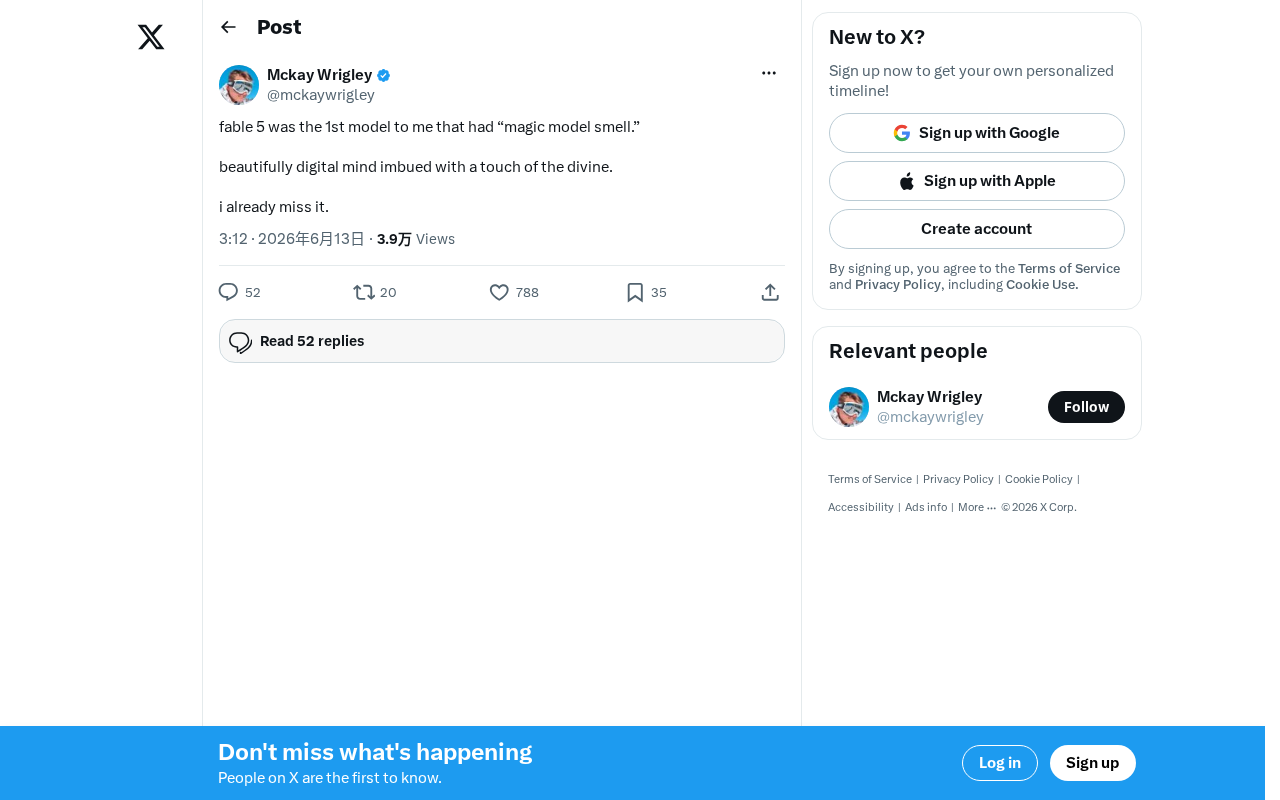
Fable 5: What It Means to Be the First AI Model with a 'Magic Model Smell'
Fable 5 is hailed as the first AI model with a "magic model smell." This article explores what that means and the industry shift from benchmarks to experience quality.