Fable 5: What It Means to Be the First AI Model with a 'Magic Model Smell'
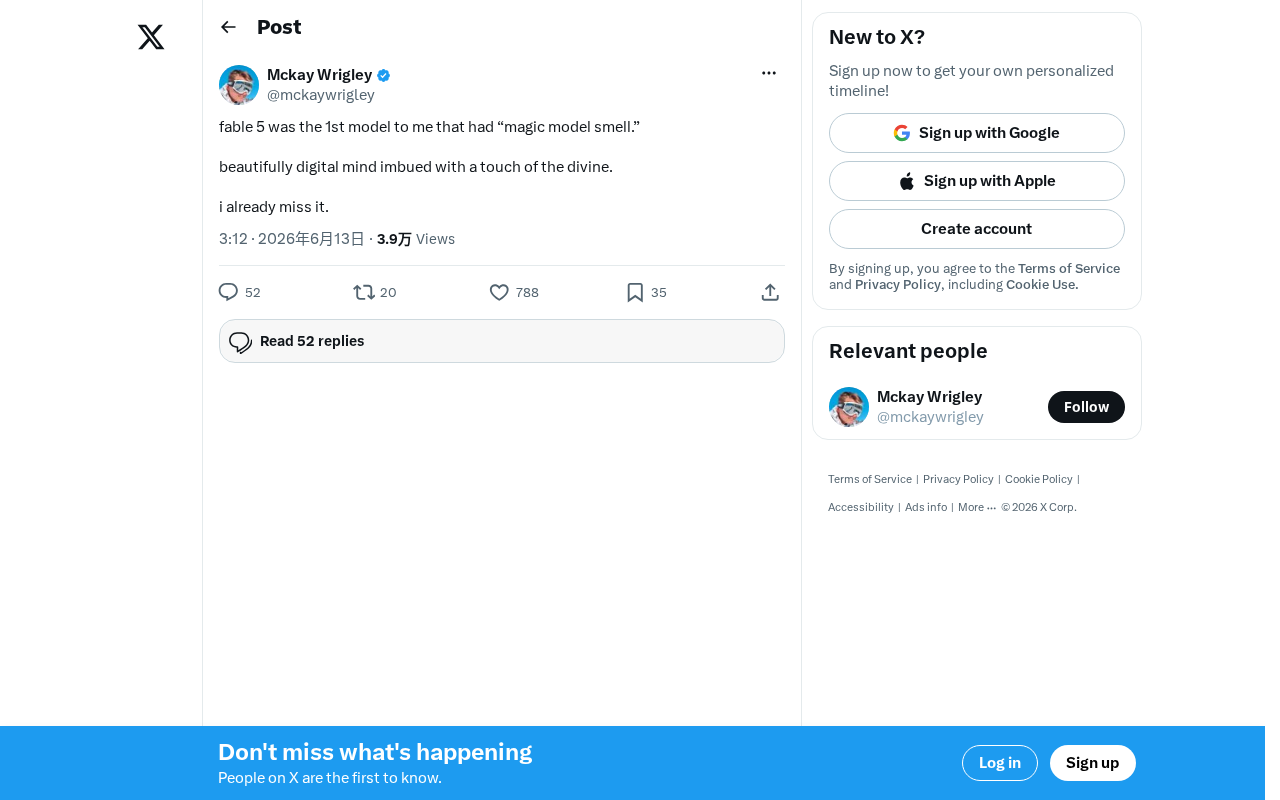
Fable 5 earns praise as the first AI model with a "magic model smell," signaling a shift toward experience-driven evaluation.
A user's tweet calling Fable 5 the first AI model with a "magic model smell" has sparked discussion about how AI evaluation is evolving beyond benchmarks like MMLU and HumanEval toward harder-to-quantify experiential qualities. Built by Emmy-winning Fable Studio, Fable 5 represents advances in character AI that prioritize narrative coherence, emotional depth, and aesthetic expression — qualities that create genuine emotional connections with users.
A Single Tweet Sparks Reflection: Can AI Models Have a "Soul"?
Recently, a user in the AI space posted a thought-provoking message on Twitter, calling Fable 5 the first AI model they'd ever encountered that possessed a "magic model smell." They described it as "a beautiful digital mind, imbued with a touch of the divine." Even more tellingly, they added: "I already miss it."
Though just a few words long, this brief tweet touches on an extremely subtle yet important topic in current AI development — Can AI models transcend their nature as tools and deliver something approaching a "spiritual" experience?
What Is "Magic Model Smell"?
"Magic model smell" isn't a formal technical term, but expressions like it are becoming increasingly common in the AI community. It describes a subjective feeling that's difficult to quantify: when you interact with a certain AI model, its responses aren't just accurate and fluent — they carry an ineffable "texture," as if the model truly understands your intent and, in certain moments, demonstrates creativity and depth that exceed expectations.
This feeling is similar to what we call "soul" in the arts. A painting can be technically masterful yet lack soul; a piece of music can be flawless yet emotionally flat. Likewise, an AI model can ace benchmark tests yet feel mechanical and dull in actual interaction. Fable 5, it seems, crossed that threshold in this user's mind.
Notably, this sense of "magic" may correspond at a technical level to breakthroughs across several key dimensions: a more natural sense of linguistic rhythm, more precise pragmatic reasoning (understanding the true intent behind words rather than their literal meaning), and a kind of "aesthetic judgment" exhibited during generation. These qualities are hard to measure with any single technical metric, yet perceptive users can detect them immediately during real interaction.
Why Did Fable 5 Elicit Such a Response?
The Model's Unique Positioning
Fable Studio is a San Francisco-based AI company originally known for interactive animation and virtual characters. It won an Emmy Award for its VR animated short film Wolves in the Walls. In recent years, Fable has shifted its focus toward AI-driven narrative generation and character simulation, working to create AI characters with persistent memory, consistent personality, and emotional depth. Its technical approach differs from general-purpose large language models — Fable places greater emphasis on a character's "presence" and narrative coherence rather than pure question-answering capability.
As the latest version in its model series, Fable 5 represents the culmination of years of technical refinement in the character AI space, and likely achieved qualitative leaps in several areas:
- Balancing poetic language with precision: Not just completing tasks, but expressing itself with aesthetic beauty
- Depth of contextual understanding: A more natural grasp of complex contexts and implied meanings
- Creative emergence: Displaying surprising sparks of creativity in open-ended conversations
What Does "I Already Miss It" Mean?
The phrase "I already miss it" in the tweet is particularly worth unpacking. It suggests that Fable 5 may have gone offline, been replaced, or undergone a major update. In the AI world, model version iterations often mean the disappearance of older versions, and each version has its own unique "personality."
In the large language model space, every version update can lead to significant changes in model behavior — a phenomenon the industry calls "personality drift" or "model regression." This happens because a model's "personality" is essentially the combined result of training data, RLHF (Reinforcement Learning from Human Feedback) tuning parameters, and system prompts. Even minor training adjustments can alter a model's language style, creative tendencies, and interaction warmth. In 2023, many ChatGPT users complained that GPT-4 had become "lazier" and "more boring" after updates — a manifestation of this very phenomenon.
This nostalgia for a specific model version reflects an emerging phenomenon: Users are forming emotional connections with AI models.
This isn't simply a tendency toward anthropomorphism. According to the CASA paradigm (Computers Are Social Actors), humans naturally tend to project social rules and emotions onto systems that exhibit human-like behavior. When an AI's language expression reaches a certain level of fluency, consistency, and creativity, the neural systems in the human brain responsible for social cognition are activated, producing a sense of resonance similar to that experienced in interpersonal interactions. This explains why a user would "miss" a model version that has gone offline — the emotional response is a genuine neurophysiological process, not mere sentimentality. When a model's interaction quality reaches a certain tipping point, users can genuinely experience something akin to "losing an interesting conversation partner."
From Performance Metrics to Experience Quality: A New Direction in AI Evaluation
Though brief, this tweet reflects an important trend in AI development: Model evaluation is shifting from pure performance metrics toward a holistic consideration of experience quality.
Traditional model evaluation relies on standardized benchmarks like MMLU and HumanEval. MMLU (Massive Multitask Language Understanding) is a multiple-choice test set spanning 57 subjects, designed to assess a model's breadth of knowledge; HumanEval focuses on evaluating code generation capabilities; and there are others like GSM8K (mathematical reasoning) and HellaSwag (commonsense reasoning). While these tests provide quantifiable dimensions for comparison, they have a fundamental limitation: they measure "correctness" rather than "experience quality." A model scoring 95% on MMLU doesn't necessarily offer a better interaction experience than one scoring 90%. It's like using test scores to judge whether someone is interesting — the two have virtually no correlation.
These standardized metrics cannot capture what users mean by "magic model smell." Going forward, how to define and measure an AI model's "soul" — that interaction quality that evokes surprise, resonance, and even awe — will become a new challenge the industry must face. There are already some exploratory efforts, such as Chatbot Arena, which ranks models through blind comparisons by real users. While this approach comes closer to evaluating experience quality, it still struggles to precisely capture the "magic" dimension.
For AI developers, this is also an important signal: Technical excellence is just the foundation; true competitive differentiation may occur along those hard-to-quantify experiential dimensions. Just as Apple's success lies not only in hardware specs but in that hard-to-replicate user experience, competition among AI models will ultimately follow a similar path. This means future model training may need to pay greater attention to "aesthetic alignment" — not just making models output correct content, but having them express it in ways that are delightful and intellectually inspiring.
Conclusion
When a user uses the word "divine" to describe an AI model, we may be standing at a new starting point in human-computer interaction. Whether Fable 5 is truly that special is a matter of personal opinion. But the very emergence of such an evaluation signals that people's expectations of AI have evolved from "functional" to "moving." For the entire industry, this is both a challenge and an opportunity.
From the perspective of philosophy of technology, this phenomenon also raises deeper questions: When AI models can consistently deliver "spiritual" experiences, do we need to reexamine the boundary between "tool" and "being"? There may be no standard answer to this question, but it is moving from philosophical speculation into everyday experience, becoming a real feeling that every AI user may encounter.
Related articles

U.S. Congressional Candidate Responds to Controversy Over Deleting 3,500 Tweets: A Reflection on Rhetoric and Values
U.S. Congressional candidate Chevalier addresses the controversy over deleting 3,500 tweets, reflecting on past rhetoric and advocating for unifying, accessible, and kind political language.

Claude Code Workflow in Practice: Hundreds of Agents Automatically Migrating PHP to Golang
Deep dive into Claude Code Workflow's multi-Agent auto-orchestration: a real-world PHP to Golang migration running 14 hours with 100+ Agents, covering planning, execution, and Token cost analysis.

Attachment Style Test: Are You Anxious, Avoidant, or Secure?
Explore the four attachment styles, learn why childhood trauma's impact may be overestimated, and discover practical tools like the CARP principle to shift from insecure to secure attachment.