Augment in Practice: Building an AI Recipe Generator from Scratch and Deploying to Cloudflare

Full-stack hands-on: building an AI recipe generator from scratch with Augment Code
Bilibili creator Kate demonstrates building a smart recipe generator using Augment Code as an AI coding assistant. The project uses a Next.js 15 + Cloudflare Workers stack with Gemini 2.0 Flash for recipe generation. The article highlights Augment's prompt enhancement and codebase context engine as core strengths, while revealing AI's knowledge lag on new SDK versions — a gap bridged by cross-verifying with GPT O3, forming an effective multi-AI tool collaborative development paradigm.
Project Overview: An AI-Powered Smart Recipe Generator
Bilibili creator Kate shared a complete full-stack development case study — using Augment Code as an AI coding assistant to build a smart recipe generator from scratch and deploy it to Cloudflare Workers. The project features a cutting-edge tech stack: Next.js 15 + Tailwind CSS v4.1 + OpenNext + Cloudflare Workers, with the backend calling Google Gemini 2.0 Flash to generate recipe content.
Users simply input ingredients (e.g., "belt fish, eel"), select flavor preferences, difficulty level, and cuisine type, and the system generates a complete recipe including an ingredient list, preparation steps, nutritional information, and tips — even creating innovative dishes like "Spicy Pineapple Chicken Feet."
Augment's Core Strengths: Prompt Enhancement and Codebase Understanding
Prompt Enhancement
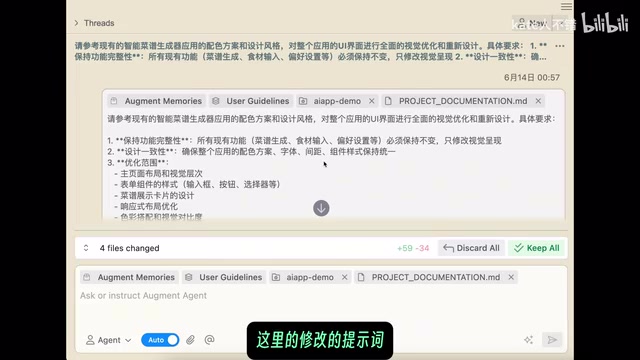
Throughout the development process, Kate was most impressed by Augment's prompt enhancement feature. There's a star icon in the bottom-right corner of the editor — clicking it causes Augment to automatically enhance the user's input prompt. This feature delivers value on three levels:
- Reduced input effort: Automatically extracts relevant context, eliminating the need to manually copy and paste code
- Intelligent association detection: Leverages codebase understanding to automatically include contextual information about related files, functions, and patterns
- Exposing comprehension gaps: Shows users how the model interprets their prompt, making it easy to correct misunderstandings early
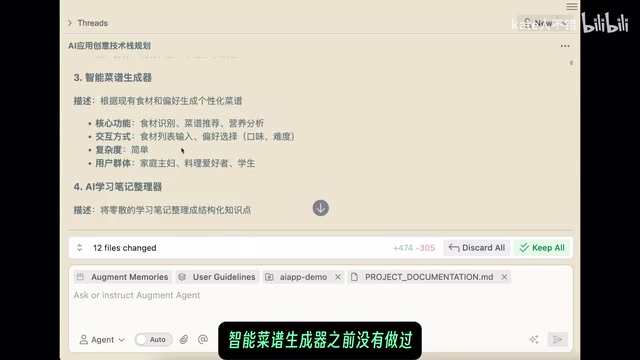
For example, when asked to modify the UI, Augment automatically refined the prompt into multiple dimensions such as "maintain functional integrity, ensure consistency in settings, optimize main page layout and visual hierarchy, form component styling, recipe display card design, and color coordination" — far more precise than the user's original input.
Codebase Context Engine
Augment's other killer feature is its context engine. When modifying code, it frequently invokes this engine to pinpoint exactly where changes need to be made — fast and accurate. Kate specifically noted that throughout the entire development process, she rarely encountered the cascading problem of "fixing one thing breaks another."
While Augment may not be as fast as Cursor on individual tasks, its modification accuracy is higher — given a requirement that involves changes across multiple locations, you rarely need to go back and forth on the same issue. In Kate's words: "It might take longer on a single task, but the result is that it actually gets things done right."
Key Challenges and Solutions During Development
Knowledge Lag on New SDK Versions
The development process exposed a classic weakness of AI coding assistants: knowledge lag on the latest tech stack versions. During technical research, Augment searched for outdated information and incorrectly believed the latest Gemini SDK was still the old generative-ai package. It also claimed there were compatibility issues between Shadcn UI and Tailwind v4.
Kate's solution was clever:
- Specify the current date in Augment's settings to avoid retrieving outdated information
- Bring in GPT O3 as a search verification tool to cross-check the accuracy of technical information
O3 helped her confirm that the latest Gemini SDK is @google/genai v1.5, and pointed out that the Shadcn UI and Tailwind v4 compatibility issue was "half-outdated information" — newer versions had already resolved it. Once this accurate information was fed back to Augment, development proceeded smoothly.
Debugging Hydration Errors
Next.js 15 hydration issues were another major roadblock. Interestingly, O3 discovered an unexpected cause during debugging — browser extensions like "Super Copy" can trigger hydration errors. Kate confirmed she had indeed installed such an extension, and the problem disappeared after disabling it. This case illustrates that sometimes the root cause of a bug isn't in the code itself.
Security Auditing and Iterative Optimization
Augment also took on the role of security auditor. The initial audit uncovered several serious issues: API keys stored directly in the .env.local file, overly permissive CORS configuration, and more — resulting in a security score of only 7.5.
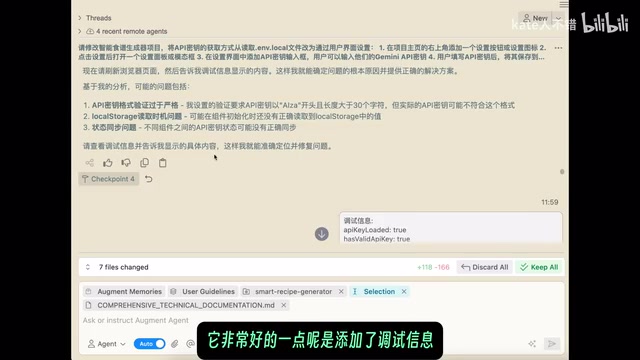
Kate had Augment change the API key retrieval method to a user interface setting that saves to the browser's localStorage, and fixed other security issues. After multiple rounds of optimization, the security score improved from 7.5 to 9.2, ultimately reaching 9.5 after production deployment.
The Multi-Tool Collaborative Development Paradigm
The most valuable takeaway from this project isn't about any single tool, but rather the demonstration of a multi-AI tool collaborative development paradigm:
| Tool | Role | Strengths |
|---|---|---|
| Augment | Primary coding assistant | Codebase understanding, prompt enhancement, documentation generation |
| GPT O3 | Search verification tool | Latest tech information retrieval, problem diagnosis |
| Gemini 2.0 Flash | Business API | Recipe content generation |
Kate repeatedly emphasized that "human involvement is crucial" — you need to constantly monitor what the AI has modified and make correct decisions at critical junctures (such as SDK version selection and security configuration). AI coding assistants aren't omnipotent, but leveraging the complementary strengths of different tools can significantly boost development efficiency.
Deployment and Documentation: Augment's Added Value
It's worth noting that Augment excels at documentation generation. Throughout the project, it automatically generated over a dozen Markdown documents, including:
- Complete technical documentation (with Mermaid visualization diagrams)
- Project architecture diagrams and data flow charts
- API call sequence diagrams
- Developer quick-start guides
- Deployment success reports and health check scripts
During deployment, Augment handled the entire workflow of OpenNext configuration, Cloudflare Workers configuration, compatibility adjustments, and test verification, and created monitoring scripts to verify production environment status.
Takeaways and Recommendations
This hands-on case study offers several important insights for the AI coding space: First, Augment's codebase understanding capability is genuinely a differentiating advantage, making it especially well-suited for complex projects requiring cross-file modifications. Second, when working with cutting-edge tech stacks, a single AI tool's information may be outdated — introducing search tools like O3 for cross-verification is a wise move. Finally, the efficiency gains from AI coding don't come from going fully hands-off, but from finding the optimal division of labor in human-AI collaboration.
Related articles
 Tutorials
Cursor + Codex Dual-IDE Collaboration: A Practical Methodology for Open-Source Project Customization
A complete methodology for open-source project customization based on real-world experience, detailing the Cursor+Codex dual-IDE workflow, seven-stage process, MVP validation, and AI source code reading techniques.
 Tutorials
Cursor Multi-Agent in Practice: Building a Full-Stack Next.js Blog in 50 Minutes
Build a full-stack blog in 50 minutes using Cursor IDE's multi-Agent mode with Next.js, Clerk auth, and Supabase. Learn the 4-phase AI Agent workflow and key integration pitfalls.
 Tutorials
Building an AI Software Factory from Scratch: A Cursor Engineer's Hands-On Experience with Multi-Agent Collaboration
Cursor engineer Eric shares practical insights on building an AI software factory: automation levels, guardrail design, parallel Agent management, and scaling to 1000+ Agents for 24/7 development.