Beginner's Guide to Agent Skills: Core Components and Customization Methods Explained
A comprehensive guide to understanding, building, and applying Agent Skills for AI development.
This guide explains Agent Skills — modular capability units for AI Agents — covering their four core components (skill.md, references, scripts, assets), how they differ from simple prompts, and practical customization methods. With real-world examples, it shows developers how to build reusable, composable AI skill modules that elevate Agents from general conversation to professional task execution.
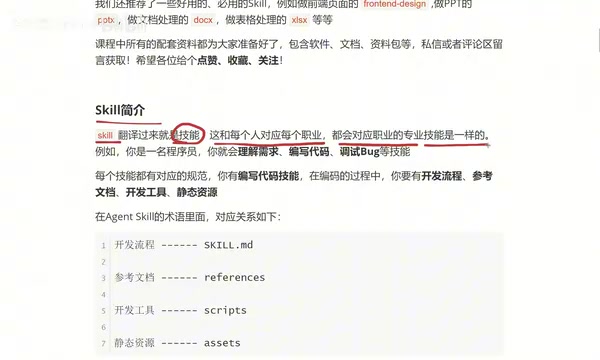
What Is an Agent Skill?
With the explosive popularity of AI coding tools like Claude Code, Open Cloud, and Hermes Agent, a core concept keeps appearing in developers' field of vision — Skill. It's becoming an indispensable part of the Agent ecosystem, yet many people still have only a surface-level understanding of it.
It's worth providing some background on these tools first. Claude Code is Anthropic's command-line AI coding assistant that can understand codebases, perform edits, and run commands directly in the terminal. Hermes Agent is a recently emerging open-source Agent framework that emphasizes organizing AI capabilities in a modular way through Skills. The common trend across these tools is: AI Agents are shifting from "general-purpose conversation" to "specialized skill execution." Early AI Agents primarily relied on the ReAct (Reasoning + Acting) paradigm — having large models alternate between reasoning and action in a loop to complete tasks. But as application scenarios grew more complex, developers realized that general reasoning ability alone was far from sufficient. Agents needed to be equipped with structured, reusable professional capability modules — and that's the fundamental reason the Skill concept emerged.
Skill is straightforward to understand. Just as different people possess different professional skills depending on their occupation — students write essays, solve math problems, and do English homework; programmers understand requirements, write code, and debug — the essence of an Agent Skill is the various professional capabilities given to an AI Agent.
Equip an Agent with different Skills, and it can handle different tasks — creating posters, writing code, processing documents, generating presentations — each one an independent skill module.
The Four Core Components of a Skill
Now that we understand what a Skill is, the key question is: what exactly does a Skill contain internally?
Take a programmer's "writing code" skill as an example. To truly complete a project, you need four things:
- Development workflow: What to do first, what to do next, and how different parts relate to each other
- Reference documentation: API docs, requirements docs, and other coding references
- Development tools: Java developers use IntelliJ IDEA; frontend/Python developers use VS Code
- Static resources: Images, audio, video, and other assets used in web pages
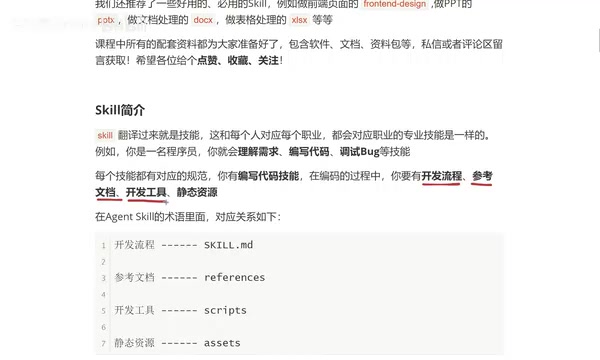
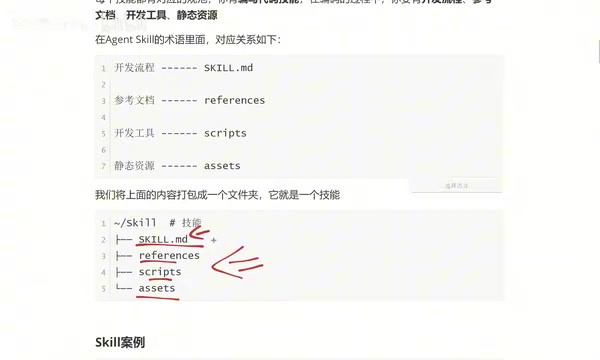
In the Agent Skill terminology, these four elements have precise counterparts:
| Human Skill Element | Skill Counterpart | Description |
|---|---|---|
| Development workflow | skill.md | Core instruction file describing the skill's execution logic |
| Reference documentation | references/ | Folder for reference materials |
| Development tools | scripts/ | Folder for script tools |
| Static resources | assets/ | Folder for images, audio, and other static resources |
Bundle these four files and folders into a single folder, and you have a complete Skill.
Which Files Are Required?
Here's an important detail: not all files and folders are required. Of the four components, only skill.md is mandatory. The other three (references, scripts, assets) are added based on actual needs. Some Skills may not need any of them, while others may require all three.
This flexible structural design means a Skill can be very lightweight (just a single skill.md) or very complex (with complete reference documentation, automation scripts, and static resources). This design philosophy aligns with the software engineering principle of "Convention over Configuration" — through agreed-upon folder naming and structure, Agent frameworks can automatically identify and load each component of a Skill without developers needing to write additional configuration files.
A Skill Case Study
Let's look at a concrete example — a Skill for generating brand material design ideas for a restaurant. The entire case is written in the skill.md file and consists of two main parts:
Meta Information
At the top of skill.md is the meta information section, containing two key fields:
- Name: The name of the current Skill
- Description: What this Skill specifically does
For example: "Generate brand-aligned material design ideas for iPhone Restaurant. When a user says they want to create a certain type of material (such as a poster, packaging box, etc.), output the design concept for that material."
Meta information isn't just descriptive text for humans. In actual Agent systems, when an Agent has multiple Skills mounted, the Agent's dispatch layer (typically called a Router or Orchestrator) performs semantic matching between the user's input intent and each Skill's name and description to determine which Skill to invoke for the current request. This means the quality of the description directly affects the probability of a Skill being correctly triggered — the more precise the description, the more accurate the Agent's intent recognition. This mechanism is very similar to how function descriptions work in OpenAI Function Calling.
Instructions Section
Below the meta information is the detailed instructions section, which is the core of the entire Skill. It's like the natural language instructions we normally send when chatting with a large model, but more structured and systematic.
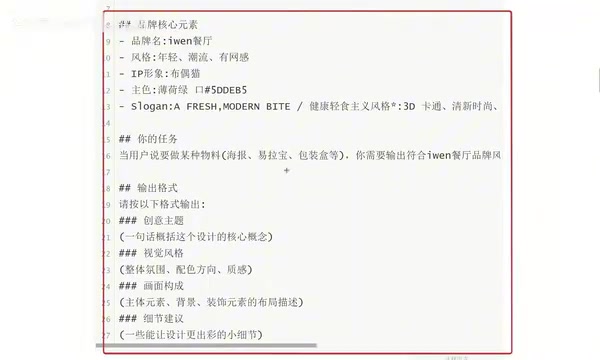
Using this restaurant Skill as an example, the instructions section includes:
- Brand core elements: Brand name, style, IP mascot, primary colors, slogan
- Task trigger conditions: When a user says "create a certain type of material," output the corresponding material in the brand's style
- Output format specifications:
- What the theme concept looks like
- What the visual style looks like
- What the composition looks like
- What the detail suggestions look like
The more detailed the description, the more closely the AI-generated content matches expectations.
From a Prompt Engineering perspective, the instructions in skill.md are essentially a persisted System Prompt. In regular large model conversations, the System Prompt is a hidden instruction injected at the beginning of each session to set the AI's role, behavioral boundaries, and output format. skill.md takes this practice further into engineering: it solidifies prompts that were previously scattered across conversations into files, making them amenable to version control (e.g., Git management), team collaboration, and cross-project reuse. Additionally, the structured writing commonly seen in skill.md — such as using Markdown headings for hierarchy, lists for enumerating constraints, and tables for defining output formats — represents best practices in Structured Prompting. Research shows that this approach significantly improves large models' instruction-following rates compared to pure natural language descriptions.
The Essential Difference Between Skills and Prompts
At this point, many people will have a question: isn't an Agent Skill just a prompt?
Indeed, the content in skill.md looks very similar to a carefully crafted prompt. But a Skill's capabilities far exceed those of a simple prompt, for the following reasons:
- Structured extension: A Skill isn't limited to skill.md — it can also include references (documentation), scripts (automation scripts), and assets (static resources), forming a complete capability loop
- Reusability: A single Skill can be called repeatedly by different Agents, whereas prompts are often one-time use
- Modular composition: Multiple Skills can be combined, giving an Agent multiple professional capabilities simultaneously
- Toolchain integration: Through the scripts folder, Skills can invoke external tools and scripts, breaking through the limitations of pure text prompts
Among these, toolchain integration deserves deeper exploration. The scripts in the scripts folder are essentially the Agent's "hands and feet" — they allow AI to go beyond generating text and actually execute operations. The underlying technical mechanism is Function Calling (also known as Tool Use) in the large model domain. When a large model determines during reasoning that it needs to call an external tool, it generates a structured function call request (containing the function name and parameters). The Agent framework captures this request, executes the corresponding script, and returns the results to the large model to continue reasoning. For example, a "frontend page development" Skill's scripts folder might contain lint.sh (code linting script), build.sh (build script), and deploy.sh (deployment script). After generating code, the Agent can automatically invoke these scripts to complete the entire workflow of linting, building, and deploying — something pure prompts simply cannot achieve.
The modular composition capability points to an even grander architectural vision — Multi-Agent collaboration. In complex business scenarios, a single Agent often can't handle all tasks. By assigning different Skills to different specialized Agents (such as a design Agent, coding Agent, and testing Agent), and having an Orchestrator coordinate their collaboration, you can build AI workflows resembling human team divisions of labor. Each Skill in this architecture serves as an atomic capability unit — the clearer its boundaries and the more singular its responsibility, the better the maintainability and scalability of the entire multi-Agent system. This is why Skill design emphasizes the principle of "one Skill does one thing."
Put simply, a prompt is a sentence; a Skill is a complete solution.
Practical Application Scenarios for Agent Skills
Once you've mastered how to write Skills, you can customize all kinds of practical AI skill modules:
- Promotional poster generation: Input a simple description (e.g., "Wellington steak for only $38, first come first served"), and automatically generate poster concepts aligned with brand style, positioning, target audience, and other dimensions
- Frontend page development: Quickly generate page code that conforms to design specifications
- Presentation creation: Automatically generate slide decks based on content
- Document processing: Batch process and format various types of documents
- Spreadsheet handling: Automate data organization and analysis
These are all proven effective Skill application areas, each capable of significantly boosting work efficiency.
It's worth noting that the value of Skills extends beyond individual use — it lies in their ecosystem potential for sharing and reuse. Similar to npm for JavaScript and pip for Python, Skills inherently have the DNA to become an "AI capability package manager." High-quality Skills written by senior developers on a team can be reused by the entire team or even the entire community. Enterprises can establish internal Skill repositories to codify best practices into standardized skill modules. Currently, some Agent platforms have begun building Skill marketplaces (similar to browser extension stores), where users can install Skills published by others with one click to extend their Agent's capabilities. This ecosystem-oriented development direction means that in the future, an AI Agent's capability boundaries will no longer depend on an individual developer's prompt-writing skills, but on the collective wisdom of the entire community.
Summary
The learning path for Agent Skills can be summarized in three steps: Understand Skills → Customize Skills → Apply Skills.
The key takeaway is: a Skill is essentially a folder structure containing skill.md (required) along with references, scripts, and assets (optional). It elevates AI capabilities from "chat conversation" to "professional skill execution."
For developers looking to dive deep into AI Agent development, mastering Skill writing and customization is an indispensable core competency. Start with a simple skill.md, gradually add reference documentation, script tools, and static resources, and you can build powerful AI skill modules. As the Agent ecosystem matures, Skill writing ability will likely become one of the most important core competencies for AI application developers — right after Prompt Engineering.
Key Takeaways
Related articles
Klue Hacked: Data Breach Exposes Huntress, HackerOne, and Other Major Security Companies
Market research firm Klue was hacked, exposing data from Huntress, HackerOne, Jamf, Recorded Future, and Tanium. Analysis of supply chain attack risks and third-party risk management strategies.
GPT-5 SWE-bench Evaluation: GPT-5-mini Crushes the Competition on Cost-Effectiveness vs Claude Sonnet 4
mini-SWE-agent's GPT-5 series evaluation on SWE-bench shows GPT-5 matches Claude Sonnet 4, while GPT-5-mini loses only ~5 points at less than 1/5 the cost.
DAQIRI Platform Explained: Deep Integration of High-Speed Data Acquisition and Real-Time AI Inference
Deep dive into how the DAQIRI platform embeds NVIDIA GPU-accelerated computing into high-speed data acquisition pipelines, enabling real-time AI inference for industrial inspection, scientific experiments, and autonomous driving.