Beginner's Guide to AI Large Language Models: GPU Requirements & Core Tech Stack Explained
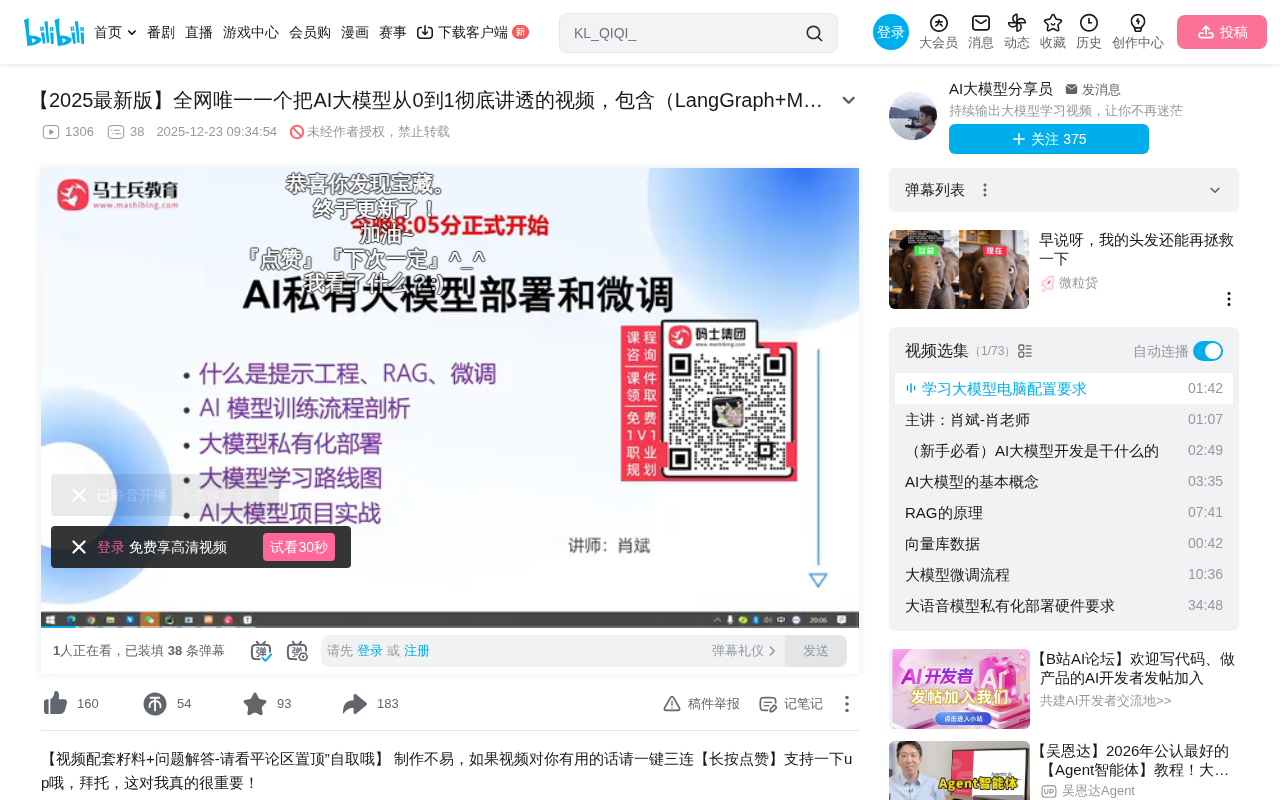
2025 guide to AI LLM local deployment hardware requirements and core tech stack learning path
This article provides a complete beginner's guide to AI LLMs from both hardware and technology perspectives. On hardware, VRAM is the core bottleneck—the RTX 4090 (24GB VRAM) offers the best consumer-grade value, with cloud GPUs as a budget alternative. On technology, learners should progressively master five core areas: Prompt Engineering, AI Agents, MCP Protocol, LangGraph framework, and WorkFlow orchestration, following a six-phase structured learning path.
Introduction
In 2025, AI large language model (LLM) technology has moved from research labs into everyday use. More and more developers and tech enthusiasts want to deploy and run LLMs locally, but the first obstacle is often not the code—it's the hardware, especially the GPU and VRAM.
This article starts with hardware configuration and combines it with the core AI LLM tech stack (LangGraph, MCP, Agent, WorkFlow, Prompt Engineering) to lay out a complete learning path from scratch.
Can Your GPU Handle Running LLMs Locally?
VRAM Is the Core Bottleneck
Running AI large models demands extremely high VRAM (Video RAM), a problem many beginners tend to underestimate. Most personal computer GPUs currently have between 8GB and 12GB of VRAM, which is far from sufficient for running mainstream large models.
Here's what different VRAM capacities can handle:
| VRAM Capacity | Runnable Models | Experience Rating |
|---|---|---|
| 8GB | 3B-7B quantized models | Barely usable, slow inference |
| 12GB | 7B quantized models | Reasonably smooth |
| 24GB (RTX 4090) | Models under 10B | Essentially no pressure |
| 36GB and above | 10B+ level models | Comfortable operation |
Parameter count (B = Billion) is the key metric for measuring model scale. The larger the model, the stronger its theoretical capabilities—but hardware requirements grow exponentially.
The Most Economical AI GPU Solution in 2025
If you're serious about getting into AI LLM development, the most recommended consumer-grade GPU remains the NVIDIA RTX 4090, with 24GB of GDDR6X VRAM. It's the best value option available to individual developers.
RTX 4090 price reference:
- Official MSRP is approximately ¥13,000 CNY (~$1,800 USD)
- Actual market prices generally range from ¥16,000-18,000 (~$2,200-2,500 USD)
- The China-specific 4090D version is slightly cheaper, about ¥1,000-2,000 less
- Due to supply and demand dynamics, prices still trend upward
Budget-friendly alternatives:
For learners on a tight budget, there's no need to rush into buying an expensive GPU. You can use cloud GPU services (such as AutoDL, Hengyuan Cloud, etc.) to rent compute by the hour, or leverage free platforms like Google Colab for initial learning. Consider hardware investment only after you've determined your direction.
Core AI LLM Tech Stack Breakdown
Hardware is just the foundation. What truly determines how far you can go is your understanding and mastery of core technologies. In 2025, there are five key technical directions in the AI LLM space worth focusing on.
Prompt Engineering
Prompt engineering is the fundamental skill for interacting with large models—it has the lowest barrier to entry but an extremely high ceiling. Good prompts can make the same model produce dramatically different output quality.
Core techniques include:
- Role assignment: Give the model a professional identity, such as "You are a senior Python developer"
- Few-shot learning: Provide 2-3 examples to guide output format
- Chain of Thought (CoT): Guide the model to reason step by step rather than jumping to answers
- Structured output: Explicitly require output formats (JSON, Markdown, etc.)
Prompt engineering is the cornerstone of all subsequent technologies. Whether you're building Agents or WorkFlows, everything ultimately comes back to the question of how to communicate efficiently with the model.
Agents: Letting AI Autonomously Complete Tasks
Agent is one of the hottest AI concepts of 2024-2025. Simply put, an Agent is an AI system capable of autonomously planning, making decisions, and executing tasks. It's no longer just "you ask, I answer"—it can proactively invoke tools, access external data, and complete complex multi-step tasks.
A typical Agent architecture contains four core components:
- LLM core: Responsible for understanding, reasoning, and decision-making
- Tools: Search engines, code executors, database queries, etc.
- Memory system: Short-term conversation memory and long-term knowledge storage
- Planning module: Breaks complex tasks into executable sub-steps
For example: You ask an Agent to "analyze competitors' pricing strategies over the past month," and it will automatically decompose this into searching for competitor information, scraping price data, organizing comparison tables, and generating analysis reports—completing each step sequentially.
MCP Protocol: The USB Port of the AI World
MCP (Model Context Protocol) is an open standard proposed by Anthropic, designed to solve the connection problem between large models and external tools and data sources. Think of MCP as the "USB port" of the AI world—it provides a standardized protocol that allows any large model to invoke external services in a unified way.
The core value of MCP lies in:
- Standardizing tool invocation interfaces, reducing integration costs
- Supporting seamless access to multiple data sources (databases, APIs, file systems, etc.)
- Dramatically expanding the capability boundaries of Agents
- Enabling different models and frameworks to share the same tool ecosystem
For developers, mastering MCP means the tools you build can be invoked by any AI system that supports the protocol, greatly improving development efficiency and reusability.
LangGraph: A Powerful Tool for Building Complex AI Workflows
LangGraph is a framework from the LangChain team, specifically designed for building stateful, multi-step AI applications. If a single conversation is a "point," then LangGraph helps you connect these points into a "graph."
Its core features include:
- State management: Maintaining context information across multiple interaction rounds
- Conditional branching: Dynamically selecting execution paths based on model output
- Loop control: Supporting retry logic, human review, and other cyclic patterns
- Multi-Agent collaboration: Enabling multiple Agents to work together within the same workflow
LangGraph is particularly suited for building complex application scenarios that require human-AI collaboration and multi-round decision-making, such as customer service systems, content moderation pipelines, and automated data analysis workflows.
WorkFlow Orchestration
WorkFlow is the "glue" that ties all the above technologies together. In real enterprise-level AI applications, few scenarios can be solved with a single simple model call. More commonly, there's a complete processing pipeline:
User input → Intent recognition → Information retrieval → Model inference → Result validation → Formatted output
The keys to workflow orchestration are:
- Properly decomposing task nodes, with each node having a single responsibility
- Designing clear data flow logic
- Adding exception handling and fallback mechanisms
- Balancing effectiveness and cost (not every step needs the most powerful model)
Recommended AI LLM Learning Path
For developers who want to systematically learn AI LLM technology, here's a suggested progressive approach:
Phase 1: Foundational Understanding (1-2 weeks)
Understand the basic principles of large models, the relationship between parameter count and VRAM, and the difference between inference and training. Read technical blogs and official documentation from major model providers.
Phase 2: Prompt Engineering (2-4 weeks)
Master methods for efficient model interaction—this is the skill with the highest ROI. Practice extensively and compare the effects of different prompts.
Phase 3: API Calls & Application Development (2-4 weeks)
Learn to call mainstream LLMs via API (OpenAI, Claude, domestic models, etc.) and build simple conversational applications and text processing tools.
Phase 4: Agent Development (4-6 weeks)
Understand Agent architecture, learn to use frameworks like LangChain/LangGraph, and build intelligent agents capable of invoking tools and making autonomous decisions.
Phase 5: MCP & Tool Integration (2-3 weeks)
Master standardized tool invocation protocols and connect Agents to various external data sources and services.
Phase 6: WorkFlow Orchestration (Ongoing Practice)
Integrate all technologies to build enterprise-level AI applications. This phase requires continuous refinement through real projects.
Conclusion
AI LLM technology is evolving at an unprecedented pace. From a hardware perspective, a single RTX 4090 GPU (24GB VRAM) can run models under 10B locally. From a technology perspective, Prompt Engineering, Agents, MCP, LangGraph, and WorkFlow form a complete development tech stack.
The key isn't mastering everything at once—it's establishing the right learning path and deepening your knowledge progressively. In 2025, market demand for AI developers will only continue to grow. Now is the perfect time to start learning.
Related articles
 Tutorials
Cursor + Codex Dual-IDE Collaboration: A Practical Methodology for Open-Source Project Customization
A complete methodology for open-source project customization based on real-world experience, detailing the Cursor+Codex dual-IDE workflow, seven-stage process, MVP validation, and AI source code reading techniques.
 Tutorials
Cursor Multi-Agent in Practice: Building a Full-Stack Next.js Blog in 50 Minutes
Build a full-stack blog in 50 minutes using Cursor IDE's multi-Agent mode with Next.js, Clerk auth, and Supabase. Learn the 4-phase AI Agent workflow and key integration pitfalls.
 Tutorials
Building an AI Software Factory from Scratch: A Cursor Engineer's Hands-On Experience with Multi-Agent Collaboration
Cursor engineer Eric shares practical insights on building an AI software factory: automation levels, guardrail design, parallel Agent management, and scaling to 1000+ Agents for 24/7 development.