Build AI Agents from Scratch: A Practical Guide to the Coze Platform
Build AI Agents from Scratch: A Practi…
Low-code platforms now let anyone build AI agents with zero programming skills
This article introduces the book *Building AI Agents with Coze*, which leverages ByteDance's Coze platform to help complete beginners build AI agents through 10 hands-on projects with visual, template-based guides. Ideal for content creators, HR professionals, salespeople, and operations staff, it enables automated emails, poster creation, and more — though AI agents currently work best for structured, rule-based tasks.
The Era Where Anyone Can Have an AI Assistant Has Arrived
Not long ago, building an AI agent meant you needed to master API calls, write code, and understand complex technical architectures. But with the rise of low-code/no-code AI platforms, this technical barrier is being rapidly leveled. ByteDance's "Coze" platform is a prime example of this trend — it enables people with zero programming knowledge to build AI agents that can actually get work done in a short amount of time.
Recently, a practical guide titled Building AI Agents with Coze has attracted considerable attention. Its core value proposition is clear: No API knowledge required, no coding skills needed — complete beginners can get started quickly.

What Does This Book Actually Teach?
A Complete Path from Basic Concepts to Hands-On Projects
The book's content follows a clear learning curve: starting from basic prompt writing, moving to workflow template usage, and gradually transitioning to detailed methods, operational procedures, and real-world cases. The book features 10 hands-on projects, all presented with step-by-step visual guides that walk readers through the entire agent-building process.

This "follow along and it works" design philosophy is genuinely user-friendly for those without technical backgrounds. The application scenarios covered include:
- Integrating large models like DeepSeek into WeChat and Feishu (Lark) for AI-assisted daily communication
- Automated email sending to reduce repetitive communication tasks
- Automated poster and PPT creation to boost content production efficiency
- Other customizable intelligent assistant scenarios
Core Philosophy: Template-Based Design — Just Tweak and Deploy
A key design principle of this book is template-based reusability. Readers don't need to architect an agent from scratch. Instead, they can take the ready-made examples provided in the book, make minor adjustments based on their actual needs, and create their own personalized AI assistant.

This approach lowers two critical barriers: first, the cognitive barrier — you don't need to understand the technical principles behind agents; second, the operational barrier — you don't need any programming skills, just the ability to use basic office software.
Who Needs AI Agents the Most?
Professionals Bogged Down by Repetitive Work
The book clearly identifies several ideal target users: content creators, HR professionals, salespeople, operations staff, teachers, and product managers. These roles share a common trait — their daily work involves massive amounts of repetitive tasks and information processing.

Here are some specific application scenarios:
- Content creators can use agents to assist with topic selection, generate first drafts, and batch-produce social media graphics
- HR professionals can use agents to screen resumes and auto-reply to candidates' common questions
- Salespeople can use agents to organize client information and generate follow-up emails
- Operations staff can use agents to monitor data and generate daily/weekly reports
The common thread across these scenarios: the tasks themselves aren't complex, but they consume enormous amounts of time. The value of AI agents lies precisely in freeing people from this low-creativity work.
A Realistic Perspective: The Capability Boundaries of AI Agents
While the claim of "building an AI agent in minutes" is certainly appealing, we need to stay rational. Agents built on platforms like Coze are currently best suited for tasks that are structured, rule-based, and have a relatively high tolerance for errors. For work requiring deep judgment, complex reasoning, or high personalization, AI agents remain assistive tools rather than replacements.
A more accurate statement would be: AI agents can significantly boost work efficiency, letting you spend your time on more valuable activities.
Conclusion: An Ideal Starting Point for Low-Code AI Agents
For everyday users who want to try AI agents but are held back by technical barriers, Building AI Agents with Coze offers a relatively smooth entry path. Ten hands-on projects, full visual guides, and template-based design — these features genuinely lower the barrier to getting started.
However, the real value isn't in the "building" itself, but in whether you can identify the parts of your work that are truly suitable for AI to take over. The tools are ready — what matters is how deeply you understand your own workflows. As AI capabilities rapidly become mainstream, the efficiency gap between those who know how to leverage AI and those who don't will only continue to widen.
Related articles
 Tutorials
Cursor + Codex Dual-IDE Collaboration: A Practical Methodology for Open-Source Project Customization
A complete methodology for open-source project customization based on real-world experience, detailing the Cursor+Codex dual-IDE workflow, seven-stage process, MVP validation, and AI source code reading techniques.
 Tutorials
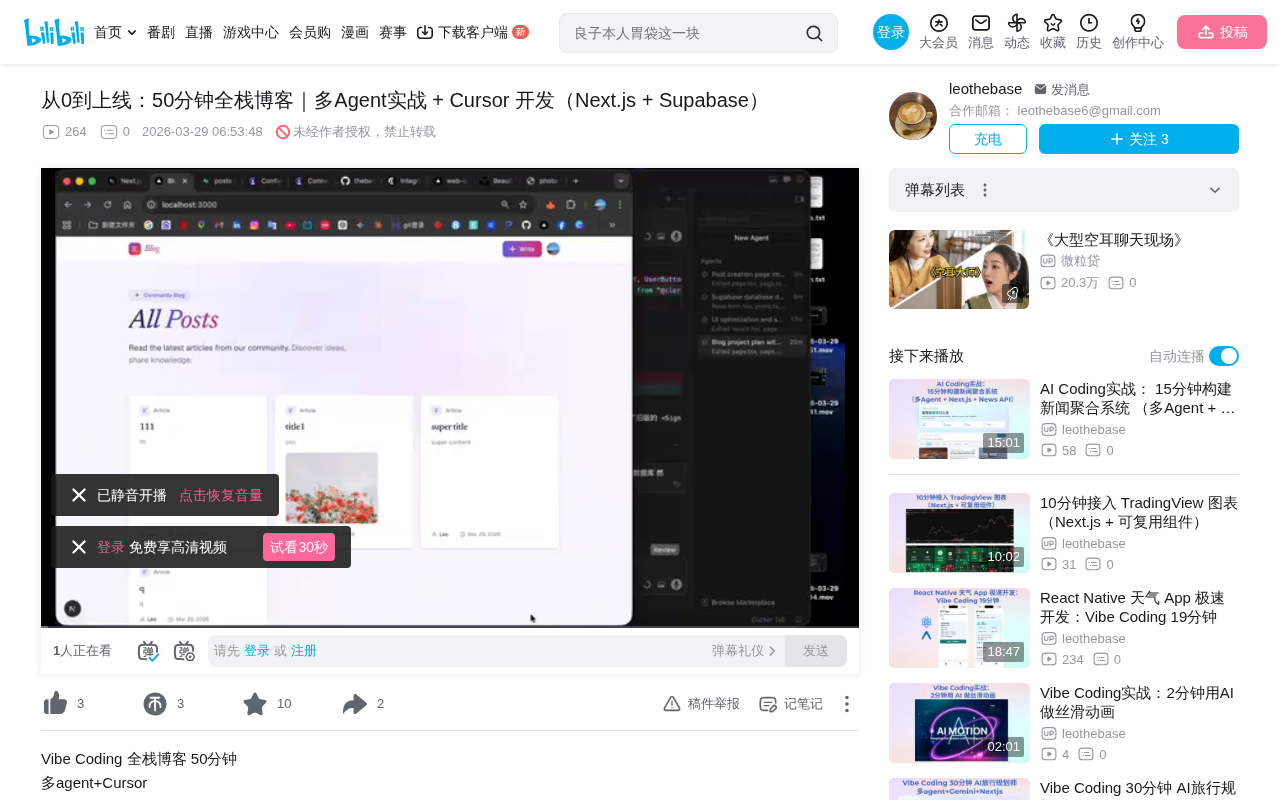
Cursor Multi-Agent in Practice: Building a Full-Stack Next.js Blog in 50 Minutes
Build a full-stack blog in 50 minutes using Cursor IDE's multi-Agent mode with Next.js, Clerk auth, and Supabase. Learn the 4-phase AI Agent workflow and key integration pitfalls.
 Tutorials
Building an AI Software Factory from Scratch: A Cursor Engineer's Hands-On Experience with Multi-Agent Collaboration
Cursor engineer Eric shares practical insights on building an AI software factory: automation levels, guardrail design, parallel Agent management, and scaling to 1000+ Agents for 24/7 development.