Build an AI Agent with One Sentence Using Coze Programming: Complete WeChat Monetization Workflow Breakdown

Complete workflow for building AI agents with Coze and monetizing them via WeChat Mini Programs
This article covers the complete four-step process for users with zero programming experience to generate AI agents using Coze Programming with a single sentence, deploy them to the WeChat ecosystem via the Xiaowei AI Agent Mini Program, implement monetization through a built-in freemium payment model, and leverage multi-channel promotion strategies to drive traffic — achieving a full closed loop from AI capability to commercial monetization.
Introduction
For many creators looking to monetize with AI, the biggest pain point isn't "I can't build an agent" — it's "I built one but don't know how to monetize it." Coze Programming offers the ability to generate an AI agent with a single sentence, and when combined with the "Xiaowei AI Agent" WeChat Mini Program, you can quickly deploy AI agents into the WeChat ecosystem and achieve a complete commercial loop through paid settings.
This article breaks down the complete four-step process from building an agent to WeChat monetization, helping users with zero programming experience get started quickly.
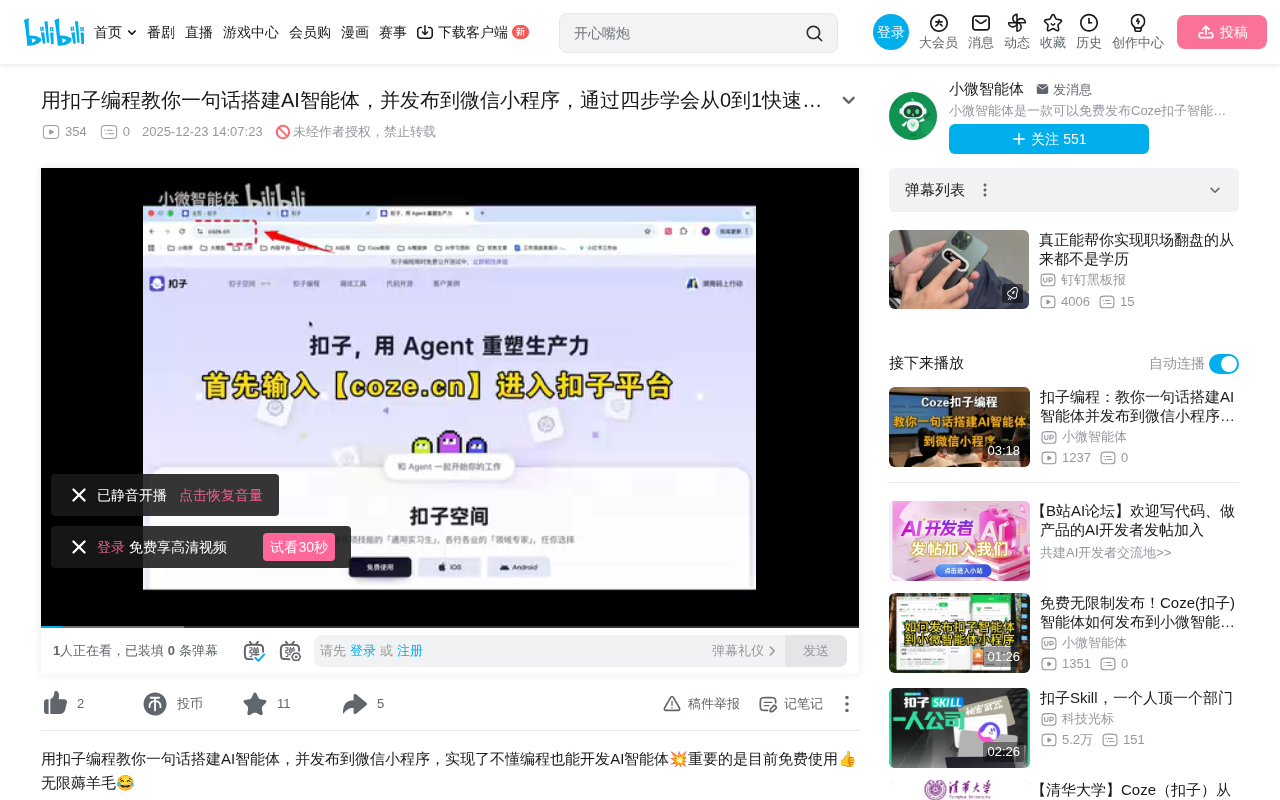
Step 1: Build an AI Agent with One Sentence Using Coze Programming
Platform Background
Coze is an AI application development platform launched by ByteDance, positioned as an "AI app building tool accessible to everyone." The platform integrates multiple large language models at its core (including the Doubao model) and provides visual agent orchestration capabilities. "Coze Programming" is its core feature module, which automatically generates complete AI agent applications through natural language instructions, including automated handling of Prompt design, workflow orchestration, and plugin invocation. This stands in stark contrast to traditional agent-building approaches — previously, developers needed to manually write system prompts, configure API interfaces, and design conversation logic, whereas now the platform uses AI to understand user intent and automatically completes all this technical work.
Specific Operation Process
Go to the Coze platform (coze.cn), click "Coze Programming," and select "Agent" mode. The core operation is extremely simple — just input one sentence describing the agent functionality you want, such as "Create an English speaking practice agent for me," and the platform will automatically complete the following:
- Auto-planning: Analyzes the agent's functional modules based on your description
- Auto-coding: Generates underlying logic code without requiring any programming knowledge from the user
- Auto-generating the agent: Outputs a ready-to-use AI agent
The "AI Agent" mentioned here is fundamentally different from a simple chatbot. Agents typically possess memory capabilities, tool-calling abilities, and multi-step reasoning capabilities. For example, an "English speaking practice agent" can not only converse but also remember the user's learning progress, invoke speech synthesis tools, and dynamically adjust difficulty based on the user's level. Current mainstream agent development frameworks include LangChain, AutoGPT, and others, but these frameworks have high technical barriers for ordinary users. The value of Coze Programming lies precisely in encapsulating these underlying technologies into a no-code interface.
Pre-release Testing Cannot Be Skipped
After generation is complete, you must conduct pre-release testing. Simulate various user question scenarios in the conversation window to check the agent's response quality, response speed, and logical coherence. Once testing passes, you can proceed to the deployment phase.
The core value of this step is dramatically lowering the technical barrier. Previously, building an AI agent might require knowledge of Prompt engineering, API calls, or even backend development. Now, Coze Programming lets you accomplish it with a single sentence.
Step 2: Publish the Agent to a WeChat Mini Program
This step is the key to the entire process — "moving" the agent from the Coze platform into the WeChat ecosystem. The specific operation is divided into two stages:
Coze-side Deployment Operations
- Click the "Deploy" button in the upper right corner
- Scroll to the bottom of the page and click "Start Deployment"
- The system automatically packages everything; after deployment is complete, it generates API interface documentation
- Click "Manage API Token" on the left side, create and copy the API Token
- Also copy the Request information on the right side (needed for subsequent configuration)
The API Token involved here is an authentication credential, similar to a "digital key." When the Xiaowei AI Agent Mini Program needs to call the agent on the Coze platform, it must use the API Token to prove it has permission to access that agent's services. The Request information contains technical parameters such as the interface's call address (URL), request method (typically POST), and data format. The entire communication process follows RESTful API standards: user sends a message in the Mini Program → Mini Program sends a request to the Coze API with the Token → Coze platform processes it and returns the agent's reply → Mini Program displays it to the user. This architectural design completely decouples the frontend display layer from the AI capability layer, allowing users to complete the integration without understanding the underlying technology.
Xiaowei AI Agent Configuration
- Search for "小微智能体" (Xiaowei AI Agent) Mini Program in WeChat and open it
- Select "Publish Agent" → "Coze Programming"
- Fill in sequentially: agent name, upload avatar, enter description
- Paste the API Token and Request information copied from the Coze side
- Click submit
After completing these steps, your agent can be accessed and used by users within the "Xiaowei AI Agent" Mini Program.
Why Don't You Need to Develop Your Own Mini Program?
Normally, developing and launching a WeChat Mini Program requires: registering a Mini Program account, completing enterprise or individual verification, writing frontend code (typically using WXML+WXSS+JavaScript), passing WeChat's review, and other steps — the entire process usually takes 1-4 weeks. "Xiaowei AI Agent" adopts a SaaS-based "shell" model — it is itself an already-approved Mini Program that internally provides a universal conversation interface and payment system. Users only need to connect their agent by configuring the API interface. This model is also known in the industry as a "Mini Program aggregation platform," saving you all the hassle of WeChat Mini Program development and review.
Step 3: Monetize the Agent Through Payment Settings
With a user reach channel in place, the next step is the most critical monetization phase. Xiaowei AI Agent has a built-in "free trial + premium" payment model.
Business Logic of the Payment Model
This payment model is known in the internet industry as the Freemium model, first widely validated by SaaS products like Spotify and Dropbox. Its core psychological principle is the "endowment effect" — when users have already experienced and become accustomed to a product's value, they develop a sense of "ownership" and become more willing to pay for continued use. The key to setting free trial counts is that the number should be enough for users to feel the value, but not so much that it satisfies all their needs.
Payment Configuration Key Points
- Upload personal payment QR code: Used for accumulating users and distributing redemption codes — this is the foundation of fund flow
- Set free trial count: For example, allow users to use it 5 times for free so they can first experience the value
- Set package pricing: Design different tiers of paid packages (e.g., daily pass, monthly pass, annual pass)
- Generate redemption codes: Batch-generate redemption codes for different packages and save them
Monetization Logic Breakdown
After users exhaust their free trial count, they need to purchase redemption codes to unlock continued use. This "try before you pay" model aligns with user psychology — first let users genuinely experience the agent's value, then guide them toward paid conversion. While the redemption code mechanism adds one step of operational friction, for individual developers it avoids the enterprise qualifications and technical integration costs required to connect WeChat Pay — it's a pragmatic compromise.
You might not have noticed, but if you're a sole proprietor or enterprise, you can perform even richer personalized configurations, supporting direct online payments for a smoother monetization process without manually distributing redemption codes.
Step 4: Multi-channel Marketing and Customer Acquisition
With the agent built and payment settings configured, the final step is getting more people to see and use your agent. Xiaowei AI Agent has multiple built-in sharing and promotion methods.
Underlying Logic of the WeChat Ecosystem Traffic Matrix
The WeChat ecosystem includes Official Accounts (text content), Channels (short videos/livestreams), Mini Programs (tools/services), Moments (social sharing), WeCom (private domain operations), and other product forms, with over 1.3 billion monthly active users. The interoperability between these products is WeChat ecosystem's core competitive advantage — Official Account articles can embed Mini Program cards, Channels can attach Mini Program links, and Moments can share Mini Program pages. For operators, the key is finding your "traffic source" — whether it's existing Official Account followers, algorithmic recommendation traffic from Channels, or social fission from Moments — and then designing targeted traffic-driving paths.
Basic Sharing Methods
- Poster sharing: Generate attractive posters suitable for Moments distribution
- Moments sharing: Share directly to WeChat Moments to reach private domain traffic
- Agent collection sharing: Package all your agents together for sharing, forming a product matrix
Advanced Operations
- Embedded in Official Account articles: Embed the agent entry point within Official Account articles — content becomes the entry point
- Official Account menu integration: Set up agent entry points in the Official Account bottom menu for long-term traffic generation
- Web link sharing: Generate web links usable on any platform
Cross-traffic Strategies
- Official Account article redirects: Jump from the agent to Official Account articles to boost readership
- Channels homepage/video redirects: Drive traffic to Channels, increasing followers and views
- Mini Program redirects: Drive traffic to other Mini Programs
- Agent cross-referrals: Recommend your other agents to form a product ecosystem
The core idea behind these promotion methods is connecting all touchpoints within the WeChat ecosystem, making the agent not an isolated product but part of a coordinated matrix with Official Accounts, Channels, Moments, and more. Essentially, it aggregates user attention across different scenarios into a single monetization node (the agent Mini Program), achieving efficient traffic conversion.
Summary and Considerations
The entire process can be summarized as: Generate agent with Coze Programming → Deploy to WeChat via Xiaowei AI Agent → Set up payment for monetization → Multi-channel promotion for customer acquisition. These four steps connect the complete chain from AI capability to commercial monetization.
However, several issues need to be viewed rationally:
- Agent quality is fundamental: An agent generated with one sentence might only be "usable" — making it "good" still requires iterative Prompt tuning and testing. Prompt engineering is currently a core skill in AI application development; good prompt design can make a world of difference in output quality from the same model
- Monetization depends on traffic: No matter how good the payment model is, without a sufficient user base it's difficult to generate significant revenue. Based on industry experience, Freemium model conversion rates typically range between 2%-5%, meaning you need at least several hundred active users to generate stable income
- Platform dependency risk: The entire solution relies on two third-party platforms — Coze and Xiaowei AI Agent — so you need to monitor platform policy changes. It's recommended to gradually accumulate your own user assets during operations (such as Official Account followers, WeCom contacts) to reduce single-platform dependency
Overall, the greatest value of this solution lies in reducing the technical barrier to the absolute minimum, enabling content creators, operations personnel, and even people with zero technical knowledge to quickly build and operate their own AI agent products. For individuals looking to test the waters of AI monetization, this is a low-cost starting approach worth trying.
Key Takeaways
- Coze Programming supports auto-generating AI agents with a single sentence, requiring zero programming skills
- The "Xiaowei AI Agent" Mini Program enables rapid deployment of agents into the WeChat ecosystem without self-developing a Mini Program
- Built-in "free trial + premium" payment model supports free trial count settings and redemption code package monetization
- Provides at least eight sharing and promotion methods, connecting all WeChat ecosystem touchpoints including Official Accounts, Channels, and Moments
- The complete solution achieves an end-to-end closed loop from AI agent building to WeChat ecosystem monetization
Related articles
 Tutorials
Cursor + Codex Dual-IDE Collaboration: A Practical Methodology for Open-Source Project Customization
A complete methodology for open-source project customization based on real-world experience, detailing the Cursor+Codex dual-IDE workflow, seven-stage process, MVP validation, and AI source code reading techniques.
 Tutorials
Cursor Multi-Agent in Practice: Building a Full-Stack Next.js Blog in 50 Minutes
Build a full-stack blog in 50 minutes using Cursor IDE's multi-Agent mode with Next.js, Clerk auth, and Supabase. Learn the 4-phase AI Agent workflow and key integration pitfalls.
 Tutorials
Building an AI Software Factory from Scratch: A Cursor Engineer's Hands-On Experience with Multi-Agent Collaboration
Cursor engineer Eric shares practical insights on building an AI software factory: automation levels, guardrail design, parallel Agent management, and scaling to 1000+ Agents for 24/7 development.