Building a House Rental WeChat Mini Program: A Full-Stack Guide with UniApp + SpringBoot

Full-stack house rental WeChat Mini Program built with SpringBoot + UniApp covering three user roles.
This article introduces a house rental agency platform built as a WeChat Mini Program using a SpringBoot back-end and UniApp front-end separation architecture, covering tenant, landlord, and administrator roles. It provides detailed analysis of technology choices, core business flows (viewing appointments), multi-role permission design, and technical implementation recommendations including JWT authentication, object storage, and subscription messages—ideal for full-stack learning and graduation projects.
Project Overview
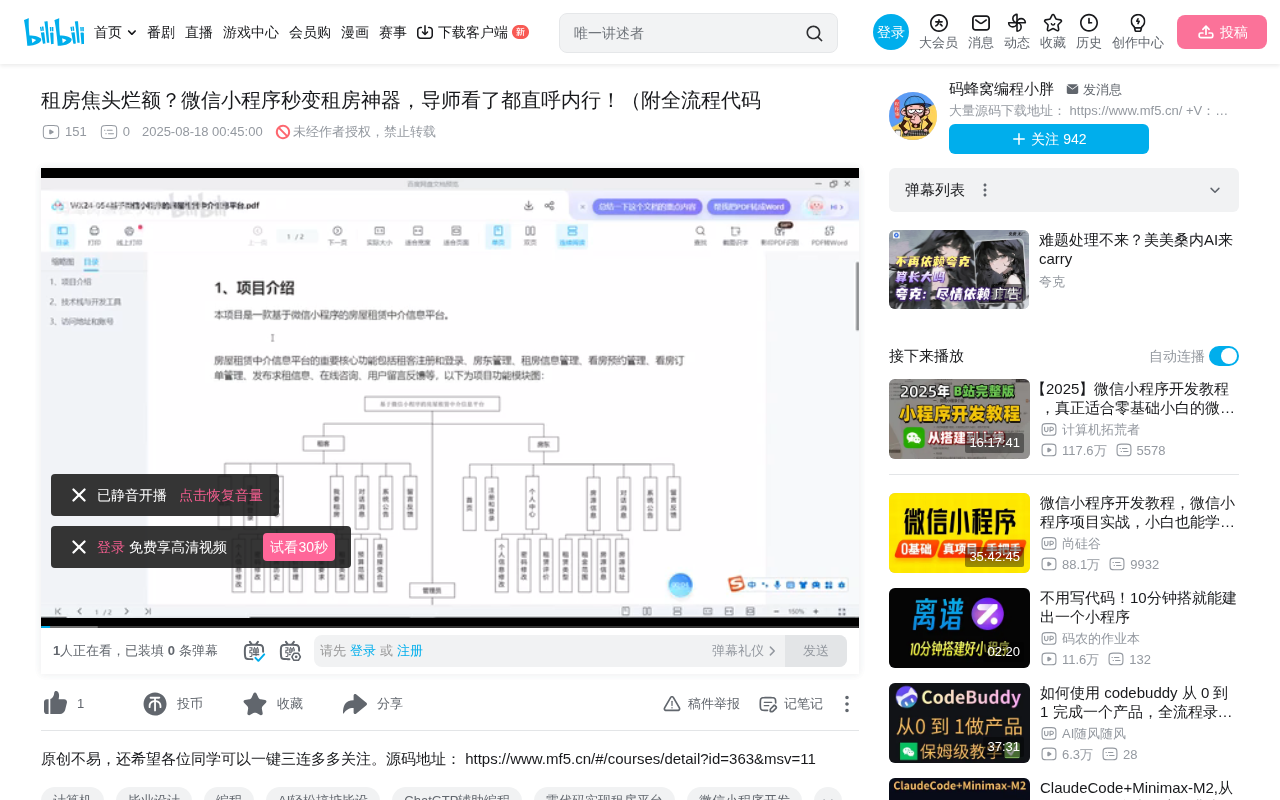
House rental is a high-frequency use case both in real life and as a popular topic for university graduation projects. This article introduces a house rental agency information platform built as a WeChat Mini Program, using a front-end/back-end separation architecture with SpringBoot on the back end and UniApp for the Mini Program front end. The system covers three user roles—tenants, landlords, and administrators—with a high degree of functional completeness, making it an excellent reference project for learning full-stack development.
Front-end/back-end separation is the mainstream architectural pattern in modern web development. Its core idea is to completely decouple the user interface (front end) from business logic and data processing (back end). The front end calls API endpoints provided by the back end via HTTP requests to retrieve data, while the back end focuses solely on data processing and business logic without concerning itself with page rendering. The advantages of this architecture include: front-end and back-end teams can develop in parallel, improving collaboration efficiency; back-end APIs can simultaneously serve multiple clients (Mini Programs, mobile apps, web); and each side can be deployed and scaled independently. In this project, the SpringBoot back end provides RESTful APIs, and the UniApp Mini Program consumes these interfaces as the front end, with data exchanged in JSON format.
Technical Architecture Analysis
Back-End Technology: SpringBoot
As the mainstream Java back-end development framework, SpringBoot handles all business logic processing, data persistence, and API provisioning in this project. Its core advantages include:
- Rapid Setup: The auto-configuration mechanism dramatically reduces XML configuration work
- Rich Ecosystem: Integrates MyBatis/JPA for database operations and Spring Security for permission management
- RESTful APIs: Provides standardized data interfaces for the Mini Program front end
Auto-Configuration is one of SpringBoot's most essential features. In traditional Spring projects, developers needed to write extensive XML configuration files to define Beans, data sources, transaction managers, and other components. SpringBoot uses the @EnableAutoConfiguration annotation and the spring.factories mechanism to automatically infer and configure required Beans based on the project's dependencies. For example, when the MySQL driver and Spring Data JPA dependencies exist on the classpath, SpringBoot automatically configures the data source, EntityManagerFactory, and transaction manager. Developers only need to provide database connection information in application.yml. This "convention over configuration" philosophy reduces project initialization time from hours to minutes.
Front-End Technology: UniApp WeChat Mini Program
Choosing UniApp is a pragmatic decision. Compared to native WeChat Mini Program development, UniApp offers cross-platform capabilities—a single codebase can be compiled into WeChat Mini Programs, H5 web apps, native mobile apps, and more. For house rental scenarios, users can complete all operations through the WeChat Mini Program with a low barrier to entry and minimal promotion costs.
UniApp is a cross-platform development framework built on Vue.js by DCloud. Its core principle is to convert a single set of Vue code into native code for different platforms through conditional compilation and a runtime adaptation layer. When compiling to a WeChat Mini Program, UniApp transforms Vue components into WXML templates and WXSS styles, mapping Vue lifecycle hooks to the Mini Program's Page and Component lifecycles. UniApp uses custom component specifications (e.g., <view> instead of <div>), which are converted to the target platform's native components during compilation. Compared to native WeChat Mini Program development, UniApp's advantages include Vue's reactive data binding, component-based development patterns, and a rich plugin ecosystem, while retaining the ability to publish to multiple platforms from a single codebase.
Detailed Breakdown of Three User Roles
Tenant Module
As the platform's core users, tenants have access to the following features:
- Registration, Login & Profile Management: A complete user system with profile editing capabilities
- Property Browsing & Search: Filter and view property listings by type to quickly locate target properties
- Viewing Appointments: Select a desired property, fill in appointment details (contact person, preferred viewing time), and submit a viewing request
- Posting Rental Requests: Proactively publish rental needs with contact information so landlords can reach out
- Rating System: Rate properties after viewings to provide reputation references for other tenants
- Feedback & Messages: Submit opinions or issues to platform administrators
- Online Consultation: Communicate with landlords in real time
Landlord Module
Landlords operate through a back-end management interface:
- Property Management: Publish, edit, and delist their property listings
- Viewing Order Management: Review tenant viewing applications (approve/reject) and mark viewing completion status
- View Ratings: Check tenant feedback on their properties
- Online Consultation Replies: Communicate with tenants
Administrator Module
Administrators have the highest privileges and are responsible for overall platform operations:
- User Management: Unified management of tenant and landlord accounts
- Property Type Management: Maintain housing categories (including icons and type names)
- Announcement Management: Publish platform announcements
- Order Monitoring: View all viewing order statuses
- Banner Management: Configure Mini Program homepage display content
- Rental Request Management: Review user-published rental requests
- Feedback Replies: Handle user-submitted opinions and issues
Core Business Flow: Viewing Appointments
The viewing appointment is the system's most critical business flow. The complete process is as follows:
- Tenant browses the property listing page and selects a target property
- Clicks "Book Viewing," fills in contact information and preferred viewing time
- Submits the appointment request
- Landlord receives the viewing order in their dashboard and reviews it (approve/reject)
- After approval, both parties meet at the agreed time for the viewing
- After the viewing is complete, the landlord marks the order as "Completed"
- Tenant can rate the viewing experience
This flow is clearly designed with logical state transitions, covering the complete business loop from demand generation to service completion. From a technical implementation perspective, this flow involves order state machine design—orders transition from "Pending Review" to "Approved" or "Rejected," then to "Completed" and "Rated." Each state transition requires validation that the current state permits the operation, preventing illegal state jumps.
Project Highlights & Learning Value
High Functional Completeness
This project goes beyond basic CRUD operations to include a rating system, simulated instant messaging, rental request publishing, and other advanced features, demonstrating the complexity expected of a complete business system.
Multi-Role Permission Design
The permission boundaries between the three roles are clearly defined, with the back-end management interface displaying different function menus based on the user's role. This type of multi-role access control is extremely common in real-world project development and offers high reference value for learning. Technically, multi-role permissions typically adopt the RBAC (Role-Based Access Control) model, managing access through a three-tier association of users, roles, and permissions. The Spring Security framework provides comprehensive permission annotations (such as @PreAuthorize) for fine-grained permission checks at the Controller method level.
Ideal as a Graduation Project
From the technology stack (SpringBoot + UniApp) to functional coverage, this project is highly suitable for computer science graduation projects. Core knowledge areas it covers include:
- Front-end/back-end separation architecture design
- Database schema design (user table, property table, order table, rating table, etc.)
- RESTful API design and implementation
- WeChat Mini Program development practices
- Multi-role access control
Technical Implementation Recommendations
If you plan to use this project as a reference for development, the following points are worth noting:
- Database Design: MySQL is recommended. Core tables include users (with role differentiation), properties, orders, ratings, messages, etc.
- API Security: Use JWT Tokens for authentication to ensure different roles can only access interfaces within their authorized scope
- Image Storage: Property images should use an object storage service (such as Alibaba Cloud OSS) to avoid performance bottlenecks from local storage
- Message Notifications: Integrate WeChat subscription messages to promptly notify users when order statuses change
JWT (JSON Web Token) is a token-based stateless authentication solution particularly suited for front-end/back-end separation architectures. The workflow is: after successful login, the server generates a JWT Token containing user information (such as user ID and role) and returns it to the client; the client includes the Token in the HTTP Header's Authorization field with each subsequent request; the server verifies the Token's signature and expiration to confirm the user's identity. JWT consists of three parts: Header (algorithm type), Payload (user data), and Signature (digital signature). Compared to traditional Session-based approaches, JWT doesn't require server-side session storage, naturally supports distributed deployment, and is more friendly to mobile and Mini Program environments since Mini Programs don't support the Cookie mechanism.
Object Storage Service is the file storage solution of the cloud computing era, represented by Alibaba Cloud OSS, Tencent Cloud COS, and Qiniu Cloud. Compared to traditional approaches of storing images on the application server's local disk, object storage offers several key advantages: CDN acceleration support, allowing users to fetch images from the nearest node for dramatically improved loading speeds; virtually unlimited storage capacity with pay-as-you-go pricing; built-in image processing capabilities supporting resizing, cropping, watermarking, and more; decoupling from the application server so that image I/O doesn't consume server bandwidth and CPU resources. In a house rental scenario, each property typically includes 5-10 high-resolution images. If stored on the application server, disk space and bandwidth pressure would quickly become bottlenecks as the number of listings grows.
WeChat template messages (now upgraded to subscription messages) are the official channel for Mini Programs to push notifications to users. Before 2020, Mini Programs used the template message mechanism, where developers could push a limited number of notifications to users within 7 days after a form submission or payment was triggered. After 2020, WeChat introduced the subscription message mechanism, requiring users to actively click a subscribe button to authorize developers to send corresponding message types. In a house rental scenario, typical subscription message use cases include: tenants receiving an "Appointment Successful" notification after submitting a viewing request, tenants receiving an "Review Result" notification after landlord approval, and "Viewing Reminder" notifications as the viewing time approaches. Implementation requires configuring message templates on the WeChat Official Account Platform and calling WeChat's subscribeMessage.send API on the back end.
Conclusion
This house rental WeChat Mini Program project features a clear architecture, comprehensive functionality, and a mainstream technology stack. Whether as a hands-on project for learning full-stack development or as a graduation project topic, it's a solution well worth referencing. The SpringBoot + UniApp technology combination also represents the typical technical approach for current small-to-medium-sized project development, and mastering this stack is equally beneficial for real-world work.
Related articles
 Tutorials
Cursor + Codex Dual-IDE Collaboration: A Practical Methodology for Open-Source Project Customization
A complete methodology for open-source project customization based on real-world experience, detailing the Cursor+Codex dual-IDE workflow, seven-stage process, MVP validation, and AI source code reading techniques.
 Tutorials
Cursor Multi-Agent in Practice: Building a Full-Stack Next.js Blog in 50 Minutes
Build a full-stack blog in 50 minutes using Cursor IDE's multi-Agent mode with Next.js, Clerk auth, and Supabase. Learn the 4-phase AI Agent workflow and key integration pitfalls.
 Tutorials
Building an AI Software Factory from Scratch: A Cursor Engineer's Hands-On Experience with Multi-Agent Collaboration
Cursor engineer Eric shares practical insights on building an AI software factory: automation levels, guardrail design, parallel Agent management, and scaling to 1000+ Agents for 24/7 development.