Building a Multi-Platform Content Distribution Assistant with Zero Code: AI Coding in Practice
Building a Multi-Platform Content Dist…
Build a Bilibili video multi-platform content distribution assistant in 30 minutes with zero-code AI tools
This article introduces how a creator used Coze's AI Coding Agent to build a multi-platform content creation assistant in 30 minutes without writing any code — just by describing requirements in natural language. The tool automatically scrapes Bilibili videos, converts speech to text, and generates adapted copy for Xiaohongshu, WeChat Official Accounts, Weibo, and Douyin with one click. It demonstrates the paradigm shift in AI Coding from "writing code" to "describing requirements," while also noting limitations around scraper stability, transcription accuracy, and copyright risks.
The Content Creator's Pain Point: One Piece of Content, Four Platforms
What's the most frustrating thing about being a content creator? Having to publish one piece of content across four platforms, each with a completely different style. Xiaohongshu needs emojis and lively formatting, WeChat Official Accounts need hierarchical structure for deep reading, Weibo needs short and punchy copy with hashtags, and Douyin needs conversational language with filming prompts. Manually rewriting for each platform easily eats up half an hour.
This pressure is particularly acute among Chinese content creators. The four major platforms — WeChat Official Accounts, Xiaohongshu, Weibo, and Douyin — have significantly different user profiles, content consumption habits, and algorithm recommendation logic. Xiaohongshu centers on visual product recommendations, emphasizing aesthetic appeal and emotional resonance; Official Accounts suit long-form deep content with stable subscription relationships; Weibo revolves around trending topics with fast dissemination but short content lifecycles; Douyin focuses on short videos where copy must complement visual storytelling rhythm. These differences make "one draft for all" virtually impossible, making content adaptation one of the most time-consuming repetitive tasks in social media operations.
What if there were a tool that could automatically generate platform-adapted copy for all four platforms in just 30 seconds, simply by pasting a Bilibili video link? That's exactly what today's article covers — a multi-platform content creation assistant built from scratch by a creator using AI Coding tools (Trae/Coze) — without writing a single line of code.
What Can the Tool Do?
The core workflow of this AI content creation assistant is remarkably clear:
- Scrape Bilibili video data: Input a Bilibili video link, and it automatically fetches the video content
- Speech-to-text: Automatically transcribes the spoken content in the video into text
- Multi-platform style rewriting: Based on the transcript, generates adapted versions for four platforms with one click
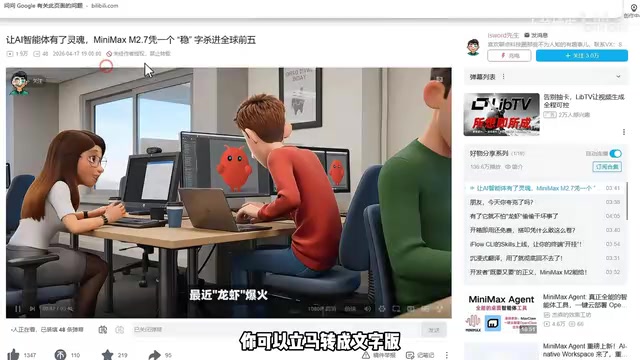
Each platform's output has its own distinctive style:
- Xiaohongshu version: Automatically adds emojis, lively formatting, matching the product recommendation note tone
- Official Account version: Automatically structured with hierarchical headings, suitable for deep reading
- Weibo version: Short and punchy, automatically includes hashtags
- Douyin version: Conversational expression, with filming prompts attached
What's even more noteworthy is a "hidden use case": if you spot a trending video on Bilibili, you can instantly convert it to text and publish it on your Official Account — essentially rapid hot-topic follow-up that takes just one minute. Of course, copyright and originality issues need attention here — it's recommended to add your own perspectives and analysis on top of the base content.
The Development Process: From Idea to Finished Product in 30 Minutes
Step 1: Choose the AI Coding Tool and Model
The entire development process used Dark Code (Coze's Coding Agent mode). After opening it, select Coding Agent mode — the platform has multiple free built-in models, and JLM 4.7 was chosen here.
Coding Agent is fundamentally different from earlier code completion tools (like GitHub Copilot). It can not only write code but also run code, read error messages, and autonomously fix problems, forming a complete "perceive-plan-execute" loop. This capability stems from the combination of Tool Use and the ReAct (Reasoning + Acting) framework, enabling the model to iteratively solve problems like a real engineer.
The core operation is simply inputting a prompt telling the AI:
Build me an AI content creation assistant that can scrape Bilibili video data, convert video content to text, and finally generate copy in four styles: Xiaohongshu, WeChat Official Account, Weibo, and Douyin.
Step 2: AI Automatically Plans and Executes
After the prompt is entered, the AI immediately starts working. It first analyzes the requirements, formulates a detailed development plan — including the scraper module, speech recognition module, content rewriting module, etc. — then executes each item according to plan.
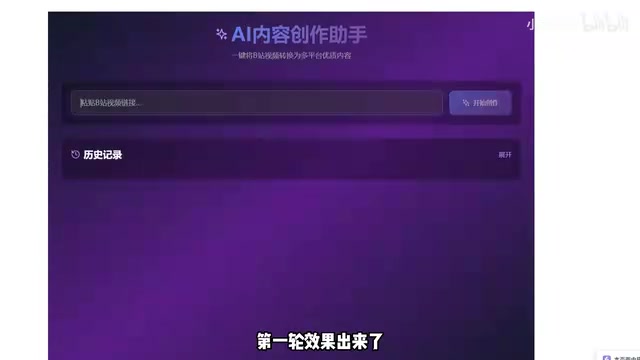
There's a critically important capability here: automatic error correction. When the AI encounters errors or failures during development, it automatically identifies the problem, modifies the code, and fixes it — no human intervention required. This dramatically lowers the barrier to entry for non-technical users.
For the speech-to-text component, the tool's underlying technology is Automatic Speech Recognition (ASR). Current mainstream solutions include OpenAI's Whisper model (open-source, multilingual support), Alibaba Cloud's speech recognition API, and iFlytek's open platform. Whisper is widely integrated into AI tools due to being open-source, free, and having excellent Chinese recognition performance. ASR accuracy is affected by multiple factors including speaker accent, background noise, density of technical terminology, and speaking speed — this is the technical root cause of the transcription quality limitations mentioned later.
After waiting a few minutes, the AI content creation assistant is fully developed and accessible directly via a link.
Step 3: Iterate and Optimize with Natural Language
The first version is functional but visually rough. At this point, you simply continue making requests in natural language:
- "The interface is too ugly — add dark/light theme switching and some visual effects" → AI automatically redesigns the UI
- "Add a history log and local storage feature" → AI automatically implements data persistence
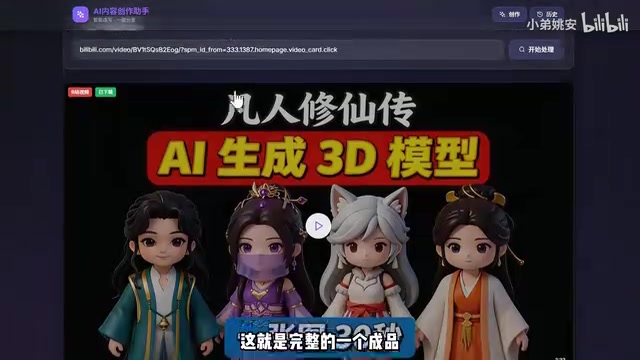
After several rounds of iteration, the final product reaches a usable level in both visual design and functionality. If you're still not satisfied, you can continue fine-tuning — just describe your requirements in natural language.
The Essence of AI Coding: Lowering the Barrier to Creation
The significance of this case goes beyond just building a content distribution tool — it demonstrates the paradigm shift of AI Coding:
From "writing code" to "describing requirements". Traditionally, developing a complete application with web scraping, speech recognition, NLP rewriting, and a frontend interface would require at least one full-stack engineer spending several days. Now, a content creator with zero programming skills can complete the entire journey from idea to usable tool in 30 minutes.
The technical foundation for this shift is the breakthrough of large language models in code generation. Zero-code development isn't a new concept — platforms like Zapier and Bubble attempted to let non-technical users build applications as early as the 2010s. However, traditional no-code platforms rely on preset modules and visual drag-and-drop, offering extremely limited flexibility. The emergence of AI Coding Agents represents a fundamental breakthrough: users can describe any requirement in natural language, and the AI is responsible for converting it into real, runnable code — unconstrained by the platform's preset functional boundaries. Models like GPT-4, Claude 3.5, and DeepSeek have achieved pass rates exceeding 80% on programming benchmarks like HumanEval, making the "natural language → runnable program" pipeline practically viable in real-world scenarios.
Of course, this type of zero-code development tool currently has limitations:
- Scraper stability: Platforms like Bilibili deploy multiple layers of anti-scraping mechanisms, including request rate limiting, User-Agent detection, Cookie verification, dynamically rendered content, and IP banning. This means AI-generated scraper code may work initially but can't guarantee long-term stability as platform policies update — this is a structural challenge of platform adversarial dynamics, not a limitation of AI capability itself
- Speech-to-text accuracy: For videos with heavy accents or significant background noise, ASR transcription quality may degrade. Diverse accents among Bilibili creators and interference from bullet comment sound effects can materially impact results
- Generated content quality: AI-rewritten copy still requires human review and polishing — it cannot fully replace creative work
- Copyright risk: Directly converting others' video content to text for publication carries infringement risks
Final Thoughts
The biggest takeaway from this case is: AI is giving people who "have ideas but lack technical skills" the ability to execute. In the past, a great tool idea might remain stuck in your head due to technical barriers; now, you just need to clearly describe your requirements, and AI can help turn it into reality.
For content creators, the value of multi-platform content distribution tools like this lies in freeing up time spent on repetitive labor, allowing creators to focus their energy on content quality itself rather than spending it on the mechanical work of format adaptation and platform distribution.
If you'd like to try zero-code development of your own content creation tools, check out the Coding Agent feature on the Coze platform — all built-in models are currently free to use.
Key Takeaways
- Using AI Coding tools (Dark Code/Coze), you can develop a content creation assistant with scraping, speech-to-text, and multi-platform rewriting capabilities without writing any code
- The tool automatically converts Bilibili video content into adapted copy for Xiaohongshu, WeChat Official Accounts, Weibo, and Douyin in 30 seconds
- AI Coding Agent, based on the ReAct framework, has the ability to automatically plan, execute, and self-correct errors, dramatically lowering the development barrier for non-technical users
- Interface and functionality can be optimized through natural language iteration, going from idea to usable product in 30 minutes
- Users should be aware of potential risks including scraper stability (platform anti-scraping countermeasures), ASR transcription accuracy, and copyright compliance
Related articles
 Tutorials
Cursor + Codex Dual-IDE Collaboration: A Practical Methodology for Open-Source Project Customization
A complete methodology for open-source project customization based on real-world experience, detailing the Cursor+Codex dual-IDE workflow, seven-stage process, MVP validation, and AI source code reading techniques.
 Tutorials
Cursor Multi-Agent in Practice: Building a Full-Stack Next.js Blog in 50 Minutes
Build a full-stack blog in 50 minutes using Cursor IDE's multi-Agent mode with Next.js, Clerk auth, and Supabase. Learn the 4-phase AI Agent workflow and key integration pitfalls.
 Tutorials
Building an AI Software Factory from Scratch: A Cursor Engineer's Hands-On Experience with Multi-Agent Collaboration
Cursor engineer Eric shares practical insights on building an AI software factory: automation levels, guardrail design, parallel Agent management, and scaling to 1000+ Agents for 24/7 development.