Building AI Agents from Scratch: A Complete Beginner's Guide

A complete beginner's guide to building AI Agents using no-code platforms and core AI techniques.
This guide breaks down AI Agent development for complete beginners, covering three core modules: prompt engineering, RAG knowledge base setup, and workflow orchestration with tool invocation. It recommends no-code platforms like Coze and Dify, explains the technical principles behind each module, and outlines practical monetization paths including customer service, content creation, and data analysis agents.
AI Agents are undeniably one of the hottest technology trends right now. More and more people are building agents to earn side income or pivot their careers, yet most beginners still hesitate — assuming it's an exclusive domain for programmers and tech experts. In reality, with the maturity of low-code/no-code tools, building AI agents with zero technical background is entirely feasible. This article is based on a comprehensive beginner-friendly tutorial series from Bilibili, distilling the core knowledge framework and hands-on path for getting started with AI Agents — so you can skip the detours.
What Is an AI Agent? The Key Difference from Chatbots
Before getting your hands dirty, it's crucial to understand what an AI Agent actually is. In simple terms, an AI Agent is an intelligent program capable of autonomously perceiving its environment, making decisions, and executing tasks. It differs fundamentally from a regular chatbot — ChatGPT passively answers questions, while an Agent can proactively plan steps, invoke tools, and complete complex tasks.
Here's an example: if you ask ChatGPT to write a market research report, it gives you a single block of text. But an Agent might first search for the latest industry data, then analyze competitor information, synthesize everything into a report, and finally send it to your inbox automatically — the entire workflow runs without you issuing step-by-step instructions.

Once you grasp this core distinction, you'll understand why Agents are called "the next paradigm in AI." At its essence, an Agent is a combination of large language model + tool invocation + autonomous planning.
It's worth adding some background on large language models here. A Large Language Model (LLM) is a deep learning model built on the Transformer architecture and trained on massive text datasets, typically with parameters ranging from billions to trillions. GPT-4, Claude, ERNIE Bot, and Qwen all fall into this category. They learn language understanding and generation by "predicting the next token," but are fundamentally probabilistic models without true "understanding" or "reasoning" capabilities. This is precisely why a standalone LLM can only handle passive Q&A, and needs an Agent framework to gain planning and execution abilities — an Agent essentially adds "hands and feet" (tool invocation) and a "prefrontal cortex" (task planning) on top of the LLM's "brain," evolving it from a passive text generator into an active task executor.
The explosion of AI Agents isn't coincidental — it sits at the intersection of multiple maturing technologies. In March 2023, Stanford University published the "Generative Agents" paper, demonstrating 25 AI Agents autonomously living and socializing in a virtual town, sparking widespread attention across academia and industry. That same year, the AutoGPT project rapidly accumulated over 150,000 GitHub stars, proving the enormous potential of autonomous agents. Gartner predicts that by 2028, at least 15% of daily work decisions will be made autonomously by AI Agents. The industry is currently evolving from "single Agent" to "Multi-Agent Systems," with frameworks like Microsoft's AutoGen and CrewAI driving this trend. Understanding this industry context will help you assess the right timing and direction for getting involved.
Three Core Modules for Beginners Getting Started with AI Agents
Module 1: Prompt Engineering — The Foundation for Communicating Effectively with AI
Prompts are the language for communicating with AI and the foundation of building any Agent. Many people think prompting is just typing a few words, but high-quality prompt engineering directly determines the upper limit of an Agent's performance.
Key prompt techniques to master include:
- Role definition: Clearly tell the AI who it is and what professional background it has
- Task decomposition: Break complex tasks into clear, step-by-step instructions
- Output format constraints: Specify the structure, length, and style of the output
- Few-shot examples: Provide 1–3 examples so the AI understands your expectations
Mastering these techniques requires zero programming knowledge, yet the results are immediate. A well-crafted system prompt can multiply the output quality of the same underlying model several times over.
The reason prompt engineering is so effective lies in how large language models work — they generate the most probable continuation based on the input context (i.e., the prompt). The Few-shot technique mentioned above originates from the In-Context Learning concept introduced in the GPT-3 paper, where the model learns new task patterns simply from a few examples provided in the prompt, without any retraining. Another important technique is Chain-of-Thought (CoT), proposed by Google in 2022, which significantly improves model performance on mathematical reasoning and logical analysis tasks by adding guiding phrases like "let's think step by step" to the prompt. When building Agents in practice, the System Prompt typically combines role definition, chain-of-thought guidance, output format constraints, and other techniques into a complete "instruction system" — this is essentially the "genetic code" of the Agent's behavior.

Module 2: Building a RAG Knowledge Base — Giving Your Agent Domain Expertise
RAG (Retrieval-Augmented Generation) is the key technology for making an Agent "specialized." While LLMs have broad general knowledge, their training data has a cutoff date, and they know nothing about your private data. RAG enables an Agent to retrieve information from your custom knowledge base and generate answers based on that information.
In practice, the RAG setup process looks roughly like this:
- Prepare knowledge documents: Organize your industry materials, product manuals, FAQs, etc. into text files
- Document chunking and vectorization: Split long documents into smaller segments and convert them into vector representations for storage
- Retrieval matching: When a user asks a question, the system automatically finds the most relevant knowledge chunks
- Answer generation: The LLM combines the retrieved content to produce a precise answer
A deeper understanding of RAG's technical principles will help you better fine-tune your Agent's performance. RAG was first proposed by Meta AI in 2020 to address two major pain points of LLMs: knowledge cutoff (training data has a time limit) and hallucination (models confidently fabricate nonexistent information). The "vectorization" step in the process above uses Embedding models (such as OpenAI's text-embedding-ada-002 or the BGE series from China), which convert text into mathematical representations in a high-dimensional vector space — think of it as turning a piece of text into a string of numerical coordinates, where semantically similar texts are positioned closer together in this space. Vector databases (such as Pinecone, Milvus, and Chroma) handle efficient storage and retrieval of these vectors. Notably, the document chunking strategy (parameters like chunk size and overlap) directly impacts retrieval quality — chunks that are too large lead to imprecise retrieval, while chunks that are too small may lose context. This is one of the most critical aspects of RAG optimization.
Platforms like Coze and Dify have already turned this entire process into a visual operation — you simply upload documents, configure parameters, and no coding is required whatsoever.
Module 3: Tool Invocation and Workflow Orchestration — Making Your Agent Actually Do Things
What makes Agents powerful is that they don't just "talk" — they can "act." Through tool invocation, an Agent can connect to search engines, databases, API endpoints, and other external services, enabling true automated execution.
The Agent's tool invocation capability technically relies on the Function Calling mechanism. This was introduced by OpenAI in June 2023 for GPT models, and other major model providers quickly followed suit. The principle works like this: developers pre-define a set of available tool descriptions (including functionality explanations, parameter formats, etc.), and the model autonomously decides during conversation when to call which tool, generating properly formatted invocation requests. The current mainstream paradigm for Agent tool invocation is the ReAct framework (Reasoning + Acting), jointly proposed by Princeton University and Google in 2022. It enables the model to complete complex tasks through a "Think → Act → Observe" loop — first reasoning about what should be done, then executing the corresponding tool, observing the returned results, and deciding on the next action. This loop mechanism is the core principle behind how Agents handle multi-step complex tasks.
Workflow orchestration strings multiple steps together into a complete automated process. For example, building an "automated content creation Agent":
- Step 1: Receive topic keywords from user input
- Step 2: Invoke a search tool to fetch the latest news and information
- Step 3: The LLM synthesizes the information and generates a draft article
- Step 4: Automatically check formatting and quality
- Step 5: Output the final product
This kind of workflow can be built on platforms like Coze and Dify by simply dragging and dropping nodes — the barrier to entry is extremely low.
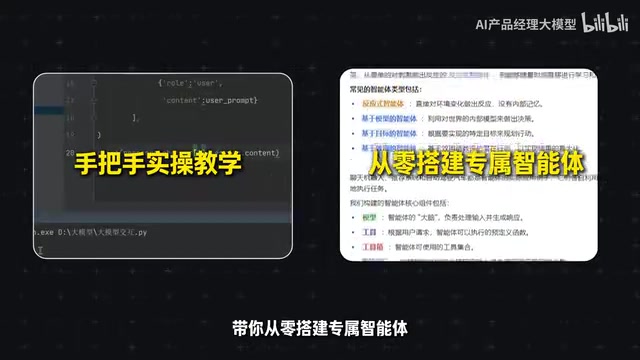
Recommended No-Code Agent Building Platforms
For beginners with zero background, choosing the right platform is critical. The mainstream low-code/no-code Agent building platforms currently include:
| Platform | Features | Best For |
|---|---|---|
| Coze | Made by ByteDance, strong Chinese ecosystem, rich plugin library | Top choice for Chinese-speaking users |
| Dify | Open-source with self-hosted deployment, highly flexible | Users with some technical ambitions |
| Baidu Qianfan AppBuilder | Part of the Baidu ecosystem, enterprise-grade applications | Enterprise scenarios |
These platforms share common traits: visual interfaces, drag-and-drop orchestration, and zero coding required, significantly lowering the barrier to entry.
Looking at the architectural differences between these platforms in more detail can help you make a more informed choice. Coze is an AI Bot development platform launched by ByteDance in early 2024. It supports the Doubao model and multiple third-party model integrations under the hood, with a plugin marketplace featuring hundreds of integrated tools (search, image generation, code execution, etc.). It also supports one-click publishing to channels like Doubao, Feishu, and WeChat, making it very friendly for creators who want to go live quickly and reach users. Dify is an open-source LLMOps platform with a separated frontend-backend architecture, supporting one-click deployment via Docker. Enterprises can keep all data entirely on their own servers, effectively addressing data privacy concerns — ideal for scenarios with data security requirements. Both platforms use a DAG (Directed Acyclic Graph) approach to workflow orchestration — users connect different functional nodes on a visual canvas, essentially transforming traditional programming logic into graphical operations, enabling people who can't write code to build complex automated workflows.
Real-World Application Scenarios and Monetization Paths for AI Agents
Learning to build Agents isn't the goal — solving real problems and creating value is what matters. The main monetization directions for Agents currently include:
- Customer service Agents: Build intelligent customer service bots for SMBs, charged on a monthly subscription basis
- Content creation Agents: Automatically generate copy, short video scripts, etc.
- Data analysis Agents: Automatically scrape and analyze industry data, generating reports
- Education tutoring Agents: Intelligent Q&A assistants for specific subjects
- Private community Agents: Automated community management and user engagement
Every one of these directions has genuine market demand. The key is finding an industry you're familiar with, combining your domain knowledge with Agent technology, and building a product with differentiated value.
Final Thoughts: Now Is the Best Time to Get In
The technical barrier for AI Agents is dropping rapidly, but the knowledge gap still exists. Many people don't fail because they can't learn — they fail because they don't dare to start. The truth is, we're currently in the early dividend period of AI Agent applications — the tools are mature, but Agent adoption across most industries is far from saturated.
The recommended learning path is: Understand core concepts first → Pick a platform and start hands-on → Begin with simple scenarios → Iterate and optimize gradually → Find monetization opportunities. Don't aim for perfection from day one. Build your first working Agent, and both your confidence and skills will grow from there.
Instead of watching from the sidelines, start your first Agent project today.
Related articles
Five Common Claude Code Mistakes — How Many Are You Making?
Five common Claude Code mistakes developers make: copy-pasting code, skipping CLAUDE.md, inefficient prompting, ignoring docs, and poor context management — with fixes.
Andrew Ng's New Course Explained: A Practical Guide to Using OpenAI's O1 Reasoning Model
Deep dive into Andrew Ng and OpenAI's Reasoning with O1 course covering test-time scaling, new prompting paradigms, multi-model orchestration, and practical applications for developers.

Learning AI After College Entrance Exams: A Complete Path from Zero to Freelancing
How to efficiently learn AI skills during summer break after exams? A complete path from mastering prompts and hands-on projects to freelancing on platforms.