Building AI Agents on Kinoviz for Vector Animation: System Capabilities and AI Collaboration in Practice
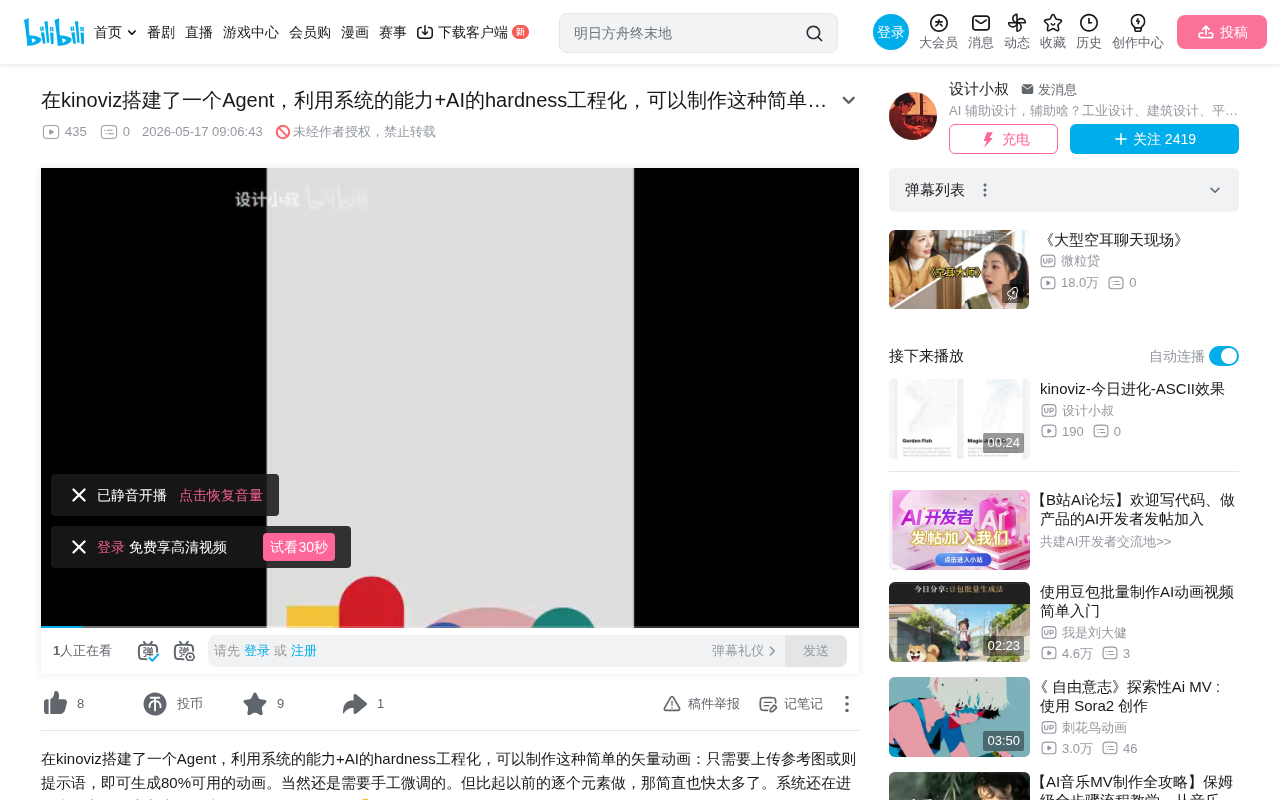
Building AI Agents on Kinoviz to automate vector animation production
A Bilibili creator built an AI Agent on the Kinoviz visual creation platform, achieving automated simple vector animation production through a clear division of labor — system capabilities handle vector rendering execution while AI handles creative decisions. This Agent architecture is more controllable and stable than pure AI generation, representing an important trend of componentizing AI capabilities into professional toolchains.
Overview: AI-Driven Vector Animation Workflow
Recently, a Bilibili creator shared an interesting practical case — building an AI Agent on the Kinoviz platform that combines native system capabilities with AI's engineering capabilities (hardness engineering) to automate the creation of simple vector animations. This exploration demonstrates new possibilities for AI in the creative tools space.
What is Kinoviz?
Platform Positioning
Kinoviz is a visual creation platform that allows users to build dynamic visual content through node-based or programmatic approaches. Its core advantage lies in providing system-level vector graphics rendering capabilities, upon which users can build secondary development and automated workflows.
Node-based Programming is a programming paradigm that constructs logical workflows by connecting visual nodes. It's widely used in visual effects, game development, and motion design. Representative tools include Houdini, Blender's Geometry Nodes, TouchDesigner, and others. This approach lowers the barrier of traditional code writing while preserving the flexibility of procedural generation. Kinoviz adopts a similar node-based architecture, allowing users to modularly combine operations like graphic generation, transformation, and animation into reusable creative pipelines. This architecture is naturally suited for integration with AI Agents, as each node can be treated as a functional interface callable by AI.
The Intersection of Kinoviz and AI
The creator's approach embeds AI as an "Agent" within Kinoviz's workflow. The concept of "hardness engineering" here can be understood as structurally encapsulating AI capabilities so they can stably and reliably execute specific animation generation tasks, rather than relying on simple one-off prompt calls.
More specifically, the core of "hardness engineering" is transforming AI from uncertain, probabilistic outputs into predictable, engineered services. Specific techniques include: structured output constraints (such as JSON Schema format enforcement), multi-round validation and error correction mechanisms, input/output type safety checks, failure retry and degradation strategies, and more. This aligns with the concept of "hardening" in software engineering — using systematic engineering measures to transform originally fragile AI calls into production-grade reliable automated workflows. This is also one of the key challenges in moving AI applications from demo to product.
Technical Approach Analysis: Collaboration Between System and AI Capabilities
Division of Labor: System Capabilities + AI Capabilities
The core design philosophy of this approach is to clearly delineate the boundaries between two types of capabilities:
- System Capabilities: The underlying functions provided by the Kinoviz platform itself, including vector graphics rendering, animation timeline control, keyframe interpolation, etc. These are deterministic, high-performance computational tasks.
- AI Capabilities: Responsible for creative decision-making, such as generating animation parameters, planning motion paths, suggesting visual element layouts, etc. AI plays the role of a "creative engine" here.
The technical characteristics of vector animation deserve further explanation: Vector Animation describes graphics through mathematical equations rather than pixel grids. Its core advantages include lossless scaling (adapting to any resolution), small file sizes, and ease of programmatic control. Key technical elements of vector animation include Bézier curve paths, keyframe interpolation (linear, ease-in/ease-out, elastic and other easing functions), transformation matrices (translation, rotation, scaling), and rendering standards like SVG/Canvas. Since vector graphics are fundamentally parameterized mathematical descriptions, they are naturally suited to being generated and manipulated by AI in structured data form — AI only needs to output a set of numerical parameters, and the system can precisely render the corresponding visual effects. This is far more reliable than having AI directly generate pixel-level content.
Advantages of the AI Agent Architecture
Compared to having AI directly generate complete animation code, the Agent architecture has several clear advantages:
- Greater controllability: AI is only responsible for decisions; execution is handled by the system, avoiding the uncertainty of AI-generated code
- Higher efficiency: Leveraging the platform's native rendering capabilities is much faster than AI generating from scratch
- More stable quality: The precision of vector animation is guaranteed by the system; AI's creative variability doesn't affect final output quality
An AI Agent is an autonomous system architecture capable of perceiving its environment, making decisions, and executing actions. Unlike traditional single-prompt calls, Agents possess core capabilities including Planning, Memory, Tool Use, and Reflection. Driven by frameworks like LangChain and AutoGen, Agent architecture has become one of the mainstream paradigms for AI application development. Agents decompose complex tasks into multiple sub-steps, progressively calling external tools to achieve objectives, making them particularly suited for interacting with professional software APIs. In animation production scenarios, an Agent can first understand user intent, then translate it into a series of specific parameter calls and operation sequences, achieving a complete pipeline from natural language description to precise animation output.
Application Scenarios and Practical Value
Applicable Scope
From the demonstration, this AI Agent animation approach is currently suitable for creating relatively simple vector animations, such as:
- Logo animations and brand motion effects
- Transition animations in data visualization
- Micro-interaction animations in UI/UX prototypes
- Graphic elements in social media short videos
Insights for Creators
The value of this case lies not only in the final output but also in the mindset it demonstrates: rather than having AI replace the entire creative process, let AI become an intelligent component within the existing toolchain. This "AI-augmented" rather than "AI-replaced" approach often achieves better results in actual production.
Summary and Outlook
Embedding AI Agents into professional creative tools represents an important trend — the "toolification" and "componentization" of AI capabilities. In the future, we'll likely see more practices like this: across various professional software, AI is no longer a standalone generator but an intelligent assistant integrated into workflows, significantly lowering creative barriers and boosting efficiency while maintaining the precision of professional tools.
This trend is already validated across the industry: Adobe embeds AI as a built-in feature in Photoshop and Illustrator through Firefly; Figma enhances design workflows through AI plugins; Runway makes AI video generation capabilities available as APIs for third-party use. The underlying logic is consistent — professional tools have established mature precision and reliability through years of iteration, and AI's value lies not in replacing these tools but in filling the gaps of "creative decision-making" and "parameter exploration" — the areas where humans spend the most time. Emerging standards like Model Context Protocol (MCP) are also driving standardized integration between AI and external tools, enabling AI Agents to more conveniently access the capabilities of various professional software and accelerating the realization of this componentization trend.
Key Takeaways
- Building an AI Agent on the Kinoviz platform enables automated vector animation creation
- The core approach assigns rendering execution to system capabilities and creative decisions to AI, with clear division of labor
- Agent architecture offers stronger controllability and output stability compared to pure AI generation
- This AI-augmented toolchain model represents an important trend toward componentization of AI capabilities
- Suitable for simple vector animation scenarios such as logo animations and data visualization motion effects
Related articles
 Tutorials
Cursor + Codex Dual-IDE Collaboration: A Practical Methodology for Open-Source Project Customization
A complete methodology for open-source project customization based on real-world experience, detailing the Cursor+Codex dual-IDE workflow, seven-stage process, MVP validation, and AI source code reading techniques.
 Tutorials
Cursor Multi-Agent in Practice: Building a Full-Stack Next.js Blog in 50 Minutes
Build a full-stack blog in 50 minutes using Cursor IDE's multi-Agent mode with Next.js, Clerk auth, and Supabase. Learn the 4-phase AI Agent workflow and key integration pitfalls.
 Tutorials
Building an AI Software Factory from Scratch: A Cursor Engineer's Hands-On Experience with Multi-Agent Collaboration
Cursor engineer Eric shares practical insights on building an AI software factory: automation levels, guardrail design, parallel Agent management, and scaling to 1000+ Agents for 24/7 development.