Building an Automated Money-Making System with AI Agents: A Multi-Agent Hands-On Tutorial

AI Agents can automate the entire pipeline from customer acquisition to product delivery as a money-making system.
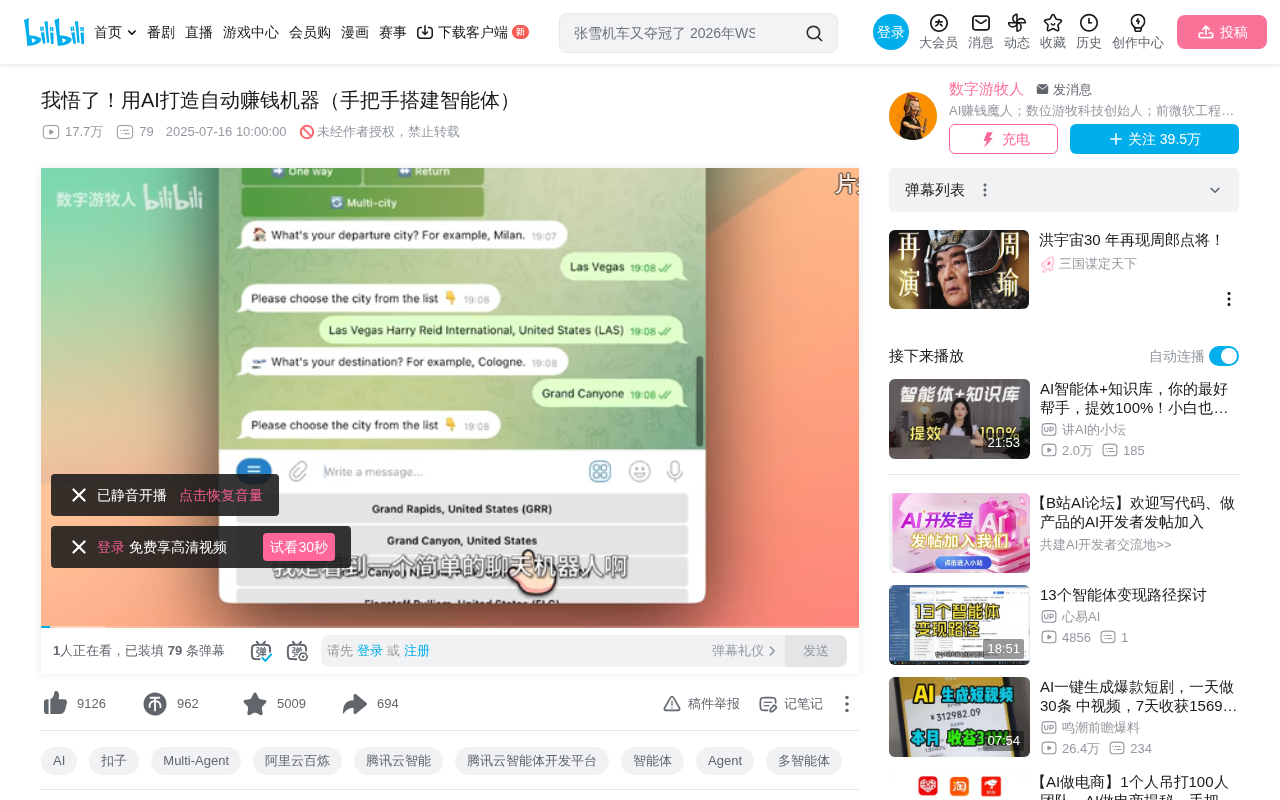
Starting from a flight query chatbot earning $7,000/month, this article breaks down how to build a full-pipeline automated money-making system using Multi-Agent architecture. The system consists of a Customer Service Agent (driven by RAG knowledge base for sales conversion), a Cashier Agent (automated payment via MCP protocol), and a Delivery Agent (plugin combinations for service delivery), covering the complete closed loop from customer acquisition, sales conversion, payment collection, to product delivery—all without human intervention.
Starting with a Chatbot That Makes $7,000/Month
A simple flight query chatbot called AirTrackBot has 2 million users and generates $7,000 in monthly revenue. This case reveals a fact that many people overlook: AI agents are turning seemingly trivial services into automated money-making machines.
An AI Agent refers to an AI system capable of autonomously perceiving its environment, making decisions, and executing actions. Unlike traditional chatbots that can only passively answer questions, Agents can proactively call external tools, access databases, and execute multi-step tasks. 2024 has been called the "Year of the Agent" by the industry, with OpenAI, Google, Anthropic, and other companies releasing Agent frameworks, while domestic platforms like Coze, Alibaba Cloud Bailian, and Tencent Cloud have quickly followed suit. The core capabilities of Agents include: planning (breaking complex tasks into subtasks), memory (maintaining context and long-term information), tool use (calling APIs and external services), and self-reflection (evaluating execution results and adjusting strategies).
From resume editing and compliment groups on Xianyu (China's secondhand marketplace) to various manual services, AI agents can automate the entire pipeline from customer acquisition, sales conversion, payment collection, to product delivery. This is no longer a distant future—it's a technical solution that can be implemented right now.
Full-Pipeline Automated Money-Making System: A Complete Case Study
Using a "Literary Youth Travel Planning Service" as an example, the entire automated workflow looks like this:
- Customer Acquisition: AI generates promotional content, precisely pushed to target users through algorithms
- Sales Conversion: After users send a private message, they receive an auto-reply link; the Customer Service Agent answers inquiries and closes deals
- Payment Collection: The Cashier Agent calculates prices, sends payment QR codes, and confirms receipt
- Product Delivery: The Delivery Agent calls weather, map, Deep Research, and other tools, combined with high-value knowledge bases (such as 500+ digital nomad spaces, independent bookstores, and other data), to create personalized travel plans for users
The entire process requires no human intervention, seamlessly completing the closed loop from consultation to delivery.
Multi-Agent Architecture: Core Principles of Multi-Agent Collaboration
Multi-Agent architecture originates from classic research in distributed artificial intelligence. Its core idea is to have multiple specialized Agents each handle their own responsibilities and collaborate to complete complex tasks. This is similar to departmental division in a company—each Agent focuses on its area of expertise (such as customer service, cashiering, delivery), achieving collaboration through clear communication protocols and task handoff mechanisms. Currently, mainstream Multi-Agent frameworks in the industry include Microsoft's AutoGen, CrewAI, LangGraph, and others. In terms of implementation, there are two main paradigms: centralized orchestration (where a master Agent dispatches other Agents) and decentralized collaboration (where Agents autonomously coordinate through message passing). Commercial platforms typically provide visual orchestration interfaces to lower the barrier to entry.
Platform Selection and Configuration Differences
Implementing the above workflow requires multiple Agents working together—the Multi-Agent pattern. Current mainstream platforms differ significantly in their implementation approaches:
- Coze, Alibaba Cloud Bailian: Use workflow orchestration, configuring strict logic through nodes and connections, with a certain learning curve
- Tencent Cloud Agent Development Platform: Uses a simpler approach—add all relevant Agents, set up handoff relationships, and describe the scheduling logic in natural language
For beginners, the natural language description approach clearly has a lower barrier to entry, but workflow orchestration offers stronger controllability in complex scenarios.
Building the Three Core Agents
Customer Service Agent: Knowledge Base-Driven Sales Conversion
The core of the Customer Service Agent is the knowledge base. Setup steps:
- Prepare documents: Clearly describe service offerings, past excellent cases, and core advantages
- Upload to knowledge base: Supports Word, spreadsheets, PDF, PPT, and other formats
- Set the role: "You are a top-tier sales customer service representative, strictly referencing the knowledge base, professionally answering questions and promoting services"
Key tip: The knowledge base needs continuous iteration—constantly add common user questions and pain points to form a positive feedback loop of "learning from battle."
The core technology behind the "knowledge base" is RAG (Retrieval-Augmented Generation). RAG works as follows: first, documents are split into small chunks and converted into vector embeddings, stored in a vector database; when a user asks a question, the system first finds the most relevant document fragments through semantic retrieval, then provides these fragments as context for the large model to generate answers. This approach solves two core problems of large models: first, the knowledge cutoff date limitation (training data has a time boundary), and second, the hallucination problem (models may fabricate non-existent information). The quality of the knowledge base directly determines the accuracy and professionalism of Agent responses, making continuous knowledge base iteration the key to building core competitiveness.
Regarding knowledge base support, different platforms have their own features: Coze supports internet content sources like Notion and WeChat Official Accounts; Tencent Cloud Agent Development Platform supports one-click upload of multi-format documents (including web files, image-text mixed PDFs), and can even have AI use images from the knowledge base to provide illustrated answers.
Cashier Agent: Automated Payment Collection via MCP Tool Calling
The core of the Cashier Agent is the large model's tool-calling capability (MCP).
MCP (Model Context Protocol) is an open standard protocol proposed by Anthropic in late 2024, designed to provide large language models with a unified way to access external tools and data sources. Before MCP, each AI platform had its own plugin/tool-calling interface, requiring developers to repeatedly build adaptation layers for different platforms. MCP's design philosophy is similar to the USB interface—providing a standardized "plug-and-play" protocol that allows AI models to connect to databases, APIs, file systems, and other external resources in a unified way. Large models determine when to call these tools through the Function Calling mechanism and automatically generate the correct calling parameters.
Specific implementation:
- Tencent Cloud Agent Development Platform: Connect to WeChat Pay MCP
- Alibaba Cloud Bailian: Connect to Alipay MCP
- Only two plugins needed: Generate payment QR code + Check payment status
- Combined with prompts to achieve automated payment collection
Delivery Agent: Plugin Combinations for Service Delivery
The Delivery Agent has two modes:
Mode 1: Connect to Existing Business Create custom plugins to let AI call your API interfaces, integrating with existing business systems.
Mode 2: Deliver Directly Using Agent Capabilities Build services directly through the combination of large model + knowledge base + plugins. For example, the case study used Tencent Maps, weather, and Deep Research plugins, plus knowledge base spreadsheets containing differentiated data. When complex requirements are specified in the prompts, the large model autonomously thinks and precisely calls multiple plugins to complete tasks.
Deep Research is a capability that allows AI to autonomously conduct multiple rounds of web searching, information integration, and analysis. Unlike ordinary single searches, Deep Research works like a human researcher: first formulating a research plan, then searching for information across different dimensions step by step, cross-verifying multiple sources, and finally generating a structured research report. In travel planning scenarios, Deep Research can automatically search for the latest information about destinations (such as newly opened restaurants, temporarily closed attractions, local events, etc.), compensating for the timeliness limitations of static knowledge bases and providing users with more fresh and personalized recommendations.
Workflow Orchestration: Best Practices for Fixed-Process Scenarios
When services need to follow a fixed process (AI shouldn't be allowed to improvise), you need to build a workflow. Using "paid news articles" as an example:
- Let users choose a news topic
- Generate preview content
- User pays
- Generate the complete news article
Workflow orchestration is essentially an implementation of a Finite State Machine. In traditional software engineering, workflow engines (such as Airflow, Temporal) are widely used to orchestrate complex business processes. AI workflow orchestration inherits this concept but adds the intelligent judgment capability of large models—at each node, AI can dynamically decide the next step based on user input. The advantage of workflows lies in determinism and controllability: the input and output of each step are explicit, making debugging and auditing easy. However, the disadvantage is also obvious—insufficient flexibility, making it difficult to handle unexpected user behavior.
The Fatal Flaw of Workflows and Solutions
Traditional workflows have a fatal problem: What if the user changes their mind midway? If the user wants to switch topics halfway through, the AI won't respond, and the only option is to refresh the page and start over. The essence of this problem is that the state machine lacks reverse transition paths—once the state advances forward, it cannot revert to a previous node.
Currently, based on testing, only Tencent Cloud Agent Development Platform supports intelligent workflow node rollback—when users indicate they want to change topics, the system automatically rolls back to the corresponding node and re-executes, providing a more user-friendly experience. This "intelligent rollback" feature essentially adds natural language understanding-based reverse transition capability to the state machine, where the system can identify the user's rollback intent and locate the correct historical node.
Practical Advice: How to Start Building Your Automated Money-Making System
Six months ago, almost no one was discussing Agents, but now Agents can accomplish many practical tasks. The pace of development in this field far exceeds most people's reaction speed.
Practical recommendations:
- Don't wait for perfection before starting—first find one step in your daily work to replace with an Agent
- The knowledge base is your core competitive advantage—continuously accumulate differentiated data
- Choose a platform that matches your technical level to lower the building barrier
- Focus on the full-pipeline closed loop, not single-point optimization
The technology is ready. The real challenge lies in finding the right scenarios and sustainable business models. Those seemingly insignificant services on Xianyu might just be the starting point for the next automated money-making machine.
Key Takeaways
- Multi-Agent architecture can automate the entire pipeline from customer acquisition, sales, payment collection, to delivery—without human intervention
- The Customer Service Agent's core lies in continuous iteration of the knowledge base (RAG technology); the Cashier Agent relies on MCP tool calling for automated payment collection
- Different platforms (Coze, Alibaba Cloud Bailian, Tencent Cloud) differ significantly in Multi-Agent configuration approaches; natural language scheduling has a lower barrier to entry
- Workflow mode suits fixed-process scenarios, but attention must be paid to the rollback problem when users change their minds midway (reverse transitions in finite state machines)
- AI Agent technology has matured to the point where various small services on secondhand marketplaces can be turned into automated business closed loops
Related articles
 Tutorials
Cursor + Codex Dual-IDE Collaboration: A Practical Methodology for Open-Source Project Customization
A complete methodology for open-source project customization based on real-world experience, detailing the Cursor+Codex dual-IDE workflow, seven-stage process, MVP validation, and AI source code reading techniques.
 Tutorials
Cursor Multi-Agent in Practice: Building a Full-Stack Next.js Blog in 50 Minutes
Build a full-stack blog in 50 minutes using Cursor IDE's multi-Agent mode with Next.js, Clerk auth, and Supabase. Learn the 4-phase AI Agent workflow and key integration pitfalls.
 Tutorials
Building an AI Software Factory from Scratch: A Cursor Engineer's Hands-On Experience with Multi-Agent Collaboration
Cursor engineer Eric shares practical insights on building an AI software factory: automation levels, guardrail design, parallel Agent management, and scaling to 1000+ Agents for 24/7 development.