Building WeChat Mini Programs with AI from Scratch: A Complete Vibe Coding Walkthrough
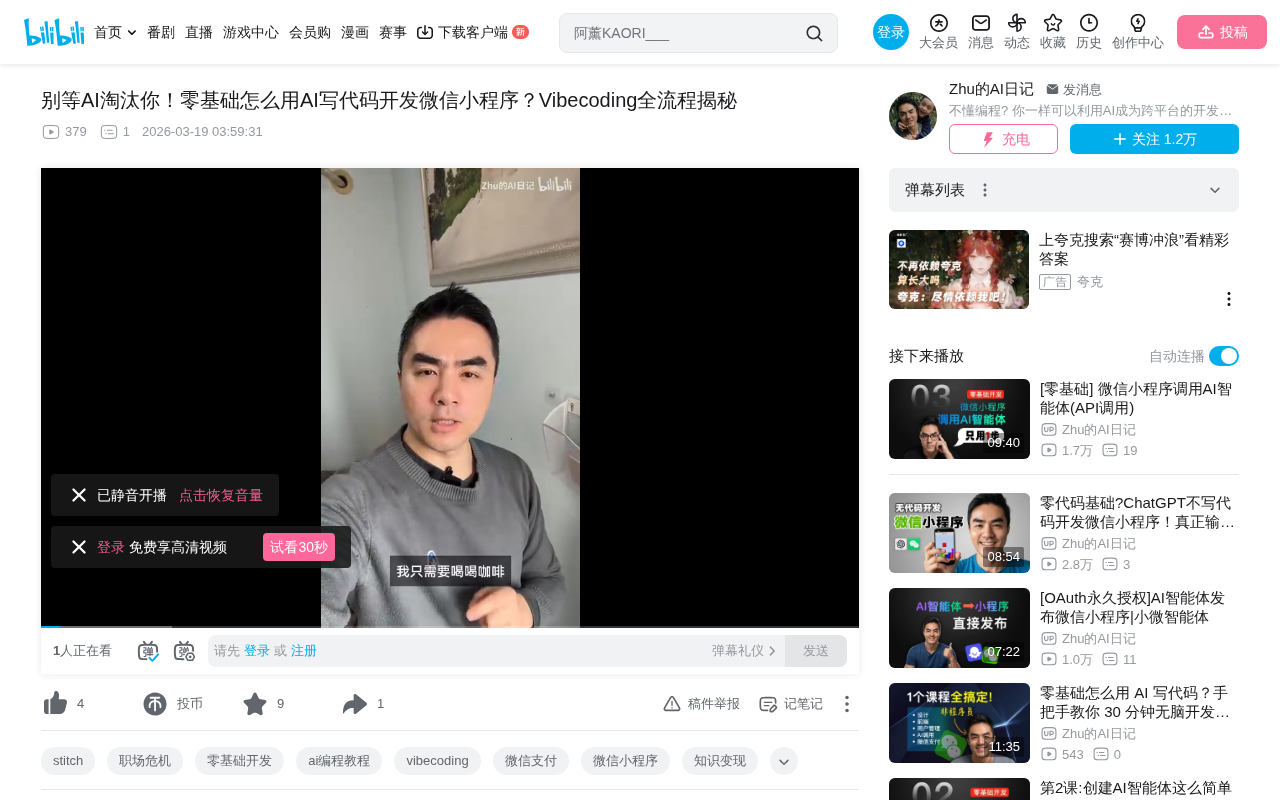
Vibe Coding lets non-programmers build functional apps by describing requirements to AI in natural language.
Vibe Coding is a new paradigm for developing applications through natural language conversations with AI, requiring no programming background. Using WeChat Mini Program development as an example, this article introduces a three-step workflow: generating UI designs with AI tools, converting designs to frontend code with prompts, and implementing backend features with SDK plugins. The author emphasizes that the right approach to AI isn't letting it replace your work, but mastering the ability to harness AI to create new value — representing the broader trend of democratizing technical capability.
Why You Need to Learn Vibe Coding
Recently, discussions about AI replacing human jobs have intensified. Many people fantasize about having AI agents completely take over their work while they sip coffee and wait for results. But this thinking has a fatal logical flaw: If AI can truly replace you entirely, why would your boss still need to hire you?
Deploying an AI tool costs far less than employing a person. Therefore, the right approach isn't to let AI replace your job, but to master the ability to harness AI — creating new value for yourself beyond your current role.
Vibe Coding is precisely this kind of capability — it enables people with zero technical background to develop genuinely usable applications with AI assistance, solving real-world needs and even achieving commercial monetization.
What Is Vibe Coding?
Core Concept: Developing Apps Without Writing Code
Vibe Coding is an entirely new development paradigm. The core idea is to describe your requirements in natural language and let AI handle all the technical work from design to coding. You don't need to know programming languages, frontend frameworks, or even UI design — you just need to clearly know what you want.
This term was first coined by OpenAI co-founder Andrej Karpathy in early 2025. He described a completely new way of programming: developers fully immerse themselves in the "vibe," building software through conversations with AI rather than writing code line by line. The concept quickly sparked heated discussion in the tech community because it represents a paradigm shift in software development from "precise instructions" to "intent expression." Traditional programming requires developers to master syntax rules, data structures, and algorithmic logic, while Vibe Coding encapsulates these technical details within AI models, letting humans focus solely on "what they want" rather than "how to implement it."
This approach is particularly suited for scenarios like:
- Developing AI-powered customer service: Reducing enterprise operational costs
- Automated product listing tools: Improving e-commerce workflow efficiency
- Sales-oriented mini programs: Monetizing knowledge or creative works
How It Differs from Traditional AI Agents
Current AI agent tools on the market (various automation Agents) don't truly boost productivity for most people. AI Agents are artificial intelligence systems designed to autonomously perceive their environment, make decisions, and execute tasks — typically engineered to complete complex workflows end-to-end. However, in reality, these agent tools often require extensive configuration, debugging, and supervision, with limited reliability and consistency. Tasks you spend hours debugging an AI agent to complete can often be done more efficiently with familiar AI-assisted tools. The advantage of Vibe Coding is that it doesn't let AI work for you — it gives you an entirely new creative capability. You remain the decision-maker and creator; AI is merely the tool that executes your intent.
The Complete Vibe Coding Workflow for WeChat Mini Programs
Step 1: UI Design — Generate Professional Interfaces with Plain Language
In traditional development, UI design requires professional designers using tools like Figma to meticulously craft interfaces. In the Vibe Coding workflow, you can use AI design tools like Stitch — simply describe the interface you want in natural language and instantly receive a professional-grade application interface mockup.
The underlying technology of AI design tools like Stitch combines multimodal large language models with diffusion models. They can understand spatial relationship descriptions in natural language (such as "top," "grid layout") and map them to visual elements that conform to modern UI design standards. These tools are typically trained on vast quantities of excellent application interfaces, internalizing rules from mainstream design systems like iOS Human Interface Guidelines and Material Design, so generated interfaces naturally possess a professional feel. Compared to traditional design tools like Figma and Sketch, AI design tools compress the design cycle from days to minutes, dramatically reducing the time cost of product prototype validation.
For example, you simply say "I need a clean product display page with a search bar at the top, a grid layout of product cards in the middle, and a shopping cart navigation at the bottom," and the AI generates the corresponding design.
Step 2: Frontend Development — Convert Designs to Code with One Set of Prompts
Once you have the design generated by Stitch, you only need to use a specific set of prompts to convert the design into WeChat Mini Program frontend code. The entire process is copy-and-paste — you don't need to understand what the code means, and the frontend interface is perfectly implemented.
The key to this step is prompt quality. Prompt Engineering is one of the most critical skills in current AI applications. In Vibe Coding scenarios, prompt quality directly determines the accuracy and usability of AI-generated code. Excellent prompts typically contain several elements: clear functional descriptions, specific technical constraints (such as "generate WeChat Mini Program WXML and WXSS code"), and expected code style and structural requirements. The industry has already developed best practices, such as describing complex requirements step by step, providing reference examples, and explicitly specifying output formats. The essence of prompt engineering is transforming human ambiguous intent into precisely executable instructions for AI. Good prompts enable AI to accurately understand design intent and generate mini program page code with clear structure and precise styling.
The WeChat Mini Program frontend tech stack includes WXML (a markup language similar to HTML), WXSS (a styling language similar to CSS), and a JavaScript logic layer. While you don't need to write this code by hand, understanding this basic structure helps you more accurately describe modification requirements when AI-generated code has issues.
Step 3: Backend Functionality — SDK Plugins with a Single Sentence
Backend development is usually the most daunting part for non-technical people, but in the Vibe Coding system, it's actually the simplest step. Common backend features for WeChat Mini Programs all have corresponding SDK plugin packages:
- WeChat One-Click Login: Call the corresponding SDK, implemented with a single sentence
- User Management System: Quickly built through plugin packages
- AI Model Integration: Integrate large language model capabilities
- WeChat Pay: Connect payment functionality to complete the business loop
SDK (Software Development Kit) is essentially pre-packaged functional modules that developers can call without understanding the underlying implementation details. WeChat officially provides core SDKs including login authentication, payment interfaces, cloud development, and subscription messages, while the third-party ecosystem offers extended capabilities like data analytics, AI model integration, and content moderation. WeChat Cloud Development (CloudBase) further simplifies backend work like server operations and database management — you don't need to purchase and configure servers or set up databases; all infrastructure is hosted by the WeChat platform. Combined with the Vibe Coding approach, this brings the barrier to complete application development to an unprecedented low.
Every backend feature requires zero hand-written code — you just tell the AI what functionality you want to implement, and it's done with the corresponding SDK plugin.
Feasibility Analysis for Zero-Background Learners
Is the Learning Barrier Really Zero?
From a technical operations perspective, Vibe Coding has indeed dramatically lowered the development barrier. But it's important to note objectively that "zero background" doesn't mean "zero learning." You still need to:
- Understand basic product logic: Know what functional modules an application needs, understand the basic concept of User Flow, and be able to decompose a complete requirement into independent modules like login, browsing, interaction, and payment
- Master prompting techniques: Learn how to accurately describe requirements, including using specific rather than vague language, providing sufficient context, and learning to iteratively optimize AI output
- Understand basic debugging workflows: When AI-generated code has issues, know how to provide feedback and corrections. Debugging doesn't require you to read code, but it does require you to accurately describe "what's wrong" and "what it should look like" — this ability is essentially a structured communication skill
Time and Cost Considerations
For someone with absolutely no technical background, going from zero to having a mini program running on their phone can indeed be achieved in a relatively short time following a structured learning path. The key is having a clear learning roadmap and a concrete project goal, rather than exploring aimlessly.
From a cost perspective, WeChat Mini Program development and operation costs are relatively low: individual developers can register a mini program account for free, WeChat Cloud Development provides a free basic quota, and AI tool costs continue to decline. By comparison, outsourcing the development of a mini program with similar functionality traditionally costs tens of thousands of yuan, while completing it independently through Vibe Coding can reduce development costs to virtually zero.
Conclusion and Recommendations
Vibe Coding represents an important trend: the democratization of technical capability. From a historical perspective, this trend isn't appearing for the first time: in the 1980s, personal computers brought computing power out of laboratories; in the 2000s, WordPress and other CMS platforms let non-technical people build websites; in the 2010s, Shopify enabled ordinary people to open online stores. Vibe Coding represents the latest stage of this trend — the democratization of application development capability. Gartner predicts that by the end of 2025, 70% of new applications will be developed using low-code/no-code technologies, meaning the "Citizen Developer" population will expand dramatically.
It won't make programmers obsolete — just as Excel didn't make accountants obsolete, and WordPress didn't make web designers obsolete — but it will enable more non-technical people to turn ideas into products. Professional programmers' value will increasingly be reflected in higher-level work like architecture design, performance optimization, and security assurance, while basic application building will increasingly be completed with AI assistance.
For those looking to get started, I recommend beginning with a specific, small-scale real need — such as a simple information display mini program — and walking through the complete process from design to launch. When you first see an application you "developed" running on your phone, you'll truly understand the enormous potential of AI-empowered individual creativity.
Key Takeaways
- Vibe Coding enables zero-background users to develop WeChat Mini Programs by describing requirements in natural language, with no hand-written code required throughout the process
- The development workflow has three steps: generate UI designs with Stitch, convert to frontend code with prompts, and implement backend features with SDK plugins
- The right approach to AI isn't letting it replace your work, but mastering the ability to harness AI to create new value for yourself
- Backend features including WeChat login, user management, AI integration, and WeChat Pay can all be implemented with SDK plugins in a single sentence
- Zero background doesn't mean zero learning — you still need to understand product logic, master prompting techniques, and develop basic debugging skills
Related articles
 Tutorials
Cursor + Codex Dual-IDE Collaboration: A Practical Methodology for Open-Source Project Customization
A complete methodology for open-source project customization based on real-world experience, detailing the Cursor+Codex dual-IDE workflow, seven-stage process, MVP validation, and AI source code reading techniques.
 Tutorials
Cursor Multi-Agent in Practice: Building a Full-Stack Next.js Blog in 50 Minutes
Build a full-stack blog in 50 minutes using Cursor IDE's multi-Agent mode with Next.js, Clerk auth, and Supabase. Learn the 4-phase AI Agent workflow and key integration pitfalls.
 Tutorials
Building an AI Software Factory from Scratch: A Cursor Engineer's Hands-On Experience with Multi-Agent Collaboration
Cursor engineer Eric shares practical insights on building an AI software factory: automation levels, guardrail design, parallel Agent management, and scaling to 1000+ Agents for 24/7 development.