Claude Account False Ban Incident: Anthropic's Emergency Fix, Impact, and Full Analysis
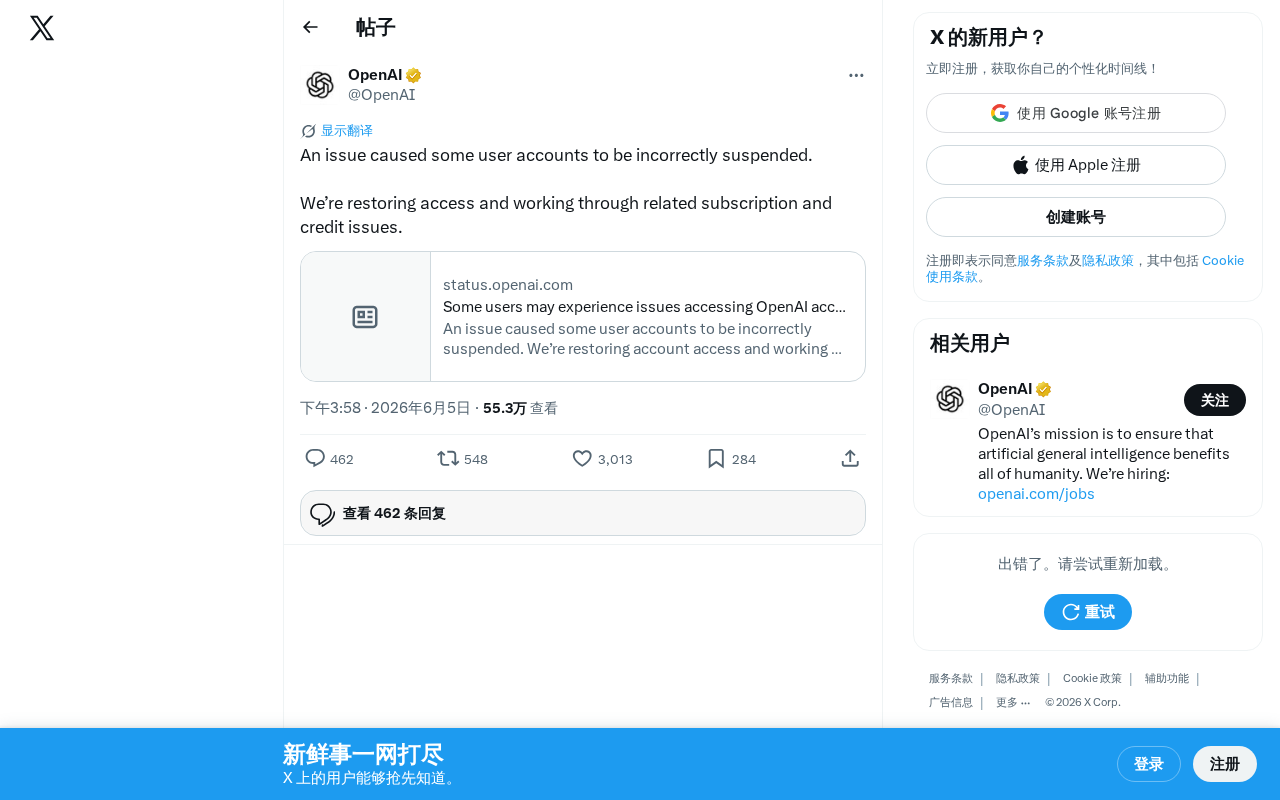
Anthropic confirms and fixes a bug that incorrectly suspended Claude user accounts and affected subscriptions.
Anthropic acknowledged a technical issue that caused some Claude accounts to be incorrectly suspended, affecting access, subscriptions, and credits. The company responded quickly with transparent communication and began restoring affected accounts. The incident highlights growing challenges around AI service reliability, automated trust and safety systems, and the need for stronger user rights protections as AI tools become essential productivity infrastructure.
Incident Overview
Anthropic (the developer of Claude) recently posted an announcement on social media confirming that a technical issue caused some users' Claude accounts to be incorrectly suspended. The company stated it is actively restoring access for affected users while simultaneously addressing related subscription and credit issues.
Anthropic was founded in 2021 by siblings Dario Amodei and Daniela Amodei, with Dario previously serving as VP of Research at OpenAI. The company centers its mission on "AI safety" and developed the Constitutional AI technical framework, which reduces the risk of harmful outputs by having AI systems self-regulate. As of 2024, Anthropic has secured multiple rounds of massive funding from investors including Google and Amazon, with a valuation exceeding tens of billions of dollars, making it one of OpenAI's primary competitors in the large language model space.
The incident quickly drew widespread attention from the Claude user community, with paid subscribers in particular expressing strong concerns about account security and service reliability.
Impact Analysis
Direct Impact on Users
Having a Claude account incorrectly suspended means users were completely unable to access the service for a period of time. For developers, content creators, and enterprise users who rely on Claude for daily work, this sudden service interruption could cause real productivity losses.
It's worth noting that Claude currently offers a free tier, a Pro subscription ($20/month), and enterprise-facing API services. Pro users receive higher usage quotas and priority access to the latest models (such as Claude 3.5 Sonnet, Claude 3 Opus, etc.). API users are billed by token consumption, with credits being the core of their prepaid mechanism. This means the false ban incident affected users at different tiers to varying degrees.
More notably, Anthropic specifically mentioned "subscription and credit issues" in their announcement — indicating that the false bans not only affected account access but may have also caused:
- Anomalies in paid users' subscription status
- Credits being incorrectly deducted or rendered unusable
- Historical conversation records becoming temporarily inaccessible
Platform Trust Under Scrutiny
In today's increasingly competitive AI services landscape, the impact of the Claude false ban incident on platform reputation cannot be overlooked. When users choose to pay for an AI service subscription, they are essentially casting a vote of confidence in the platform's stability and reliability. While such incidents are not uncommon among internet services — Google, Twitter, and other major platforms have all experienced similar false ban issues — for Anthropic, which is in a rapid growth phase, how well they handle the aftermath will directly affect user retention.
Looking at industry precedents, large-scale false bans are not isolated events. In 2021, Google's automated systems malfunctioned and incorrectly terminated numerous developers' Google Play accounts. In 2023, Twitter (now X) experienced batch account status anomalies during platform migration. These incidents share common characteristics: the fragility of automated systems operating at scale, and the complexity of post-incident recovery processes — since ban operations often involve cascading state changes across multiple subsystems.
Technical Background: How Account Suspension Systems Work
To understand this false ban incident, it helps to understand the basic principles behind account suspension systems at large internet platforms. These systems are typically driven by automated Trust & Safety systems, powered by rule engines and machine learning models that monitor user behavior in real-time for violations of terms of service. Common triggers include abnormal login patterns, sudden spikes in API call frequency, and content violation detection.
When the system's False Positive Rate fluctuates, it can lead to large-scale false bans. Such issues typically stem from risk model updates, threshold configuration errors, or underlying data anomalies. For a rapidly growing platform like Anthropic, the sharp expansion of the user base may render existing risk control parameters inadequate, thereby increasing the probability of false triggers.
Anthropic's Response
Based on the official announcement, Anthropic's response speed deserves recognition. After discovering the issue, the company quickly issued a public statement through official channels, clarifying three key points:
- Problem classification: Explicitly acknowledged this was "incorrect suspension" caused by a system issue, not user violations
- Immediate action: Actively restoring access for affected accounts
- Follow-up handling: Simultaneously resolving subscription and credit issues caused by the false bans
This transparent, direct communication approach reflects Anthropic's maturity in crisis management. However, the company has not yet disclosed the following critical information:
- The specific scale of affected users
- The root technical cause of the problem
- The estimated timeline for complete resolution
This information remains crucial for affected users.
Implications for the AI Services Industry
Service Reliability as a Core Competitive Advantage
As AI tools transition from "novelty toys" to "productivity tools," user expectations for service availability are rising dramatically. In the cloud computing and SaaS industry, Service Level Agreements (SLAs) are the core metric for measuring platform reliability. The industry typically measures availability in "nines" — 99.9% allows approximately 8.76 hours of downtime per year, while 99.99% allows only about 52 minutes. Currently, mainstream AI service providers like OpenAI and Google Gemini have not yet offered strict SLA commitments comparable to traditional cloud services (AWS, Azure), reflecting that the AI services industry still has room to improve in infrastructure maturity.
A single false ban incident may be just a minor technical glitch, but it reflects deeper challenges in AI service infrastructure development — how to ensure the stability and reliability of underlying account systems and billing systems while rapidly iterating on product features. As more enterprises deeply integrate AI tools into their workflows, the cost of service interruptions will grow exponentially.
User Rights Protection Mechanisms Need Improvement
This incident also reminds the entire AI industry that service providers need to establish more comprehensive user rights protection mechanisms, including:
- Providing clear appeal channels and rapid recovery processes when accounts are incorrectly suspended
- Offering appropriate compensation to paid users for service interruptions caused by platform failures
- Building more transparent account status notification systems so users are informed of anomalies immediately
- Developing and publishing service level agreements that clearly define platform responsibilities and compensation standards during service interruptions
Summary and Recommendations
While the Claude account false ban incident was a technical failure, Anthropic's rapid response and transparent communication deserve recognition.
Recommendations for affected users:
- Closely follow Anthropic's subsequent official announcements
- Verify that your account status, subscription, and credits have been fully restored
- If issues persist, promptly provide feedback through official customer service channels
This incident also serves as a reminder that in an era of increasing dependence on AI services, maintaining backup plans for critical workflows is always wise. Whether it's Claude, ChatGPT, or any other AI tool, relying solely on any single platform carries risk. Strategically configuring multiple AI tools as complementary solutions is the best way to minimize the impact of unexpected outages.
Key Takeaways
Related articles

Five Common Claude Code Mistakes — How Many Are You Making?
Five common Claude Code mistakes developers make: copy-pasting code, skipping CLAUDE.md, inefficient prompting, ignoring docs, and poor context management — with fixes.
Andrew Ng's New Course Explained: A Practical Guide to Using OpenAI's O1 Reasoning Model
Deep dive into Andrew Ng and OpenAI's Reasoning with O1 course covering test-time scaling, new prompting paradigms, multi-model orchestration, and practical applications for developers.

Learning AI After College Entrance Exams: A Complete Path from Zero to Freelancing
How to efficiently learn AI skills during summer break after exams? A complete path from mastering prompts and hands-on projects to freelancing on platforms.