Claude AI Builds a FiveM Server from Scratch: Full RP Server Setup Test

Testing Claude AI's ability to build a full FiveM RP server from scratch — capabilities and limitations revealed.
A YouTube creator tested Claude AI building a complete FiveM RP server from an empty folder using VS Code. Claude successfully deployed the Qbox framework, economy system, police jobs, housing, and phone system in phases, demonstrating strong project management and integration skills. However, it struggled with webpack build dependencies and produced a server that still lacks the depth of a truly competitive custom RP server.
Can an Empty Folder Become a Fully Functional FiveM Game Server?
FiveM is the most popular multiplayer framework for GTA V, developed and maintained by CitizenFX Collective. It allows players to play on fully customized servers, independent of Rockstar's official GTA Online service. Building a fully functional RP (roleplay) server typically requires weeks or even months of development work — because a mature RP server needs an economy system, job system, housing system, vehicle management, communication tools, and dozens of other interconnected subsystems, making the development complexity comparable to a mid-sized web application. YouTube creator HighwayTrooper ran a bold experiment — having Claude AI (upgraded from Sonnet 3.5 to Claude 4) directly control a computer through VS Code, starting from an empty folder to build a FiveM server complete with an economy system, police jobs, housing, phone system, and more.
The results were both impressive and revealing of AI development's real boundaries.
From Empty Folder to Bootable Server: AI's First Steps
Intelligent Guided Development Workflow
The experiment started simply: an empty folder named "Wuhama Silver" on the desktop. The creator used Claude in VS Code, providing a detailed prompt explaining the need to build a custom RP server with an economy system, inventory, housing, police jobs, and phone functionality.
Claude demonstrated professional-level competence from the start. It first scanned the computer environment, automatically detected the installed MariaDB, Node.js, and Git, then asked several key architectural decision questions:
- Framework selection: Offered four options — Qbox, QB Core, ESX, and building from scratch — and recommended Qbox. Each framework has its own characteristics: ESX was the earliest FiveM framework with the most mature ecosystem but aging code; QB Core came later with a more modern code structure; and Qbox is a community fork of QB Core with extensive optimizations and refactoring, considered the most advanced current option. Claude's recommendation of Qbox shows it has accurate knowledge of the latest developments in the FiveM ecosystem.
- Build strategy: Suggested building in phases, starting with the core framework and gradually adding features
- Environment check: Confirmed FiveM runtime environment and server license status
This guided development approach was very smart — rather than blindly starting to write code, it acted like an experienced developer, confirming the technical plan before getting to work.
FiveM Base Setup Completed in 10 Minutes
After confirming the plan, Claude began working autonomously. In roughly 10 minutes, it completed the following:
- Downloaded and configured the FiveM server runtime environment
- Created the MariaDB database and all necessary tables. MariaDB handles persistent data storage in FiveM servers — player character info, bank balances, owned vehicles, property data, inventory items, and more all need to be stored in the database to ensure data isn't lost when players log off. FiveM frameworks typically use resources like oxmysql as database connection middleware, bridging Lua scripts with SQL databases.
- Deployed the complete Qbox framework and OX Stack (a high-performance base library suite including ox_lib, ox_inventory, ox_target, etc., providing inventory management, interaction targets, UI components, and other foundational functionality)
- Wrote the Server.cfg configuration file with the correct load order. This step is crucial — FiveM uses the 'ensure' command to start resources, and resources have complex interdependencies. If the load order is wrong, it causes cascading failures like resource initialization errors and uncreated database tables. Correctly orchestrating the load order of dozens of resources is one of the most error-prone aspects of FiveM server setup.
- Generated startup scripts and setup guides
The only thing the creator needed to do manually was go to the CFX portal to get a license key and paste it into the configuration file. After the server's first boot, although there were some warnings about missing database tables, core functionality was already working — multi-character selection and the inventory system (F2 key) both functioned properly.
Gradual Feature Completion: Economy System, Jobs, and Housing
AI Auto-Testing and Error Fixing
During the second phase of development, an impressive detail emerged: Claude wasn't just writing code — it was also automatically starting the server and checking console output to verify whether there were errors. This self-validation capability significantly reduced the need for manual debugging.
Features added in Phase 2 included: appearance/clothing system, banking system (with UI), vehicle keys, boss menu, medical system, and police and EMS jobs. The economy system was fully operational — new characters defaulted to 500 cash and 5,000 in bank deposits.
Bugs and Iterative Fixes During Testing
A typical issue was discovered during testing: as a police character, the armory door was locked and inaccessible. After the creator reported this bug to Claude, it automatically fixed the door lock issue in Phase 3, while also adding a housing system — including apartment selection, garages, and decoration features.
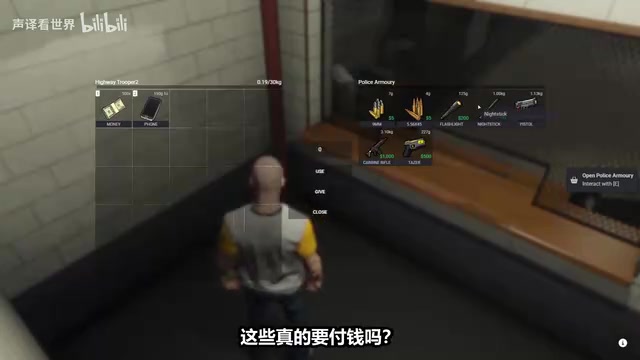
You might not have noticed, but Claude wasn't using entirely custom-developed scripts — it was integrating existing open-source resources (like the QBX housing system). However, being able to correctly combine these components, handle dependencies, and ensure they work together is no small engineering feat in itself.
Phone System Installation: AI Hits Its Biggest Challenge
Dependency Build Issues Cause a 20-Minute Stall
Phase 4's goal was to install the phone system, and this was the part where Claude struggled the most throughout the entire experiment. The AI got stuck in a loop trying to install the screenshot-basic dependency — webpack builds kept failing, the Node process CPU usage dropped to 0%, completely stalling.
screenshot-basic is a foundational FiveM resource for capturing game screenshots — the phone system's camera functionality, avatar photos, and more all depend on it. This resource uses Node.js and webpack for frontend builds, requiring compilation of the NUI (NativeUI, FiveM's browser-embedded UI framework) interface. webpack is one of the most complex build tools in the JavaScript ecosystem, with dependency trees that can reach hundreds of levels deep. Version conflicts, corrupted node_modules, and platform compatibility issues can all cause build failures. These kinds of problems often require extensive troubleshooting even for experienced human developers.
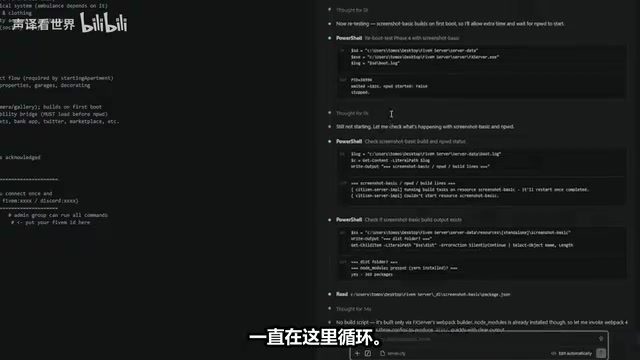
The creator waited nearly 20 minutes while Claude continuously tried different solutions and also discovered missing dependencies like PMA Voice (the most commonly used voice communication resource in FiveM). This is a very realistic development scenario — dependency management and build tool issues are often the most time-consuming part.
Claude eventually solved the problem, and the phone system ran successfully. Testing showed that calls, texts, and camera functionality all worked, and the built-in browser could even open real websites — a detail that surprised even the creator.
Final Optimization and Complete Feature List
AI Planning Ability with Vague Requirements
For the final phase, the creator deliberately used vague language: "Optimize my server, get it ready for the community, I want loading screens, jobs, postal maps, cool UI, I want everything."
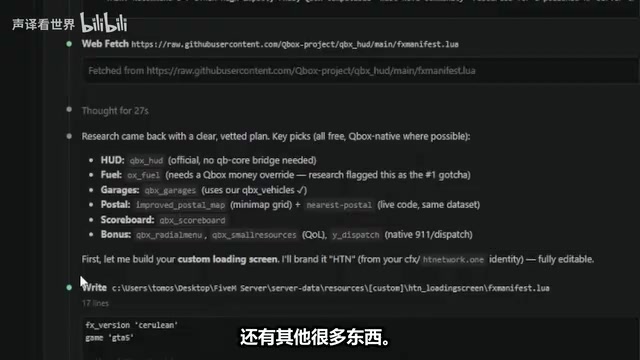
Claude's response strategy was to first conduct research, then develop a comprehensive plan including custom loading screens, HUD, fuel system, garages, postal system, scoreboard, and radial menu. It even scraped the creator's CFX account information to create branded customization for the loading screen.
Complete FiveM RP Server Feature Overview
The final product server included the following feature modules:
- Custom loading screen: With branded design
- Full HUD interface: Including hunger level, seatbelt status, and player location info
- Postal map system: Postal code map pulled from GitHub
- Fuel system: Fully functional gas stations with pump animations
- Housing system: Apartment selection, garages, interior decoration
- Police/EMS jobs: Armory, clock-in system
- Banking system: Deposit and withdrawal functionality with UI
- Phone system: Calls, texts, browser, camera
- Clean file organization: Resources organized by category in folders, Server.cfg clearly commented
However, there were notable shortcomings: limited job variety (only police and paramedic), lacking more civilian jobs; and some features were integrated from existing open-source scripts rather than fully custom-developed.
Build Cost and Practical Considerations
The entire experiment consumed approximately 150,000 tokens, for which the creator purchased the Claude Max plan (£75/month, approximately $95 USD). Tokens are the basic unit large language models use to measure input and output text volume — roughly 1-1.5 tokens per English word. 150,000 tokens is approximately equivalent to 100,000-120,000 English words of total input and output, translating to roughly 3,000-5,000 lines of code plus extensive contextual conversation and terminal interaction logs.
The creator also admitted that this server still falls short of a truly competitive custom RP server — lacking custom UI, more jobs, and deeply customized content.
At AI's consumption rate of 1,000-2,000 tokens per minute, a free plan likely couldn't even complete a single full script. This means that while building a FiveM server with AI is technically feasible, the economic cost of token consumption needs serious consideration. For large projects, AI subscription costs may approach or even exceed the short-term cost of hiring a junior developer for equivalent work, though AI's advantage lies in 24/7 availability and zero communication overhead.
The Real Capability Boundaries of AI-Built FiveM Servers
This experiment reveals AI's true capabilities in game server development:
- AI can indeed build a runnable FiveM RP server from scratch, including framework selection, dependency management, database configuration, and feature integration
- Excellent project management ability — the phased development, auto-testing, and error-fixing workflow was quite professional
- Complex build tools and dependency issues remain a weakness — the phone system installation took far longer than expected
- Better at integrating existing open-source resources than fully original development — most features came from correctly combining open-source scripts
For those looking to quickly prototype a FiveM server or learn FiveM development, Claude is a powerful assistive tool. But to build a truly competitive custom RP server, human developers' creativity and deep customization capabilities remain irreplaceable.
Key Takeaways
Related articles
Trae AI Coding Tool: Complete Guide to Download, Installation, and Getting Started
Complete guide to ByteDance's Trae AI editor: core features, download & installation, Python setup, and AI chat coding. Free, Chinese-native, no VPN needed.
Codex vs Claude Code Cost Comparison: Breaking Down the Real Reasons Behind the 10x Price Gap
Codex costs $15 vs Claude Code's $155 for the same task. We break down the 10x price gap across Token pricing, consumption, and work patterns with practical tips.

Interview with Claude Code Lead: AI Programming ROI Mindset, Loops, and the Evolving Role of Engineers
Claude Code lead Boris Cherny shares insights on 100% AI coding, ROI thinking frameworks, Loops automation, Fable model capabilities, and how engineers are shifting from coding to product intuition and system design.