Claude Code Chinese Manual: A Complete Guide from Installation to Hands-On Practice
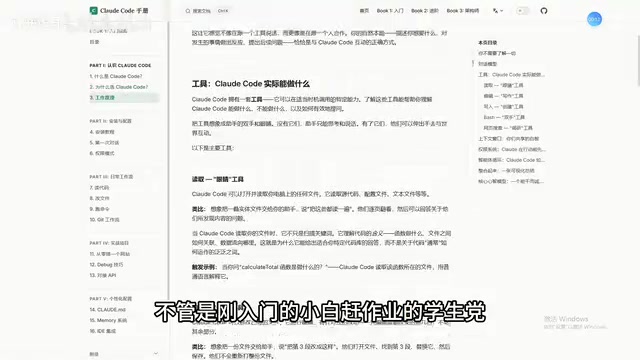
A comprehensive Chinese manual helps developers quickly master Claude Code's setup, commands, and workflows.
This article introduces a well-structured Claude Code Chinese manual designed to help developers overcome the English documentation barrier. It covers environment setup, core terminal commands, real-world project demonstrations, and common troubleshooting scenarios. The guide also explains Claude Code's technical foundations, including its agentic coding paradigm and RAG-based file retrieval, while offering practical advice on prompt engineering for effective AI-assisted development.
Recently, Claude Code has been gaining significant traction in the developer community. This AI programming tool can dramatically boost coding efficiency, but the English-only official documentation has deterred many Chinese-speaking users. Today, we introduce a well-regarded Claude Code Chinese manual to help you get started quickly with this tool.
Why Claude Code Deserves Your Attention
Claude Code is an AI programming assistant from Anthropic that helps developers write code, debug, and optimize projects directly within the terminal environment. Compared to traditional code completion tools, its core advantage lies in understanding the entire project context — not just a few lines in the current file.
From a technical standpoint, Claude Code is built on Anthropic's Claude large language model and represents the "agentic coding" paradigm. Unlike code-completion tools such as GitHub Copilot, Claude Code uses a terminal-native interaction approach, capable of directly executing shell commands, reading and writing to the file system, and running test suites. It is essentially an AI Agent with code execution capabilities. Anthropic, a major competitor to OpenAI, was founded by former OpenAI Research VP Dario Amodei. Its technical philosophy emphasizes AI safety and controllability, and the Claude model series excels in long-context understanding and instruction following — the technical foundation that enables Claude Code to comprehend large codebases.
AI programming tools have evolved through three stages: code completion, conversational programming, and agentic programming. The first stage, represented by TabNine and Kite, offered line-level completions. The second stage, represented by ChatGPT and Claude's chat interfaces, had developers copy-pasting code snippets for suggestions. The third stage includes tools like Claude Code, Cursor Agent, and Aider, where AI directly manipulates files and executes commands within the development environment. By choosing the terminal over IDE plugins, Claude Code achieves greater versatility — it doesn't depend on any specific editor and can integrate with any development workflow.
However, Claude Code's official documentation is currently available only in English, which poses a significant barrier for developers in China. Misunderstandings in installation, command usage, or parameter tuning can easily lead to pitfalls. That's why a well-structured Chinese reference manual is especially valuable.
What the Chinese Manual Covers
The value of this Claude Code Chinese manual lies in its systematic organization of scattered English documentation. It primarily covers the following modules:
Environment Setup and Basic Configuration
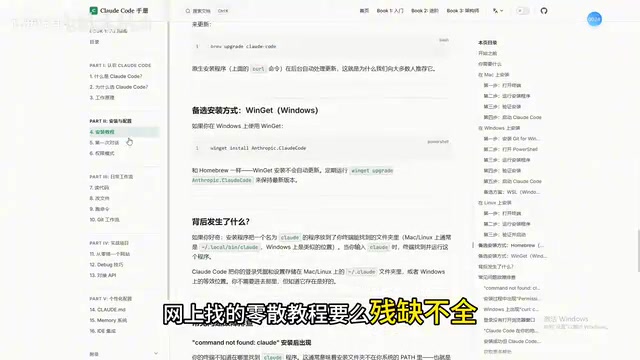
From preparing the Node.js environment and running Claude Code installation commands, to configuring API keys and initializing the terminal environment, the manual provides step-by-step illustrated instructions. Each step includes copy-ready command-line code, reducing the chance of installation failures due to typos or incorrect parameters.
Core Commands and Terminal Operations
The manual categorizes Claude Code's commonly used commands, covering scenarios such as project initialization, file operations, code generation and modification, and debugging. Each command comes with usage examples and parameter descriptions, making it easy for developers to quickly find what they need.
Hands-On Project Demonstrations
This is the highlight of the manual. Rather than simply listing commands, it demonstrates Claude Code's actual workflow through real project scenarios — including how to help the AI understand an existing codebase, how to describe requirements to generate high-quality code, and how to iterate and optimize through multi-turn conversations.
Claude Code's ability to understand entire project contexts relies on two key technologies: first, the Claude model's ultra-long context window (up to 200K tokens), which can process large volumes of code files at once; second, an intelligent file retrieval strategy where Claude Code automatically locates relevant files based on the user's query rather than feeding the entire codebase into the model at once. This RAG (Retrieval-Augmented Generation) approach maintains accuracy when handling large projects while keeping API call costs under control.
Common Issues and Bug Troubleshooting
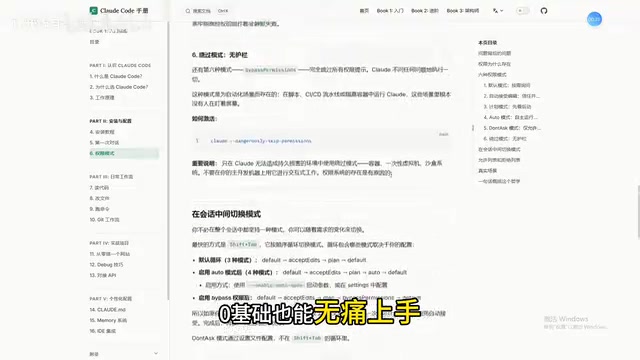
The manual compiles frequently encountered problems and their solutions, such as troubleshooting approaches for connection timeouts, permission configuration errors, and unexpected output results — offering practical reference value.
Who Is This Manual For?
Based on its content positioning, this Claude Code Chinese manual primarily targets the following user groups:
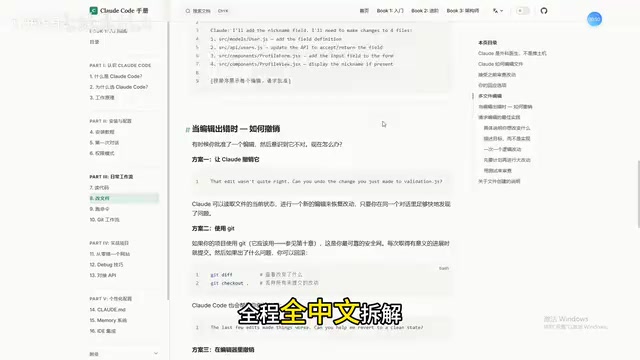
Programming beginners: Those unfamiliar with terminal operations and AI programming tools who need step-by-step guidance from scratch. The manual's combination of text and visuals lowers the entry barrier.
Developers with some experience: Those who already understand the concept of AI-assisted programming but lack systematic knowledge of Claude Code's specific usage and need a quick Chinese reference.
Requirement-driven programmers: Those whose core goal is improving work efficiency and who want to master practical tool tips in the shortest time possible, rather than diving deep into underlying principles.
Usage Tips and Caveats
It's worth noting objectively that any third-party manual faces timeliness issues. Claude Code itself is still rapidly iterating, and some features and commands may change with version updates. It's recommended to use Chinese manuals like this as an introductory reference, and after mastering the basics, gradually develop the habit of reading the official English documentation for the most accurate first-hand information.
Additionally, the effectiveness of AI programming tools largely depends on the quality of the user's prompts. Even with a comprehensive operations manual, learning to clearly and accurately describe requirements to the AI remains a skill that requires continuous practice. The tool is an aid — improving your thinking approach is what truly matters.
In Claude Code usage scenarios, effective prompts typically contain three elements: a clear task objective (what to do), constraints (tech stack, code style, performance requirements), and contextual information (relevant file paths, existing implementation logic). The industry refers to this ability to write prompts for AI programming tools as an "AI-native development skill," and it's becoming one of developers' core competencies. Anthropic also officially provides a CLAUDE.md project configuration file mechanism, allowing developers to codify project-level prompts for team-wide sharing.
Key Takeaways
Related articles

Five Common Claude Code Mistakes — How Many Are You Making?
Five common Claude Code mistakes developers make: copy-pasting code, skipping CLAUDE.md, inefficient prompting, ignoring docs, and poor context management — with fixes.
Andrew Ng's New Course Explained: A Practical Guide to Using OpenAI's O1 Reasoning Model
Deep dive into Andrew Ng and OpenAI's Reasoning with O1 course covering test-time scaling, new prompting paradigms, multi-model orchestration, and practical applications for developers.

Learning AI After College Entrance Exams: A Complete Path from Zero to Freelancing
How to efficiently learn AI skills during summer break after exams? A complete path from mastering prompts and hands-on projects to freelancing on platforms.