Claude Code Chinese Practical Handbook: A Complete Beginner's Guide for Users in China
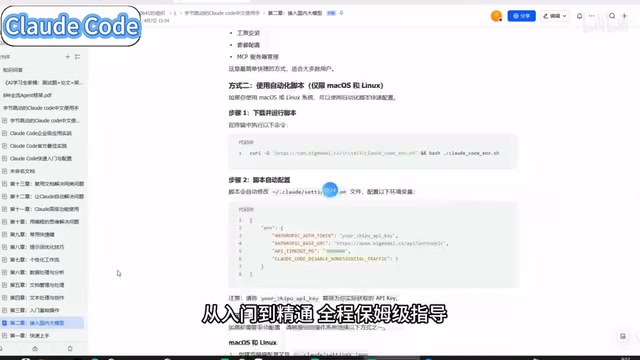
A Feishu-published Chinese handbook helps users in China get started with Claude Code from scratch.
A comprehensive Claude Code Chinese practical handbook published on ByteDance's Feishu platform has gained widespread attention for addressing the unique challenges faced by users in China. Covering everything from installation and configuration to domestic large model adaptation, common commands, and ready-to-use templates, the guide systematically removes language and network barriers, enabling even non-programmers to leverage Claude Code's agentic coding capabilities for development, content creation, data analysis, and workflow automation.
Why Do We Need a Chinese Version of the Claude Code Handbook?
Claude Code, the AI programming tool launched by Anthropic, has become a popular choice among developers and productivity enthusiasts thanks to its powerful code generation, debugging, and automation capabilities. Unlike traditional IDE plugin-based AI assistants (such as GitHub Copilot and Cursor), Claude Code runs directly in the terminal command line, reads the entire project codebase for context, executes shell commands, edits files, and can even autonomously complete complex multi-step development tasks. This approach, known as "agentic coding," means developers can describe requirements in natural language, and Claude Code will autonomously plan execution paths, write code, run tests, and iterate on fixes. Anthropic, founded by former OpenAI Research VP Dario Amodei, is one of OpenAI's primary competitors. Its Claude model series excels in code generation and reasoning, and Claude Code is the core product that brings these model capabilities to life as a developer tool.
However, the all-English official documentation and interface have deterred many users in China — they can't understand the installation and configuration, can't figure out the commands, and have no way to access advanced techniques.
Recently, a Claude Code Chinese Practical Handbook published on ByteDance's Feishu (Lark) platform has attracted widespread attention. This handbook specifically addresses the pain points of users in China, offering systematic, step-by-step tutorials from beginner basics to advanced techniques, aiming to thoroughly eliminate all barriers Chinese-speaking users face when using Claude Code.
Key Highlights of the Handbook
Fully Chinese, Zero-Barrier Teaching
The greatest value of this Claude Code Chinese handbook lies in its entirely Chinese-language instruction, eliminating the barrier of technical jargon. For users who aren't comfortable reading English technical documentation, this means no more toggling between translations and fumbling through operations. The handbook localizes Claude Code's core concepts, operational steps, and common commands. Even complete beginners with no programming background can follow the steps and get started.
It's worth noting that the scarcity of Chinese documentation for AI development tools isn't an isolated case — it's a systemic issue across the entire tech ecosystem. In the programming domain, core knowledge sources like Stack Overflow, GitHub Issues, and official SDK documentation are almost entirely in English. Although China has one of the world's largest developer communities (according to GitHub statistics, Chinese developers rank second only to the US), the quality and coverage of Chinese technical documentation falls far behind demand. This contradiction is especially pronounced in the AI tools space, where products iterate extremely fast, official documentation updates frequently, and community translations often can't keep pace with version changes.
Domestic Large Model Adaptation Solutions
A practical challenge of using Claude Code is the stability of accessing overseas models. The handbook addresses this pain point by providing seamless integration solutions with domestic large models, helping users maintain stable and smooth AI programming capabilities even in restricted network environments, free from network fluctuations and access limitations.
From a technical perspective, Claude Code calls Claude series models through the Anthropic API by default. However, due to network environment restrictions, users in China face instability or even inability to connect directly to the Anthropic API. The so-called "domestic large model adaptation" typically refers to configuring domestic large model services that are compatible with the OpenAI API format (such as DeepSeek, Tongyi Qianwen, Zhipu GLM, etc.) to replace the default Claude API backend. This relies on Claude Code's custom API endpoint configuration capability, allowing users to forward requests to domestic model services that support the same protocol. Additionally, some solutions involve using API relay services or proxy gateways to forward Anthropic API requests through compliant channels. While this adaptation may result in some differences in model capabilities, it ensures basic functionality and stable network connectivity.
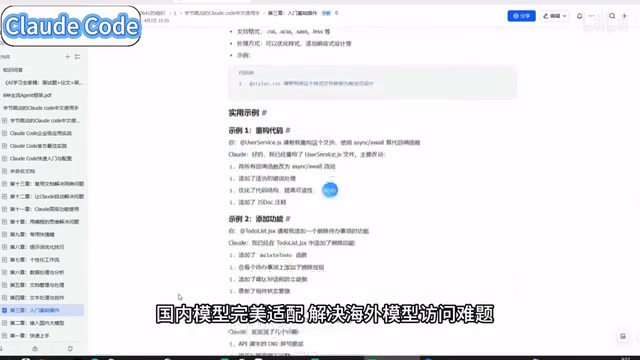
A Practical Guide Covering All Scenarios
You might not have noticed, but this handbook doesn't limit Claude Code to just "writing code." According to the handbook, Claude Code's application scenarios are expanded across multiple dimensions:
- Code Development: Code generation, bug debugging, code review
- Content Creation: Document writing, content optimization
- Data Analysis: Data processing, report generation
- Workflow Automation: Automated execution of repetitive tasks
This all-scenario coverage approach is closely related to the "Agentic Coding" paradigm that Claude Code represents. Unlike early AI code completion tools — traditional tools like GitHub Copilot primarily offer line-level or function-level code completion suggestions, requiring developers to confirm and edit line by line — in the agentic coding model, AI can understand high-level task objectives and autonomously perform a series of operations including codebase analysis, file creation and modification, dependency installation, and test execution. The core lies in the "plan-execute-verify" closed-loop capability: AI first analyzes the project structure and requirements, formulates an implementation plan, executes step by step, and automatically adjusts strategy based on execution results (such as test failures or compilation errors). It's precisely this autonomous execution capability that extends Claude Code's application range far beyond traditional code completion, enabling non-professional programmers to complete relatively complex development and automation tasks, truly making it a productivity powerhouse for professionals and AI tool enthusiasts alike.
Handbook Structure and Learning Path
Progressive Design from Installation to Advanced Techniques
The handbook adopts a progressive learning path design, starting from the most basic installation and configuration and gradually advancing to advanced usage techniques. Each step is broken down in detail — users simply need to follow along to complete the process, significantly reducing the time cost of trial and error.
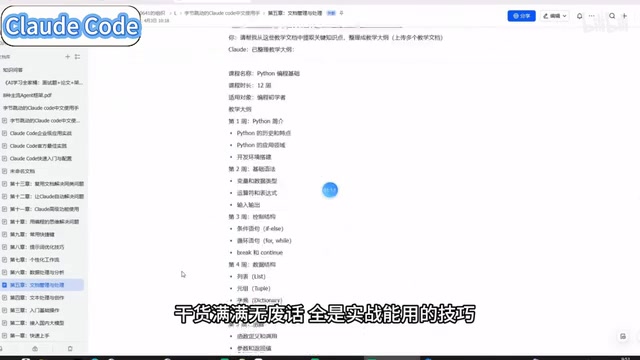
Practice-Oriented: Commands, Tips, and Templates
Unlike many tutorials on the market that only cover concepts without practical guidance, the core feature of this Claude Code usage guide is its dense, actionable content with a practice-first orientation. The handbook contains a wealth of ready-to-use tips, commands, and templates, enabling users to immediately apply what they've learned rather than being stuck in the "I know about it but can't use it" stage.
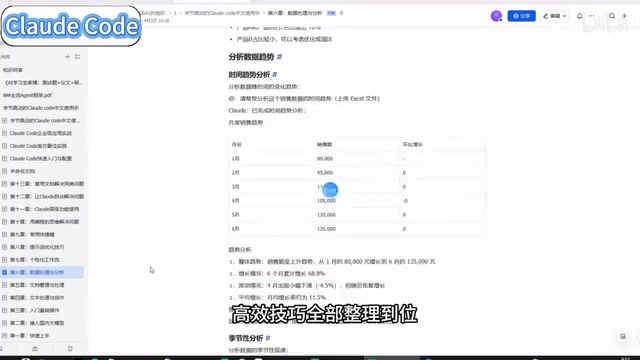
Implications for China's AI Tool Ecosystem
The Scarcity of Chinese Documentation Resources
The popularity of this handbook reflects a deeper issue: there is a severe shortage of quality Chinese learning resources for AI tools. Currently, the official documentation and community resources for mainstream AI programming tools — whether Claude Code, Cursor, or GitHub Copilot — are predominantly in English. Users in China either rely on scattered blog posts and short videos or struggle through English originals, significantly reducing learning efficiency.
Community-driven Chinese localization efforts are filling this gap. Systematic Chinese practical handbooks like this one play a positive role in lowering the barrier to AI tool adoption and promoting the widespread use of AI programming tools in China. Feishu (Lark), ByteDance's collaboration platform, supports rich text, multimedia embedding, and collaborative editing in its document features, making it one of the key platforms for sharing systematic tutorials in China's tech community. This also explains why an increasing number of high-quality technical handbooks are being published and distributed on the Feishu platform.
The Importance of Localization and Adaptation
The handbook's content on domestic large model adaptation also reflects a trend: AI tool localization isn't just about language translation — it requires deep adaptation to local network environments, usage habits, and actual needs. Only by solving the fundamental problem of "being able to use it" can more users truly benefit from AI tools.
From a broader perspective, this localization demand is giving rise to a new ecosystem layer — an "adaptation layer" between overseas original tools and domestic end users. Whether it's API relay services, Chinese prompt template libraries, or configuration solutions tailored to domestic development environments, all of these help bridge the gap between global AI tools and local usage scenarios. As the capabilities of domestic large models continue to improve, these adaptation solutions will gradually evolve from "second-best alternatives" to "locally optimized best choices."
Summary and Getting Started Recommendations
For users in China who want to learn Claude Code, this Chinese handbook on Feishu provides an excellent starting point. Its value lies not in how technically deep it goes, but in systematically removing the barriers for Chinese-speaking users going from zero to one.
That said, it's important to maintain realistic expectations: any tool handbook is just the first step to getting started. Real productivity gains require continuous practice and exploration in actual work scenarios. Users are encouraged to build on what they learn from the handbook, apply it to their specific use cases, and gradually develop an AI workflow that works best for them.
Key Takeaways
Related articles

Five Common Claude Code Mistakes — How Many Are You Making?
Five common Claude Code mistakes developers make: copy-pasting code, skipping CLAUDE.md, inefficient prompting, ignoring docs, and poor context management — with fixes.
Andrew Ng's New Course Explained: A Practical Guide to Using OpenAI's O1 Reasoning Model
Deep dive into Andrew Ng and OpenAI's Reasoning with O1 course covering test-time scaling, new prompting paradigms, multi-model orchestration, and practical applications for developers.

Learning AI After College Entrance Exams: A Complete Path from Zero to Freelancing
How to efficiently learn AI skills during summer break after exams? A complete path from mastering prompts and hands-on projects to freelancing on platforms.