Claude Code in Practice: An In-Depth Efficiency Comparison Between Claude and DeepSeek for Programming

Real-world comparison shows Claude delivers higher code quality while DeepSeek offers 6-10x cost savings at the expense of efficiency.
Based on two days of intensive AI-assisted development, this article compares Claude and DeepSeek V4 across code quality, efficiency, and cost. Claude achieves higher first-pass completion rates and better self-assessment, while DeepSeek costs only 1/6 to 1/10 as much but requires 1-2x more time due to iterative fixes and occasional degradation issues. The author recommends a hybrid strategy: DeepSeek for routine work, Claude for critical modules.
Introduction: Real-World Experience Rebuilding a Platform in Two Days
The author (a Bilibili content creator known as "人越的IT") spent two days during the Dragon Boat Festival holiday using Claude Code CLI to rebuild a complete ontology modeling platform from scratch. This platform covers the entire workflow from requirements exploration, ontology modeling, and model implementation, to final packaging as skill packs and generating general-purpose intelligent agents.
During this process, the author frequently switched between Claude and DeepSeek V4, accumulating substantial first-hand comparison data. Today we'll dive deep into the real performance differences between these two models in AI programming scenarios.
Code Quality: A Clear Gap in First-Pass Completion
After reviewing the entire development process, the author offered a key insight: if Claude had been used exclusively throughout, the two-day workload could have been completed in roughly one day. This efficiency gap primarily stems from differences in code quality.
Two Core Issues with DeepSeek
First, inconsistent first-pass output quality. Although Claude Code CLI's underlying architecture fully implements the HARIS engineering framework (a systematic approach to improving AI programming quality), this framework doesn't reach maximum efficiency when connected to third-party models. Specifically, DeepSeek's generated code has a lower rate of meeting requirements on the first attempt, frequently requiring multiple rounds of corrections.
Here's a telling detail: when using DeepSeek, the AI sometimes claims "all functionality is complete" when it hasn't actually performed comprehensive end-to-end testing. This situation rarely occurs with Claude. This suggests Claude has more accurate self-assessment of task completion.
Second, the "degradation" phenomenon where iterative fixes make things worse. This is a very common problem—when you repeatedly ask DeepSeek to modify code, it consumes large amounts of tokens while the modifications actually introduce more errors.

Practical Coping Strategies
The author encountered this "fixes making things worse" scenario one to two times during the two-day development. His approach is worth learning from:
- Decisively abandon the current session: Don't try to keep patching within an already confused context
- Manually summarize the context: Organize the previous requirements and completed work yourself
- Start a fresh session from scratch: Let the AI re-implement the feature module based on clear context
This experience is extremely practical. Many developers fall into an infinite patching loop when AI keeps making things worse with each fix, ultimately wasting more time and tokens. Cutting losses early and starting fresh is often the more efficient choice.
Cost Comparison: A 6x to 10x Difference in Value
Cost is a major consideration for many developers when choosing models. The author provided very specific reference data:

DeepSeek's Actual Costs
- Heavy usage (full-day programming): Close to ¥50/day (~$7/day)
- Author's actual experience (morning to night, including breaks): ¥20-30/day (~$3-4/day)
- Light usage: Under ¥10/day (~$1.4/day) is sufficient
This dispels a common misconception—many people assume DeepSeek costs "just a few yuan," but in truly intensive AI programming scenarios, token consumption is quite substantial.
Comparison with Claude
Based on the author's previous dedicated testing, DeepSeek's overall cost is approximately one-sixth to one-tenth that of Claude. In other words, if the same work costs ¥300 with Claude, DeepSeek would only cost about ¥30-50.
From a pure cost-saving perspective, DeepSeek's advantage is overwhelming.
The Efficiency-Quality Tradeoff: Time or Money?
This is the most valuable analytical framework in the entire piece. The author provides a very clear quantitative assessment:

Quality Dimension
- DeepSeek can generally reach about 80% of Claude's quality level
- With an additional investment of double the time for optimization, it can reach about 90%
- 90% quality is sufficient for most routine, non-highly-complex scenarios
Time Dimension
- To achieve equivalent quality, DeepSeek requires 1-2x more time
- This time cost includes: multiple correction rounds, handling the "fixes making things worse" problem, restarting sessions, etc.
Decision Framework
The author proposes a concise decision model:
| Scenario | Recommended Choice | Reasoning |
|---|---|---|
| Projects requiring high efficiency and quality | Claude | Higher first-pass success rate, saves time |
| Routine scenarios, learning and practice | DeepSeek V4 | Excellent value, adequate quality |
| Limited budget but ample time | DeepSeek V4 | Trade time for money |
| Commercial projects, tight deadlines | Claude | Trade money for time |
At its core, it's a choice between "spending money to save time" or "spending time to save money."
Summary and Recommendations
Through this two-day hands-on comparison, we can draw several key conclusions:
- The Claude Code CLI + native Claude model combination delivers the best results, because the HARIS engineering framework achieves maximum efficiency on the native model
- DeepSeek V4 is entirely viable as an alternative, but you need to accept the efficiency tradeoff
- The cost difference is significant (6-10x), making DeepSeek a pragmatic choice for individual developers and budget-constrained teams
- Mastering the "cut your losses" technique is important—when AI keeps making things worse with each fix, decisively starting a new session is more efficient than stubbornly persisting
For most developers, the recommendation is: use DeepSeek for daily development practice and iteration, then switch to Claude for critical milestones and complex modules to ensure quality. This hybrid strategy is likely the optimal cost-efficiency balance point at the current stage.
Related articles
Klue Hacked: Data Breach Exposes Huntress, HackerOne, and Other Major Security Companies
Market research firm Klue was hacked, exposing data from Huntress, HackerOne, Jamf, Recorded Future, and Tanium. Analysis of supply chain attack risks and third-party risk management strategies.
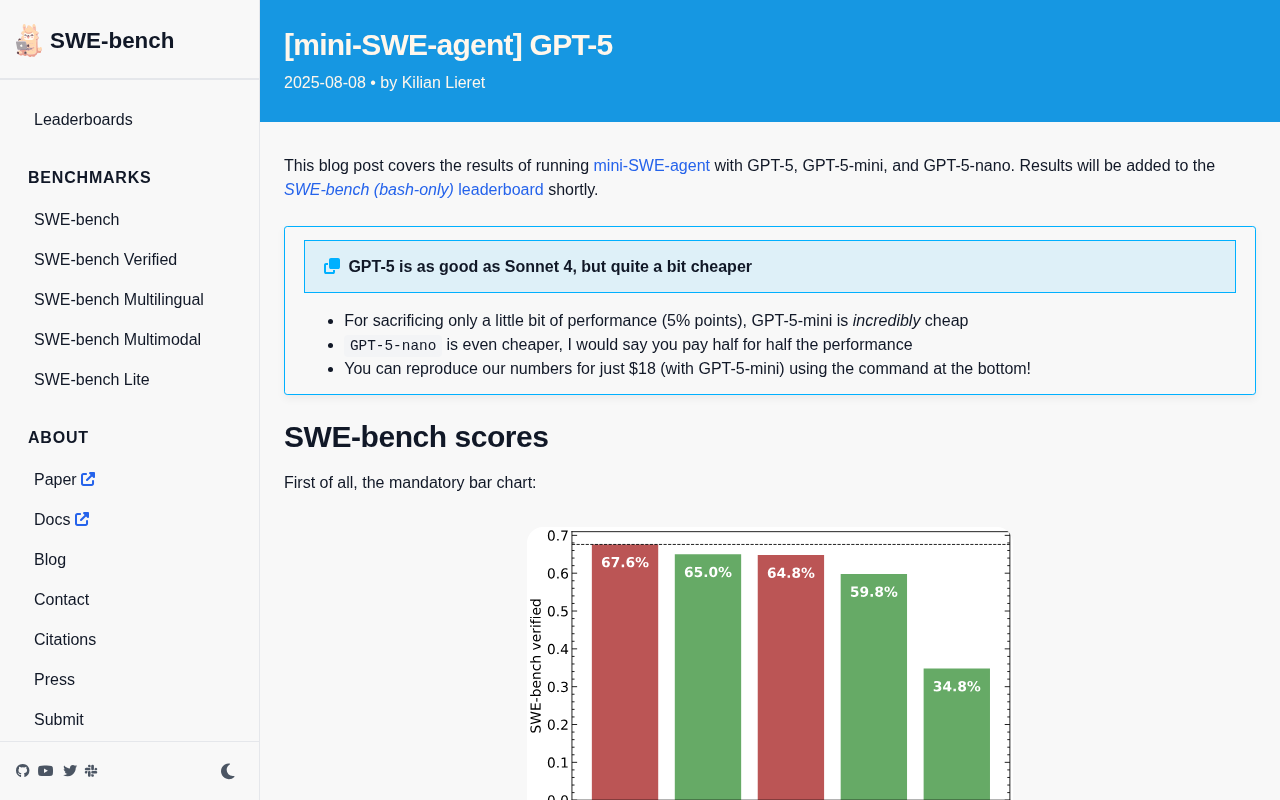
GPT-5 SWE-bench Evaluation: GPT-5-mini Crushes the Competition on Cost-Effectiveness vs Claude Sonnet 4
mini-SWE-agent's GPT-5 series evaluation on SWE-bench shows GPT-5 matches Claude Sonnet 4, while GPT-5-mini loses only ~5 points at less than 1/5 the cost.
DAQIRI Platform Explained: Deep Integration of High-Speed Data Acquisition and Real-Time AI Inference
Deep dive into how the DAQIRI platform embeds NVIDIA GPU-accelerated computing into high-speed data acquisition pipelines, enabling real-time AI inference for industrial inspection, scientific experiments, and autonomous driving.