Claude Code in Practice: Completing a Complex Payment System Integration in 4 Hours for $60
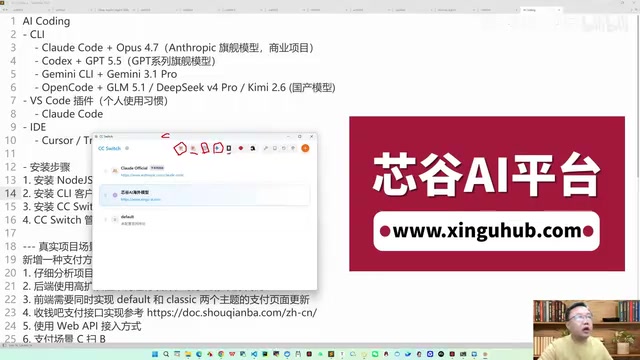
Claude Code + Opus 4.7 completes a complex payment system integration in 4 hours for just $60.
This article demonstrates how Claude Code paired with Opus 4.7 was used to complete a real commercial payment system integration in 4 hours at $60 cost with zero hand-written code. It covers CC Switch configuration for bypassing authentication, structured prompt engineering techniques, model selection strategies for different scenarios, and the emerging core competencies needed in the AI Coding era.
AI Coding Is Now Production-Ready
Many people still think of AI programming as a demo-stage novelty — running small scripts or generating sample code snippets. But in reality, when you choose the right tool combination and master proper engineering methodology, AI Coding can handle real commercial-grade project development.
This article shares a real case study: using Claude Code + Opus 4.7 to complete a complex payment system integration in 4 hours, at a total cost of just $60, without manually writing a single line of code.
Comparing Three Mainstream AI Coding Approaches
There are currently three mainstream AI Coding approaches, each suited to different scenarios:
- CLI (Command Line): Pure terminal interaction, ideal for lightweight tasks and scripting
- VS Code + Plugins: Integrating AI capabilities within a familiar IDE for the best development experience
- Dedicated IDE Tools: Such as Cursor, ByteDance's Trae, Alibaba's Coder, etc. — ready to use out of the box
After extensive hands-on comparison, the VS Code + Claude Code plugin combination achieves the best balance of flexibility and practicality. Cursor is decent too, but requires a $20/month Pro subscription with mediocre quota and latency performance. Domestic tools like Trae also fall short in complex project scenarios.
Technical Background: Claude Code and the Opus Model
Claude Code is a command-line AI programming tool launched by Anthropic in early 2025. It's essentially an AI Agent with file system operations, terminal command execution, and code comprehension capabilities. Opus 4.7 is the most powerful version in the Claude model family, achieving industry-leading performance on SWE-bench (Software Engineering Benchmark). What makes Anthropic unique is that they jointly trained Claude Code as an Agent framework with the Opus model through reinforcement learning. This means the model excels not just at generating code snippets, but at executing complex multi-step tasks in real engineering environments — including understanding project structures, modifying multiple files, and handling dependencies. This joint Agent+Model optimization strategy is the fundamental reason Claude Code performs exceptionally well on complex engineering tasks.
CC Switch: One-Stop Management for All AI CLI Tools
Why You Need CC Switch
The biggest pain point when using Claude Code, Codex, and other CLI tools is account registration and login verification — many tools simply can't be registered in certain regions.
CC Switch solves this problem perfectly. It's a unified model management tool that, once configured, allows all CLI clients to skip login entirely, bypassing all authentication steps.
Detailed Installation Steps
The complete installation process has four steps:
Step 1: Install Node.js
This is the base dependency. After installation, verify with:
node --version
npm --version
Step 2: Install CLI Clients
Install the tools you need:
- Claude Code:
npm install -g @anthropic-ai/claude-code - Codex:
npm install -g openai-codex-cli - Open Code:
npm install -g open-code-ai
Step 3: Install CC Switch
Download the latest version (e.g., 3.0.1.5) from the GitHub Release page, selecting the appropriate package for your operating system.
Step 4: Configure Models in CC Switch
Add a unified provider and configure the API address and key.
CC Switch supports a comprehensive range of clients, including Claude Code CLI, Claude Code Desktop, Codex, Gemini CLI, Open Code, and even Agent tools like OpenHands and Harmon.
Critical Configuration Point
In CC Switch settings, there's one option you must enable: "Skip Claude Code first-time installation confirmation." Once enabled, it automatically applies to the Claude Code plugin, skipping all account login and authentication flows. If you miss this step, you'll repeatedly get stuck at verification prompts.
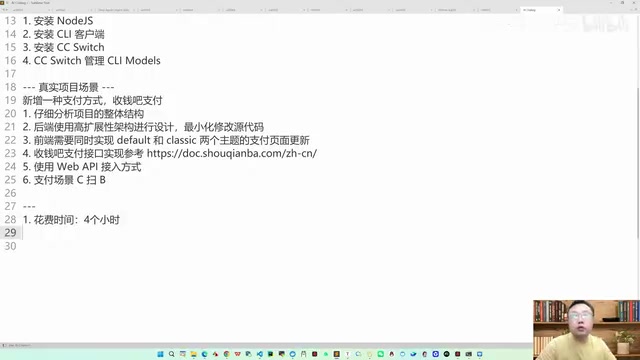
Real Case Study: Payment System Integration in 4 Hours for $60
Project Background
This is a real commercial project — upgrading an aggregation platform to add Shouqianba (收钱吧) payment functionality. The project is based on the latest version of NuAPI, with a Go backend, and the frontend needing to adapt to both Default and Classic theme UIs simultaneously. The codebase is massive and project complexity is high.
Payment system integration is considered a high-complexity project because it requires simultaneous coordination across multiple technical dimensions: the backend needs payment gateway integration (including signature verification, encrypted communication, async callback handling), the frontend needs to handle payment state transitions and user interactions, plus idempotency design to prevent duplicate charges and reconciliation mechanisms to ensure eventual data consistency. Shouqianba, as an aggregated payment platform, requires handling merchant authentication (SN + key system), terminal activation, dynamic token management, and more via its Web API. The entire process chain is long with extremely high fault tolerance requirements. Traditionally, this type of project requires at least a senior engineer with payment industry experience.
Prompt Engineering: The Make-or-Break Factor
If you just write "add a new payment method — Shouqianba payment," the AI will most likely produce a pile of unusable code. The correct approach is writing a structured requirements description that clearly communicates architectural constraints and technical details:
- Carefully read the overall project structure — let the AI understand the existing code organization
- Use a highly extensible architecture for the backend, minimizing modifications to source code — define architectural constraints
- The frontend must implement payment pages for both Default and Classic themes — specify implementation scope
- Reference the official Shouqianba integration documentation, using Web API C-scan QR code payment — provide technical details
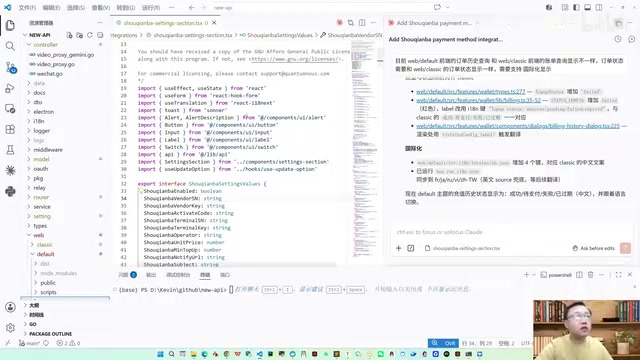
In AI Coding scenarios, prompt engineering has evolved into a new form of software engineering practice. Unlike traditional PRDs (Product Requirements Documents), AI-facing requirements descriptions need to include both "what to do" and "constraints on how to do it." Traditional PRDs target human developers who can rely on implicit knowledge and verbal communication to fill in details, whereas AI needs explicit architectural constraints, code style specifications, and technology selection boundaries. Excellent prompt engineering is essentially a form of "declarative programming" — you declare the target state and constraints, letting the AI autonomously plan the implementation path.
This approach reflects engineering-minded architectural thinking — you don't need to write code by hand, but you must know what good architecture looks like. The quality of your requirements description directly determines the quality of the AI's code output.
Execution Process and Final Results
Key metrics from the entire development process:
| Metric | Data |
|---|---|
| Total Time | 4 hours |
| Total Cost | ~$60 (Claude Code + Opus 4.7) |
| Manually Written Code | 0 lines |
| Work Mode | Manual confirmation (not fully automated) |
| Final Result | Passed on first run, both frontend themes fully functional |
"Manual confirmation mode" means human approval is needed at key modification points. In practice, most of the time it was just clicking "Yes Yes Yes" without reviewing code line by line — because Opus 4.7's code quality is genuinely high, with professional-grade architecture design and implementation details.
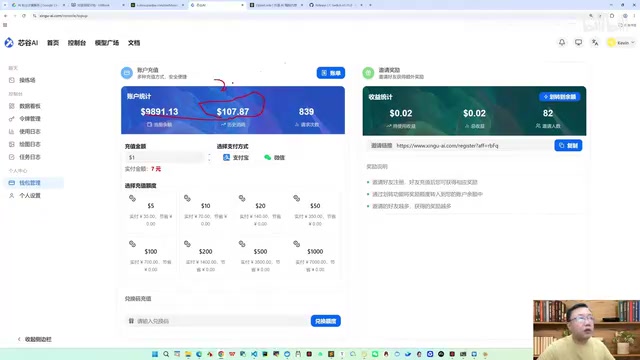
The final results were impressive:
- AI automatically generated a Shouqianba payment gateway module
- Implemented flexible configuration management (merchant SN, keys, activation codes)
- Dynamically generates terminal SA and terminal keys
- Supports aggregated QR code payment (compatible with both Alipay and WeChat Pay)
- Both frontend UI themes fully adapted with consistent visuals and interactions
- Order management, reconciliation, and other features fully implemented
Cost Comparison: AI Development vs Traditional Development
Is $60 expensive? Let's do the math against traditional development:
- Traditional approach requires at least 2 senior engineers (Go backend + frontend) — junior developers can't handle this kind of complex integration
- Conservative estimate: ¥500/person/day (including hidden costs like benefits), 2 people × 3 days = ¥3,000 RMB
- AI approach: $60 ≈ ¥430 RMB, completed in 4 hours
Efficiency improved by over 10x, cost reduced by nearly 7x. For small teams and indie developers, this cost-performance advantage is extremely significant.
Model Selection Guide: Best Combinations for Different Scenarios
For Commercial Projects: Claude Code + Opus 4.7
This is a conclusion validated through repeated testing — for company-level commercial projects, there's no second choice.
Why is Claude Code paired with Opus 4.7 so powerful? The core reason is that Anthropic specifically performed reinforcement learning on this Claude Code + Opus combination. Claude Code is essentially an intelligent agent, and its engineering harness capabilities have been specifically optimized. Switching to DeepSeek, GLM, or other models within Claude Code significantly diminishes the results.
For Small-Medium Projects or Domestic Solutions: Open Code + GLM 5.1
If the project scope is moderate, or if there's a requirement to use domestic models (such as compliance requirements preventing code from leaving the country), the Open Code + GLM 5.1 combination is recommended. Kimi 2.6 can serve as an alternative.
For code development involving sensitive industries like finance, government, and healthcare, data sovereignty compliance is a hard constraint. Under China's Data Security Law and Personal Information Protection Law, in certain scenarios code and business logic cannot be transmitted to overseas servers, making domestic models a necessity rather than an option. GLM 5.1 (Zhipu AI) and Kimi 2.6 (Moonshot AI) have certain advantages in Chinese comprehension and domestic tech stack compatibility, but there remains a generational gap compared to the Claude Opus series in extended-context engineering reasoning and multi-file collaborative modifications, primarily reflected in maintaining consistency across complex logic chains.
This solution is more cost-effective and adequate for small-to-medium projects, but shows a noticeable gap compared to the Claude Code solution on complex commercial projects.
Another Top-Tier Option: Codex + GPT-5
Codex + GPT-5 can also handle complete delivery of complex commercial projects, serving as a strong alternative to the Claude Code solution. If you already have significant investment in the OpenAI ecosystem, this combination is equally worth considering.
Core Competencies in the AI Coding Era
Here's an insightful observation: in the past, programmer interviews would ask "how much code have you written?" Now, many major tech companies interviewing for AI Coding positions ask "how many tokens have you consumed in total?"
Token consumption is becoming a new metric for measuring AI engineer productivity, reflecting a fundamental shift in how the industry perceives AI Coding roles. In actual hiring at major companies, high token consumption indicates the candidate has extensive hands-on experience — they've encountered various edge cases, know how to debug AI output, and have mastered decomposition strategies for complex projects. This is similar to using GitHub commit history to evaluate developer activity in the past. Token consumption is essentially the "code contribution volume" of the AI era. Currently in the industry, engineers consuming millions of tokens monthly are considered markers of deep practical experience.
This means the core competencies of the AI Coding era have fundamentally shifted:
1. Engineering-Minded Architectural Thinking
Being able to write high-quality requirements descriptions and architectural constraints is more important than writing code by hand. You need to clearly understand what good architecture looks like to guide AI toward producing qualified code.
2. Efficient Interaction with AI
Knowing how to decompose tasks, provide context, and course-correct at critical points — these are skills that require deliberate practice.
3. Continuous Accumulation of Hands-On Experience
Only by consuming large amounts of tokens and practicing repeatedly can you master best practices. Don't practice with low-end models — the lower the quality of the model, the harder it is to produce good results, which actually builds incorrect assumptions. Practice with the best models available — that's the only way to truly understand where the ceiling of AI Coding lies.
Conclusion
AI Coding has moved from concept to real production deployment. Through the combination of CC Switch + Claude Code + Opus 4.7, even complex commercial-grade payment system integrations can be completed with high quality in just a few hours.
The key isn't whether you can write code, but whether you possess engineering thinking and can collaborate with AI in a structured way. In this era, coding itself is no longer a scarce skill — the ability to engineer AI Coding into production is the true core competitive advantage.
Related articles
Beginner's Guide to Agent Skills: Structure Breakdown & Custom AI Skill Development
A deep dive into Agent Skill's core concepts and internal structure, covering skill.md, references, scripts, and assets with a restaurant poster Skill example.
Complete Guide to Commercial AI Agent Development: From Requirements Analysis to Production Deployment
Complete guide to commercial AI agent development from scratch, covering requirements analysis, architecture design (ReAct framework, deep search, intent recognition), hands-on Coze platform implementation, workflow creation, and production deployment.
Hermes AI Kanban: A Five-Layer Autonomous Architecture for Fully Automated Delivery from Idea to Finished Product
Deep dive into Hermes Kanban 2.0's five-layer autonomous architecture covering intelligent planning, human approval gates, multi-agent execution, and Obsidian integration for fully automated delivery.