Beginner's Guide to Agent Skills: Structure Breakdown & Custom AI Skill Development
A structural breakdown of Agent Skills and hands-on guide to building custom AI capability packages.
This guide explains what Agent Skills are, breaks down their four core components (skill.md, references, scripts, assets), and demonstrates how to build a custom Skill through a restaurant poster example. It clarifies how Skills differ from simple prompts by offering extensibility, reusability, and structured engineering practices.
What Is an Agent Skill? Starting with Professional Skills as an Analogy
With the explosive popularity of products like Open Cloud, Crayfish Cloud, and CodeHermes Agent, "Agent Skill" has become a high-frequency buzzword in the AI space. Yet many people's understanding of it remains superficial. The word "Skill" is actually a remarkably precise analogy.
Before diving deep into Skills, it's essential to clarify the core concept of an Agent. In AI, an Agent refers to a software entity capable of perceiving its environment, making autonomous decisions, and executing actions. Unlike traditional chatbots, Agents possess goal-oriented behavior, autonomous planning capabilities, and tool-calling abilities. Since 2023, with the capability leap of large language models like GPT-4, Agents have rapidly moved from academic concepts to engineering implementations, spawning open-source frameworks like AutoGPT, MetaGPT, and CrewAI, as well as commercialized Agent products across major cloud platforms. The core paradigm of an Agent can be summarized as the "Perceive-Plan-Act" loop: after receiving user instructions, it autonomously decomposes tasks, invokes tools, and iterates execution until the goal is achieved. Skills are precisely the key units that define "what an Agent can do."
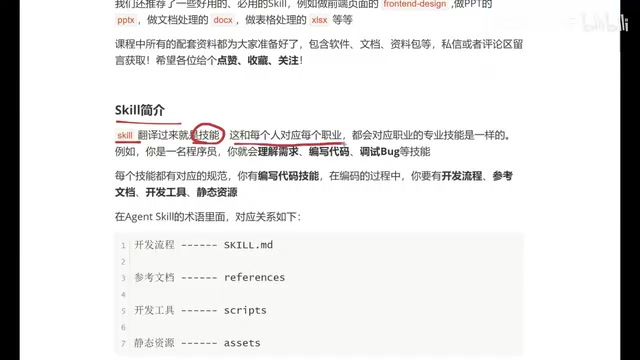
Everyone possesses different professional skills depending on their occupation. Students can write essays, solve math problems, and complete English assignments; programmers can understand requirements, write code, and debug. These professional skills are the real-world counterparts of Skills in the Agent world.
Put simply, human professional skills = Agent Skills. Each Skill grants an AI Agent a specific capability, enabling it to efficiently complete tasks in particular scenarios. Whether it's creating promotional posters, writing frontend pages, or processing documents and spreadsheets—each can be encapsulated as an independent Skill.
Internal Structure of a Skill: Four Core Components
Now that we understand what an Agent Skill is, the next key question is: what does a Skill actually look like inside?
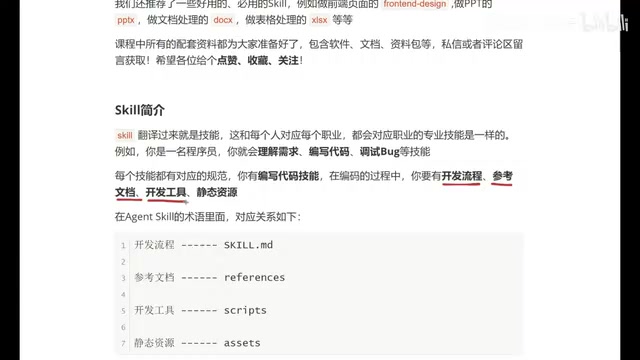
We can use a programmer's workflow as an analogy. To complete a project, a programmer needs at least four things:
- Development workflow: What to do first, what comes next, and how different parts relate to each other
- Reference documentation: API docs, requirement specs, and other reference materials
- Development tools: VS Code for frontend, IntelliJ IDEA for Java—you need the right tools for the job
- Static resources: Images, audio, video, and other assets used in web pages
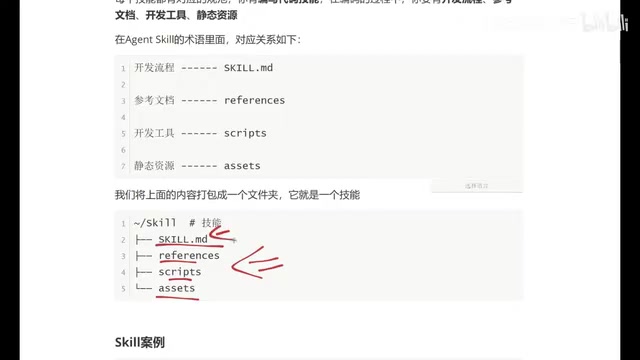
In the Agent Skill terminology system, these four things have corresponding standardized names:
| Development Concept | Skill Counterpart | Description |
|---|---|---|
| Development workflow | skill.md | The core instruction file of the skill |
| Reference documentation | references/ | Reference materials folder |
| Development tools | scripts/ | Script tools folder |
| Static resources | assets/ | Folder for images, audio, and other resources |
Packaging these four files and folders together constitutes a complete Agent Skill.
Which Components Are Required?
Here's an important detail: not all components are mandatory. Among the four components, only skill.md is required; the other three (references, scripts, assets) are added as needed. Some simple Skills may only need a single skill.md, while complex Skills might require all four components.
Deep Dive into skill.md: A Restaurant Poster Skill Example
As the only required file, skill.md carries the most essential content of a Skill. Let's break down its structure through a poster generation Skill customized for "Evan's Restaurant."
Meta Information Section
At the top of skill.md is the Meta Information, containing two key fields:
- Name: What this Skill is called
- Description: What this Skill specifically does
For example, this Skill's description reads: "Generate brand-aligned material design concepts for Evan's Restaurant. When a user requests a specific type of material (poster, roll-up banner, packaging box, etc.), output the design concept for that material."
The meta information design borrows from the software package management approach—just like how npm's package.json contains name and description fields, a Skill's meta information allows Agent platforms to quickly index and match user intent. When a user issues a command, the Agent performs semantic matching against each Skill's description to automatically select the most appropriate Skill for the task. This process is similar to how an operating system selects the default program to open a file based on its type.
Instructions Section
Below the meta information is the Instructions section. This part is similar to the prompts we typically send to large language models, but with a higher degree of structure.
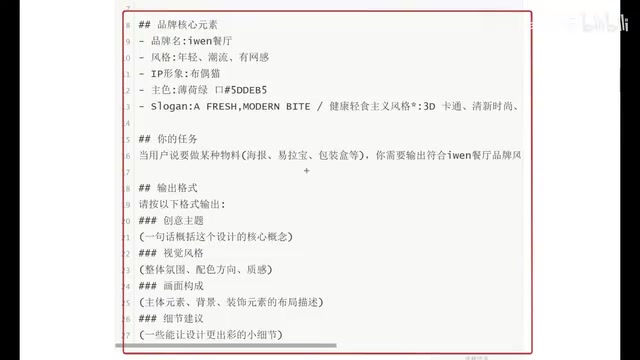
Using this restaurant Skill as an example, the instructions section contains detailed definitions across the following dimensions:
- Brand core principles: Brand name, visual style, IP mascot, primary colors, slogan
- Task definition: When a user requests materials, output design concepts that align with the brand style
- Output format specifications:
- Theme and creative direction
- Visual style requirements
- Composition suggestions
- Supplementary details
The more detailed the description, the more closely the Agent's output will match expectations. This is a core principle in Skill design.
The Essential Difference Between Skills and Prompts
At this point, many people might wonder: isn't an Agent Skill just prompt engineering?
Indeed, the instructions section in skill.md shares similarities with carefully crafted prompts. But a Skill's capability boundary far exceeds that of a simple prompt, for three reasons:
1. Extensibility
A Skill isn't limited to skill.md—it can import external knowledge bases through references, invoke tool scripts through scripts, and load static resources through assets. This combination enables Skills to handle complex tasks that prompts alone simply cannot.
The underlying technology of the references folder is closely related to RAG (Retrieval-Augmented Generation). RAG's core approach is: before the large model generates an answer, it first retrieves document fragments relevant to the question from an external knowledge base and injects them as context into the prompt, allowing the model to respond based on real, up-to-date information. This approach effectively mitigates the "hallucination" problem of large models—generating content that seems plausible but is actually incorrect—while breaking through the timeliness limitations of model training data. Documents in the references folder are vectorized and indexed, then retrieved on demand when the Agent executes tasks.
The scripts folder corresponds to the Function Calling capability in the large model domain. OpenAI first introduced Function Calling for GPT models in June 2023, allowing models to identify user intent during conversations and output function call requests in structured JSON format, which are then executed by external programs with results returned to the model. This mechanism bridges large models and external systems—models are no longer limited to text generation but can query databases, call APIs, execute code, and manipulate file systems. Developers can write Python, Shell, JavaScript, and other scripts in the scripts folder, giving Agents the ability to operate in the real world.
2. Reusability
A well-written Skill can be repeatedly invoked by different Agents, just like functions in a program. Prompts, on the other hand, tend to be one-off and difficult to standardize for reuse.
3. Degree of Structure
Skills have clear file organization conventions and naming standards, facilitating team collaboration, version management, and community sharing. Prompts lack this kind of engineering-oriented organization.
From a technical evolution perspective, Prompt Engineering has rapidly iterated from zero-shot prompting, few-shot prompting, to Chain-of-Thought and the ReAct framework. However, prompts alone always face bottlenecks such as context window limitations, lack of persistent storage, and inability to call external tools. The emergence of Skills represents a paradigm shift from "improvisational conversation" to "engineered configuration," upgrading prompts from one-time text inputs to version-manageable, composable, and reusable structured files.
So more accurately, a Skill is the engineering-grade evolution of a prompt—it transforms scattered prompts into a complete capability unit with structure, resources, and tools.
Recommended Skills & Application Scenarios
Beyond custom Skills, the community has produced a wealth of high-quality, ready-to-use Skills covering multiple scenarios in daily development and content creation:
- Frontend page generation Skill: Describe requirements and get page code generated
- PPT creation Skill: Automatically generate presentation slides
- Document processing Skill: Batch processing and format conversion
- Spreadsheet processing Skill: Data analysis and report generation
- Creative material Skill: Such as the restaurant poster scenario above
The value of these Skills lies in encapsulating domain-specific expertise and workflows into standardized capability modules, significantly lowering the barrier to using AI applications.
Final Thoughts
Agent Skill is essentially a standardized approach to capability encapsulation. It transforms AI from a generic chat tool into a professional assistant that can be precisely configured and composed on demand. Understanding the Skill structure (skill.md + references + scripts + assets) is fundamental to mastering today's mainstream Agent platforms.
The design philosophy of Skills deeply draws from modularity and encapsulation principles in software engineering. In object-oriented programming, classes encapsulate data and behavior together, exposing interfaces while hiding implementation details; in microservices architecture, each service is independently deployed and scaled, communicating through APIs. Skills similarly follow the principle of "high cohesion, low coupling": each Skill focuses on a specific capability, internally containing all resources needed to fulfill that capability (instructions, knowledge, tools, assets), while externally declaring itself through standardized meta information (name and description). This design enables Skills to be published, shared, and composed like npm packages or Docker images, laying the foundation for community-driven collaboration on AI capabilities.
For developers looking to get started, I recommend beginning with the simplest pure skill.md—write your instructions clearly and thoroughly first, then gradually introduce other components to extend capabilities. After all, at the heart of a good Skill is always a precise definition of the task.
Related articles
Claude Code Codex Plugin Integration: A Practical Guide to Dual-AI Adversarial Review for Better Code Quality
Learn how to install and configure the Codex plugin in Claude Code, leveraging dual-AI adversarial review to uncover code vulnerabilities across seven attack surfaces.
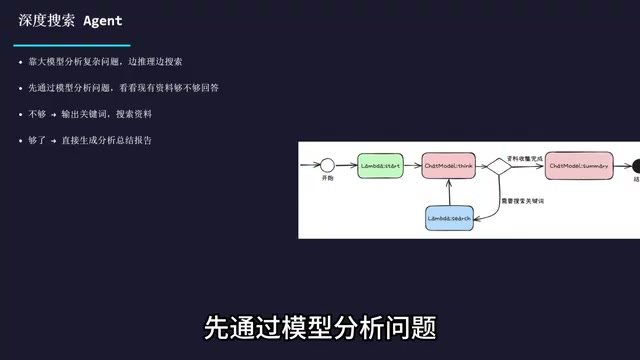
Complete Guide to Commercial AI Agent Development: From Requirements Analysis to Production Deployment
Complete guide to commercial AI agent development from scratch, covering requirements analysis, architecture design (ReAct framework, deep search, intent recognition), hands-on Coze platform implementation, workflow creation, and production deployment.
Hermes AI Kanban: A Five-Layer Autonomous Architecture for Fully Automated Delivery from Idea to Finished Product
Deep dive into Hermes Kanban 2.0's five-layer autonomous architecture covering intelligent planning, human approval gates, multi-agent execution, and Obsidian integration for fully automated delivery.