Claude Code Reverse-Engineered & Open-Sourced: Local Deployment Guide and Domestic Model Integration

Claude Code fully reverse-engineered and open-sourced, enabling local deployment with third-party model support
Developers have successfully reverse-engineered Anthropic's Claude Code programming tool and open-sourced it, with the project containing 1,900+ files and millions of lines of code. Core features including local execution, MCP tool invocation, model switching, and third-party model integration are already functional. The project aims to integrate with domestic Chinese LLMs like DeepSeek V4 to build a self-controlled AI programming tool, eliminating ban risks and privacy concerns. The current version still has bugs requiring community collaboration to resolve.
Core Event: Claude Code Source Code Fully Reverse-Engineered and Open-Sourced
Recently, developers successfully performed a complete reverse engineering of Claude Code's leaked code and got it running in a local environment. This means developers can now have a fully functional Claude Code programming tool locally without relying on official services, while also eliminating the risk of account bans.
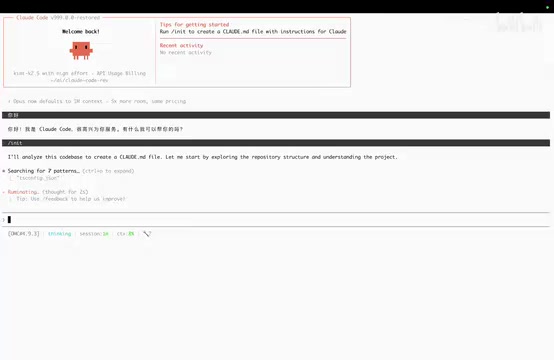
Claude Code is a command-line AI programming tool developed by Anthropic, built on the Claude large language model. It enables interactive programming collaboration with developers directly in the terminal. Unlike traditional IDE plugin-based AI coding assistants (such as GitHub Copilot), Claude Code adopts an Agent architecture that can autonomously read files, execute commands, search codebases, and perform complex cross-file code modifications. Its design philosophy is to make AI a true "programming partner" rather than a simple code completion tool.
The project has been open-sourced on GitHub, containing over 1,900 files and millions of lines of code with a highly complex engineering structure. Currently, the project can connect to third-party models (such as KeyMid), and core features including local MCP tool invocation and model switching have been implemented.
Why Claude Code Is Worth Reverse-Engineering
The Current Ceiling of AI Programming Tools
According to the project author, Claude Code's official engineering capabilities are remarkably powerful — "currently it outperforms all AI programming tools" — and no other AI coding tool can surpass Claude Code's capability level at this time. This explains the community's intense enthusiasm for reverse-engineering this project.
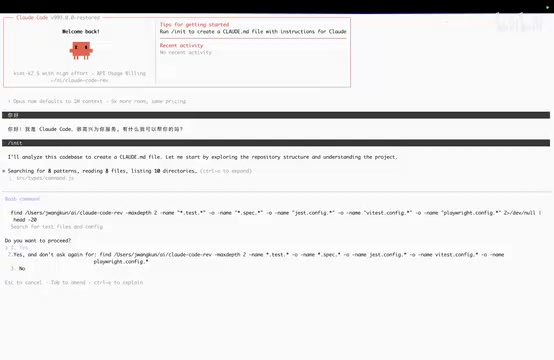
Claude Code's core advantage lies in its understanding and handling of engineering-level code — not just simple code completion, but the ability to comprehend entire project structures, contextual relationships, and perform systematic code generation and modification. Internally, it implements complex Agent loop mechanisms including multi-step reasoning, tool call orchestration, context window management, and error recovery strategies. These engineering details represent core competitive advantages that other open-source AI programming tools currently struggle to replicate.
The Technical Path of Reverse Engineering
Claude Code is built as a command-line tool using Node.js/TypeScript and distributed via NPM. The main reverse engineering work includes: decompiling and restoring obfuscated and bundled JavaScript code, understanding its internal Agent loop mechanisms, parsing tool call routing logic, and abstracting the interface layer (originally bound to the Anthropic API) into a universal interface compatible with any large model. The difficulty lies in the massive code scale and numerous engineering abstraction layers, requiring a step-by-step process to untangle module dependencies and data flows.
The Strategic Significance of Local Deployment
Running Claude Code locally carries several important implications:
- Eliminating ban risks: Official services carry the possibility of account suspension; local deployment is fully self-controlled
- Connecting to domestic models: Can integrate with Chinese LLMs like DeepSeek V4 to build domestic AI programming tools
- Privacy and security: Code doesn't need to be uploaded to third-party servers, suitable for enterprise applications
- Free customization: Open-source code allows developers to perform secondary development and optimization based on their needs
Current Project Status and Known Issues
Implemented Features
The current reverse-engineered version already has the following capabilities:
- Basic code programming interaction
- Local MCP (Model Context Protocol) tool invocation
- Model switching commands
- Third-party model integration (verified with KeyMid)
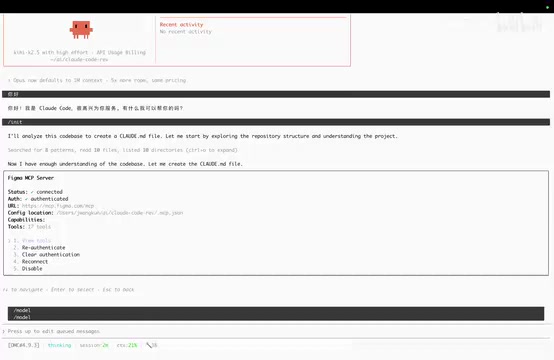
MCP (Model Context Protocol) is an open standard protocol introduced by Anthropic in late 2024, designed to establish a unified communication interface between AI models and external tools/data sources. MCP adopts a client-server architecture where AI applications act as clients and various tools and data sources serve as servers. Through MCP, AI models can invoke external capabilities such as file system operations, database queries, and API requests, greatly expanding AI's practical operational scope. This protocol has been adopted by multiple AI tools and is becoming an infrastructure standard for the AI tool ecosystem.
KeyMid is an API relay/aggregation service that provides a unified interface compatible with the OpenAI API format, routing requests to various different LLM service providers behind the scenes. By connecting to middleware services like KeyMid, the reverse-engineered Claude Code can flexibly switch between underlying models — including GPT-4, Claude, DeepSeek, and others — without needing to adapt interfaces for each model individually. This architectural design significantly enhances the tool's flexibility and extensibility.
Existing Shortcomings
The author candidly states that due to the massive engineering scale (1,900+ files, millions of lines of code), the current version "isn't as polished as one might expect" and still has some bugs that need fixing. This is an ongoing optimization process that requires community participation to improve.
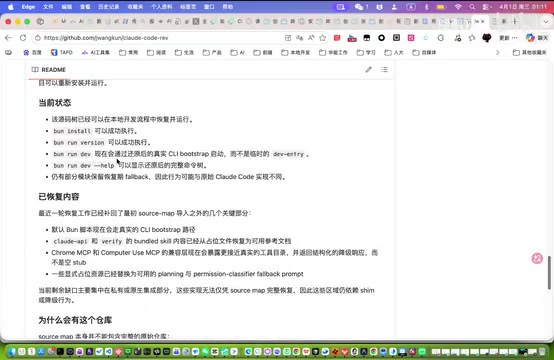
Looking at the GitHub repository's issues, there are indeed some features not yet completed, but the core framework has been established. Future work mainly involves detail polishing and bug fixes.
Future Plans and Community Collaboration
Short-term Goals
- Fix known bugs and improve overall stability
- Enhance MCP toolchain compatibility
- Upload to NPM registry for one-click installation
Long-term Vision
The project's long-term goal is to integrate with domestic Chinese LLMs like DeepSeek V4, creating an AI programming tool built entirely on the domestic ecosystem. DeepSeek V4 is the next-generation large language model expected to be released by DeepSeek. The DeepSeek model series is renowned for its excellent coding and reasoning capabilities, with its open-source DeepSeek-Coder and DeepSeek-V3 achieving outstanding results on multiple programming benchmarks. Combining Claude Code's engineering framework with domestic models means Chinese developers can achieve AI programming experiences approaching or even matching top commercial tools without relying on overseas API services — significant for data security compliance and cost reduction.
If Claude Code's engineering capabilities can be combined with the reasoning power of domestic models, it will generate tremendous practical value.
The author is also actively recruiting community contributors, hoping more developers will participate in project optimization. Interested developers can download the code directly from the GitHub repository for local deployment testing, or join community groups to participate in discussions and collaborative development.
Summary and Reflections
The emergence of this project reflects a clear trend in the AI programming tools space: the developer community has a strong demand for open-source, controllable AI programming tools. While the current version isn't yet fully polished, as a starting point, it provides the community with a foundation framework for continuous iteration.
Notably, as domestic Chinese LLMs rapidly improve in capability, the combination of open-source tools plus domestic models is likely to become the mainstream choice for Chinese developers. From a broader perspective, this also reflects a transformation underway in the AI development tools space — from closed commercial products to open-source community-driven solutions. Similar to how Linux replaced Unix and VS Code disrupted commercial IDEs, the open-source wave for AI programming tools may be arriving.
Key Takeaways
- Claude Code's leaked code has been fully reverse-engineered and open-sourced on GitHub, containing 1,900+ files and millions of lines of code
- Local deployment runs successfully, supporting MCP tool invocation, model switching, and third-party model integration
- The project aims to integrate with domestic models like DeepSeek V4 to build a self-controlled AI programming tool
- The current version still has bugs and requires ongoing community collaboration for improvement
- Plans to upload to NPM registry for one-click installation, lowering the barrier to entry
Related articles
 Tutorials
Cursor + Codex Dual-IDE Collaboration: A Practical Methodology for Open-Source Project Customization
A complete methodology for open-source project customization based on real-world experience, detailing the Cursor+Codex dual-IDE workflow, seven-stage process, MVP validation, and AI source code reading techniques.
 Tutorials
Cursor Multi-Agent in Practice: Building a Full-Stack Next.js Blog in 50 Minutes
Build a full-stack blog in 50 minutes using Cursor IDE's multi-Agent mode with Next.js, Clerk auth, and Supabase. Learn the 4-phase AI Agent workflow and key integration pitfalls.
 Tutorials
Building an AI Software Factory from Scratch: A Cursor Engineer's Hands-On Experience with Multi-Agent Collaboration
Cursor engineer Eric shares practical insights on building an AI software factory: automation levels, guardrail design, parallel Agent management, and scaling to 1000+ Agents for 24/7 development.