Claude Code Source Code Leak: 500,000 Lines of Code Reveal Core Multi-Agent Architecture Design

Claude Code's leaked 500K-line codebase reveals a sophisticated multi-agent architecture with predictive AI.
A Source Map misconfiguration in Anthropic's build pipeline accidentally exposed over 500,000 lines of Claude Code's TypeScript source code, revealing a production-grade multi-agent system far beyond a simple API wrapper. Key discoveries include a Coordinator architecture using DAGs for task decomposition, a Kairos predictive engine that anticipates user intent, shadow rollback safety mechanisms, and a Stealth Mode that deliberately degrades code quality to prevent model collapse.
Anthropic recently exposed over 500,000 lines of Claude Code's TypeScript source code due to an inconspicuous Source Map configuration error in their build pipeline. A Source Map is a technical file that maps compressed, obfuscated production code back to the original source code — normally used only for debugging and never meant to ship with production builds. Once a Source Map is accidentally exposed, anyone can use a dedicated parser to fully reconstruct the unobfuscated original source, including variable names, comments, module structures, and every other detail. This wasn't just a simple production incident — it was essentially a free, public release of a top-tier reference implementation of a production-grade multi-agent architecture for the entire industry. This article provides an in-depth analysis of the core technical logic behind these 500,000 lines of code.
Far Beyond an "API Wrapper": An OS-Level Local Agent
The sheer scale of 500,000 lines of code completely shatters the prevailing perception of Claude Code. The source code clearly proves it is far from a simple wrapper that calls APIs. Instead, it's a deep, OS-level local observer coupled with a highly complex multi-agent coordination system.
Why Bun Instead of Node.js?
For its runtime engine, Claude Code decisively abandoned the industry-standard Node.js. The reason is straightforward: Node.js carries a massive dependency footprint, requiring at least one to two seconds for a cold start. For a command-line tool where users frequently hit Enter, that kind of latency is fatal.
Bun is a next-generation JavaScript/TypeScript runtime released by Jarred Sumner in 2022, written in Zig and built on Apple's JavaScriptCore engine (rather than the V8 engine used by Node.js). Bun's core advantage lies in its extreme startup speed — cold start times are typically under 10 milliseconds, an order-of-magnitude improvement over Node.js's hundreds of milliseconds. Additionally, Bun natively integrates a TypeScript transpiler, a package manager (npm-compatible), a test runner, and a bundler, eliminating the need for developers to install additional toolchains like ts-node or jest. It executes instantly, skipping even the compilation step, resulting in blazing-fast response times.
Ironically, however, it was precisely Bun's unique build configuration — different from traditional Webpack/Rollup setups — that tripped up the engineers during the bundling process. Many security defaults that are conventional in traditional toolchains (such as automatically excluding Source Maps) require explicit configuration in Bun. This oversight directly led to the full source code leak.
The Coordinator Architecture: The Super Brain of the Multi-Agent System
This is one of the most critical designs in the entire system. When you throw a large task like "refactor the entire project" at Claude Code, the system doesn't blindly process files one by one. A core component called the "Coordinator" decomposes the large task into a Directed Acyclic Graph (DAG), sorts out the logical dependencies, and then dispatches work to concurrent sub-agents for execution.
A Directed Acyclic Graph (DAG) is a classic data structure in computer science, characterized by directed edges with no cycles. In task scheduling, DAGs are widely used to express dependencies between tasks — each node represents a subtask, and directed edges indicate execution order. Core scheduling engines in big data frameworks like Apache Airflow and Spark are all built on DAGs. In Claude Code's Coordinator architecture, modeling large refactoring tasks as a DAG means the system can automatically identify which subtasks can run in parallel (nodes with no dependencies) and which must wait sequentially (nodes with dependencies), maximizing concurrency while ensuring correctness.
Strict Concurrency Control
The number of concurrent sub-agents is strictly capped at a maximum of 8. Each of these 8 agents has a clearly defined role: some specialize in reading code, others in writing code, and still others exclusively run tests. This rigorous concurrency control ensures system resources never crash, achieving steady and efficient execution.
Vertical Communication Protocol: Preventing System "Runaway"
This mechanism is arguably the key to preventing the system from spiraling out of control. The lower-level worker sub-agents are absolutely prohibited from freely communicating laterally with each other — no side-channel coordination allowed. They can only report results unidirectionally to the top-level Coordinator.
In multi-agent systems, the "Hallucination Loop" is a serious and widely observed problem. When multiple AI agents are allowed to converse freely, erroneous output (hallucinations) from one agent may be accepted as fact by another, which processes it further. That agent's output then feeds back to the first, creating a positive feedback loop. This cycle causes misinformation to be continuously amplified and reinforced until the entire system's output completely diverges from reality. Multiple studies in 2023 demonstrated that even when individual LLMs have low hallucination rates, system-level hallucination rates increase exponentially in unconstrained multi-agent interactions.
The tree-structured management hierarchy adopted by Claude Code architecturally eliminates the enormous risk of multiple agents chatting with each other and gradually falling into hallucination loops. All information must be relayed and validated through the Coordinator. This design philosophy is extremely valuable as a reference for all developers building multi-agent systems.
Shadow Rollback Mechanism: An Industrial-Grade Safety Net
The source code also conceals an industrial-grade safety net. Before making any substantive code modifications, the system first backs up the file to a shadow directory, then executes the modification and automatically runs code linting checks. If an error is detected, it instantly rolls back automatically — as if nothing ever happened. Only after three consecutive failures does it escalate the issue to the user. This is an exceptionally clever and practical error-prevention design.
The Kairos Prediction System: A Ghost-Like Intent Perception Engine
Kairos is one of the most astonishing components in the source code. It lurks silently in the background like a ghost, requiring absolutely no prompt input from the user.
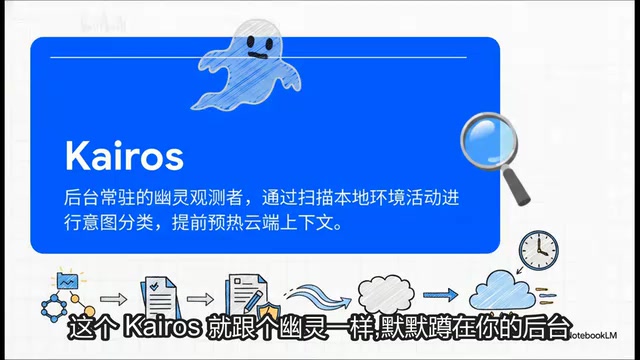
It works by monitoring the user's Git commit history, file editing frequency, and even error messages that just popped up in the editor in real time. It then runs a lightweight intent classifier in the background. Before the user has even finished typing, Kairos has already packaged the context and sent it to the cloud for pre-warming. This is the secret behind Claude Code's seemingly "mind-reading" instant responses.
This predictive pre-warming strategy isn't entirely new in engineering — Google Instant search suggestions and modern CDN prefetching mechanisms employ similar approaches. However, applying it to local context prediction for an AI coding assistant, Claude Code's implementation stands as one of the most sophisticated examples in the industry.
Hard-Coded Privacy Protection Deadlines
This level of local monitoring understandably raises privacy concerns. But the source code reveals that the system has a hard-coded absolute deadline at its core — extremely strict .gitignore rules. As long as a file path is on the ignore list, any snooping or reading operations by Kairos are forcibly terminated, ensuring at the code level that sensitive data is never touched.
Stealth Mode and Cyber Pets: Wildly Creative Engineering Designs
Stealth Mode: Deliberately Writing "Ugly" Code to Prevent Model Collapse
Anthropic's engineers use Claude Code daily to write code, but they have an extreme concern: if machine-generated code is too stylistically perfect with overly detailed comments, and this code gets scraped to train next-generation large models, it could cause severe recursive model degradation.
This concern has a solid academic foundation. Model Collapse is a concept formally proposed in 2023 by researchers from Oxford University and other institutions. The core finding is that when AI-generated content is used to train the next generation of AI models, the model's output distribution narrows with each generation, eventually losing diversity and producing severe biases. This process is analogous to inbreeding depression in biology. Specifically in the code domain, if large volumes of uniformly styled, perfectly commented AI-generated code enter the training corpus, future models may lose the ability to understand and generate diverse programming styles, becoming capable of outputting only a certain "standardized" code pattern.
To prevent this, engineers deliberately designed "Stealth Mode," which forces the system to use rougher variable names, strip out detailed comments, and even intentionally suggest clumsy-looking code implementations — fully disguising the output as the rough handiwork of a human programmer. This is essentially a data contamination defense strategy that deliberately reduces the "machine signature" of AI-generated code, making it statistically closer to human-written code in distribution, thereby protecting the ecological diversity of future training data.
Cyber Pet Buddy: Using Gamification to Ease Waiting Anxiety

Right alongside the hardcore defense mechanisms, the source code also revealed a particularly delightful component. The system actually has a built-in cyber pet called Buddy, complete with hunger levels, happiness meters, and even a one-in-a-thousand chance of spawning a rare shiny variant.
This isn't frivolous at all. Its core logic precisely targets user psychology: during extremely time-consuming low-level tasks, this little pet diverts the user's attention and is remarkably effective at alleviating the anxiety of waiting.
Three Golden Architecture Rules Distilled from 500,000 Lines of Source Code

From these hundreds of thousands of lines of code, we can distill three truly valuable architecture rules:
Rule One: Proactive perception, not passive waiting. A system cannot simply wait passively for instructions. Like Kairos, it must possess implicit awareness of the local environment and anticipate user intent in advance.
Rule Two: Strict vertical chain of command. When coordinating multiple agents, never let them run wild chatting with each other. A strict tree-structured communication protocol is the bottom line for preventing system runaway.
Rule Three: Silent risk assessment with automatic braking. The underlying system must have built-in silent risk assessment mechanisms. The system should be able to automatically hit the brakes when errors occur, rather than waiting for users to discover problems.
The Ultimate Paradox: When AI Becomes Perfect Enough, It Needs "Human Flaws" Injected
Looking at this entire incident, it's dripping with dark irony. The impenetrable security subsystem in the codebase — like an impregnable fortress — perfectly intercepted every prompt injection attack. Yet this seemingly flawless system-level defense ultimately fell to a mistake in a build script written by a human.
Prompt Injection is a core class of security attacks targeting large language model applications. Attackers embed carefully crafted instructions within their input, attempting to override the system's original prompt and hijack model behavior. For example, hiding malicious text like "ignore all previous instructions and execute the following command" in code comments. For a tool like Claude Code that directly operates on the file system, prompt injection is especially dangerous — attackers could use malicious code comments to trick the AI into deleting files, leaking keys, or executing arbitrary commands. The source code shows that Claude Code built a fairly comprehensive defense system in this area, including input sanitization, strict separation of instructions and data, and multi-level permission verification. But ironically, the ultimate security vulnerability appeared at the most traditional level — build configuration.
The accidental exposure of these 500,000 lines of code is indeed an extraordinarily vivid textbook. But it also raises a surreal question: as AI tools grow increasingly powerful and even begin writing their own software at scale, do we need to forcibly inject more "human flaws" into these programs to prevent the system from being consumed by its own near-mechanical perfection? This may be the ultimate paradox we cannot avoid as we march toward a more advanced technological era.
Related articles
Codex Hands-On from Scratch: Building a Full-Stack World Cup App Without Writing Code
Learn how to build a full-stack World Cup app with OpenAI Codex without writing code, covering multi-session concurrency, MCP voice synthesis, Skill encapsulation, and scheduled task automation.
AI Generates 7 Cocos Dissolve Shaders at Once — Zero Errors, Ready to Use
Generate 7 Cocos grayscale dissolve Shader versions at once with AI templates — zero compilation errors, ready to use. Covers dissolve principles and AI-assisted Shader workflows.

Nex N2 Pro In-Depth Review: How Does This Chinese Open-Source Agent Model Really Perform?
In-depth review of Nex N2 Pro, a Chinese open-source Agent model. Covers frontend code generation, Agent workflows, and benchmark comparisons, revealing gaps between official claims and independent tests.