Claude Code Sub-Agents and Cursor BugBot Launch: AI Programming Tools Get Major Upgrades

AI programming tools go specialized as multiple vendors release model and ecosystem integration updates
On July 25, 2025, the AI programming space saw a wave of updates. Anthropic added custom sub-agents to Claude Code, Cursor launched code review Agent BugBot, pushing AI programming from assisted coding toward engineered collaboration. Qwen released a 92+ language translation model, while Zhipu GLM4.5 and GPT-5 are on the horizon. Meanwhile, Claude and ChatGPT accelerated ecosystem integration with tools like Canva and Notion, as AI assistants evolve from standalone tools into ecosystem platforms.
On July 25, 2025, the AI programming space saw a wave of updates. Anthropic added custom sub-agent functionality to Claude Code, Cursor officially launched its code review Agent BugBot, Google released three experimental AI products, and Qwen unveiled a powerful translation model. Multiple vendors continue pushing the boundaries of model capabilities and developer tools. Here's a detailed breakdown of the day's key developments.
Claude Code Introduces Custom Sub-Agents
Anthropic has added custom sub-agent functionality to its AI programming assistant Claude Code. Users can now create specialized AI assistants tailored to their needs, each handling specific tasks like code review, debugging, or test generation—breaking down complex programming workflows into multiple specialized subtasks.
The core value of this feature lies in task specialization. Previously, when using AI programming assistants, users often had to repeatedly switch context within a single general conversation. Sub-agents allow each Agent to focus on a single responsibility, improving both accuracy and reducing the risk of context confusion. This design philosophy aligns perfectly with the "Single Responsibility Principle" in software engineering, signaling that AI programming tools are evolving from "general-purpose conversations" toward "engineered workflows."
Behind the sub-agent feature is the rapidly developing Multi-Agent System (MAS) architecture. In traditional AI applications, a single large model must handle all tasks, which can lead to "attention dilution" when context grows too long or task complexity becomes too high. Multi-agent architecture decomposes complex tasks across multiple specialized Agents working collaboratively, each maintaining independent context and toolsets, dramatically improving overall system reliability and maintainability. This approach closely mirrors microservices architecture in software engineering—decomposing monolithic applications into single-responsibility, independently deployable service units. Frameworks like LangGraph, AutoGen, and CrewAI have already validated multi-agent orchestration at the engineering level, and Anthropic's decision to build this directly into Claude Code means this capability is moving from research prototypes into mainstream developer tools.
Cursor Launches Code Review Agent BugBot
AI code editor Cursor has officially released its code review tool BugBot. This tool automatically analyzes code changes, identifies logic errors and security issues, and supports one-click fixes directly within the IDE.
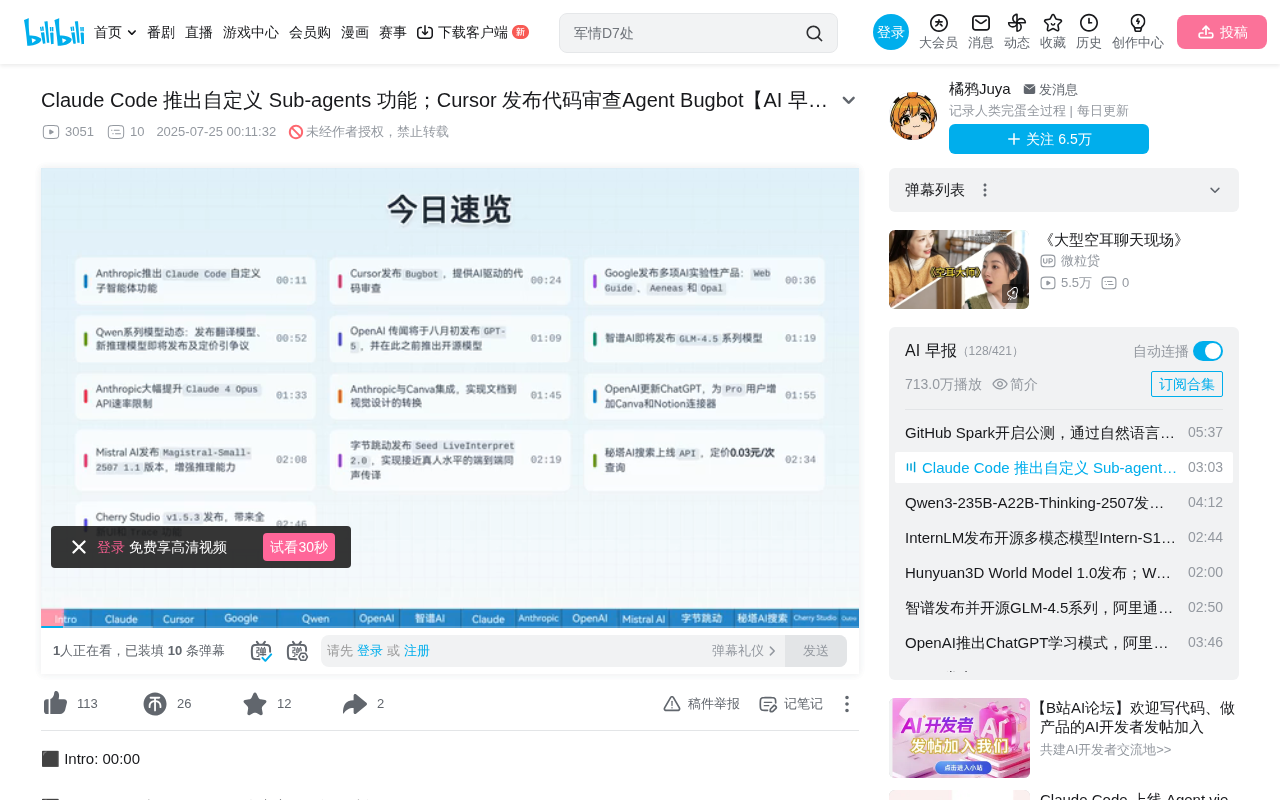
BugBot's positioning is crystal clear—it's not a simple Linter or static analysis tool, but a code review Agent with contextual understanding capabilities. It can comprehend the intent behind code changes and, on that basis, determine whether logic defects or potential security vulnerabilities exist. For team collaboration scenarios, BugBot is poised to become the "first line of defense" in the Pull Request process, filtering out obvious issues before human review and significantly improving code review efficiency.
To understand BugBot's value, it helps to know the evolution of AI code review technology. Early automation tools relied primarily on Static Analysis, such as ESLint and SonarQube, using rule matching to catch syntax errors and code style issues—but they couldn't understand code's business semantics. AI-driven code review Agents introduce the contextual understanding capabilities of large language models, combining Pull Request change intent, function call chains, and business logic to identify semantic-level defects that traditional tools cannot catch—such as inverted conditional logic, async race conditions, or missing permission validation. BugBot's "one-click fix" capability further shortens the Feedback Loop from problem discovery to resolution, which is considered a key metric for improving engineering effectiveness in DevOps practices.
Qwen Releases Multilingual Translation Model, New Reasoning Model Coming Soon
The Qwen team released the Qwen3-MT translation model, supporting translation tasks across more than 92 languages. The team also previewed an upcoming new reasoning model.
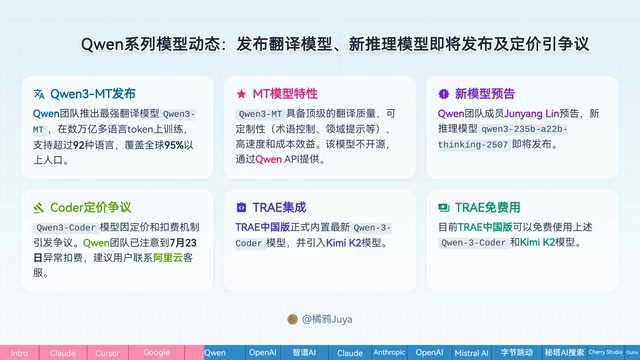
Machine translation has evolved through three generations: rule-based systems, Statistical Machine Translation (SMT), and Neural Machine Translation (NMT). The introduction of the Transformer architecture in 2017 fundamentally changed NMT's technical trajectory, after which multilingual pre-trained models like mBART and NLLB (No Language Left Behind) pushed translation quality to new heights. Meta's NLLB-200 model supports 200 languages and is one of the most language-comprehensive open-source translation models available. Qwen3-MT supports 92 languages, positioning itself to balance language coverage with translation quality, with specialized optimization for Chinese-to-multilingual translation scenarios. Compared to general-purpose large models, dedicated translation models typically have clear advantages in inference efficiency and BLEU scores for specific language pairs, making them better suited for high-concurrency enterprise translation scenarios.
Notably, in response to pricing controversies around the new Qwen3 Code model, the team publicly stated they would optimize pricing and address abnormal billing issues. This reflects the ongoing need for calibration between pricing strategies and user expectations as domestic AI models commercialize. The transparent communication is commendable, but finding the balance between model capabilities and reasonable pricing remains a shared challenge for all domestic LLM vendors.
Google's Three Experimental AI Products and Zhipu GLM4.5 Revealed
Google released three experimental AI products at once: OPPO—a feature for building AI applications using natural language; NES—a model specifically designed for interpreting and restoring ancient Roman inscriptions; and WebGuide—a search experiment that organizes search results into structured guides. These three products span application development, academic research, and information retrieval, demonstrating Google's broad exploration at the AI application layer.
Meanwhile, based on codebase information, Zhipu AI is about to release the GLM4.5 series, expected to include a 106B-parameter GLM4.5 Air model and a 355B-parameter GLM4.5 flagship model.
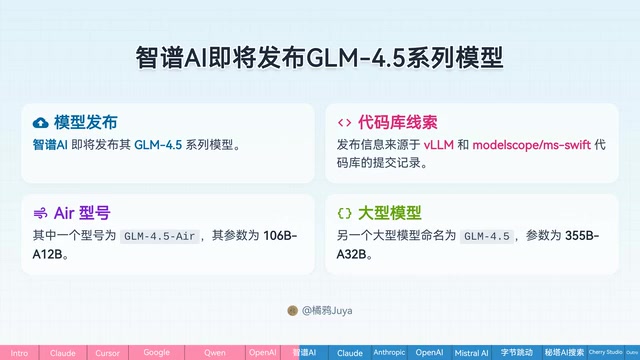
To understand the significance of this scale, one needs to understand model parameter counts and the competitive landscape. Parameter count is one of the core metrics for measuring large language model scale, but the relationship between parameters and actual performance is not linear. According to Scaling Law theory, model capabilities improve with increases in parameter count, training data volume, and compute, but with diminishing marginal returns. The 355B-parameter GLM4.5 flagship model represents top-tier scale among domestic open-source models, competing in the same weight class as international flagship models like Meta LLaMA 3.1 405B and Mistral Large. The actual deployment cost of ultra-large models is extremely high, so vendors typically release lightweight versions simultaneously (such as the 106B GLM4.5 Air) to serve users with different compute budgets. This "flagship + lightweight" product matrix strategy has become standard practice among leading AI vendors—showcasing technical prowess while maintaining commercial viability.
Additionally, reports indicate that OpenAI is preparing to release its next-generation flagship model GPT-5 in early August, with plans to release a new open-source language model beforehand. Competition in the second half of the year will only intensify.
Anthropic and ChatGPT's Ecosystem Integration Moves
Anthropic significantly increased API rate limits for the Claude 4 Opus model, covering Tier 1 through Tier 4 users with substantially more tokens per minute. Simultaneously, Anthropic announced Claude's integration with design platform Canva, allowing users to convert text content directly into branded visual designs.
On the ChatGPT side, Pro users gained new Canva and Notion connectors for chat search and deep research. The app is also testing chat theme customization and in-app shopping features.
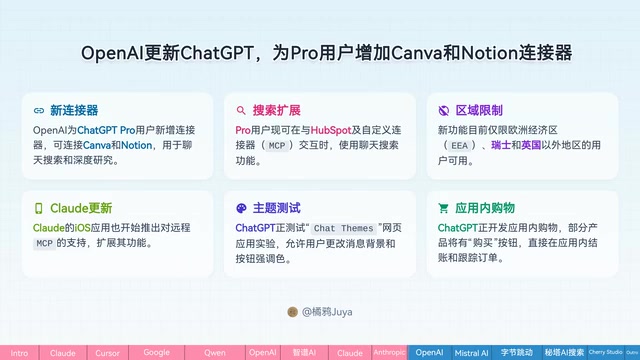
These integration moves send a clear signal: AI assistants are evolving from standalone tools into ecosystem platforms. Integration with productivity tools like Canva and Notion means AI is no longer just a "chat companion in a dialog box" but a core node truly embedded in users' daily workflows. From a product strategy perspective, this ecosystem integration approach closely mirrors how WeChat and DingTalk built open platforms during the mobile internet era—using Connector mechanisms to lower third-party integration barriers, leveraging platform network effects to strengthen user stickiness, and ultimately forming an ecosystem moat that no single competitor can replicate.
Other Notable Updates
Mistral AI released Magistral Small 1.1, a 24-billion parameter efficient reasoning model with enhanced reasoning capabilities and optimized output formatting. Additionally, Mistral AI Search officially launched, with the search API priced at $0.03 per query, supporting multimodal search across web pages, images, and videos.
ByteDance released Seed Live Interpret 2.0, an end-to-end simultaneous interpretation model that approaches human-level performance in Chinese-English speech interpretation latency and accuracy, with support for zero-shot voice cloning. The technology is now available externally through Volcano Engine.
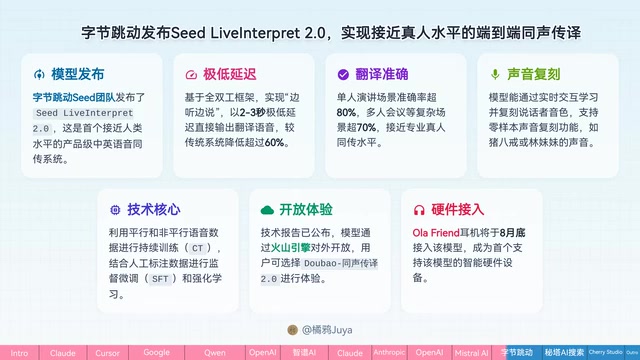
Simultaneous Interpretation is one of the pinnacles of human language ability, requiring interpreters to output the target language in real-time while listening to the source language, typically with latency controlled within 2-4 seconds. For AI systems, this task presents three major challenges: first, low-latency streaming Automatic Speech Recognition (ASR), which requires beginning translation before sentences are complete; second, cross-lingual semantic alignment, where syntactic structure differences between languages (such as Chinese topic-comment structure versus English SVO structure) cause translation timing misalignment; and third, Voice Cloning, outputting target language speech while preserving the original speaker's vocal characteristics. Seed Live Interpret 2.0 supports zero-shot voice cloning—cloning voice timbre without pre-collecting target voice samples—which represents a significant breakthrough in end-to-end speech translation systems and foreshadows profound technological disruption for the professional interpretation profession.
Cherry Studio released V1.53 with a completely new UI and introduced features like call chain visualization (Trace), providing AI application developers with better debugging and monitoring capabilities.
Summary
Looking at today's developments, the AI industry is accelerating simultaneously in two directions: first, specialization of programming tools—Claude Code's sub-agents and Cursor's BugBot are both pushing AI programming from "assisted code writing" toward "engineered collaboration"; second, deepening ecosystem integration—both Anthropic and OpenAI are actively building connections with third-party tools to construct more complete AI workflows. For developers and enterprise users, the criteria for choosing AI tools is expanding from "model capability" to "ecosystem completeness."
Key Takeaways
- Anthropic adds custom sub-agent functionality to Claude Code, supporting specialized AI assistants for code review, debugging, and other specific tasks
- Cursor officially launches code review Agent BugBot, capable of automatically analyzing code changes and identifying logic errors and security issues
- Qwen releases the Qwen3-MT translation model supporting 92+ languages, with a new reasoning model preview announced
- ChatGPT and Claude accelerate ecosystem integration, connecting with third-party productivity tools like Canva and Notion
- Zhipu GLM4.5 series, OpenAI GPT-5, and other major models are on the horizon, with second-half model competition set to intensify
Related articles
 Tech Frontiers
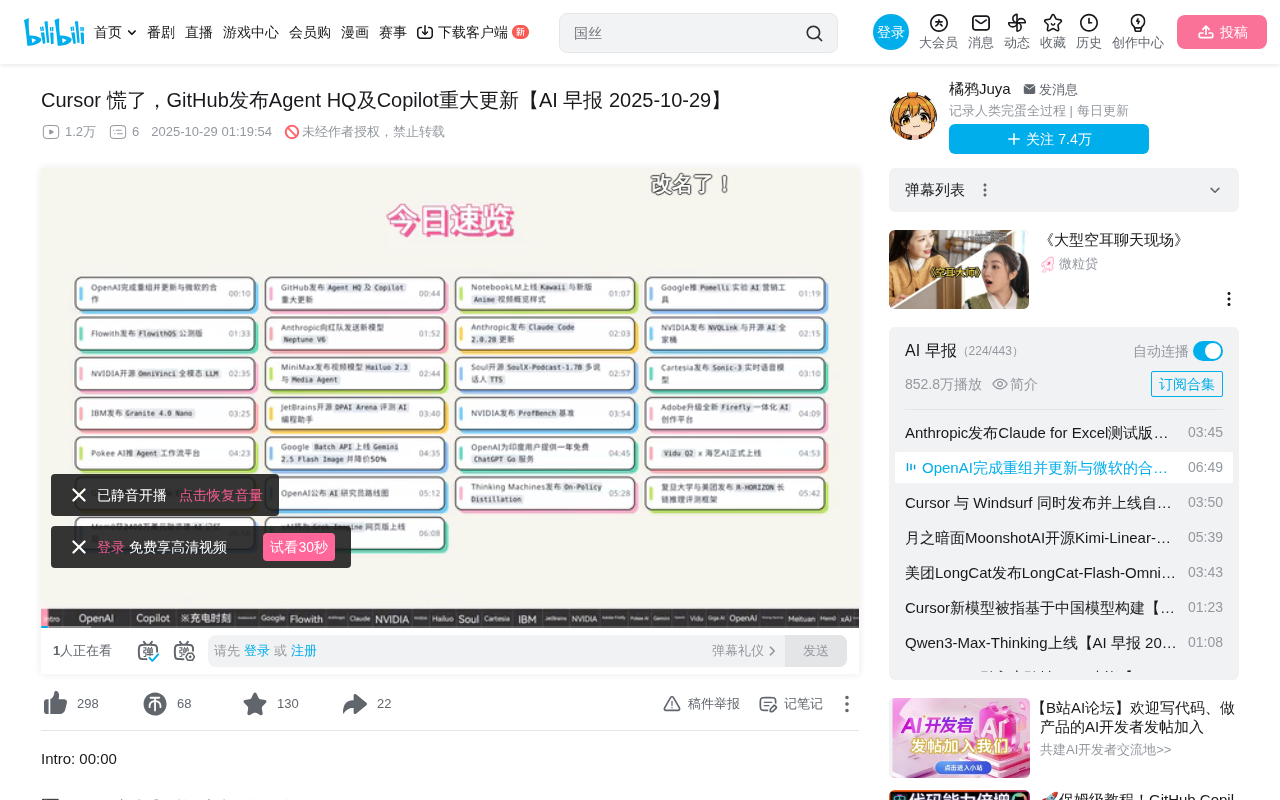
GitHub Agent HQ Launch: AI Coding Tools Enter the Era of Platform Competition
GitHub Universe unveils Agent HQ platform for unified coding agent management, Copilot upgrades with multi-model support. OpenAI completes restructuring, Anthropic tests new model, NVIDIA open-sources AI models.
 Tech Frontiers
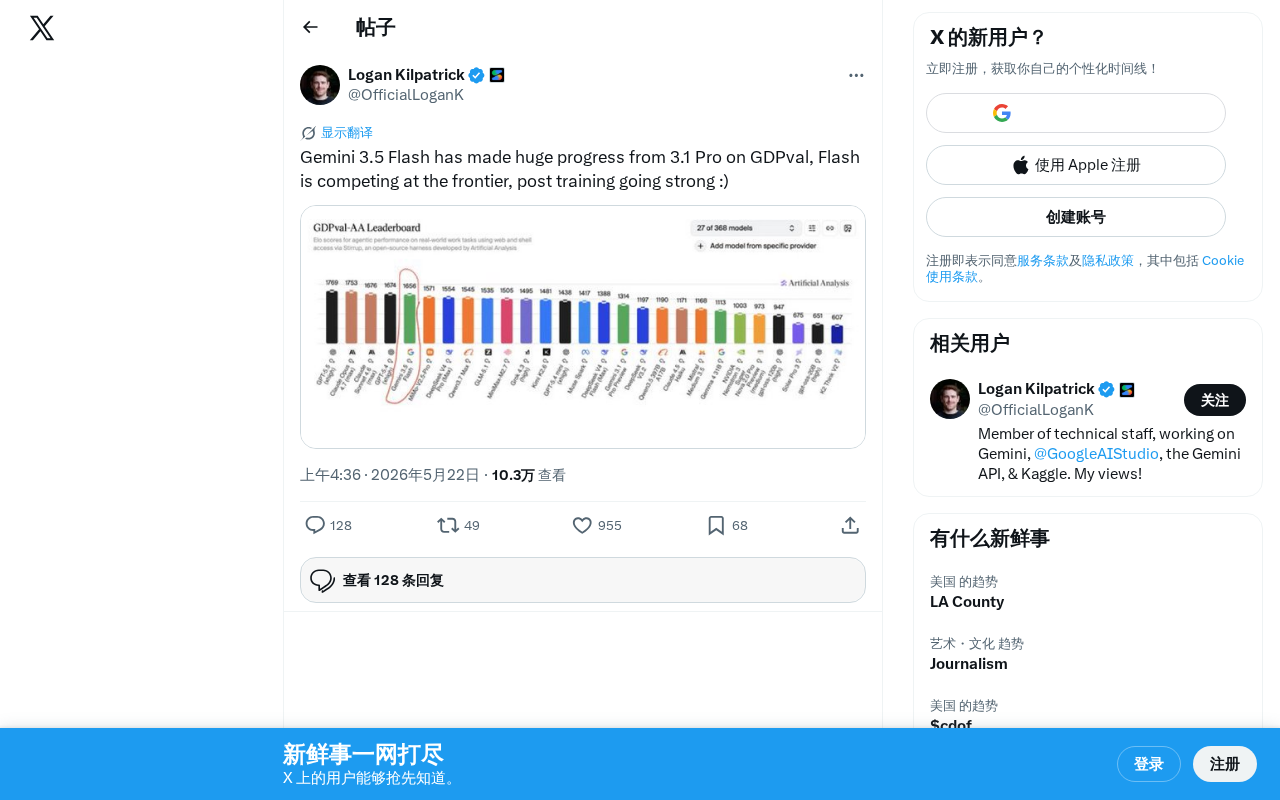
Gemini 3.5 Flash Achieves a Massive Leap on the GDPval Benchmark
Google Gemini 3.5 Flash surpasses Gemini 3.1 Pro on the GDPval benchmark. The lightweight Flash model leverages post-training techniques to approach frontier-level performance, redefining the balance between quality and cost.
 Tech Frontiers
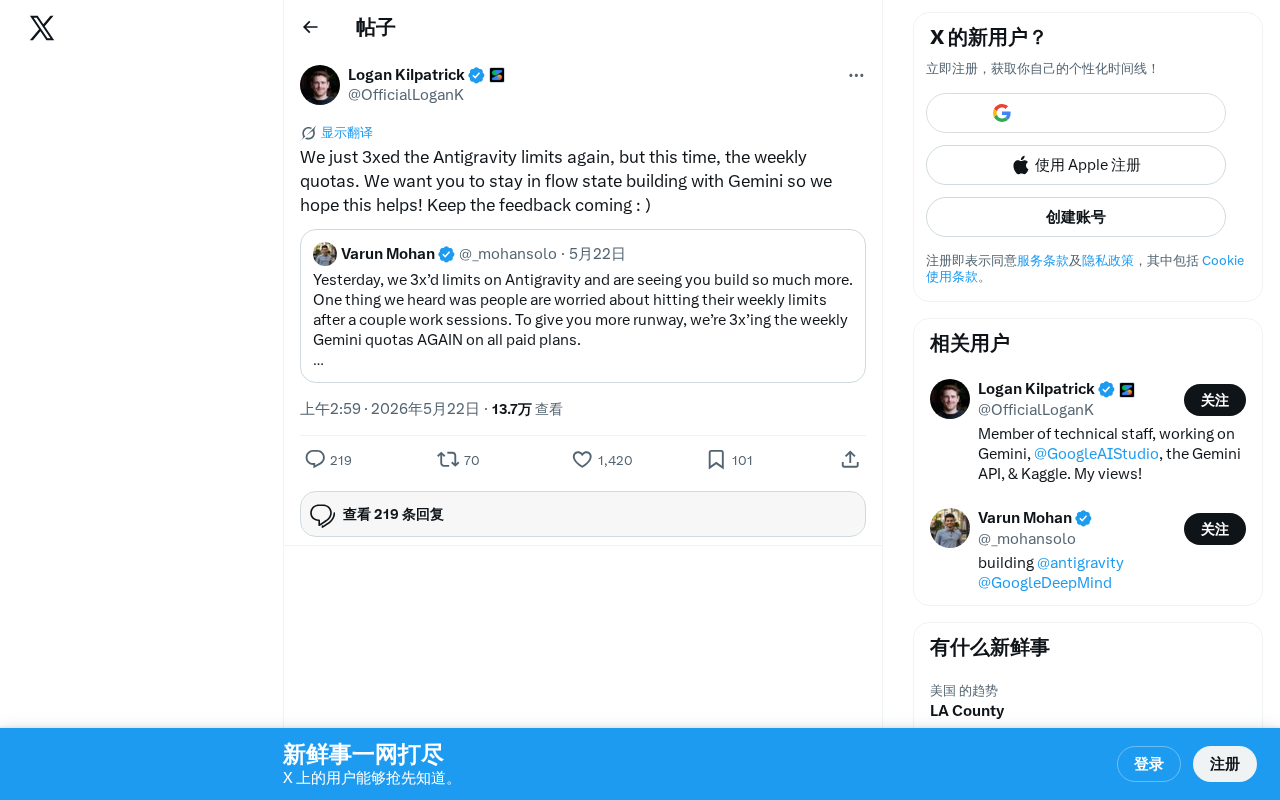
Google Gemini Antigravity Weekly Quota Tripled — AI Coding Without Limits
Google Gemini triples Antigravity weekly quotas following a prior daily quota boost. Analyzing the impact on developers and its strategic significance in AI coding.