Claude Code vs Codex Deep Dive: A Practical Guide to Choosing the Right AI Coding Tool
Claude Code vs Codex Deep Dive: A Prac…
A comprehensive comparison of Claude Code and Codex covering design philosophy, use cases, and selection criteria.
This article provides an in-depth comparison of Anthropic's Claude Code and OpenAI's Codex. Claude Code runs locally in a pair programming model with manual confirmation, offers up to 1M token context window, scores ~80.9 on SWE-Bench, and suits complex large-scale projects. Codex runs in a cloud sandbox with automatic execution, supports high concurrency, consumes fewer tokens, and excels at rapid prototyping and batch tasks. Rather than replacements, the two tools complement each other.
The competition among AI coding tools is heating up, and Anthropic's Claude Code and OpenAI's Codex are the two most talked-about products right now. Although both have "Code" in their names, once you dig deeper you'll find their design philosophies, workflows, and ideal use cases are fundamentally different. This article provides a comprehensive breakdown from underlying principles to practical selection criteria.
Underlying Principles: Local Co-pilot vs Cloud Outsourcing
To understand the differences between these two tools, we need to start with how they actually work.
Claude Code runs on your own machine in a single-threaded workflow. Its core loop is "read code → make changes → verify results," completing one cycle before starting the next. Throughout this process, you can interrupt and redirect at any time, and sensitive operations (like deleting files or modifying configurations) require your manual confirmation. In other words, you're in the driver's seat, and Claude Code is your co-pilot.
This design philosophy stems from the classic software engineering practice of Pair Programming — a collaborative approach popularized by Extreme Programming (XP) methodology, where one person "drives" (actually types the code) while the other "navigates" (reviews logic and offers suggestions). Claude Code is a digital extension of this model: it plays the navigator role, perceiving code context locally in real-time, proposing modifications, and waiting for human confirmation. The developer always maintains ultimate control over the codebase. This is fundamentally different from traditional IDE plugin-style code completion tools — the latter passively responds to cursor position, while the former actively understands the entire project's intent and structure. When handling large projects, it automatically performs multi-level context compression, freeing up "mental capacity" to continue reading code.
Codex takes a completely different approach. It tosses tasks into a cloud sandbox for execution — running independently and delivering results without requiring your involvement in between. A Sandbox is a security isolation technology that runs code in a controlled virtual environment, preventing it from accessing or modifying the host system's files, network, and processes — all code execution happens in remote containers completely isolated from the user's local environment. Written in Rust at its core, it has inherent advantages in startup speed and token processing efficiency. Rust is a systems-level language known for memory safety and high-concurrency performance, widely adopted in recent years by well-known development tools like Deno and Turbopack. It delivers orders-of-magnitude performance improvements that translate directly into lower API call latency and more optimized cost structures. Token consumption for API calls has also been carefully optimized. Simply put: you place the order, it delivers the goods.
One is a close partner, the other is a remote outsourcing team — this analogy essentially captures the fundamental difference between the two.
Use Cases: Precision Surgery vs Batch Operations
The differences in underlying principles directly determine the battlefields where each excels.
Claude Code: A Precision Scalpel for Complex Projects
Claude Code is suited for work where "there's no room for error." Typical scenarios include:
- Large codebase refactoring: Facing legacy projects with hundreds of thousands of lines, it first builds a project dependency graph "in its head," mapping out the structure before making changes
- Cross-file bug hunting and architecture adjustments: For complex problems involving multi-file interactions, it can continuously track context
- Team standards enforcement: Place a
CLAUDE.mdfile in your project with coding standards, and team style can be effectively constrained. CLAUDE.md is a project-level configuration file designed by Anthropic specifically for Claude Code, similar to.editorconfigor.eslintrcin a code repository, but with broader scope — teams can define coding styles, naming conventions, prohibited operations, architectural constraints, and other rules within it. Claude Code incorporates these rules into its context when processing the project, solving the pain point of different team members producing stylistically inconsistent code output when interacting with AI - Toolchain integration: Connecting to CI/CD, project management tools, etc., works quite smoothly
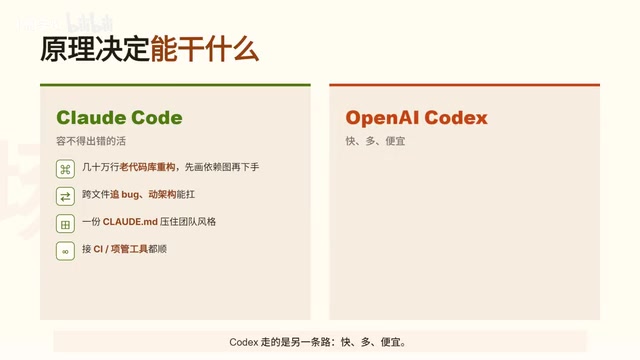
Codex: A Production Line for Rapid Delivery
Codex follows the "fast, many, cheap" approach:
- Rapid MVP prototyping: Building a minimum viable product from scratch, with prototypes ready in minutes
- Batch processing: Fixing a dozen bugs simultaneously, or generating hundreds of test cases at once — it can run them in parallel
- Scripts and data processing: Writing automation scripts and doing data transformations — these kinds of "peripheral tasks" are also well-suited
- Low barrier to entry: Non-technical colleagues using it for office automation or generating simple web pages can get things running too
It's more like a fast-working outsourcing team that can take on many jobs simultaneously, but with an upper limit on the precision of each job.
Key Dimension Comparison: Making Decisions with Data
Setting aside subjective descriptions, several hard metrics can help you make a more rational judgment.
Workflow and Security
| Dimension | Claude Code | Codex |
|---|---|---|
| Runtime Environment | Local file system | Cloud sandbox |
| Operation Confirmation | Critical operations require manual confirmation | Automatic execution, delivered upon completion |
| Environment Isolation | Direct access to local environment | Completely isolated from local environment |
It's worth noting that while Codex's cloud sandbox isolation brings the advantage of secure execution, it also means code needs to be uploaded to remote servers. For projects involving trade secrets or strict compliance requirements, data security risks need additional evaluation.
Context Window Comparison
Before diving into the numbers, it's necessary to understand the concepts of Tokens and Context Windows. A token is the basic unit by which large language models process text — roughly speaking, one English word equals about 1-2 tokens, and one Chinese character equals about 1-2 tokens. The Context Window determines how much information the model can "see" in a single inference, directly affecting its ability to process long documents or large codebases.
- Claude Code: Base 200K tokens, expandable up to 1 million tokens. One million tokens means loading approximately 750,000 English words at once, equivalent to hundreds of thousands of lines of code — you can stuff an entire codebase in there. The model doesn't need to frequently "forget" code content read earlier, maintaining a more coherent reasoning chain, which is critical for large projects.
- Codex: 400K tokens, more than sufficient for single tasks, but positioned more toward single-task focused reasoning.
SWE-Bench Benchmark and Token Cost
In the industry-standard SWE-Bench benchmark, the gap between the two tools is clear. SWE-Bench is an AI programming capability evaluation benchmark launched in 2023 by a research team at Princeton University. It pulls thousands of real Issues and corresponding Pull Requests from GitHub, requiring models to automatically generate code patches that pass unit tests given a codebase and problem description — making it currently the closest evaluation standard to real development scenarios and the core reference metric for measuring AI coding tools' "real-world capability."
- Claude Code scores approximately 80.9 points, with deeper reasoning, but token consumption for the same task is roughly 3-4 times that of Codex
- Codex scores between 69-80 points, with faster inference speed and friendlier bills
This data reveals a classic engineering trade-off: quality vs cost. Claude Code trades more computational resources for higher accuracy, while Codex significantly reduces overhead while maintaining a usable level of performance.
Concurrency Capability Differences
- Claude Code: Supports a degree of parallelism, but with upper limits, constrained by local resources
- Codex: Natively designed for cloud concurrency, capable of handling dozens of independent tasks simultaneously
This difference is particularly pronounced in team collaboration scenarios. If you need to process a large number of independent small tasks simultaneously, Codex's concurrency advantage is overwhelming.
Selection Recommendations: Make Decisions Based on Project Needs
The final choice isn't actually complicated — the key is clearly understanding your own needs.
Choose Claude Code when:
- You're maintaining a large, complex project
- Code quality and accuracy matter more than speed
- You want full control over the modification process
- The project involves sensitive code or private environments
Choose Codex when:
- You need rapid prototyping and fast iteration
- You have many independent small tasks that need parallel processing
- Budget is limited and you need to control token costs
- Tasks are relatively standardized and don't require deep contextual understanding
Final Thoughts
These two tools aren't in a "one kills the other" relationship — they represent two fundamentally different work paradigms. Claude Code is like an experienced senior engineer sitting next to you doing pair programming, while Codex is more like an efficient remote development team helping you deliver in bulk.
In practice, they can even complement each other: use Claude Code for core architecture and complex logic, and Codex for batch-generating test cases and handling repetitive tasks. Once you're clear about what kind of work you have on hand, the choice becomes straightforward.
Key Takeaways
- Claude Code runs locally, single-threaded, with manual confirmation support — like a co-pilot; Codex runs in a cloud sandbox with automatic execution and delivery — like an outsourcing team
- Claude Code scores ~80.9 on SWE-Bench with higher accuracy, but token consumption is 3-4x that of Codex
- Claude Code's context window of up to 1M tokens suits large projects; Codex's 400K tokens is positioned for single tasks
- Codex natively supports cloud concurrency, handling dozens of independent tasks simultaneously — ideal for batch operations
- The two aren't substitutes but complements: choose Claude Code for complex projects, Codex for rapid bulk delivery
Related articles
 Product Reviews
Qoder vs Cursor Real-World Comparison: Which $20/Month AI IDE Is Better?
Hands-on comparison of Qoder vs Cursor AI IDEs: Agent autonomy, human interaction count, and architecture decisions. Qoder needed only 2 interactions vs Cursor's 8.
 Product Reviews
Cursor Cloud Agent Demo: Eliminating Bottlenecks Across the Entire Software Development Lifecycle
Deep analysis of Cursor's Cloud Agent demo showing how cloud VMs, automated test artifacts, and a full-chain control plane systematically eliminate human bottlenecks across the software development lifecycle.
 Product Reviews
Cursor 3.0 Deep Dive: Multi-Agent Parallelism, Design Mode, and Best-of-N Model Comparison
Cursor 3.0 evolves from an AI coding assistant into an Agent fleet command center. Explore multi-agent parallelism, Design Mode, and Best-of-N model comparison.