Claude Code with DeepSeek V4: Complete the Switch with a Single Command
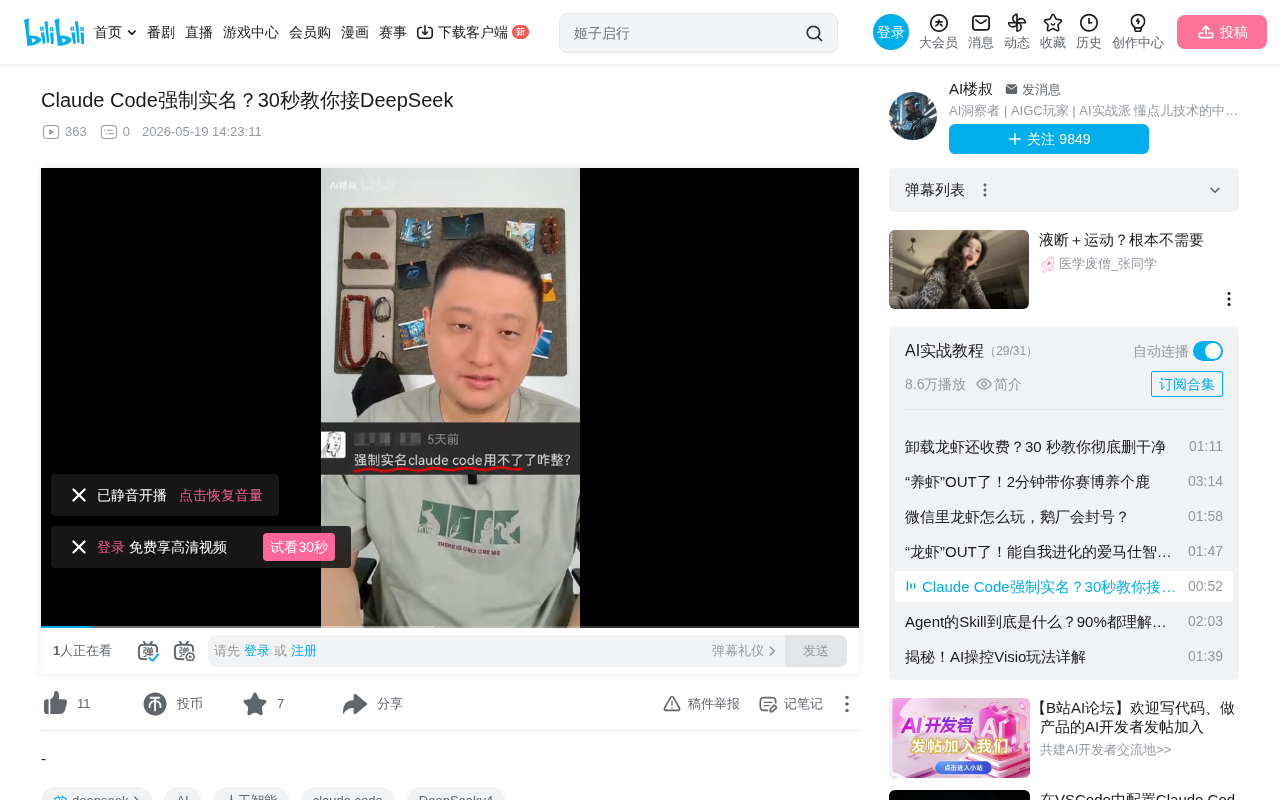
Replace Claude Code's backend with DeepSeek V4 via a single command to bypass identity verification.
Claude Code's real-name authentication policy has restricted access for some users. Developers leverage the OpenAI-compatible API protocol to swap the backend model from Claude to DeepSeek V4 by modifying connection settings—achieving a seamless "engine swap." The solution is simple to set up and cost-effective, though it comes with certain limitations in model capability and long-term stability.
Claude Code's Identity Verification Sparks Demand for Alternatives
Claude Code has recently imposed stricter user identity verification requirements, leaving some users unable to access the tool due to real-name authentication issues. Facing this limitation, Chinese developers quickly found a workaround—integrating the DeepSeek V4 model into Claude Code's command-line tool, achieving a "swap the engine, keep the shell" operation.
Claude Code is a command-line AI programming assistant developed by Anthropic that allows developers to interact with the Claude model directly in the terminal for code generation, debugging, refactoring, and other tasks. Unlike traditional web chat interfaces, Claude Code deeply integrates into developers' workflows, directly reading project files, executing shell commands, and modifying codebases. It's essentially a Node.js application that communicates with backend large language models via API—an architectural design that also makes it technically possible to swap out the backend model.
Regarding the background of the identity verification policy: Claude Code's real-name authentication requirement is closely tied to global AI regulatory trends. As a U.S.-based AI safety company, Anthropic must comply with export control and user identity verification regulations. For users in certain regions, this means providing valid identification documents or linking payment methods from specific countries. While this policy stems from compliance considerations, it objectively raises the barrier for international users—particularly developers without overseas credit cards or phone numbers—creating a substantive access obstacle.
The core logic of this workaround is simple: Claude Code is essentially a terminal interaction tool, and by modifying its connection configuration, you can replace the backend model from Claude with DeepSeek V4, thereby bypassing the real-name authentication restriction.
Windows Command-Line Configuration Steps
Prerequisites
Before getting started, make sure you've completed the following two steps:
- Claude Code installed: Ensure the Claude Code command-line tool is properly installed on your system
- DeepSeek API key obtained: Visit the DeepSeek official website to apply for an API Key—this is the credential for connecting to the model
Specific Steps
Open the Windows command line (CMD or PowerShell) and enter the configuration command. This command does the following:
- Enables a hidden configuration option in Claude Code
- Forces the model connection endpoint to point to DeepSeek V4
- Overrides the default API authentication method
The entire process essentially leverages Claude Code's hidden feature for custom model endpoints, forwarding requests to DeepSeek's API server via environment variables or startup parameters.
From a technical standpoint, this capability relies on the OpenAI-compatible API protocol. This is a de facto industry standard—most large language model providers (including DeepSeek, Qwen, Moonshot, etc.) have implemented interfaces compatible with the OpenAI API format. This means that as long as the target model supports the same request/response format (such as the /v1/chat/completions endpoint), client tools can switch backend models by simply modifying the base_url and API Key without changing any business logic code. This is the fundamental reason why the switch can be completed with "a single command."
Pros and Cons of the DeepSeek V4 Alternative
About DeepSeek V4
DeepSeek V4 is the latest-generation large language model released by DeepSeek in 2025. DeepSeek has gained widespread attention in the global AI community for its open-source strategy and highly competitive pricing. Its predecessors, DeepSeek V3 and DeepSeek R1, have already demonstrated near-GPT-4-level capabilities across multiple benchmarks. V4 further improves code generation, mathematical reasoning, and long-context processing, with API pricing at just a fraction of overseas models like Claude—making it an ideal choice for cost-sensitive applications.
Advantages
- Low cost: DeepSeek V4's API pricing is significantly lower than Claude's, offering excellent value for individual developers and learning purposes
- No identity verification required: Bypasses Claude Code's authentication restrictions, lowering the barrier to entry
- Simple setup: Configuration is completed with a single command—no complex environment setup needed
Points to Consider
- Model capability differences: There are certain gaps between DeepSeek V4 and Claude in code generation and reasoning capabilities; performance on complex tasks may vary
- Stability risks: This is an unofficially supported usage, and future Claude Code updates may affect compatibility
- Limited applicable scenarios: Perfectly adequate for daily coding assistance and simple Q&A, but for complex projects requiring deep reasoning, evaluate carefully before committing
Summary: A Pragmatic Choice for Low-Cost AI Programming
This solution embodies the pragmatic spirit of the developer community—when official channels create barriers, technical means can always find alternative paths. DeepSeek V4, as a representative of Chinese-made large models, already offers considerable practical value in the programming assistance domain. For users frustrated by Claude Code's real-name authentication, this is a low-cost solution worth trying.
Of course, if your work demands high model quality, consider this as a backup option rather than a complete replacement. The value of tools lies in solving problems—choosing the solution that best fits your current needs is the wise approach.
Related articles
 Tutorials
Cursor + Codex Dual-IDE Collaboration: A Practical Methodology for Open-Source Project Customization
A complete methodology for open-source project customization based on real-world experience, detailing the Cursor+Codex dual-IDE workflow, seven-stage process, MVP validation, and AI source code reading techniques.
 Tutorials
Cursor Multi-Agent in Practice: Building a Full-Stack Next.js Blog in 50 Minutes
Build a full-stack blog in 50 minutes using Cursor IDE's multi-Agent mode with Next.js, Clerk auth, and Supabase. Learn the 4-phase AI Agent workflow and key integration pitfalls.
 Tutorials
Building an AI Software Factory from Scratch: A Cursor Engineer's Hands-On Experience with Multi-Agent Collaboration
Cursor engineer Eric shares practical insights on building an AI software factory: automation levels, guardrail design, parallel Agent management, and scaling to 1000+ Agents for 24/7 development.