Claude-mem: The Open-Source Memory System That Stops AI from Forgetting
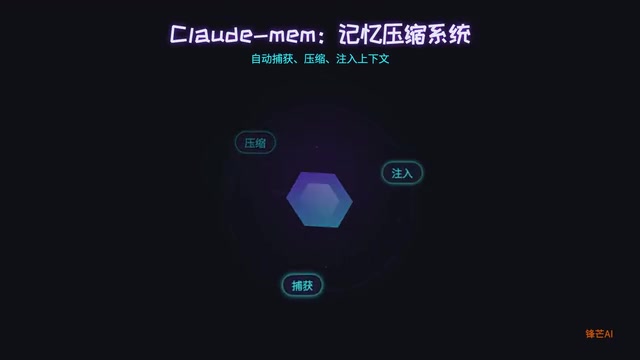
Claude-mem gives AI coding assistants persistent cross-session memory through semantic compression and local vector search.
Claude-mem is an open-source tool that solves the "amnesia" problem of AI coding assistants like Claude Code, Codex, and Gemini. It automatically captures interactions, compresses them into semantic summaries, and stores them locally in a vector database. Using hybrid retrieval combining semantic similarity and keyword matching, it injects only the most relevant context into new sessions — with just ~50 tokens of overhead. With 80K+ GitHub Stars, local-only storage for privacy, and one-line installation, it's become a phenomenon-level project in the developer community.
Starting from Scratch Every Time: The "Amnesia" Problem with AI Assistants
You spend an entire day writing code with Claude Code — squashing three bugs and finalizing an architecture plan. The next morning you open your terminal, and the AI has forgotten everything. You have to re-explain the project background, re-describe the problem, and walk it through the entire workflow again.
This isn't an isolated case — it's a universal pain point across all current AI coding assistants. Every session starts as a blank slate, and the context window is discarded once used. The "context window" refers to the maximum amount of text a large language model can process at once, measured in tokens — the smallest unit of text the model works with. One English word typically corresponds to 1–2 tokens, while one Chinese character is roughly 1.5–2 tokens. Even though Claude 3.5 boasts a 200K token window, in real-world coding scenarios it gets filled up quickly by code files, error logs, and architecture discussions. More critically, mainstream AI assistants use a stateless session model — no information from previous conversations is retained in new ones. This is dictated by the inference mechanism of the Transformer architecture: the model itself has no persistent memory capability, and all "memory" depends entirely on the context provided within the current session.
You think the AI is helping you, but in reality, you're repeatedly helping the AI build its understanding. This repetitive labor costs more than just time — it drains developer patience and disrupts flow state. Flow State is a concept introduced by psychologist Mihaly Csikszentmihalyi, describing the highly focused, highly productive mental state a person enters when fully absorbed in an activity. For developers, entering flow typically requires a 15–30 minute warm-up period, and once interrupted, re-entering it can take just as long. Having to re-explain project context to the AI at the start of every new session is essentially a forced "flow interruption" — a well-recognized productivity killer in software engineering.
Claude-mem (also known as claude-memory) is an open-source tool built specifically to solve this problem. It automatically captures every interaction you have with the AI in the background, compresses it into semantic summaries stored in a local database, and lets the AI automatically "pick up where you left off" in the next conversation.
Core Mechanism: Semantic Compression, Not Chat Log Storage
Many people's first reaction is: isn't this just saving chat history? Not quite. Simply storing conversation history creates two problems: token costs explode, and noise drowns out the important information.
Claude-mem takes a more sophisticated approach. It captures multi-dimensional information from your AI interactions — file reads/writes, command executions, edit results — and then compresses them into semantic summaries rather than storing the raw text. Semantic compression is an important direction in natural language processing. Unlike traditional text compression (like gzip compressing bytes), it focuses on the "meaning" of information rather than the "literal text." In Claude-mem's case, this process typically leverages the LLM's own summarization capabilities — using AI to compress AI conversations, extracting high-value information like decisions, code changes, and architecture choices while discarding low-value content like pleasantries and repeated attempts. This means a coding session lasting several hours might be condensed into just a few dozen structured memory fragments, such as the concise statement: "Found a race condition in JWT expiration handling in the auth module; resolved by introducing a mutex lock."
Hybrid Retrieval: Semantic Similarity + Keyword Dual Matching
Under the hood, Claude-mem uses a vector database for hybrid search, combining semantic similarity and keyword matching retrieval strategies. Vector databases (such as Chroma, Qdrant, etc.) are database systems specifically designed for storing and retrieving high-dimensional vectors. They work by first converting text into high-dimensional numerical vectors (typically 768 or 1536 dimensions) using an embedding model. The distance between these vectors in mathematical space reflects the semantic similarity between texts.
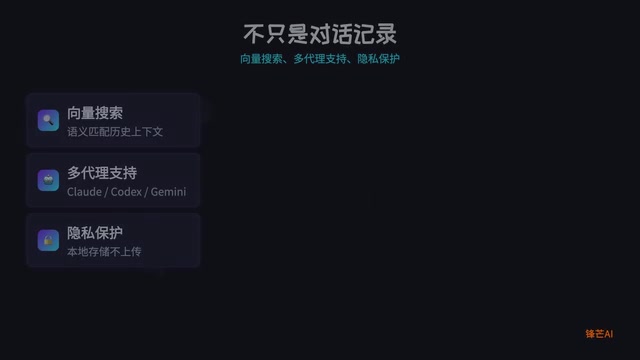
Hybrid Search is a strategy that combines vector semantic search with traditional BM25 keyword search. Pure semantic search excels at understanding "intent" — for example, searching for "user login" can match memory fragments related to "authentication." However, it may miss exact function names or variable names. Keyword search performs better for precise matching. When combined, the system captures semantic-level associations without missing exact matches for specific identifiers in code — which is especially important for programming scenarios.
When a new session begins, the system retrieves the most relevant context fragments from the memory store based on the current conversation content and automatically injects them.

The beauty of this design is that you don't need to manually tell the AI to "recall yesterday's content." The system automatically determines which historical information is relevant to the current task and precisely injects it rather than dumping everything in. According to the project, the entire process consumes only about 50 tokens of additional overhead — virtually imperceptible.
Broad Compatibility: One Memory System Covering Major AI Agents
Claude-mem isn't designed exclusively for Claude Code. It supports the current mainstream AI coding agents, including:
- Claude Code (Anthropic)
- Codex (OpenAI)
- Gemini (Google)
- OpenCode and other open-source solutions
In 2024–2025, the AI coding agent space entered a phase of intense competition. These tools share a common characteristic: they all adopt the "Agent" paradigm — not only generating code but also autonomously executing commands, reading/writing files, and running tests to form a complete development loop. Claude Code excels in deep code understanding and long-task execution; OpenAI's Codex (the agent version re-released in 2025) is deeply integrated into the ChatGPT ecosystem; Google's Gemini Code Assist leverages the Gemini 2.5 series models with unique advantages in multimodal understanding; and open-source solutions like OpenCode provide developers with self-hostable alternatives.
But all these tools share the same weakness: a lack of persistent cross-session memory. Claude-mem covers all major tools with a single memory system, meaning that even if you switch between different agents, your accumulated project memory won't be lost.

Privacy and Security: Local Storage + Tag Filtering
For developers working with sensitive code, privacy is a hard requirement. Claude-mem provides two layers of protection in this regard:
- Local Data Storage: All memory summaries are stored in a local database and never uploaded to the cloud. This stands in stark contrast to many cloud-based AI services, which typically need to send data to remote servers for processing and storage, creating risks of data leaks and compliance issues. Local storage means your code logic, architecture decisions, debugging processes, and other sensitive information always stay on your own machine.
- Private Tag Mechanism: Content marked with the
privatetag is not captured or stored by the memory system. This provides fine-grained control for handling highly sensitive information such as keys, credentials, and internal APIs.
This allows developers to enjoy the memory functionality while maintaining complete control over sensitive information.
Community Traction and Installation
Based on GitHub data, Claude-mem has already earned 80,000+ Stars and 6,900+ Forks, indicating extremely high community engagement. Well-known tech platforms like DataCamp and BetterStack have published dedicated tutorials for it, demonstrating its recognition among the developer community. For reference, GitHub projects with over 50,000 Stars are already in the top tier of open-source projects — the 80,000+ figure shows that Claude-mem has leaped from a niche tool to a phenomenon-level project in the developer community.
One-Line Installation
The installation process has zero dependencies — just one command:
npx claude-mem install
npx is a package execution tool in the Node.js ecosystem that can run npm packages directly without global installation. This means you only need a Node.js environment (which most developers already have on their machines) to complete installation and configuration with a single command — no need to manually handle vector database deployment, embedding model downloads, or other complex steps, as these are all encapsulated in the installation script.
Conclusion: A Critical Step from "Tool" to "Partner"
The biggest bottleneck for current AI coding assistants isn't that the models aren't powerful enough — it's the lack of continuity. The disconnect between sessions keeps AI permanently at the "tool" level, unable to become a true "partner" that understands your project. This problem is known in academia as the "Long-term Memory" challenge and is one of the core research directions in AI Agent development — how to enable AI systems to accumulate, organize, and apply knowledge across multiple interactions, gradually building a deep understanding of the user and the project.
Claude-mem fills this gap in a lightweight, elegant way. With just 50 tokens of overhead, local storage, and intelligent retrieval, it gives AI cross-session "project memory" for the first time. For developers who collaborate deeply with AI every day, this may be one of the highest-ROI productivity tools available today.
Related articles
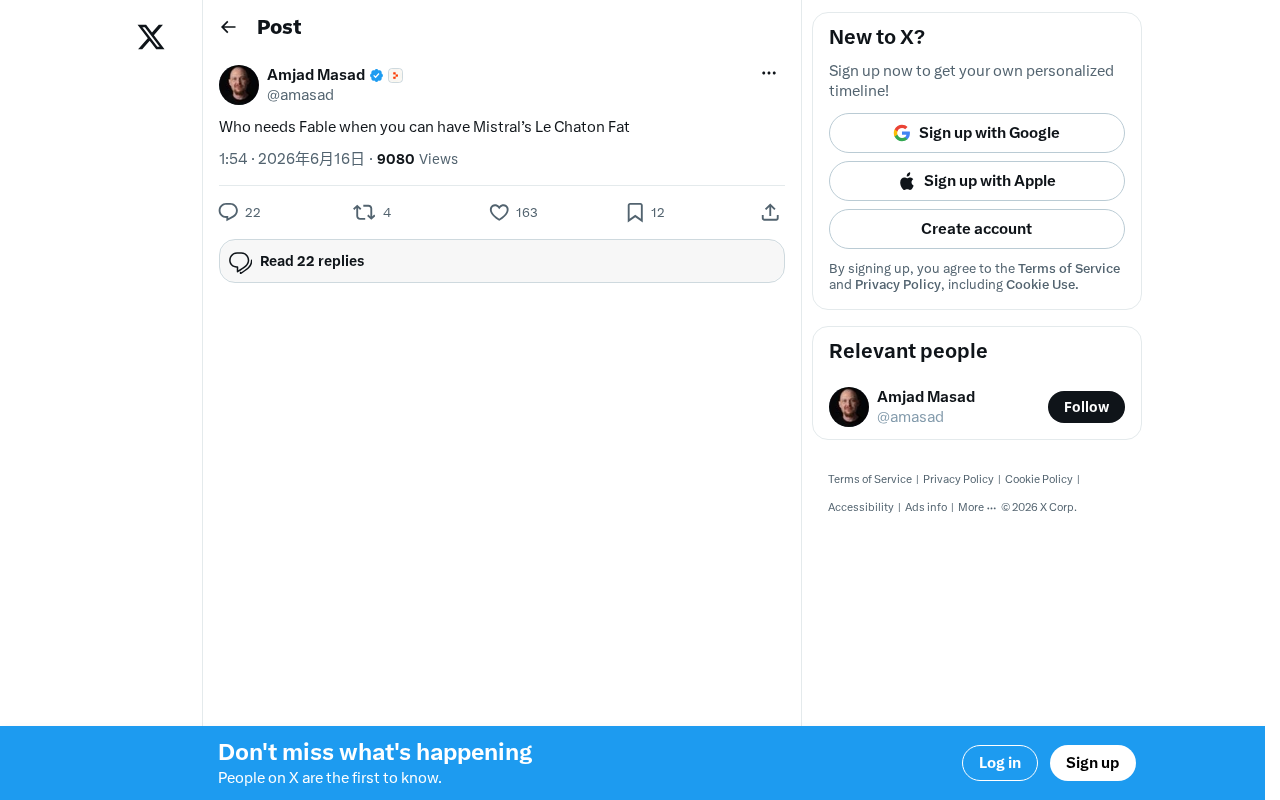
Mistral Le Chat Image Generation Review: Can It Replace Fable?
Mistral AI launches image generation in Le Chat, dubbed Le Chaton Fat. We analyze its capabilities, compare it with Fable, and explore the trend of AI chat platforms integrating image generation.

Testing DeepSeek's Safety Mechanisms: Multiple Jailbreak Attempts Successfully Blocked
An overseas security blogger systematically tested DeepSeek's jailbreak resistance using direct requests, rephrased prompts, and varied strategies. Results show robust intent recognition, consistent blocking, and context-aware safety mechanisms.
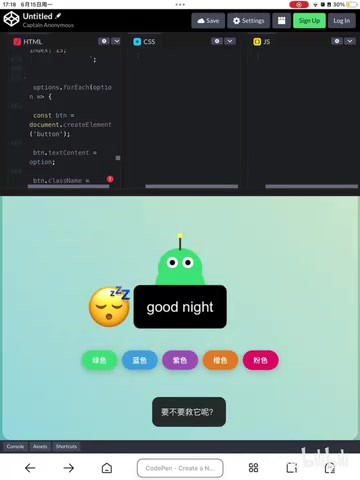
A Middle Schooler with Zero Coding Skills Built a Story-Driven Game with AI: Creativity Unshackled from Technical Barriers
A middle schooler with no coding experience used AI to build an interactive story game with branching choices and surreal alien adventures. We explore what this means for creative democratization.