Claude Mythos 5 Allegedly Spotted, Inside OpenAI's Equity Negotiations with the U.S. Government
Claude Mythos 5 leaks in API, OpenAI negotiates government equity stake, Hermes Agent ships desktop app.
Anthropic's Claude Mythos 5 model briefly appeared in the API, hinting at a major next-gen release. Meanwhile, OpenAI has been negotiating with the U.S. government for over a year on an equity transfer deal involving a public wealth fund for citizens. In open-source news, Hermes Agent V0.16.0 launched with a native desktop app and Chinese language support.
OpenAI's Equity Negotiations with the U.S. Government: A Year-Long Power Play
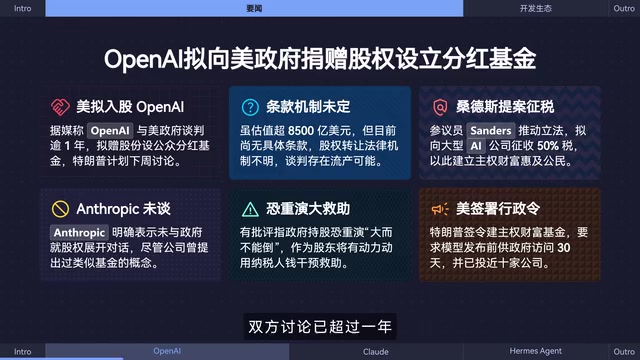
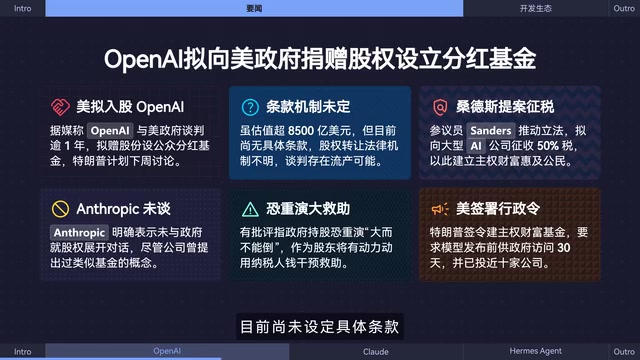
According to the latest reports, OpenAI is engaged in deep negotiations with the U.S. government regarding a potential equity stake, with discussions having lasted over a year. This revelation sheds light on an entirely new dimension of the relationship between the AI industry and government.
The core proposal under discussion involves OpenAI transferring a portion of its equity to the government and establishing a public wealth fund that would distribute dividends to citizens. The public wealth fund concept draws from sovereign wealth fund governance principles — the idea being that returns from national or public assets should benefit all citizens in some form. The most well-known global example is Norway's Government Pension Fund, which invests oil revenues globally with returns benefiting all Norwegian citizens. Alaska's Permanent Fund takes an even more direct approach, distributing annual dividends to every Alaska resident. OpenAI's proposal essentially treats AI technology as a form of "digital oil" — a public resource with enormous economic value whose commercial returns shouldn't accrue solely to a handful of shareholders, but should benefit society more broadly. This philosophy aligns closely with OpenAI's founding charter mission of "ensuring artificial general intelligence benefits all of humanity." If realized, this would mean ordinary Americans could directly benefit from the commercialization of AI technology — a groundbreaking experiment on a global scale.
However, negotiations remain in their early exploratory stages. Sources indicate that no specific terms have been set, the legal mechanism for equity transfer remains unclear, and there's a real possibility the talks could fall through.
The Strategic Calculus Behind the Deal
From the government's perspective, taking a stake in OpenAI would provide greater say in AI safety regulation while channeling AI dividends to broader society through the public wealth fund structure. From OpenAI's perspective, establishing an equity-level partnership with the government could yield policy-level support and a more favorable position in future regulatory negotiations.
This model of "government taking stakes in tech companies" is extremely rare in American history, though not entirely without precedent. During the 2008 financial crisis, the U.S. Treasury purchased massive stakes in companies like Citigroup and General Motors through the Troubled Asset Relief Program (TARP), at one point holding approximately 60% of GM's equity — earning it the nickname "Government Motors." But those were crisis response measures, not strategic investments. If the U.S. government proactively acquires equity in OpenAI, it would be the first peacetime case of a government strategically holding shares in a frontier technology company. The implications extend far beyond financial investment, touching on national security, technological sovereignty, and AI governance. If finalized, this would fundamentally reshape the governance landscape of the AI industry and could serve as a reference model for how other nations manage the relationship between AI companies and government.
Claude Mythos 5 Appears in API: What's Anthropic's Next Move?
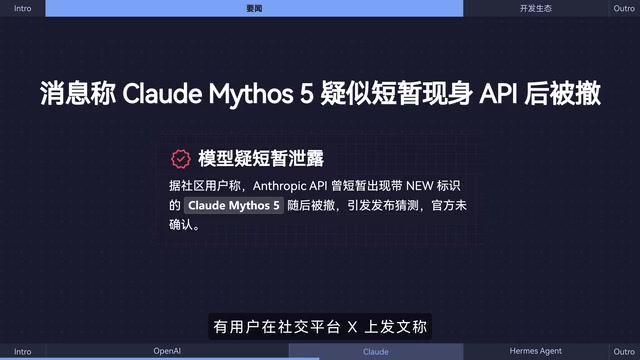
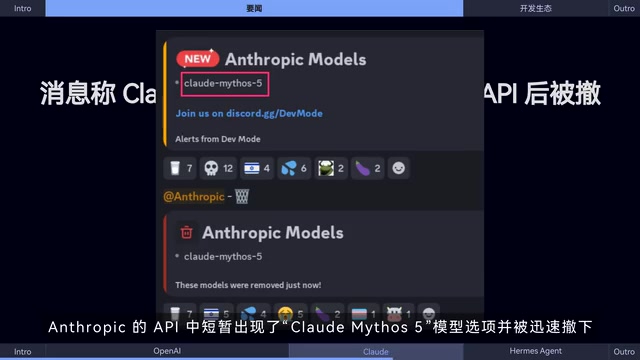
A leak on social media has captured widespread attention across the AI community: a user reported that Claude Mythos 5 briefly appeared as a model option in Anthropic's API before being quickly pulled.
This "ghost sighting" immediately triggered speculation about an imminent launch. The codename "Mythos" (mythology) is notably evocative, suggesting Anthropic may have achieved a major breakthrough in model capabilities. The version number "5" indicates this could be an entirely new generational product rather than an iterative upgrade of the existing Claude series. It's worth noting that Anthropic previously used a numerical progression system (Claude 1/2/3), with the Claude 3 series including three sub-models of different scales: Haiku, Sonnet, and Opus. If the "Mythos 5" naming is authentic, skipping generation 4 and jumping straight to 5 with an entirely new naming scheme may signal fundamental architectural innovation rather than incremental improvement. Anthropic was founded in 2021 by former OpenAI Research VP Dario Amodei and his sister Daniela Amodei. Its core technical approach emphasizes Constitutional AI and AI safety alignment. By mid-2025, the company had secured over $10 billion in funding from investors including Google and Amazon, with a valuation exceeding $60 billion — making it the second-largest unicorn in the AI space after OpenAI.
Signals Worth Watching
First, a model option briefly appearing in an API typically indicates that backend deployment preparation has reached a certain level of completion — technically, this is often a precursor to launch. In the technical architecture of large model services, the API (Application Programming Interface) is the standard channel through which developers access model capabilities. When a new model option surfaces in an API's model list, it usually means the model has completed inference service containerization, load balancing configuration, API gateway route registration, and a series of other backend preparation tasks that represent the final stage before going live. Historically, OpenAI's GPT-4 Turbo, Google's Gemini Ultra, and other models were discovered by developers in API endpoints or configuration files before their official launches, lending this signal considerable credibility.
Second, Anthropic has been facing dual pressure from OpenAI's GPT series and Google Gemini in the model capabilities race, giving it strong motivation to launch a new flagship model.
Of course, there has been no official confirmation, and the possibility that this was simply an accidental leak of internal test configurations cannot be ruled out. Regardless, this event has left the market eagerly anticipating Anthropic's next move.
Hermes Agent V0.16.0 Released: Localization Progress in Open-Source AI Tools
In the open-source tools space, North Research has officially released Hermes Agent V0.16.0. AI Agents are currently one of the hottest paradigms in the AI application layer. The core idea is enabling large language models to not just "chat" but autonomously plan tasks, invoke external tools, and execute multi-step operations. Unlike traditional chatbots, Agents possess capabilities including environment perception, goal decomposition, tool usage, and memory management. Hermes Agent belongs to the open-source Agent framework ecosystem — tools that allow developers to deploy and run AI agents in local environments, avoiding complete dependence on cloud APIs while offering significant advantages in data privacy and operational costs. Other notable projects in the open-source Agent ecosystem include LangChain, AutoGPT, and CrewAI, which together form a rapidly growing developer infrastructure layer.
This update brings several practical improvements:
- Native desktop application: Users no longer need to rely on browsers and can run the tool directly on desktop for a smoother experience. Native desktop applications have inherent advantages over browser-based web apps in terms of system resource access, file system operations, and background process management. For AI Agent tools that need to frequently interact with local files, terminal commands, and development environments, native apps can directly call operating system APIs for lower-latency responses and deeper system integration. Current mainstream cross-platform desktop application frameworks include Electron and Tauri — the former is used by well-known applications like VS Code and Slack, while the latter is notable for its smaller package size and lower memory footprint. This shift marks the evolution of open-source AI tools from "developer command-line tools" toward "user-friendly products."
- Simplified Chinese support: Good news for Chinese-speaking users, lowering the barrier to entry
- Full web-based management panel: The new management panel makes it easier for users to configure and monitor Agent runtime status
While this update may seem understated, it reflects continuous progress in user experience and internationalization for open-source AI tools. As the AI Agent concept heats up, tools like Hermes are providing developers with increasingly robust infrastructure.
Takeaways
Today's three stories point to three key trends in the AI industry: deepening government-AI company integration, accelerating arms races among leading model providers, and continued maturation of the open-source tool ecosystem. If OpenAI's government negotiations succeed, it will redefine the public nature of AI companies; the Claude Mythos 5 leak signals that the next round of model capability competition is about to begin. Together, these developments sketch the picture of an AI industry landscape evolving at breakneck speed.
Related articles
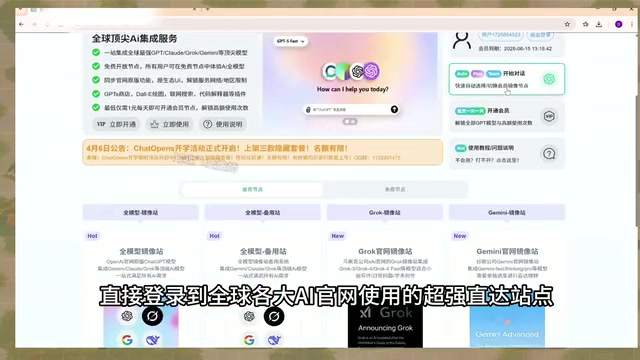
AI Aggregator Platforms Tested: A Complete Guide to Using GPT 5.5 and Other Top Models for Free
A hands-on guide to using GPT 5.5, Gemini 3.1 Pro, and Grok 4.2 for free via AI aggregator platforms, covering cross-model context memory, account pool mechanisms, and key security risks.
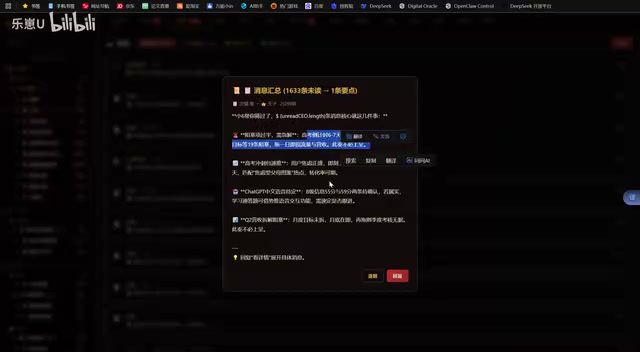
Vibe Coding in Practice: A Junior Student Uses Cursor to Build a Multi-Agent System with 51 AI Officials Based on the Three Departments and Six Ministries Framework
A junior student uses Cursor and Vibe Coding to build a multi-agent system with 51 AI officials modeled on China's Three Departments and Six Ministries, featuring task distribution, approval workflows, and Token cost visualization.
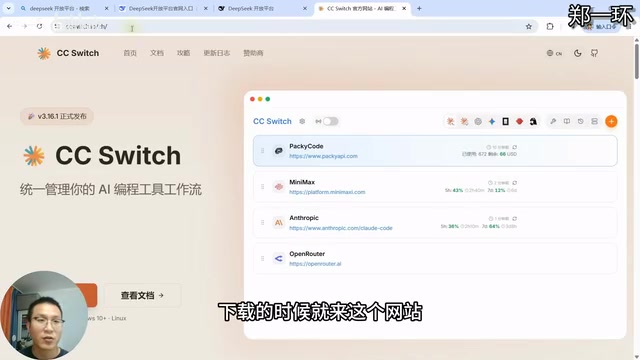
How to Connect Codex to DeepSeek Models: Free Switching via CC Switch
Learn how to connect OpenAI Codex to DeepSeek models via CC Switch, enabling free switching between DeepSeek and GPT with complete setup and routing guide.