Claude Opus 4.8 Deep Dive: Honesty Matters More Than Benchmarks
Claude Opus 4.8 Deep Dive: Honesty Mat…
Claude Opus 4.8's core upgrade focuses on greater honesty and reliability, plus multi-Agent parallel orchestration
Anthropic released Claude Opus 4.8 with no price change, focusing on model reliability: code bug oversight rates reduced by approximately 4x, with the model more willing to proactively flag uncertainties. It also introduces Dynamic Workflows supporting parallel orchestration of hundreds of sub-Agents for entire codebase-level migrations. Claude Code quotas have been reset with a promotional boost, plus new effort control features. Anthropic also revealed that stronger Miscells models will open to all customers within weeks.
Anthropic released Claude Opus 4.8 on May 28, 2025—just 41 days after the previous version 4.7. The price hasn't changed at all, but the core of this upgrade isn't about benchmark numbers—it's become more honest. For all developers and knowledge workers using AI in production environments, this may be a more valuable evolution than raw performance gains.
4.8's Overall Positioning: Fixing Bugs Matters More Than Adding Features
Claude Opus 4.8 isn't a major architectural overhaul. It's a refined upgrade that "cleans up 4.7's issues and pushes capabilities up a notch."
After 4.7's release, users concentrated their complaints on two problems: overly verbose code comments and occasional tool-calling errors. Both have been fixed in 4.8. On the capability front, Anthropic states that 4.8 has reached top-tier performance among its generation across coding, agentic tasks, reasoning, and knowledge work. For example, it scored 84% on OnlineMind2Web, a web operation benchmark.
OnlineMind2Web is a benchmark specifically designed to evaluate AI models' ability to execute operational tasks in real web environments, derived from the online version of the Mind2Web dataset. Unlike static Q&A tests, it requires models to complete multi-step tasks in dynamic web interfaces—such as searching for products on e-commerce sites and completing purchases, or filling out forms on government websites. An 84% score means the model can reliably understand web page structure, identify interactive elements, and execute operations in sequence—crucial for building AI Agents capable of autonomous browser operations.
But benchmarks are just the surface. The real star of this release is something more fundamental—reliability.
Core Upgrade: The Model Has Become More Honest
Anthropic explicitly stated in their announcement that Claude Opus 4.8's probability of overlooking bugs in its own code has decreased by approximately 4x compared to 4.7.
What does this mean? It's more willing to proactively tell you "I'm not sure about this" or "this input might have issues," rather than stubbornly pretending it knows everything. For people doing serious work, this matters far more than a few extra benchmark points.
Hedge fund Bridgewater provided highly compelling feedback during beta testing: the biggest difference between 4.8 and other models is that it proactively identifies problems with inputs and outputs in analyses—precisely the step other models frequently miss. In safety alignment evaluations, 4.8 also set new highs, with notably lower rates of misaligned behavior compared to 4.7.
Why Is "Honesty" So Critical?
AI model "honesty" technically corresponds to the concept of "Calibration"—the degree to which a model's confidence matches its actual accuracy. A well-calibrated model saying "I'm 80% sure" should have an actual accuracy rate close to 80%. Large language models universally suffer from "overconfidence," tending to output incorrect answers with high confidence—academically known as "Hallucination." Anthropic uses RLHF (Reinforcement Learning from Human Feedback) and Constitutional AI techniques to specifically train against this problem, making models more inclined to express doubt rather than force an answer when uncertain.
In AI-assisted coding and decision-making scenarios, a model that "doesn't know what it doesn't know" is the most dangerous state. A model that confidently gives wrong answers causes far more damage than one that honestly says "I'm not sure." Claude Opus 4.8's progress in this direction fundamentally reduces the trust cost of AI collaboration—you don't need to spend as much effort verifying whether the model is "fabricating" answers.
Dynamic Workflows: Orchestrating Hundreds of Sub-Agents in Parallel
Alongside the 4.8 release, Anthropic also introduced a new mechanism called Dynamic Workflows, currently in research preview.
It solves a very practical problem: how does a large model like Opus manage massive tasks requiring hundreds of steps?
The core behind Dynamic Workflows is Multi-Agent system architecture. Traditional single-model approaches to complex tasks are limited by context window length and serial reasoning speed. Multi-Agent architecture decomposes tasks and assigns them to multiple independent Agents for parallel processing, with each sub-Agent focusing on specific subtasks, and an Orchestrator aggregating results. This architecture borrows from distributed computing principles and can theoretically compress tasks that would take hours serially down to minutes. The challenges lie in state synchronization between sub-Agents, error propagation control, and final result consistency verification—which is why Anthropic positions it as a "research preview" rather than a production feature.
The workflow breaks down into three steps:
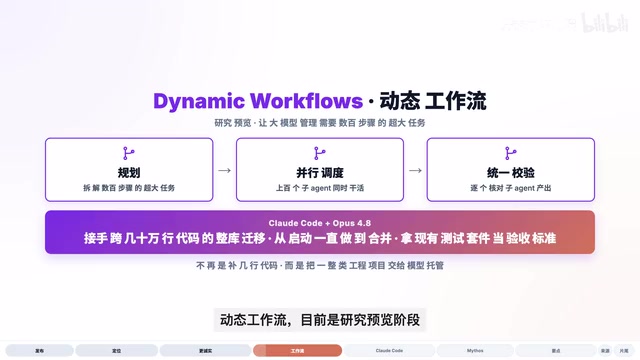
- Planning Phase: The model first plans and decomposes the overall task
- Parallel Execution: Dispatches hundreds of sub-Agents to work simultaneously
- Unified Verification: Validates and integrates each sub-Agent's output
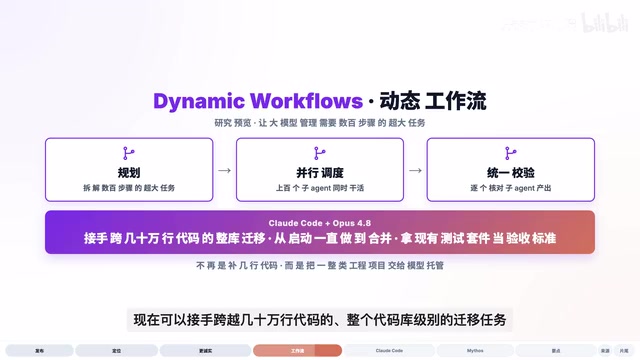
Anthropic's example is strikingly impressive: Claude Code paired with 4.8 can now handle entire codebase-level migration tasks spanning hundreds of thousands of lines of code—from initiation all the way to merge, using existing test suites as acceptance criteria. This isn't about completing a few lines of code anymore—it's about handing an entire class of engineering projects to the model to manage.
The implications for enterprise development scenarios are self-evident. Framework upgrades, language migrations, architecture refactoring—work that previously required teams spending weeks—now has the potential to be dramatically accelerated by AI.
Practical Changes in Claude Code: Quota Reset and Thinking Effort Control
For Claude Code subscribers, there are two very tangible changes this time:
1. Opus Quota Reset with Promotional Boost
Previously, Opus weekly quotas were quite tight, and many users were reluctant to use them. With the 4.8 release, weekly limits have been reset, giving all users a fresh full quota. Additionally, there's currently a 50% promotional boost lasting until July 13, making Opus availability more generous than usual.
2. Effort Control (Thinking Intensity Control)
The Effort Control feature corresponds to the recently emerging "Test-Time Compute Scaling" theory in AI. This theory, validated by OpenAI's o-series models, shows that investing more computational resources during inference (letting the model "think longer") can significantly improve accuracy on complex tasks without retraining a larger model. Anthropic's implementation controls the depth of the model's "Extended Thinking"—in low-effort mode the model gives quick answers, while in Max mode it performs more internal reasoning steps before outputting results.
The new Effort Control feature allows users to choose from "Low" to "Max" how much compute the model invests. More compute yields better output quality but consumes more quota. This design lets users flexibly allocate resources based on task complexity—simple tasks completed quickly at low intensity, critical tasks maxed out for quality assurance. Essentially, it provides a user-controllable trade-off dial between reasoning quality and API cost.
Dynamic Workflows has also been integrated into Claude Code, available to Max, Team, and Enterprise users.
The Locked-Away Miscells: 4.8 Isn't the Endpoint
Particularly noteworthy is that Anthropic explicitly stated: 4.8 is not the strongest model they have.
Above 4.8, there's a class of models called Miscells with capabilities that represent a "leap ahead." Previously, Miscells were only previewed to a very small number of organizations due to cybersecurity concerns and were not publicly available.
The "cybersecurity concerns" Anthropic mentions point to their internal AI safety evaluation framework—the Responsible Scaling Policy (RSP). This policy requires completing corresponding safety evaluations before model capabilities reach specific thresholds, including red-team testing for high-risk scenarios such as bioweapon assistance capabilities and cyberattack capabilities. The Miscells models triggered higher-level security review thresholds due to their leap in capabilities. This tiered control mechanism of "stronger capabilities, stricter review" is one of Anthropic's core strategies differentiating it from other AI companies, and a key reason it has attracted significant investment from safety-oriented investors.
However, Anthropic revealed in their announcement that they're making rapid progress on safety measures and expect to open Miscells-level models to all customers within the coming weeks.
This means the 4.8 you're using today is the strongest publicly available version, while that locked-away stronger version may be unlocked very soon. Anthropic's strategy of "ensuring safety before releasing capabilities" is consistent with their longstanding emphasis on responsible AI development.
Summary: Reliability Is AI's Ticket to Production
The two real focal points of the Claude Opus 4.8 upgrade:
- Reliability improvement: The model is more honest, overlooks fewer code bugs, is more willing to proactively flag risks, with bug oversight rates reduced by approximately 4x
- Dynamic Workflows: Parallel orchestration of hundreds of sub-Agents has been developed into an engineering-grade capability that can manage entire codebase migrations
Price unchanged, Claude Code's Opus weekly quota just reset, and we're still in the promotional boost period. If you're using Claude Code or building AI Agent products, now is a great time to seriously try 4.8.
What's even more worth anticipating is that the locked-away Miscells may open to everyone within the coming weeks. In this era of rapid AI capability iteration, 4.8 isn't the destination—it's just a stepping stone to the next leap.
Related articles
 Tech Frontiers
GitHub Agent HQ Launch: AI Coding Tools Enter the Era of Platform Competition
GitHub Universe unveils Agent HQ platform for unified coding agent management, Copilot upgrades with multi-model support. OpenAI completes restructuring, Anthropic tests new model, NVIDIA open-sources AI models.
 Tech Frontiers
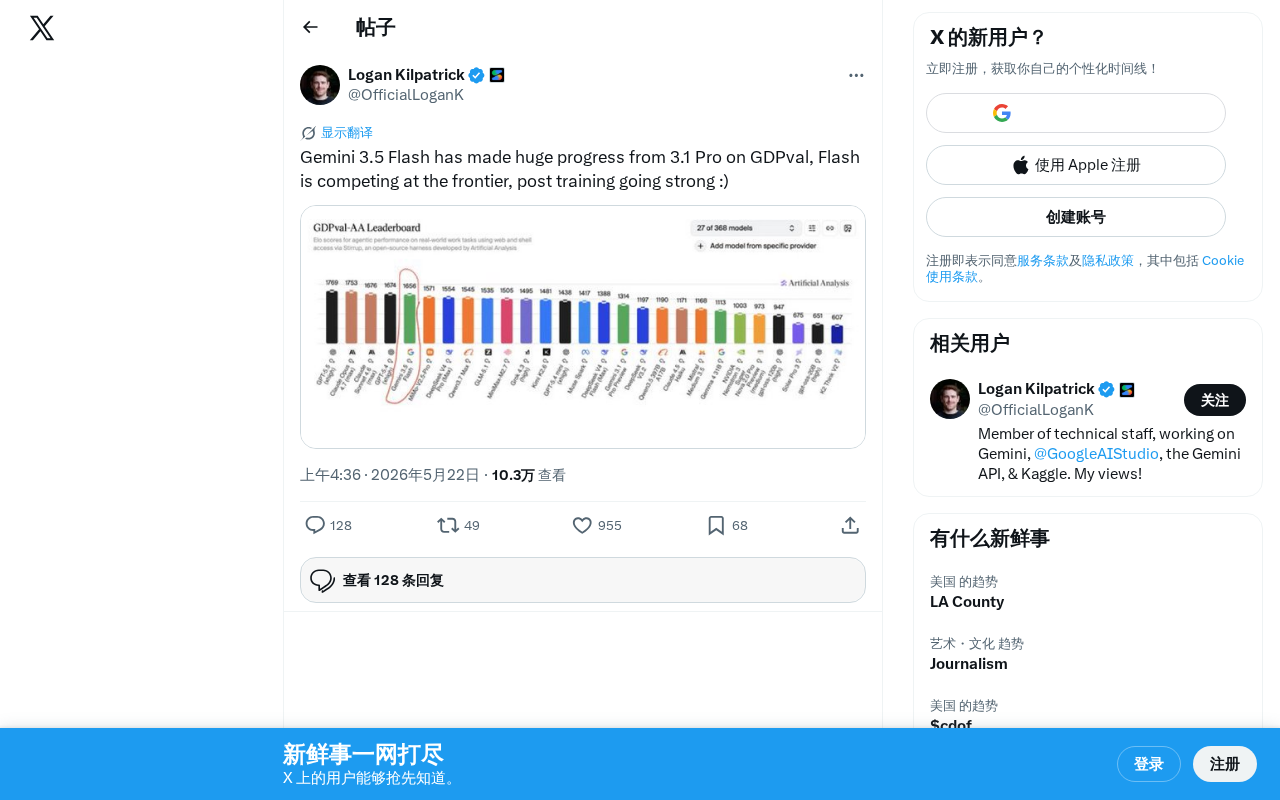
Gemini 3.5 Flash Achieves a Massive Leap on the GDPval Benchmark
Google Gemini 3.5 Flash surpasses Gemini 3.1 Pro on the GDPval benchmark. The lightweight Flash model leverages post-training techniques to approach frontier-level performance, redefining the balance between quality and cost.
 Tech Frontiers
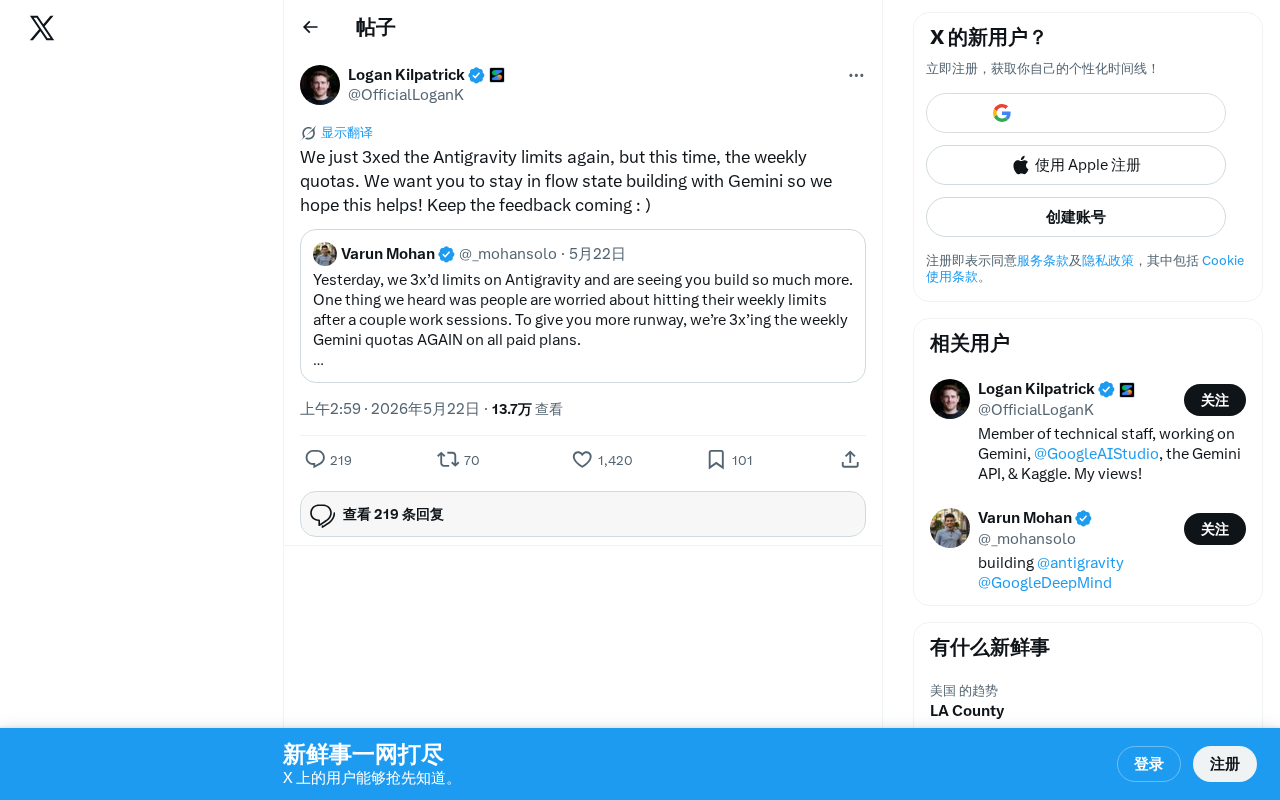
Google Gemini Antigravity Weekly Quota Tripled — AI Coding Without Limits
Google Gemini triples Antigravity weekly quotas following a prior daily quota boost. Analyzing the impact on developers and its strategic significance in AI coding.