Claude Opus vs. Sonnet vs. Haiku: How to Choose the Right Model
Claude Opus vs. Sonnet vs. Haiku: How …
A practical guide to choosing between Claude's Opus, Sonnet, and Haiku models based on your needs.
Anthropic's Claude offers three model tiers: Opus delivers the highest intelligence with extended reasoning but at higher latency and cost; Sonnet balances intelligence and efficiency with standout coding capabilities, making it the best default for most use cases; Haiku is the fastest and cheapest but lacks reasoning support, ideal for real-time interactions. Mature teams often adopt a multi-model routing architecture to combine all three. Start with Sonnet and expand as needed.
Anthropic's Claude offers three model families—Opus, Sonnet, and Haiku. They share the same core capabilities (text generation, coding, image analysis, etc.) but make different trade-offs between intelligence, speed, and cost. This article provides a deep dive into each model's characteristics and offers a simple, practical framework for choosing the right one.
Core Positioning of Claude's Three Models
Industry Context: The Tiered Model Product Strategy
Anthropic's three-tier naming system (Opus/Sonnet/Haiku) is no accident—it reflects a mature product strategy that has emerged across the AI industry during commercialization. OpenAI's GPT-4o mini vs. GPT-4o and Google's Gemini Flash vs. Gemini Pro follow similar logic. The underlying technical principle: larger model parameter counts generally deliver stronger reasoning capabilities, but also mean higher inference compute costs (FLOPS) and longer Time To First Token (TTFT). By offering differentiated model tiers, AI companies can serve everyone from startup teams to enterprise customers with varying budgets, while enabling developers to fine-tune cost control based on task complexity.
Opus: The Intelligence Ceiling
Opus is the most powerful model in the Claude family, representing the highest level of intelligence Claude can achieve. It's designed for complex scenarios—when your task demands a high degree of intelligence and planning capability, Opus is the go-to choice.
In practice, Opus can independently handle long-running, complex projects—tasks that span hours, for example. In these scenarios, the model needs to autonomously manage multi-step workflows and handle diverse requirements with minimal human intervention. Opus supports Reasoning, meaning it can respond quickly to simple tasks while spending more time "thinking" through complex problems to deliver higher-quality answers.
Technical Deep Dive: What Reasoning Really Means
The "Reasoning" capability mentioned here represents one of the most important breakthroughs in recent large language model development, and it's worth understanding in depth. This capability evolved from Chain-of-Thought (CoT) techniques—before producing a final answer, the model first generates an internal step-by-step derivation process (the "thinking process"), similar to how humans work through scratch paper when solving problems. Anthropic calls this "Extended Thinking," while OpenAI's counterpart is the o1/o3 series. The trade-off is a significant increase in output token count and response latency, but it dramatically improves accuracy on tasks like mathematical proofs, code debugging, and multi-step logical inference. This is essentially a "trading time for precision" computational strategy, and one of the key reasons behind Opus's higher latency.
Of course, the trade-offs are clear: Opus has higher latency and costs more. That's the balance you need to weigh—paying with time and money for top-tier intelligence.
Sonnet: The All-Rounder
Sonnet sits at the "sweet spot" of the Claude product line. It strikes a strong balance between intelligence, speed, and cost, making it suitable for the majority of real-world applications.
Sonnet's standout strengths are its powerful coding capabilities and fast text generation. Many developers particularly value its ability to make precise edits to complex codebases—modifying project code while minimizing the risk of breaking existing functionality.
Deep Dive: Why Sonnet Is More Popular for Coding
Sonnet's outstanding performance in coding is closely tied to code-specific training optimizations in large models. The core challenge facing modern AI coding assistants isn't just "writing code that runs"—it's "making precise, localized modifications in complex codebases without introducing regression errors." This requires strong context comprehension (effective use of long context windows) and implicit modeling of code dependency relationships. Sonnet's advantage in this area has made it a popular backend choice for AI coding tools like Cursor and GitHub Copilot. By contrast, while Opus is more intelligent overall, its higher latency can actually disrupt developer workflows in coding scenarios that require high-frequency iteration, making Sonnet the better value proposition overall.
For teams that need to balance quality and efficiency, Sonnet is often the best default choice.
Haiku: The Speed King
Haiku is the fastest model in the Claude family, purpose-built for applications where response time is critical.
An important note: Haiku does not support the Reasoning capabilities available in Opus and Sonnet. Its design philosophy is pure: maximum speed and cost efficiency. Since the reasoning process inherently requires the model to generate large numbers of intermediate tokens before arriving at a final answer, incorporating this mechanism fundamentally conflicts with Haiku's low-latency goals. As a result, Haiku foregoes this feature at the architectural level. This makes Haiku ideal for user-facing applications requiring real-time interaction, such as chatbots, live customer support systems, and similar scenarios.
Selection Framework: Understanding the Core Trade-offs Between Opus, Sonnet, and Haiku
Choosing a model is fundamentally about understanding the trade-off between intelligence and cost/speed.
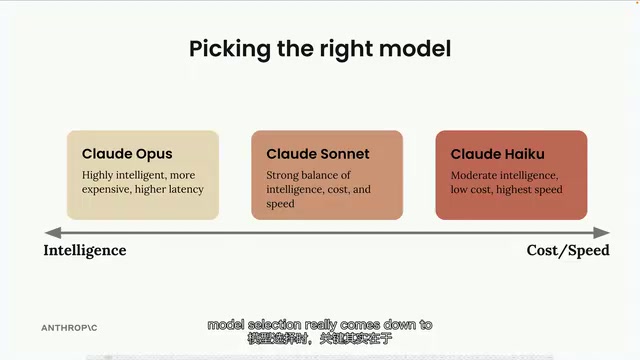
The diagram above clearly shows how the three models are positioned:
- Opus sits on the intelligence end—smartest, but more expensive with higher latency
- Haiku sits on the speed/cost end—moderate intelligence, low cost, highest speed
- Sonnet sits in the middle—balanced across all dimensions
Practical Decision Guide
When making your decision, you need to answer one core question: What matters most for your specific use case?
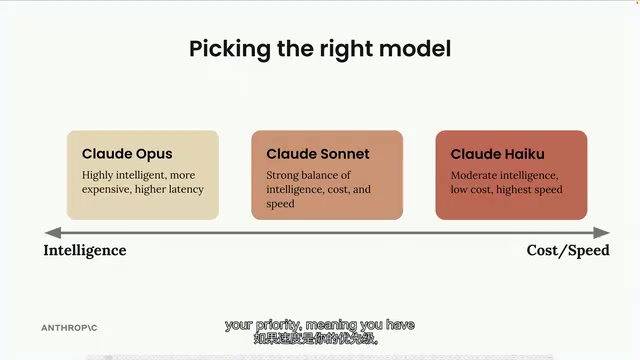
When to choose Opus: When intelligence is your top priority. If your task involves complex reasoning, multi-step planning, or requires deep thinking to complete, go with Opus. You're trading speed and cost for quality.
When to choose Haiku: When speed is your top priority. If you have real-time user interaction requirements, or need high-volume batch processing with results returned as quickly as possible, Haiku is the best choice.
When to choose Sonnet: When you need a balance between intelligence, speed, and cost—which is the reality for most applications. Sonnet is typically the safest starting point.
Advanced Strategy: Multi-Model Hybrid Architecture
It's worth emphasizing that many mature teams don't just pick one model. The smarter approach is to mix multiple models within the same application:
- Haiku handles the user-facing interaction layer—where speed is critical
- Sonnet processes core business logic—where quality and efficiency both matter
- Opus tackles the most complex tasks—where deep reasoning is required
Engineering Practice: Model Routing Architecture
Multi-model hybrid usage has become a standard engineering pattern for production-grade AI applications. From a system design perspective, this is essentially a "dynamic compute resource scheduling" strategy, similar to routing requests to different service instances based on request type in a microservices architecture. Implementing this architecture typically requires a "Router Layer" that determines which model each request should be dispatched to—simple classification tasks go to Haiku, standard business requests go to Sonnet, and only tasks requiring deep analysis trigger Opus. Some teams even use a lightweight model (like Haiku) to make the routing decisions themselves, achieving intelligent scheduling at minimal cost. Mainstream AI application frameworks like LangChain and LlamaIndex provide native support for this multi-model routing pattern, significantly lowering the engineering implementation barrier.
This layered architecture ensures a smooth user experience while delivering the highest quality output at critical junctures—all while effectively controlling overall costs.
Summary: Claude Model Comparison at a Glance
| Dimension | Opus | Sonnet | Haiku |
|---|---|---|---|
| Intelligence | Highest | High | Moderate |
| Speed | Slower | Medium | Fastest |
| Cost | Highest | Medium | Lowest |
| Reasoning | ✅ | ✅ | ❌ |
| Best For | Complex reasoning / Long tasks | General purpose / Coding | Real-time interaction / Batch processing |
For most developers and teams, starting with Sonnet is a smart choice. It offers excellent value for money and comprehensive capability coverage. Once you've identified the specific bottleneck in your use case—whether you need stronger intelligence or faster speed—you can selectively bring in Opus or Haiku to build a multi-model collaborative architecture.
Key Takeaways
- Opus is Claude's most intelligent model, supporting Chain-of-Thought (CoT) based reasoning capabilities. It's ideal for complex, long-running tasks but comes with higher latency and cost
- Sonnet strikes a balance between intelligence, speed, and cost, with standout coding capabilities. It's a popular backend choice for mainstream AI coding tools like Cursor, and the best default option for most scenarios
- Haiku is the fastest model, achieving ultra-low latency by forgoing reasoning features at the architectural level. It's ideal for real-time interaction and high-throughput processing
- Mature teams typically adopt a Model Routing architecture: Haiku handles frontend interactions, Sonnet processes business logic, and Opus handles complex reasoning. Frameworks like LangChain provide native support
- The core of model selection is understanding the trade-off between intelligence and speed/cost. Most teams should start with Sonnet and bring in other models as needed
Related articles
 Deep Dives
Deep Dive into How OpenClaw (Open-Source Crayfish) AI Agent Works
Deep analysis of OpenClaw AI Agent internals: System Prompt, tool calling, SubAgents, Skill system, memory, and Context Engineering explained.
 Deep Dives
Demystifying Transformer: A Word-Continuation Function, Deconstructed
Understand Transformer through the lens of word continuation. Breaking down language generation into Embedding, Transformer Block, and Probability output modules for intuitive understanding.
 Deep Dives
Five Core Differences Between Claude Code and Regular AI Chat
A detailed comparison of Claude Code vs regular AI chat across five dimensions: interaction, context understanding, execution, memory, and tool integration.