Claude Powers NASA Mars Rover Route Planning, Windsurf Launches IDE Model Arena

Claude plans NASA Mars rover routes; AI dev tools and open-source models see intensive updates
This article covers major AI developments: Anthropic's Claude successfully planned a 400-meter route for NASA's Perseverance rover, dramatically reducing traditional manual planning time; Windsurf launched Arena Mode for in-IDE model comparison; SenseTime, Ant Lingbo, and Unitree intensively released open-source multimodal and robot control models; Anthropic research found over-reliance on AI weakens programming learning; Grok 4 training was delayed due to extreme cold; and an AI Agent social network sparked security discussions.
Claude Plans Driving Routes for NASA's Perseverance Mars Rover
Anthropic's AI model Claude has accomplished a milestone task — planning driving routes on the Martian surface for NASA's Perseverance rover. In December 2025, under the guidance of JPL (Jet Propulsion Laboratory) engineers, Claude successfully generated driving commands to navigate through a rock field based on image analysis and code writing, enabling the rover to travel approximately 400 meters.
Perseverance is the most advanced rover in NASA's Mars exploration program, having successfully landed in Jezero Crater in February 2021. JPL, managed by Caltech, is NASA's core research and development institution for deep space exploration missions. Traditional rover path planning relies on Earth-based engineers analyzing Mars surface images frame by frame, considering rock distribution, slope gradients, soil softness, and other factors before manually writing driving commands. Due to the Earth-Mars communication delay of approximately 4-24 minutes, each planning cycle typically takes hours or even a full day. AI's involvement in this workflow means decision cycles can be dramatically compressed, increasing the rover's average daily travel distance.
The path was executed after simulation verification, significantly reducing the time required compared to traditional manual planning. This case demonstrates AI's enormous potential in space missions — from decision support to autonomous planning, AI is becoming an indispensable tool for deep space exploration.
Major AI Development Tool Updates
Windsurf Launches Arena Mode: Model Arena Inside the IDE
Windsurf introduced Arena Mode in its Wave14 update, allowing users to run two Cascade Agents in parallel within the IDE, compare models on the same task, and vote to contribute results to both personal and global leaderboards.
Windsurf is an AI-native IDE developed by Codeium, with its core engine Cascade Agent capable of understanding full codebase context and executing multi-step coding tasks. Traditional AI model arenas (such as Chatbot Arena) typically conduct blind comparisons in conversational scenarios, but this approach fails to reflect how models handle complex code dependencies and project structure understanding in real development environments. Arena Mode embeds evaluation into actual development workflows, letting developers directly compare model output quality within their own projects, generating evaluation data that more closely reflects real productivity differences.
The core value of this feature lies in solving the problem of traditional AI arenas being disconnected from actual development context. Evaluating model performance in real development environments produces more meaningful data. It's free to use during the first week of launch, allowing developers to directly experience the differences between models on actual coding tasks.
Kimi Code Upgrades to Token-Based Billing
Dark Side of the Moon's Kimi has upgraded the Kimi Code plan, switching from request-based billing to token-based billing, with quotas reset. From now until February 28, 2026, both new and existing users enjoy up to triple quotas with no rate limits or usage caps.
A token is the basic unit that large language models use to process text — in Chinese, one token typically corresponds to 1-2 characters, while in English it corresponds to approximately 4 characters or 0.75 words. Token-based billing is more granular and fair compared to request-based billing — a simple code completion request might only consume a few hundred tokens, while a complete code refactoring could consume tens of thousands. This billing model lets developers flexibly allocate budgets, frequently making small interactions without worrying about wasting request quotas, better matching the high-frequency, fragmented AI invocation patterns in programming workflows.
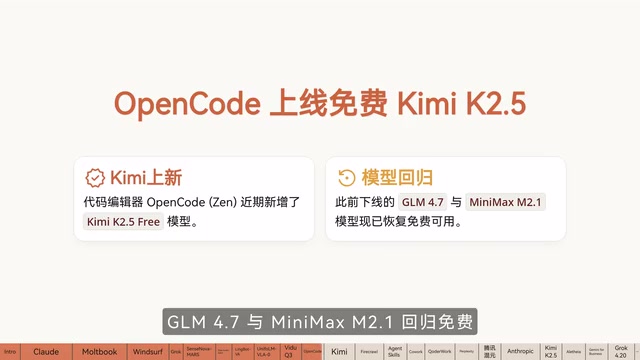
Coder Releases First Desktop AI Agent
Coder has released Coder Work, its first desktop AI Agent with macOS support. Users can complete tasks like file organization and data analysis through natural language commands. It's currently in invite-only testing, with pricing linked to Coder account credits.
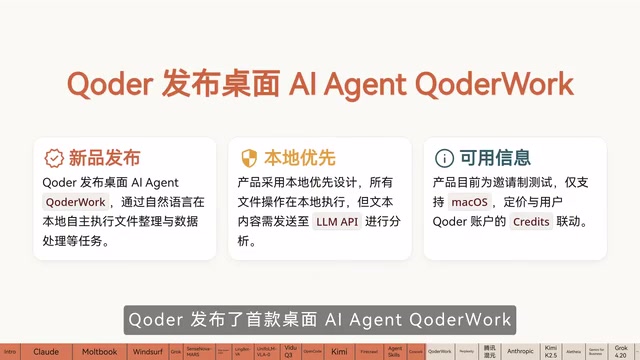
Open Source Ecosystem: SenseTime Multimodal Models and Robot Control Models Launch Together
SenseTime Open-Sources Multimodal Autonomous Reasoning Model
SenseTime has open-sourced its multimodal autonomous reasoning models SenseNova MAS 8B and 32B, supporting dynamic visual reasoning and image-text search fusion. SenseTime simultaneously released the models, code, datasets, and related testing platforms, providing the research community with a complete toolchain.
A multimodal autonomous reasoning model refers to an AI model capable of simultaneously processing multiple input modalities such as images and text, with the ability to autonomously plan reasoning chains. "MAS" in SenseNova MAS stands for Multi-modal Autonomous System, and its "dynamic visual reasoning" capability means the model can dynamically adjust reasoning strategies based on visual input rather than relying on fixed processing pipelines. 8B and 32B refer to the model's parameter scales (8 billion and 32 billion parameters respectively) — this scale is medium-to-large among open-source models, balancing reasoning capability with deployment costs.
Multiple Robot Control Models Released
- Ant Group's Lingbo Technology released the open-source robot control model Lingbot VA, using an autoregressive video-action world model architecture
- Unitree Robotics open-sourced the vision-language-action large model Unifor L-MVLA-0, built on Qwen 2.5VL 7B, with performance comparable to Gemini Robotics ER
Embodied AI refers to AI systems that interact with the real world through physical bodies (such as robots). Vision-Language-Action models (VLA) are the core architecture for current embodied intelligence, unifying visual perception, language understanding, and action generation within a single model. Ant Lingbo's autoregressive video-action world model plans action sequences by predicting future video frames, while Unitree's model built on Qwen 2.5VL leverages the powerful understanding capabilities of pretrained vision-language models to guide robot behavior. The open-sourcing of these models will lower the technical barriers to robotics R&D.
The intensive release of these open-source projects signals that the embodied intelligence field is accelerating into an era of open-source collaboration.
AI Agent Social Network Sparks Security Discussion
A social network platform called Modebook has attracted widespread attention. The platform allows AI Agents to join the network by installing plugins, where Agents automatically post and interact. Over 30,000 Agents have already participated, forming more than 2,000 sub-boards.
AI expert Andrej Karpathy called it "sci-fi level development," but programmer Simon Willison warned of serious security risks. The security risks Willison warned about span multiple dimensions: first, prompt injection attacks, where malicious Agents could manipulate other Agents' behavior through carefully crafted post content; second, data leakage risks, where Agents might inadvertently expose sensitive information about their underlying users during social interactions; and third, information manipulation, where large-scale AI Agents could be used to manufacture false consensus or spread misinformation. When 30,000 Agents form a self-organizing network, the unpredictability of emergent behaviors poses entirely new challenges to traditional security frameworks.
As AI Agents begin autonomous social interaction, issues of data security and information manipulation deserve deep consideration.
Grok Updates: NSFW Toggle Goes Live, Grok 4 Training Delayed
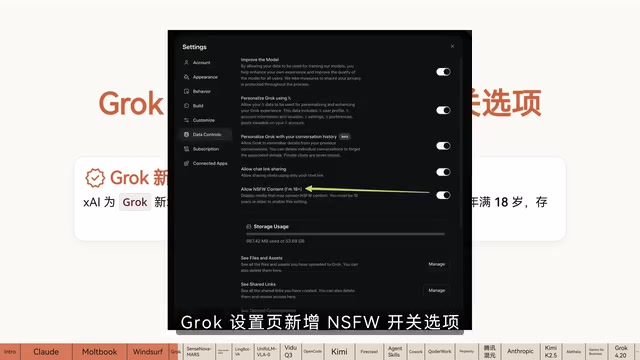
Grok Adds NSFW Content Toggle
Grok's settings page now includes an NSFW toggle option, available only to users 18 and older. This feature reflects xAI's differentiated positioning in content policy compared to competitors.
Grok 4 Training Delayed Due to Extreme Cold Weather
Elon Musk announced that due to extreme cold weather and power outages, Grok 4 training (codenamed 4.20) has been postponed to mid-February. Grok is currently training on the Colossus 2 supercomputing cluster, and its release timeline may be pushed back accordingly.
Colossus is the supercomputing cluster xAI built in Memphis, with Colossus 2 being its expanded version, reportedly equipped with approximately 200,000 NVIDIA H100/H200 GPUs — one of the largest AI training clusters in the world. Large-scale AI training is extremely sensitive to power supply — at Colossus 2's scale, peak power consumption may exceed 150 megawatts, equivalent to the electricity consumption of a small city. Extreme cold weather can not only cause grid overload (due to surging residential heating demand) but also affect data center cooling system efficiency, explaining why weather factors can directly impact training progress.
Anthropic Research: Over-Reliance on AI Weakens Programming Learning Outcomes
A study published by Anthropic shows that while using AI-assisted Python programming learning improved task completion speed, participants' skill mastery significantly declined. The research emphasizes that merely relying on AI-generated code weakens learning outcomes, while actively asking questions and seeking explanations through interactive approaches helps retain knowledge.
This finding is highly consistent with the "Generation Effect" and "Desirable Difficulties" theories in cognitive science. The Generation Effect demonstrates that actively generating answers produces deeper memory encoding than passively receiving information; Desirable Difficulties theory suggests that moderate cognitive load during learning actually aids long-term memory consolidation. When developers directly copy AI-generated code, they bypass the cognitive processes of active thinking and problem-solving, preventing knowledge from being effectively internalized. However, interacting with AI by asking "why is it written this way" or "what alternative approaches exist" preserves the active cognitive processing component.
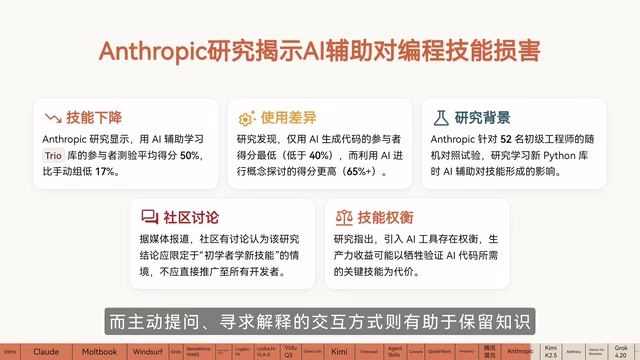
This finding has important implications for education: AI should serve as a supplementary learning tool rather than a replacement, and the design of interaction methods determines whether learning outcomes are positive or negative.
More Notable AI Industry Developments
- Perplexity and Microsoft signed a three-year $750 million agreement for access to OpenAI, Anthropic, and xAI models
- Google is testing third-party model access in Gemini for Business, including Anthropic's models
- Pang Tianyu, former Senior Research Scientist at CAI Lab, will join Tencent as Chief Research Scientist for the Hunyuan large model
- Shengshu Technology released AI video model Vidu Q3, supporting 16-second integrated audio-video generation
- Kimi.ai published the K2.5 technical report, activating visual reasoning through pure text, with Agent Swarm and Pyro architecture reducing latency by 4.5x
- AI Agent Aletheia independently solved a mathematical problem posed in 1980 (Problem #1051), powered by the Gemini DeepThink model
Key Takeaways
- Anthropic's Claude successfully planned a 400-meter driving route for NASA's Perseverance rover, significantly reducing planning time
- Windsurf launched Arena Mode for parallel AI model comparison in real IDE environments, solving the context-disconnect problem of traditional arenas
- SenseTime, Ant Lingbo, Unitree, and other companies intensively released open-source models, accelerating open source in embodied intelligence and multimodal reasoning
- Anthropic research shows relying on AI-assisted programming weakens skill mastery; active questioning interactions are more beneficial for learning
- Google is testing third-party model integration in Gemini, Perplexity signed a $750 million partnership with Microsoft — deepening industry collaboration
Related articles
 Tech Frontiers
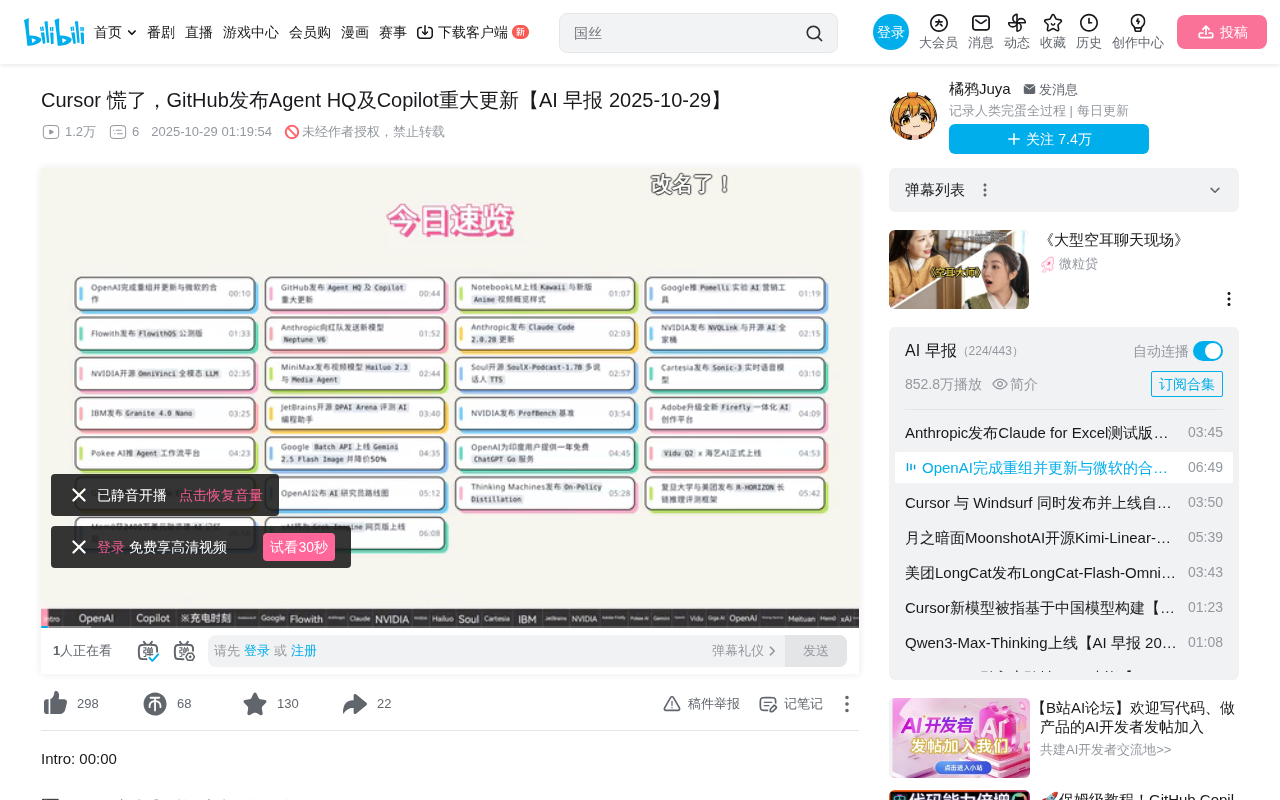
GitHub Agent HQ Launch: AI Coding Tools Enter the Era of Platform Competition
GitHub Universe unveils Agent HQ platform for unified coding agent management, Copilot upgrades with multi-model support. OpenAI completes restructuring, Anthropic tests new model, NVIDIA open-sources AI models.
 Tech Frontiers
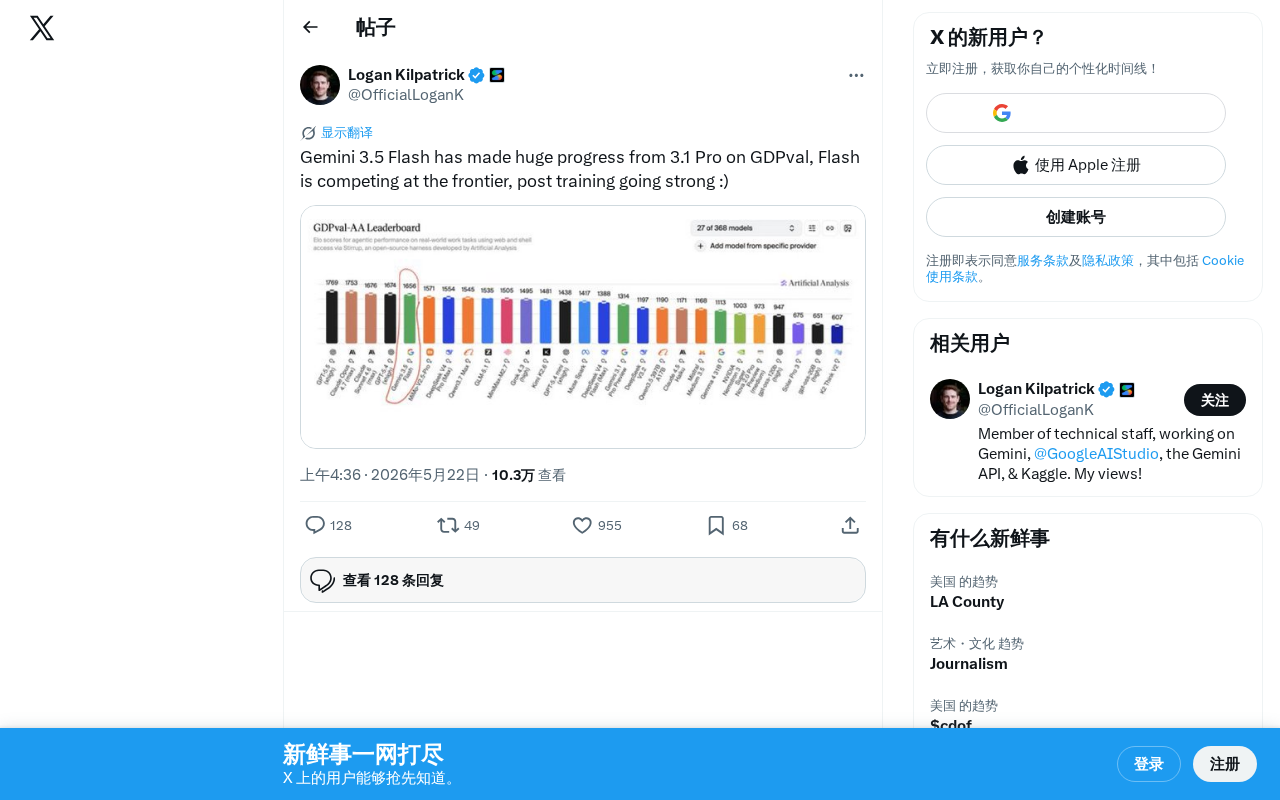
Gemini 3.5 Flash Achieves a Massive Leap on the GDPval Benchmark
Google Gemini 3.5 Flash surpasses Gemini 3.1 Pro on the GDPval benchmark. The lightweight Flash model leverages post-training techniques to approach frontier-level performance, redefining the balance between quality and cost.
 Tech Frontiers
Google Gemini Antigravity Weekly Quota Tripled — AI Coding Without Limits
Google Gemini triples Antigravity weekly quotas following a prior daily quota boost. Analyzing the impact on developers and its strategic significance in AI coding.