Codex and Claude Code Dual-Engine: A Practical Guide to AI-Powered Engineering
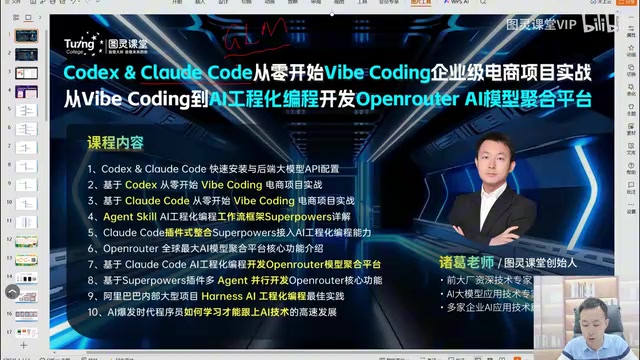
Move beyond Vibe Coding to enterprise-grade AI engineering with Codex and Claude Code.
This article explores the transition from Vibe Coding to enterprise-grade AI engineering using Codex and Claude Code as dual engines. It covers the limitations of casual AI code generation, ranks Chinese LLMs for programming tasks, introduces Skill-driven pipeline development with SuperPAL, and demonstrates real-world projects including an e-commerce platform and an OpenRouter-style aggregation service.
From Vibe Coding to Enterprise Development: The Evolution of AI Programming
In a world where AI programming tools are evolving at breakneck speed, many developers are still stuck in the "Vibe Coding" stage — tossing requirements at an AI, letting it generate code, and thinking it looks cool. But the resulting projects are often nothing more than toys. So how do you leap from Vibe Coding to true enterprise-grade AI engineering? That's exactly what this article explores in depth.
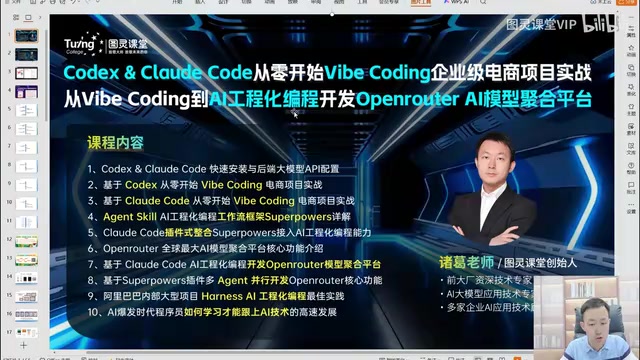
Based on a hands-on course by Teacher Zhuge on Bilibili, this article walks through the complete workflow of AI-powered engineering using the Codex and Claude Code dual-engine approach, covering tool selection, model evaluation, development paradigms, and more.
The Limitations of Vibe Coding: Why It Can't Handle Enterprise Projects
Vibe Coding essentially means describing the requirements in your head to an AI programming tool and letting it auto-generate code. The term was first coined by Andrej Karpathy (former Tesla AI Director and OpenAI co-founder) in early 2025. On social media, he described a brand-new way of programming: fully immersing yourself in the "vibe," embracing exponentially growing code complexity, forgetting about the code itself, and completing development purely through natural language conversations with AI. The concept quickly went viral in the developer community, becoming shorthand for the "low barrier, high speed, low quality" mode of AI-assisted programming.
This approach initially thrilled many non-programmers — product managers, designers, and even people with zero technical background could "write" a website or small app using AI tools.
But reality quickly set in:
- Poor code quality: Generated code is often "throwaway code" — lacking architectural design and nearly impossible to maintain
- Difficult bug fixing: When production issues arise, non-technical users can't effectively direct the AI to locate and fix bugs, easily falling into an endless loop
- Complexity ceiling: When it comes to enterprise scenarios like distributed architectures, microservices, and high concurrency, Vibe Coding is completely helpless
It's important to understand why enterprise scenarios pose a fundamental challenge for AI programming. Distributed architecture refers to splitting a system into multiple independently running service nodes that collaborate through network communication to fulfill business logic. Microservices are a mainstream implementation of distributed architecture, where each service is built around a specific business capability and can be independently deployed and scaled. High concurrency scenarios require systems to handle tens of thousands or even millions of simultaneous user requests. These scenarios involve service discovery, load balancing, distributed transactions, circuit breaking, trace monitoring, and numerous other complex engineering problems that go far beyond simple code generation — they require systematic architectural design and rigorous engineering standards.
As mentioned in the course, early on, many AI bloggers claimed Vibe Coding had "replaced programmers." But look closely at what they built — a ring light utility, a simple cross-border e-commerce page — features so basic they could probably be done with two prompts. That's a far cry from real enterprise development.
Dual-Engine Selection: Current State of Codex and Claude Code
Codex: The Rising Powerhouse
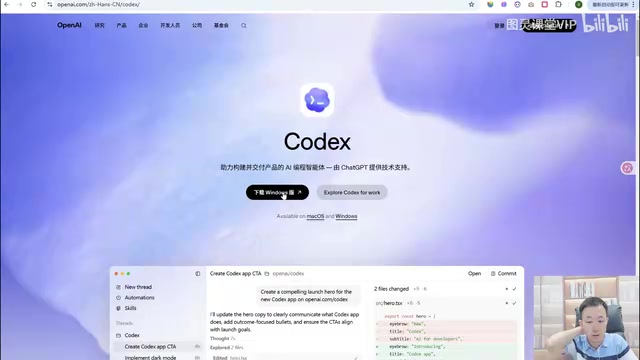
Codex is OpenAI's AI programming tool, powered by the latest GPT models on the backend. OpenAI Codex was originally released in 2021 as a code generation model fine-tuned on GPT-3, and it served as the underlying engine for GitHub Copilot. In 2025, OpenAI launched a completely new Codex agent that runs in a cloud sandbox environment, capable of handling multiple programming tasks in parallel — including writing feature code, fixing bugs, and running tests. The new Codex is based on the codex-1 model (a fine-tuned version of o3), trained with reinforcement learning to strictly follow users' coding styles and architectural conventions. Unlike traditional code completion tools, it functions more like an AI engineer capable of independently completing complex development tasks.
Previously, Codex's capabilities lagged noticeably behind Claude Code, but with continuous GPT model iterations and internal optimizations, Codex's programming ability has improved dramatically.
More importantly, due to Anthropic's (Claude's parent company) CEO's restrictive policies toward Chinese users — the latest models are limited to U.S. access, and recovering from account bans is extremely difficult — more and more developers are switching to Codex. The course instructor himself admitted: "I don't use Claude much anymore — I'm worried about getting banned again if my network setup isn't right."
Claude Code: The Gold Standard for Engineering Systems
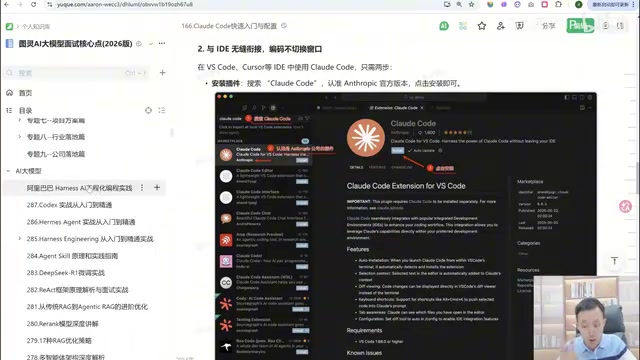
Claude Code's core advantage lies in its comprehensive engineering programming framework. Anthropic was founded in 2021 by Dario Amodei, former VP of Research at OpenAI, with a focus on AI safety research. Claude Code is Anthropic's command-line AI programming tool, upgraded from research preview to general availability in 2025. Its core design philosophy is to elevate AI programming from "conversational code generation" to "engineering-grade software development." Claude Code can understand the context of an entire codebase, execute terminal commands, manage Git workflows, and remember project conventions through configuration files like CLAUDE.md.
If you read Claude Code's source code, you'll find extensive optimizations for professional programming, including:
- A complete enterprise-grade software engineering workflow
- A pipeline-style development model composed of a series of development Skills
- An engineering programming Skill collection provided by the SuperPAL plugin
SuperPAL (Super Programming Assistant Library) is an engineering plugin system built on the Claude Code ecosystem. It encapsulates requirements analysis, architecture design, code implementation, test verification, and other stages into standardized Skills, forming a reusable development pipeline. This system is the foundation of the AI engineering programming methodology that many large tech companies are currently adopting internally.
Recommended Development Environment: VS Code as the Top Choice for AI Programming
The course recommends VS Code as the primary IDE, and the reasoning is straightforward: in the AI era, traditional IDEs (like IntelliJ IDEA) risk being marginalized within two to three years if they don't undergo major transformation. With its lightweight design and rich AI plugin ecosystem (including the Claude Code plugin), VS Code has become the go-to environment for AI programming.
Backend Model Selection: Real-World Rankings of Chinese LLMs for Programming
Due to restrictions on Claude model access, the course conducted hands-on testing of major Chinese LLMs and produced a highly valuable ranking:
Tier 1: Zhipu GLM
The course instructor stated clearly that among all major Chinese LLMs, Zhipu GLM has the relatively strongest programming capability. Zhipu AI was founded in 2019, originating from the Knowledge Engineering Group (KEG) at Tsinghua University's Department of Computer Science, established by Professor Jie Tang's team. Its core product, the GLM (General Language Model) series, uses a unique autoregressive blank-filling pre-training framework that differs from both GPT's unidirectional autoregressive approach and BERT's bidirectional encoder. Between 2024 and 2025, Zhipu released the GLM-4 series, which excels in code generation, mathematical reasoning, and other tasks. Zhipu is also one of the few Chinese AI companies with both foundational model R&D capabilities and comprehensive commercialization ability.
In terms of market performance, Zhipu's valuation has skyrocketed — shortly after its founding, its market cap approached that of Xiaomi, a company with numerous business lines including smartphones and automobiles. Zhipu achieved this scale with just a single model.
Tier 2: DeepSeek, Kimi, MiniMax, Mimo
Among these, DeepSeek offers the best value — solid capabilities at a very low price. Kimi and MiniMax are also viable options.
Other Options: Alibaba Tongyi, Tencent Hunyuan
These models can also be integrated, but their overall performance is slightly behind the first two tiers.
The course also recommends using the OpenRouter platform to view and compare real-time rankings of major models, including detailed data on usage volume, capability benchmarks, pricing, and more. OpenRouter is an AI model aggregation routing platform that wraps APIs from dozens of model providers — including OpenAI, Anthropic, Google, and Meta — into a standardized interface. Developers only need to connect to OpenRouter to access virtually all mainstream LLMs on the market. Its business model is similar to an "API gateway for AI": it bulk-purchases tokens from various providers at discounted rates and resells them to developers at a slight markup. The core value of this model lies in reducing developers' integration and switching costs while providing value-added services like model comparison, usage monitoring, and failover.
AI Engineering Programming: The Right Approach to Enterprise Development
What Is AI Engineering Programming?
The core idea of AI engineering programming is: don't let AI generate code randomly — make it follow enterprise-grade software engineering standards. This includes:
- Requirements analysis and architecture design: Before writing any code, ensure the AI understands the complete business requirements and technical architecture
- Skill-driven pipeline development: Use predefined development Skills (such as those in the SuperPAL plugin's Skill collection) to advance step by step through a standardized process
- Multi-Agent collaboration: Different AI Agents handle different development stages, forming a complete development pipeline
Multi-Agent collaboration is a cutting-edge direction in AI engineering programming, rooted in the "separation of concerns" principle from software engineering. In this paradigm, different AI Agents play different engineering roles: an Architect Agent handles system design and technology selection, a Developer Agent handles concrete code implementation, a Testing Agent writes and executes test cases, and a Review Agent handles code review and quality control. These Agents collaborate through structured communication protocols (such as shared context, task queues, and feedback loops), simulating the collaboration patterns of real software teams. Frameworks like Microsoft's AutoGen and CrewAI are exploring this direction, and the latest versions of Claude Code and Codex have also begun supporting multi-Agent orchestration capabilities.
Enterprise Practice: Alibaba's Internal AI Programming System
The course mentioned Alibaba's internal AI engineering programming practices. Major internet companies are all rolling out similar systems, with the core concept being "self-contained evolution" — AI programming systems that can self-iterate and optimize, rather than simply generating code once.
Hands-On Projects: E-Commerce Platform and OpenRouter Aggregation Platform
The course designed two hands-on projects to demonstrate the complete AI engineering programming workflow:
Project 1: Enterprise-Grade E-Commerce Platform
- First, use Vibe Coding to quickly build a demo version
- Then refactor it into an enterprise-grade project using AI engineering programming principles
- Compare the code quality and maintainability differences between the two approaches
Project 2: OpenRouter AI Model Aggregation Platform
- This is a typical "wrapper" website, but with extremely high commercial value
- The course instructor revealed that a friend of his runs a similar token resale platform with a team of just over a dozen people, generating hundreds of millions in annual revenue
The Business Truth of AI: Who's Actually Making Money?
The course also shared a thought-provoking insight: the real money in AI right now isn't coming from consumer-facing AI applications.
Products like Doubao and Tencent Yuanbao, which target general consumers, are actually losing money. The real profit sources are:
- Computing power and hardware: Companies selling GPUs, chips, and memory
- Token sales: API services from major model providers
- Token resale platforms: Model aggregation platforms like OpenRouter, along with numerous similar products built by teams targeting overseas markets
This landscape bears a striking resemblance to the historical Gold Rush — the people who actually made money weren't the gold miners themselves, but those selling shovels and jeans. In the AI era, computing infrastructure and API middlemen play exactly the role of "shovel sellers." This insight holds significant reference value for developers choosing their entrepreneurial direction.
Conclusion and Recommendations
AI programming is transitioning from the "toy stage" to the "engineering stage." For developers, the key isn't learning to use a specific AI tool to generate code — it's mastering the methodology of AI engineering programming: understanding architecture design, mastering Skill-driven development workflows, and learning multi-Agent collaboration.
Tools will keep changing, but engineering thinking is a lasting competitive advantage. Whether you choose Codex or Claude Code, what ultimately determines project quality is the depth of your understanding of software engineering fundamentals.
Related articles
Vibe Coding in Practice: How a Product Manager Built a Study App from Pain Point to Launch Using AI Tools
A product manager used AI tools like Claude Code to independently build a quiz app from exam prep pain points to launch. A full walkthrough of Vibe Coding methodology, MVP definition, and testing.
PilotDeck: A Local Console That Tames Multi-Task Agent Chaos
PilotDeck is an open-source local Agent console from a Tsinghua-affiliated team that solves multi-task chaos with workspace isolation, white-box memory management, and smart model routing.
Fusion Startup Funding Landscape: A Deep Dive into the $7.1 Billion Flow and Industry Dynamics
Global fusion startups have raised $7.1B, heavily concentrated in top players. A deep analysis of funding patterns, tech pathways, commercialization challenges, and the investment logic behind this ultimate energy bet.