PilotDeck: A Local Console That Tames Multi-Task Agent Chaos
PilotDeck is a local Agent console that brings workspace isolation, memory auditing, and cost control to multi-task AI workflows.
PilotDeck is an open-source local Agent console built by a Tsinghua-affiliated team (OpenBNB) to solve the chaos of managing multiple Agent tasks. It introduces Workspace-based context isolation to prevent projects from bleeding into each other, white-box memory management for full auditability, smart model routing to optimize cost vs. quality, and an Always-On mode for background task execution.
When you start seriously using Agents to get work done — rather than just asking the occasional question — an overlooked problem quickly surfaces: the chaos of multi-task management. One project has the Agent modifying code, another running research, another organizing documents. After dozens of conversation turns, when you ask "where did we leave off on that project?", the Agent often can't give a clear answer. PilotDeck is a local Agent console built specifically to solve this problem.
Project Background: Built by a Tsinghua-Affiliated Team
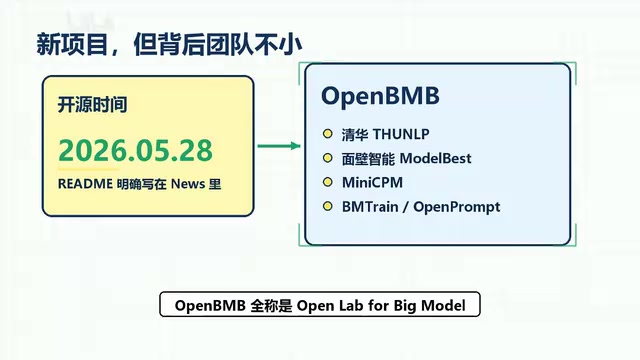
PilotDeck is a very new open-source project — the README lists its open-source date as May 28, 2025, and it has already garnered around 2.8K stars on GitHub. To be clear upfront: it's not a skill plugin or a prompt pack. It's a full-fledged application you install and run locally. Once launched, it provides a web interface for managing workspaces, tasks, memory, and model configurations, and can even track Token consumption per task.
The team behind it, OpenBNB (Open Lab for Big Model Base), has serious credentials. It was co-founded by Tsinghua University's Natural Language Processing Laboratory and ModelBest (面壁智能). Well-known projects like MiniCPM, BMTrain, and OpenPrompt all trace back to this team. Tsinghua's NLP Lab (THUNLP) is one of the most influential NLP research groups in China, founded by Professor Sun Maosong and led by Professor Liu Zhiyuan and others. ModelBest is the lab's commercialization arm. Their MiniCPM series is a flagship example of on-device small models in China, achieving near-large-model performance with minimal parameters. BMTrain is an efficient distributed framework for large model training, and OpenPrompt is a standard toolkit for prompt learning. This team is characterized by both top-tier academic output and solid engineering execution. PilotDeck can be seen as their strategic move from "model R&D" into "Agent engineering." This means PilotDeck isn't something someone threw together by wrapping a prompt into a tool — it's a product from a team with deep engineering roots, seriously tackling real pain points in Agent engineering.
Three Core Pain Points It Solves
Pain Point 1: Projects Bleed Into Each Other — Workspace-Based Context Isolation
In a typical chat interface, requirements, files, memories, and failure logs all pile up in a single conversation thread. After chatting long enough, even you might not remember what was said earlier — let alone the Agent. This is a universal problem with all conversational AI tools today: context windows are finite, but project complexity is not.
Some technical background is helpful here: mainstream LLMs currently have context windows ranging from 4K to 200K tokens (e.g., Claude supports 200K, GPT-4o supports 128K). But even the largest windows can't expand infinitely — the self-attention mechanism in the Transformer architecture has computational complexity that scales quadratically with sequence length, meaning longer windows lead to slower inference and higher costs. More critically, research has shown that models exhibit a "Lost in the Middle" phenomenon in ultra-long contexts, where retrieval accuracy for information in the middle of the sequence drops significantly. This is why simply enlarging the context window doesn't truly solve multi-project management — you need context isolation and external memory management at the architectural level.
PilotDeck's solution introduces the Workspace concept. Project A has its own files and memory; Project B has its own files and memory — completely isolated from each other. When switching between tasks, you don't need to re-explain the background every time; the Agent can pick up right where it left off within the corresponding workspace's context. This design seems simple, but for power users juggling multiple projects simultaneously, it's a genuine necessity.
Pain Point 2: Memory Is a Black Box — White-Box Memory Management
When an Agent makes a wrong judgment, you can't just look at the final answer and call it a day. You need to know why it made that judgment — which memory influenced it? Which piece of context led it astray? In traditional chat interfaces, this is nearly impossible to trace.
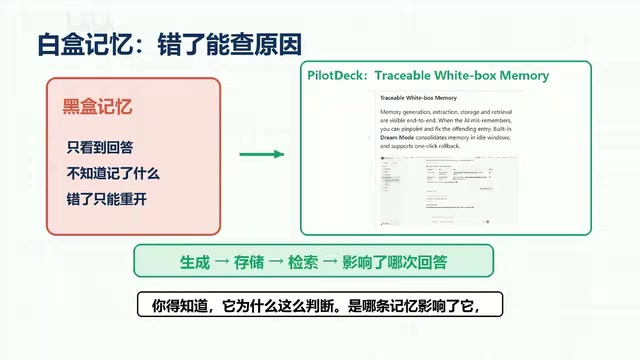
PilotDeck makes its memory system a white-box design: how memories are generated, how they're stored, and how they're retrieved — everything is visible and auditable. The "white-box" vs. "black-box" distinction touches on core concepts in software engineering and AI explainability. A black-box system means users can only see inputs and outputs while the internal workings remain hidden — which is exactly the state of most AI chat tools today. A white-box system means internal states, decision paths, and data flows are all transparent and auditable. In traditional software development, logging systems, debugging tools, and distributed tracing (like OpenTelemetry) are all white-box mechanisms. PilotDeck brings this philosophy to the Agent domain, essentially building "observability" infrastructure for Agents. This aligns with the approach of LLM observability tools like LangSmith and Langfuse, but with a sharper focus on end-user daily workflows.
This feature may not sound flashy, but it's extremely useful for long-running tasks. The more work you delegate to an Agent — and the more complex that work becomes — the more you need a complete "work record audit" capability. This fundamentally transforms the Agent from a black-box chat tool into a manageable, auditable work system.
Pain Point 3: One-Size-Fits-All Models — Smart Routing and Cost Control
Not every task needs the most powerful model. Organizing text works fine with a lightweight model; planning, reasoning, and coding require something stronger. But in most Agent tools, you can only bind one model — either you waste money using the expensive one for everything, or you sacrifice quality by using the cheap one across the board.
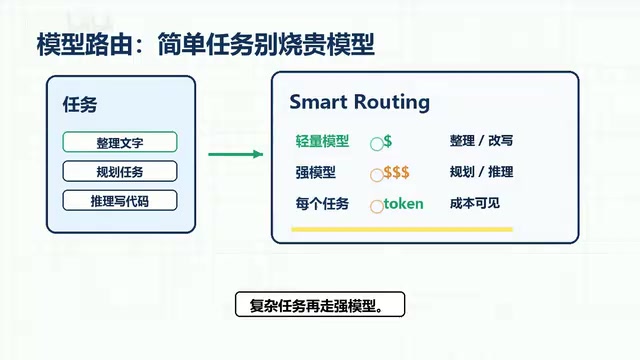
PilotDeck supports model routing: simple tasks go to cheaper models, complex tasks go to stronger ones. Model routing has been a hot topic in AI engineering over the past year. The core idea is dynamically selecting the most appropriate model based on task complexity, type, and cost budget. Technically, routing strategies typically include rule-based routing (pre-assigning models by task type), cost-based routing (automatic downgrade when budget thresholds are hit), and quality-assessment-based smart routing (using a small model to evaluate task difficulty before dispatching). The Token price differences between models are enormous — as of mid-2025, GPT-4o's input price is roughly 15-20x that of GPT-4o-mini, and there's a similar gap between Claude Sonnet and Haiku. For heavy users consuming hundreds of thousands of Tokens daily, proper model routing can reduce costs by 60%-80% without noticeably sacrificing quality.
More importantly, every task's Token consumption is visible directly in the interface. This transforms cost awareness from "finding out when the bill arrives at month's end" to "real-time visibility and optimization." For enterprise users or heavy individual users, the value of this feature speaks for itself.
Installation and Configuration
The installation process is quite user-friendly and doesn't require complex environment setup:
- macOS / Linux: The official team provides a one-line install script. After installation, run the
pilotdeckcommand and the local service will be available atlocalhost:3001 - Developers: Can start from source code
- Docker users: Simply run
docker compose up -d
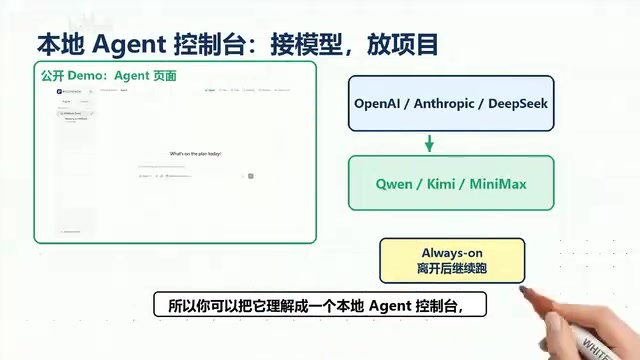
Model API keys need to be configured by the user — either in a local config file or through the settings page in the web interface. The project supports OpenAI, Anthropic, DeepSeek, Qwen, Kimi, MiniMax, and all OpenAI-compatible endpoints, meaning virtually all mainstream models — both domestic and international — can be connected.
Always-On Design: Keeps Running After You Walk Away
PilotDeck also features a noteworthy design — Always-On mode. After you step away from your computer, the Agent can continue executing long-running tasks, write the results to local files, and provide you with a summary.
The Always-On mode involves asynchronous execution architecture design for Agent systems. Traditional synchronous conversation mode requires the user to stay online and wait for each step's result, while asynchronous mode decouples task submission from result retrieval. Technically, this typically requires a task queue (such as a message queue mechanism), persistent state management (so tasks can resume after interruption), and a result write-back mechanism. Similar designs appear in AI coding Agents like Devin and OpenHands. The significance of this mode is that it upgrades the Agent from a "real-time assistant" to a "background worker" — closer to the human team collaboration model of "assigning a task to a colleague and then each going about their own work." However, this also introduces new challenges: ensuring the Agent doesn't drift from its objective without supervision, and handling exceptions and ambiguities during execution, are problems that require ongoing optimization.
This is extremely practical for research tasks or data organization jobs that take hours to complete, truly enabling the "hand it off to the Agent and go do something else" workflow.
Who Needs PilotDeck?
Frankly, if you only ask AI the occasional question, PilotDeck isn't a must-have for you. But if you've already started using Agents to write projects, conduct research, and run workflows — and you're frequently juggling multiple tasks at once — this kind of tool is well worth your attention.
From a broader perspective, PilotDeck represents an important direction in Agent tool evolution: the progression from "chat tool" to "work system." When Agents are no longer just answering questions but genuinely helping you execute complex, multi-step tasks, what we need isn't a better chat interface — it's "infrastructure-level" capabilities like project management, memory auditing, and cost control. PilotDeck is making a valuable exploration in this direction.
Key Takeaways
Related articles
Vibe Coding in Practice: How a Product Manager Built a Study App from Pain Point to Launch Using AI Tools
A product manager used AI tools like Claude Code to independently build a quiz app from exam prep pain points to launch. A full walkthrough of Vibe Coding methodology, MVP definition, and testing.
Fusion Startup Funding Landscape: A Deep Dive into the $7.1 Billion Flow and Industry Dynamics
Global fusion startups have raised $7.1B, heavily concentrated in top players. A deep analysis of funding patterns, tech pathways, commercialization challenges, and the investment logic behind this ultimate energy bet.
Codex and Claude Code Dual-Engine: A Practical Guide to AI-Powered Engineering
A deep dive into AI engineering with Codex and Claude Code: Vibe Coding limitations, Chinese LLM rankings, Skill-driven development, and enterprise project practices.