Codex in Practice: A Detailed Guide to AI Programming Workflows for Enterprise Code Review and Personal Projects
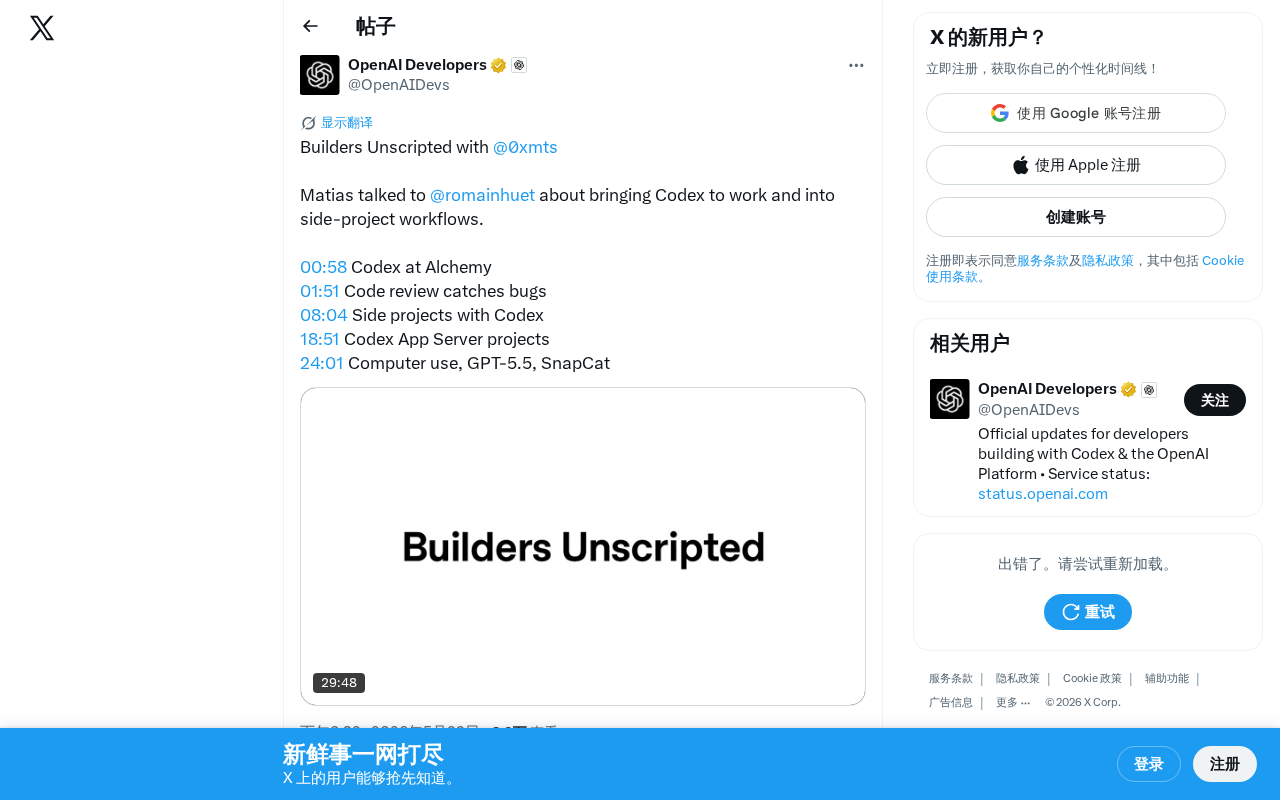
How Codex powers enterprise code review at Alchemy and accelerates personal side project development.
This article breaks down a Builders Unscripted interview featuring Alchemy's Matias and OpenAI's Romain Huet, exploring how Codex is used for enterprise code review — catching bugs humans miss — and accelerating personal side projects by handling boilerplate code. It also covers the evolution of Codex from code completion to an async coding agent, and looks ahead at Computer Use, GPT-5.5, and the future of AI programming tools.
Overview
OpenAI recently released an episode of Builders Unscripted, featuring Alchemy's Matias (@0xmts) in conversation with OpenAI's Romain Huet for an in-depth discussion on using Codex in real-world work and personal projects. The conversation covered multiple scenarios ranging from enterprise-level code review to side project development, demonstrating how AI programming assistants can truly integrate into developers' daily workflows.
OpenAI Codex was originally fine-tuned from GPT-3, specifically optimized for code generation tasks. The early version of Codex (released in 2021) was essentially an autoregressive language model trained on billions of lines of public code, capable of generating code snippets based on natural language descriptions or code context. The initial version of GitHub Copilot was built on this very technology. By 2025, Codex has evolved into a cloud-based asynchronous coding agent that runs in a sandbox environment and can independently complete multi-step tasks such as writing code, running tests, and fixing errors — a far cry from the single-pass code completion of its earlier versions. A sandbox environment refers to a secure execution space isolated from the main system, where Codex can freely install dependencies, run tests, and even start servers without affecting the user's local development environment or production systems. Developers can submit programming tasks to Codex through the ChatGPT interface or API, and Codex autonomously completes them in the background and returns results. This asynchronous model allows developers to handle multiple parallel tasks simultaneously, dramatically boosting productivity. This shift from "synchronous completion" to "asynchronous agent" marks the evolution of AI programming tools from a "copilot" role that assists with input to an "autopilot" role capable of independently executing complex tasks.
Codex in Enterprise Use at Alchemy
Bug Detection in Code Review
During the interview, Matias shared real-world use cases of Codex at Alchemy. Alchemy is one of the most important infrastructure providers in the Web3 space, offering node services, developer APIs, and data indexing capabilities for major blockchains including Ethereum, Polygon, and Solana. Specifically, Alchemy operates thousands of blockchain full nodes, processes billions of API requests daily, and abstracts away the underlying complexity of blockchains for developers — including node synchronization, data consistency, and RPC call optimization. Its clients include numerous well-known DeFi protocols and NFT platforms, earning it the reputation of being the "AWS of blockchain." Introducing AI programming tools in such a company carries benchmark significance for the entire Web3 developer ecosystem, as the unique characteristics of blockchain infrastructure code (immutability, financial implications, cross-chain compatibility) demand code quality standards far exceeding those of traditional web applications.
The most striking aspect was Codex's performance in code review — its ability to effectively catch bugs that human reviewers might miss. Traditional code review relies on developers reading through code changes in Pull Requests line by line, checking for logical correctness, coding standards, and security vulnerabilities. However, research data shows that the defect detection rate of manual code review typically falls between 60%-70%, meaning roughly one-third of defects may be missed during review. The advantages of AI-assisted review include: it can simultaneously correlate context across thousands of files in a project, identifying cross-module dependency conflicts — for example, when a function signature changes, AI can immediately locate all call sites and check compatibility; it's unaffected by cognitive fatigue, maintaining the same level of attention on line 100 as on line 1 — psychological research shows that human attention significantly declines after continuously reviewing 200 lines of code; and it can perform systematic security scans based on known vulnerability pattern libraries (such as OWASP Top 10, which covers ten major web security risk categories including injection attacks, broken authentication, and sensitive data exposure), a pattern-matching capability that humans cannot replicate within limited time.
For large engineering teams, code review is a critical step in ensuring code quality, but manual review is often constrained by time pressure and attention fragmentation. As a tireless reviewer, Codex can systematically check code logic, boundary conditions, and potential security vulnerabilities. This is particularly important in fields like blockchain infrastructure where security requirements are extremely high — a tiny bug in a smart contract could lead to losses of hundreds of millions of dollars (there have been multiple major security incidents caused by code vulnerabilities, such as the 2022 Wormhole bridge attack resulting in $320 million in losses and the 2021 Poly Network attack resulting in $610 million in losses), making the additional AI review layer an extremely high-ROI investment.
Key Considerations for Workflow Integration
Looking at the interview timeline, Matias spent considerable time (approximately 6 minutes) discussing the code review scenario, indicating that this isn't a simple tool replacement but involves redesigning team collaboration processes. The core value of AI-assisted code review lies not in replacing human reviewers, but in providing an additional safety net that allows developers to focus their attention on higher-level architectural decisions. In practical implementation, teams need to consider questions such as: How do AI review results integrate with existing CI/CD pipelines? How should AI-discovered issues be prioritized (blocking defects vs. suggested optimizations)? How do you prevent developers from lowering their own review standards due to over-reliance on AI review? The complexity of these process design questions is often no less than the technology itself.
Codex in Practice for Personal Projects
Efficient Development Workflows for Side Projects
The second part of the interview focused on Codex's application in personal projects. For many developers, side projects often progress slowly due to limited time. Codex changes this dynamic — it can handle large amounts of boilerplate code and repetitive work, allowing developers to invest their limited free time in creative ideation and core logic.
Boilerplate code refers to repetitive code that must exist in software projects but lacks unique business logic, such as database connection configurations, API route definitions, authentication middleware (OAuth flows, JWT validation), error handling templates, logging setup, Docker configuration files, and more. Research shows that developers spend approximately 30%-50% of their time writing and maintaining boilerplate code in typical projects. AI programming tools have extremely high accuracy in generating this type of code (because the patterns are fixed and training data is abundant — millions of projects on GitHub contain highly similar configuration code). This is why they deliver the most tangible efficiency gains in personal projects — developers can redirect the time saved toward core business logic that truly requires creativity. Taking a typical full-stack web application as an example, project initialization, user authentication systems, and CRUD interfaces may account for over 70% of the workload in the early stages of a project, and these are precisely the parts that AI excels at generating quickly.
This usage pattern is particularly well-suited for developers who have ideas but lack time. Codex not only accelerates prototype development but also helps developers quickly validate the feasibility of technical approaches, dramatically shortening the cycle from idea to working demo. In traditional development workflows, a weekend project might take weeks to reach a demonstrable state; with AI programming tools, developers can build a complete technical skeleton in just a few hours, compressing iteration cycles from "weeks" to "days" or even "hours."
From Code Completion to Full Application Development
The discussion then turned to Codex App Server-type projects. This indicates that Codex's capabilities have expanded from simple code completion to building complete application services, including backend logic, API design, and service deployment — far more complex engineering tasks. Behind this capability leap is the expansion of model context windows and the enhancement of multi-step reasoning abilities — early code completion only needed to understand a few dozen lines of context in the current file, while building a complete application requires the model to simultaneously understand data model design, API contracts, front-end/back-end interaction logic, error handling strategies, and other dimensions of information while maintaining consistency across them. For independent developers and small teams, this means one person can now sustain projects that previously required multi-person collaboration — frontend, backend, database, and deployment configuration work that once required different specialized backgrounds can now be efficiently completed by a single person with AI assistance.
Cutting-Edge Technology Outlook
Computer Use, GPT-5.5, and SnapCat
The interview concluded by mentioning several noteworthy directions: Computer Use, GPT-5.5, and a project called SnapCat. These keywords point to the future development path of AI programming tools — moving from pure text code generation toward broader computer operation capabilities, supported by more powerful underlying models.
Computer Use refers to AI models' ability to operate computer graphical interfaces just like humans — including moving the mouse, clicking buttons, entering text, and reading screen content. This technology was first introduced by Anthropic in October 2024 in the form of Claude 3.5 Sonnet, with OpenAI subsequently following suit in its product line (through products like Operator). The technical principle involves passing screenshots as visual input to multimodal models, which understand the interface state and output specific operation instructions (coordinate clicks, keyboard inputs, etc.). For programming scenarios, Computer Use means AI is no longer limited to generating code text — it can directly operate IDEs (such as installing plugins and configuring debuggers in VS Code), browsers (consulting documentation, testing web applications), terminals (executing deployment commands, monitoring logs), and deployment tools (configuring CI/CD, managing cloud resources), completing the full loop from coding to testing to deployment. This represents a paradigm shift for AI programming assistants from "code generators" to "full-stack automation agents" — AI is no longer just a tool that can write code, but an autonomous agent capable of completing software engineering tasks end-to-end.
The mention of GPT-5.5 is particularly noteworthy. Its naming suggests it may be an enhanced version of GPT-5, similar to the relationship of GPT-4o and GPT-4 Turbo to GPT-4 — achieving performance leaps through post-training optimization, inference efficiency improvements, or multimodal capability enhancements while keeping the core architecture unchanged. The industry generally expects the next-generation model to achieve significant improvements in the following programming-related capabilities: ultra-long context windows (potentially reaching the million-token level, sufficient to understand an entire large codebase at once — GPT-4 Turbo's current 128K context is roughly equivalent to a medium-length technical book, while a million tokens could accommodate a mid-sized enterprise's complete code repository), stronger multi-step reasoning capabilities (able to plan and execute complex refactoring tasks, such as splitting a monolithic application into a microservices architecture), and lower hallucination rates (reducing the generation of code that appears correct but is actually wrong — current models still "fabricate" non-existent function signatures when dealing with unfamiliar libraries or APIs). These improvements will directly impact the practical ceiling of programming tools like Codex, potentially bringing a qualitative leap to programming scenarios, enabling AI to advance from handling local code snippets to understanding and operating entire software systems.
Practical Takeaways for Developers
This interview sends a clear signal: AI programming tools have moved from the "early adopter" phase to the "productivity tool" phase. Whether improving code quality in enterprise environments or accelerating development iterations in personal projects, Codex has demonstrated tangible application value.
For developers looking to integrate AI programming tools into their workflows, it's recommended to start with these two low-risk scenarios:
- Code review assistance: Use Codex as an additional review layer to catch issues that humans easily miss
- Personal project acceleration: Leverage Codex to handle boilerplate code so you can focus your energy on core creative work
Gradually building an understanding of the tool's capability boundaries before expanding to more critical production environments is the prudent path to adoption. It's worth noting that current AI programming tools still have clear capability boundaries: they still require deep involvement and judgment from human developers when handling highly customized business logic, algorithm design requiring deep domain knowledge, and concurrent systems involving complex state management. The best practice is to treat AI as an extremely capable but supervision-requiring junior engineer — it can quickly complete well-defined tasks, but critical architectural decisions and quality assurance still need to be handled by humans.
Key Takeaways
Related articles
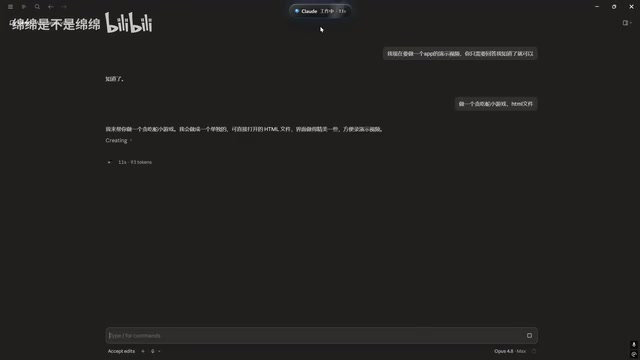
Claude Code Desktop Status Capsule: An Open-Source Widget for Real-Time AI Coding Status Monitoring
An open-source desktop status capsule that monitors Claude Code's idle, working, and completed states in real time, with multi-conversation management, memos, and music control for developers.

GPT-5.2 Codex vs Opus 4.5 Hands-On: A Comprehensive Comparison of Coding Ability, Speed, and Developer Experience
Hands-on comparison of GPT-5.2 Codex vs Opus 4.5 across frontend generation, physics simulation, 3D scenes, and code refactoring, with practical selection advice.
Deep Dive into the Three AI Programmin…
Deep Dive into the Three AI Programming Frameworks: The Right Way to Do Specification-Driven Development
Deep dive into the three frameworks of Specification-Driven Development (SDD) for AI programming: Blueprint, Execution Flow, and Change Records — solving the problem of AI code going off the rails.