Codex Team Reveals a New AI Programming Paradigm: Organizational Skills Replace Coding Skills
Codex Team Reveals a New AI Programmin…
AI programming paradigm shifts from writing code to organizing capabilities, defining goals, and building context
OpenAI's Codex team practices reveal AI programming is undergoing a paradigm shift: developer core value moves from writing code to organizing capabilities, defining goals, and building context. Long spec documents are replaced by brief descriptions, repetitive tasks are encapsulated as reusable Skills, and the developer-model relationship transforms from command-execute to collaborative partnership. Models have crossed the reliability threshold, with development shifting from 80% manual coding to 80% completed by agents.
Core Trend: From Writing Code to Organizational Ability
The latest practices from OpenAI's Codex team reveal an important trend: the focus of AI programming is shifting from "writing lengthy documents and detailed descriptions" to "organizational ability and goal definition." A developer's value is no longer embodied in writing code itself, but in how they organize context, define constraints, and build workflows.
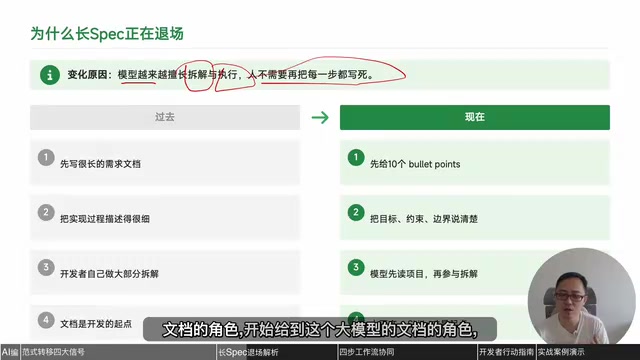
The fundamental reason for this shift is that models are becoming increasingly adept at autonomously decomposing and executing tasks. Humans no longer need to spell out every step—previously, models could only complete code, but today's models can understand projects on their own, participate in task decomposition, and generate solutions. Behind this is a qualitative leap in large language models' instruction following and long-range reasoning capabilities: from the GPT-3 era, which required carefully designed few-shot examples, to today where simply providing goals and constraints allows models to autonomously fill in execution details. This capability leap has shifted the focus of "prompt engineering" from "how to make the model understand my intent" to "how to let the model make autonomous decisions within the correct boundaries."
Four Key Signals: The Paradigm Shift Has Already Happened
Signal One: No More Reliance on Long Spec Documents
Previously, writing detailed requirements documents could easily run to five thousand words. Now, in many scenarios, writing ten bullet points is enough to kick off development. Long documents are not only no longer necessary—they may actually hinder AI's ability to perform.
The deeper logic behind this change is that modern large models possess powerful semantic completion capabilities—they can infer reasonable implementation paths from sparse goal descriptions. Overly detailed specification documents actually compress the model's reasoning space, downgrading it to a simple "text-to-code" tool rather than a true collaborative partner. From an information theory perspective, redundant process descriptions dilute the weight of key constraint information, causing the model to more easily deviate from core objectives during execution.
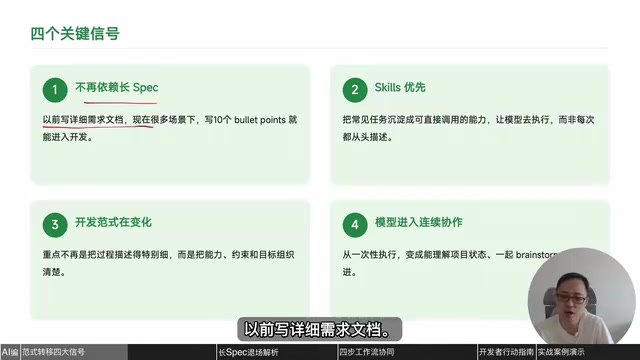
Signal Two: Skills First
Skills are about encapsulating repetitive tasks into reusable capability modules. For example, the action of "search"—you don't need to describe "open browser → enter keywords → wait for response → parse results" every single time. Instead, you package it as a skill and directly call it for reuse going forward. This avoids describing the same task from scratch each time, dramatically saving token consumption.
Skills are essentially a capability abstraction layer, similar to function encapsulation or microservice design philosophy in software engineering. In AI Agent architectures, Skills are typically implemented as Tool Calling or Function Calling—the model invokes predefined capability modules through standardized JSON Schema interfaces without needing to re-understand execution details. This aligns closely with the DRY principle (Don't Repeat Yourself) in traditional software engineering: once a capability has been verified as reliable, it should be encapsulated for reuse rather than re-described in every conversation. From a token economics perspective, a well-encapsulated skill call might require only 5 tokens, while fully describing the same operation could require 200 tokens—a difference that gets significantly amplified in large-scale Agent tasks.
Signal Three: From Describing Processes to Organizing Capabilities
The core change in the development paradigm is: the old method focused on "how to do things step by step," while the new method focuses on "what capabilities do I have available to call." Tell the model the set of capabilities it can invoke, provide concise requirements and boundary definitions, and let the model autonomously decompose and program.
At the architectural level, this shift corresponds to a philosophical migration from "imperative programming" to "declarative programming." The imperative approach requires developers to precisely describe every execution step, while the declarative approach only needs to declare the desired end state, letting the system autonomously determine how to reach it. SQL query language and Kubernetes configuration files are classic examples of the declarative paradigm—you describe "what I need" rather than "how to get it." The way AI Agents organize capabilities is converging toward this paradigm, with the developer's core work becoming the definition of capability boundaries and acceptance criteria, rather than orchestrating execution steps.
Signal Four: Models Enter Continuous Collaboration Mode
It's no longer about giving the model a detailed document and having it output code in one shot. Now models can have conversations with you, brainstorm, formulate plans, and even produce more detailed and comprehensive plans than you would.
The technical foundation of this continuous collaboration mode is the context accumulation capability across multi-turn conversations. Modern models' context windows have expanded from an early 4K tokens to 128K and beyond, making deep collaboration spanning multiple conversation turns possible. More importantly, models can maintain an implicit "project mental model" during collaboration—remembering discussed constraints, excluded approaches, and confirmed directions—thereby providing truly incremental value in each interaction round rather than simply repeating previous outputs.
The Fundamental Change in Documentation's Role
Documentation has shifted from "describing how to do it" to "defining what to do, where the boundaries are, and what counts as done." Here's a specific comparison:
- Before: Write very long requirements documents → Now: Ten bullet points
- Before: Implementation process described in great detail → Now: Just clarify goals, constraints, and boundaries
- Before: Developers do most of the decomposition themselves → Now: Model reads the project first, then participates in decomposition
- Before: Documentation is the starting point for development → Now: Context + skills are the starting point
This transformation in documentation's role has deep parallels in software engineering methodology. Traditional waterfall development relied on exhaustive Software Requirements Specifications (SRS), while agile development has already simplified these into User Stories. AI-assisted development further compresses documentation into Intent Declarations—you only need to express "who needs what, for what purpose, and what are the success criteria," and the model can autonomously fill in the technical implementation path. This requires developers to have stronger goal abstraction abilities, being able to distill essential requirements from specific implementation details.
The Codex Team's Four-Step Efficient Workflow
The efficient workflow practiced by the Codex team consists of four steps:
Step One: Launch with a single sentence. Use voice or text input to describe the requirement in one sentence—no excessive information needed. Voice input is faster and lowers the barrier to getting started. The advantage of voice input isn't just speed—research shows that spoken expression often more naturally includes implicit context and emotional weighting compared to written expression, and this information, after speech-to-text conversion, can provide richer semantic cues for the model.
Step Two: GPT generates a functional prototype. The model combines context to directly produce a runnable MVP result. The generation speed of an MVP (Minimum Viable Product) in AI-assisted development has been compressed from days to minutes, giving unprecedented reinforcement to the development philosophy of "get it running first, then iterate."
Step Three: Plan Model collaboration. Discuss and adjust the next steps together with the model. This isn't about humans unilaterally assigning tasks—it's about humans and models jointly discussing what needs to be split up and what doesn't.
Plan Model is an AI workflow architecture that separates planning from execution. The planning phase is handled by models specifically optimized for reasoning capabilities (such as the o1 and o3 series), which are responsible for task decomposition and strategy formulation, while the execution phase is handled by code generation models for concrete implementation. This division of labor draws from the collaboration model between architects and engineers in human teams, and is also consistent with the ReAct (Reasoning + Acting) framework and Chain-of-Thought prompting concepts that have emerged in recent years. Decoupling "thinking clearly about what to do" from "actually doing it" can significantly reduce error rates in the execution phase, because when models generate code with a clear plan in place, both hallucination rates and logical error rates drop substantially.
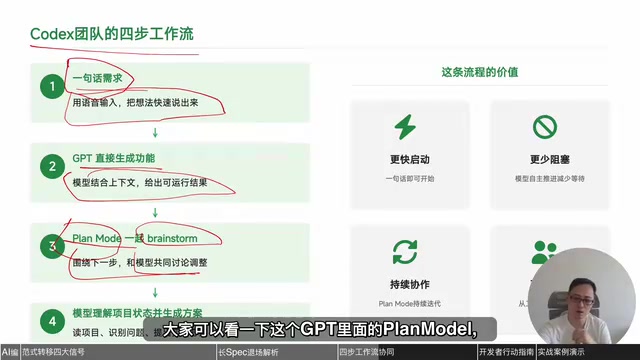
Step Four: Model understands project state and generates solutions. The model reads the entire project's state, context, and historical brainstorm records, identifies problems, and proposes implementation plans. This step relies on Codebase Indexing technology—tools vectorize and store the entire project's file structure, function signatures, dependency relationships, and other information, enabling the model to efficiently retrieve and understand the global state of large codebases within a limited context window.
The value of this workflow lies in: faster startup (one sentence can produce an MVP), fewer blockers (model autonomously progresses, reducing wait times), and continuous collaboration (humans and models are more like partners than in a command-execute relationship).
Rapid Reshaping of the Developer Role
Data shows that the development model is rapidly shifting from "80% manual coding" to "80% completed by agents." The core reason is that models have crossed the reliability threshold—they can stay focused on solving problems for 30 minutes or even longer.
The reliability threshold refers to the critical point at which AI models can maintain stable output quality during prolonged autonomous execution of complex tasks. Early models were prone to context drift, hallucination accumulation, and instruction forgetting when executing tasks lasting more than a few minutes, causing the completion quality of long tasks to deteriorate sharply over time. GPT-4o and subsequent models, through longer context windows, reinforcement learning alignment optimization, and improved reasoning chain mechanisms, have made sustained focus of 30 minutes or more possible. Breaking through this threshold is the key turning point for agent-based development moving from experimental tools to production-grade workflows—only when models can reliably complete entire functional modules, rather than merely generating code snippets, can developers truly delegate "execution" and focus on higher-level architectural decisions.
The developer's new value positioning:
- Define goals and boundaries: Clarify what to do, what not to do, and how to verify completion
- Organize callable capabilities: Distill common tasks into skills for model reuse
- Build project context: Help the model understand project state, existing code, and constraints
- Autonomous identification and acceptance: From describing processes to defining goals to accepting results
This role reshaping has historical precedents. Every leap in programming paradigms—from machine code to assembly language, from assembly to high-level languages, from imperative to object-oriented—has been accompanied by developers ascending from "controlling machines" toward "expressing intent." This leap in the AI Agent era essentially raises the abstraction level of "intent expression" once again, enabling developers to think at the business logic and system architecture level while completely delegating syntax details, API calls, and boilerplate code to models.
Four Actionable Recommendations
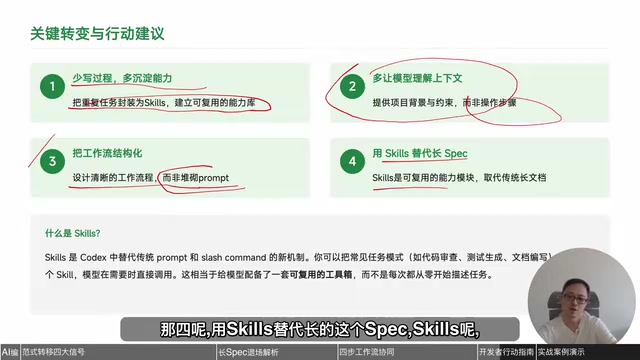
Based on the Codex team's practices, here are four actionable directions:
- Write less process, accumulate more capabilities: Encapsulate repetitive tasks as skills and build a reusable capability library. This is similar to building a team's "engineering infrastructure"—invest in encapsulation costs upfront, reap reuse dividends long-term. Start with the 5-10 highest-frequency operations and gradually expand the skills library's coverage.
- Let the model understand more context: Provide project background rather than operational steps. In practice, you can maintain a
CONTEXT.mdfile that records the project's technology selection rationale, core constraints, and historical decisions, serving as standard pre-loaded context for every conversation. - Design clear workflows: Rather than piling up prompts. A good workflow should clearly define the input, output, and acceptance criteria for each stage, giving the model clear success criteria at every node.
- Use skills to replace long specs: Reusable capability modules replace traditional lengthy documents. When you find yourself repeatedly describing the same operation across different tasks, that's the signal to encapsulate it as a skill.
Practical Example: From Brief Description to Runnable Project
The author shared a daily work case: rewriting an open-source project (Huobao Drama), with a very concise prompt—retain the AI agent framework, all prompts, Vue3+TypeScript tech stack, five independent agent tool calls, use a database for persistence, retain the core runnable parts and provide complete code.
The technology stack choices in this case are quite representative: the Vue3+TypeScript combination provides strong type constraints, making model-generated frontend code easier to pass static checks; the five independent agent tool call design reflects the Single Responsibility Principle applied in Agent architecture; database persistence addresses the core challenge of Agent state management—maintaining state consistency in multi-turn interaction and task interruption recovery scenarios. These technology choices themselves constitute implicit constraints on the model, guiding it to generate code within reasonable architectural boundaries.
With just this brief description, the model can produce a runnable project skeleton containing frontend, backend, tool registration, persistence, agent prompts, and database modules. After five or six rounds of iterative adjustments, you get a fully formed project.
Summary
The core of the new AI programming paradigm: Write less process, accumulate more capabilities; do less repetitive description, let the model understand more context. This is a major industry trend, and every developer should try adapting to this new workflow in their daily work to achieve a more efficient development experience.
From a broader perspective, this paradigm shift is not merely a tool-level efficiency improvement—it's a deep transformation in software engineering epistemology: when execution costs approach zero, what's scarce is no longer "people who can write code" but "people who can define the right problems." Developers' core competitiveness is migrating from technical depth toward systems thinking and problem abstraction ability—this is perhaps the most fundamental capability requirement that the AI era places on engineers.
Key Takeaways
- The focus of AI programming shifts from writing code to organizational ability: defining goals, building context, and clarifying constraints become the developer's core value
- Long Spec documents are exiting the stage—ten bullet points can kick off development, with models autonomously participating in decomposition and solution generation
- Skills (reusable capability modules) replace repetitive descriptions, avoiding teaching the model the same task from scratch every time
- The developer-model relationship shifts from command-execute to collaborative partnership, jointly discussing and adjusting plans through Plan Model
- By late 2025, the development model is rapidly transforming: from 80% manual coding to 80% completed by agents, as models have crossed the reliability threshold
Related articles
 Tutorials
Cursor + Codex Dual-IDE Collaboration: A Practical Methodology for Open-Source Project Customization
A complete methodology for open-source project customization based on real-world experience, detailing the Cursor+Codex dual-IDE workflow, seven-stage process, MVP validation, and AI source code reading techniques.
 Tutorials
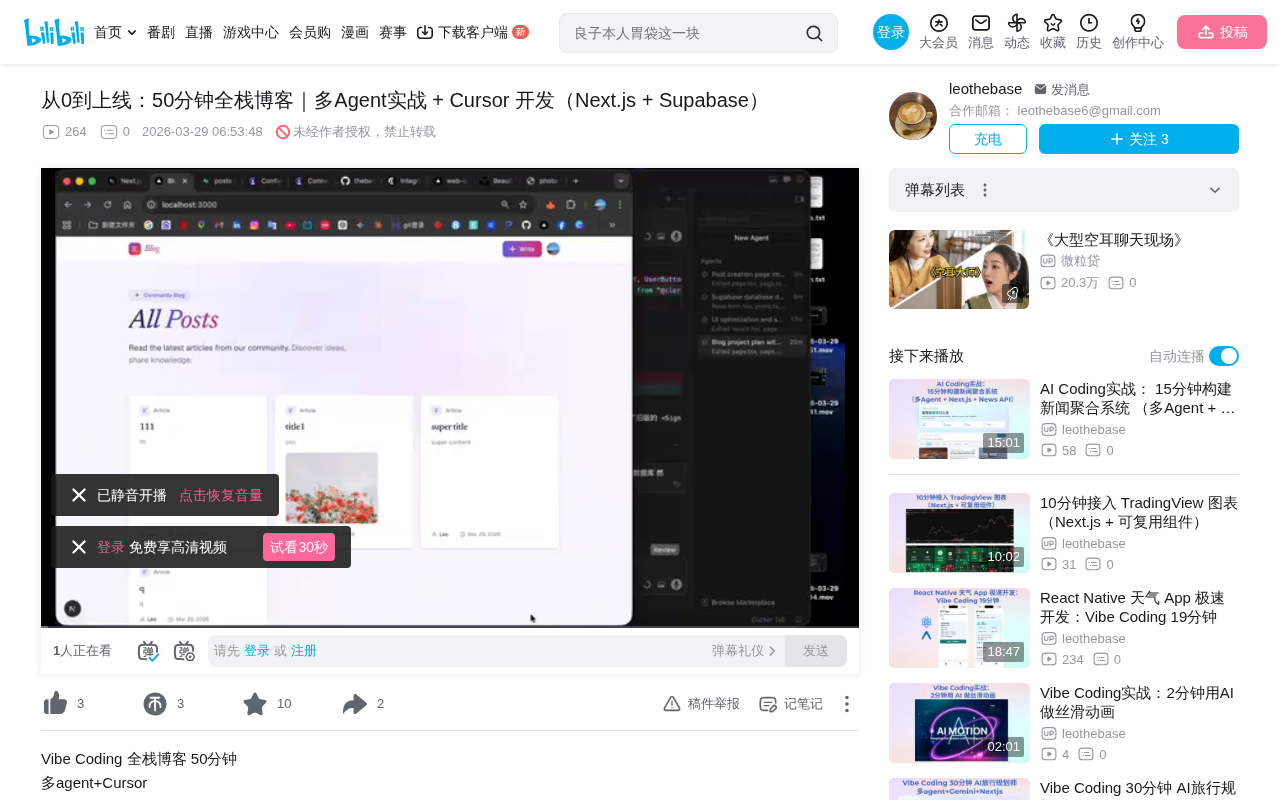
Cursor Multi-Agent in Practice: Building a Full-Stack Next.js Blog in 50 Minutes
Build a full-stack blog in 50 minutes using Cursor IDE's multi-Agent mode with Next.js, Clerk auth, and Supabase. Learn the 4-phase AI Agent workflow and key integration pitfalls.
 Tutorials
Building an AI Software Factory from Scratch: A Cursor Engineer's Hands-On Experience with Multi-Agent Collaboration
Cursor engineer Eric shares practical insights on building an AI software factory: automation levels, guardrail design, parallel Agent management, and scaling to 1000+ Agents for 24/7 development.