Complete Breakdown of Andrew Ng's Agent Course: A Practical Guide to the Five Core Modules of AI Agent Development

Andrew Ng's viral Agent course breaks down AI agent development into five core modules for practical learning.
Andrew Ng's AI Agent course series on YouTube has sparked a global learning frenzy by breaking down the traditionally high-barrier field of agent development into five core modules: Reflection, Planning, Tool Use, Multi-Agent Collaboration, and Memory, with hands-on teaching that makes it accessible to regular developers. The course's viral success reflects the industry's transition from "training models" to "using models," making Agent architecture design a critical skill.
A Course That Sparked a Wave of AI Learning
Recently, something noteworthy happened in AI education — Andrew Ng's Agent (AI agent) course series on YouTube went viral, sparking a global learning frenzy among developers.
About Andrew Ng: Andrew Ng is one of the world's most influential AI educators, having served at Stanford University, Google Brain, and Baidu AI Research. His Deep Learning Specialization on Coursera has attracted over 5 million learners, earning him the reputation as the key figure who "brought deep learning to the masses." His DeepLearning.AI platform continues to produce high-quality AI courses, and this Agent series maintains his signature hands-on teaching style. It's precisely this credibility that drove widespread attention the moment the course was released.
The reason this course has been such a massive hit is that it breaks down the traditionally high-barrier field of LLM-based agent development into practical tutorials that even regular developers and beginners can follow.

In an era where large language model technology is increasingly becoming an industry focal point, many practitioners face a common challenge: they've consumed plenty of theory, but when it comes to actually building a functional AI Agent system, they don't know where to start.
What is an AI Agent? An AI Agent is an AI system capable of perceiving its environment, making autonomous decisions, and executing actions to accomplish goals. Unlike traditional single-turn Q&A-style LLM calls, Agents possess the ability to reason continuously, call tools, and plan multi-step processes. Since 2023, with the proliferation of powerful foundation models like GPT-4, Agent development has rapidly moved from academic concept to engineering practice, becoming the core paradigm for AI application deployment. It's precisely this technological trend that made Andrew Ng's course perfectly timed.
This course precisely addresses this pain point, using an intensely practical orientation to break down the perception that "large models are only for elite players."
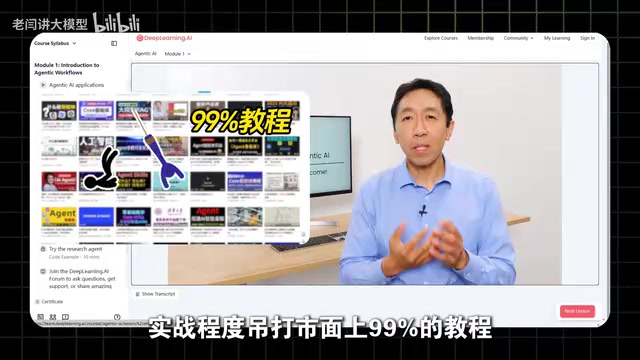
Why Andrew Ng's Agent Course Outperforms 99% of Tutorials
A Practice-First Teaching Philosophy
There are countless tutorials about large models and Agents on the market, but the vast majority remain at the level of concept explanation or simple API calls. What sets Andrew Ng's course apart is that from the very first lesson, you're writing code and building systems — every knowledge point corresponds to a runnable project. This "learn by doing" approach allows learners to quickly develop intuitive understanding of agent systems.
A Modular Design That Delivers a Decisive Advantage
The most brilliant aspect of this course is how it decomposes complex agent architecture into five core modules, each with clear functional definitions and implementation paths. This modular thinking not only reduces the learning curve but, more importantly, provides developers with a reusable Agent architecture design framework.

Detailed Breakdown of the Five Core Modules of AI Agent Development
Based on Andrew Ng's course framework, a complete AI Agent system can be decomposed into the following five key modules:
1. Reflection Module — Teaching Agents to Self-Correct
The Reflection module gives agents the ability to examine their own work. After completing a task, the Agent can review its output, identify shortcomings, and make improvements. This is the critical leap from "functional" to "excellent" and forms the foundation for building high-quality AI applications.
Technical Principle: The reflection mechanism is typically implemented through "Self-Critique Prompting" — after generating an initial output, the Agent calls the language model again to evaluate and revise that output. This approach draws from the Self-Play concept in reinforcement learning and is closely related to Chain-of-Thought reasoning techniques. Research from Google DeepMind shows that introducing reflection mechanisms can improve complex task completion quality by 20%-40%, making it one of the most cost-effective methods for enhancing Agent output quality.
2. Planning Module — Step-by-Step Decomposition of Complex Tasks
The Planning module gives agents the ability to break complex tasks into subtasks. A good Agent doesn't blindly execute instructions — it first formulates a plan, then proceeds step by step, and can dynamically adjust its strategy when encountering problems. This mirrors how humans approach complex problem-solving.
Core Framework — ReAct: The technical backbone of the Planning module is the ReAct (Reasoning + Acting) framework, jointly proposed by Princeton University and Google Research in 2022. ReAct enables language models to alternate between "reasoning" and "acting," observing results after each action before deciding the next step, forming a dynamic planning loop. Additionally, advanced methods like Tree of Thoughts allow Agents to explore multiple planning paths in parallel, further enhancing complex task processing capabilities and representing the frontier of current planning module research.
3. Tool Use Module — Breaking Beyond Pure Text Capabilities
The Tool Use module enables Agents to call external tools and APIs, such as search engines, code executors, databases, and more. This dramatically expands the agent's capability boundaries, allowing it to interact with real-world systems rather than being limited to pure text generation.
Function Calling Technology: The technical foundation for tool use is the Function Calling capability of large models, which OpenAI officially introduced to the GPT series API in June 2023. Through structured JSON Schema tool interface definitions, models can accurately determine when to call which tool and what parameters to pass. The current mainstream tool ecosystem covers web search (Tavily, Bing API), code execution (Code Interpreter), database queries, and third-party SaaS integrations. Tool calling has become the standard paradigm for Agent capability extension and is the key leap that upgrades large models from "chatbots" to "digital workers."
4. Multi-Agent Collaboration Module — Simulating Team Cooperation
Multi-Agent collaboration is the most imaginative aspect of Agent development. Multiple Agents divide labor and collaborate, simulating team workflows — some write code, some review, some test — completing complex tasks through collaboration that would be beyond a single Agent's capabilities.
Framework Ecosystem: The multi-agent collaboration field has developed a relatively mature open-source framework ecosystem. AutoGen (open-sourced by Microsoft) supports automatic conversation and task allocation between multiple Agents; CrewAI uses "role-playing" as its core abstraction, letting each Agent assume a clear professional role; LangGraph orchestrates Agent workflows based on directed graph structures, suitable for building complex state-machine-style collaboration systems. The emergence of these frameworks has dramatically lowered the engineering barriers to multi-agent systems, turning "AI teams" from concept into deployable reality.
5. Memory Module — Maintaining Context and Continuous Learning
The Memory module provides Agents with short-term and long-term memory capabilities, enabling them to maintain contextual coherence across multiple interactions and learn and improve from historical experience. This is an indispensable component for building truly intelligent Agents.
Four Levels of Memory: An Agent's memory system is typically divided into four levels: first, short-term memory within the context window (limited by token count); second, external long-term memory based on vector databases (such as Pinecone, Chroma, Weaviate), achieving relevant information recall through semantic retrieval; third, structured entity memory for tracking state changes of specific objects; fourth, procedural memory that solidifies successful operation sequences into reusable skills. The combination of vector databases and RAG (Retrieval-Augmented Generation) technology is the mainstream approach for implementing long-term memory and serves as the technical foundation for Agents that "get smarter with use."
Insights and Practical Recommendations for AI Learners
LLM Application Development Is Becoming Democratized
The viral success of Andrew Ng's course reflects an important trend: the barrier to LLM application development is dropping rapidly. Fields that once required deep machine learning expertise can now be accessed by regular developers through well-designed frameworks and toolchains, enabling them to build agent systems with advanced capabilities like reflection and planning.
This doesn't mean the technology has become simple — rather, the industry is transitioning from the "training models" phase to the "using models" phase. For most developers, understanding how to design Agent architectures and orchestrate multiple modules working together is far more practical than training a large model from scratch.
Recommended Learning Path for AI Agent Development
For learners looking to get started with AI Agent development, here's a suggested progression:
- Foundation Preparation: Master Python programming and basic LLM API calls (e.g., OpenAI API), and understand the Function Calling mechanism
- Framework Learning: Familiarize yourself with core concepts of mainstream Agent development frameworks like LangChain and CrewAI. LangChain is currently the most widely used Agent framework, providing complete abstraction layers for chain calls, tool integration, and memory management, with over 80K GitHub Stars; LlamaIndex focuses on data indexing and RAG scenarios; Semantic Kernel (Microsoft) targets enterprise development scenarios — together these form the current mainstream Agent development toolchain
- Module Practice: Implement core modules one by one — reflection, planning, tool calling — understanding the design principles and underlying technologies of each (such as the ReAct framework, vector database integration)
- System Integration: Combine modules and build complete multi-agent collaboration systems using frameworks like LangGraph or AutoGen
- Scenario Deployment: Choose specific business scenarios (such as automated customer service, code generation assistants, etc.) for optimization and deployment
Conclusion: Now Is the Best Time to Learn Agent Development
The reason Andrew Ng's Agent course has generated such enormous response is fundamentally because it got one thing right: explaining complex technology in simple terms while enabling everyone to get hands-on practice. In an era of rapid AI iteration, the ability to transform cutting-edge technology into actionable knowledge is rarer than the technology itself.
From the Reflection module's Self-Critique Prompting, to the Planning module's ReAct framework, to the Memory module's vector database integration — each module is backed by mature technical systems, and these technologies are being rapidly engineered through frameworks like LangChain and CrewAI. For every technologist following AI developments, now is the best time to learn Agent development. Open-source toolchains are increasingly mature, learning resources are unprecedentedly abundant — all that remains is whether you're willing to take the first step.
Related articles
 Tutorials
Cursor + Codex Dual-IDE Collaboration: A Practical Methodology for Open-Source Project Customization
A complete methodology for open-source project customization based on real-world experience, detailing the Cursor+Codex dual-IDE workflow, seven-stage process, MVP validation, and AI source code reading techniques.
 Tutorials
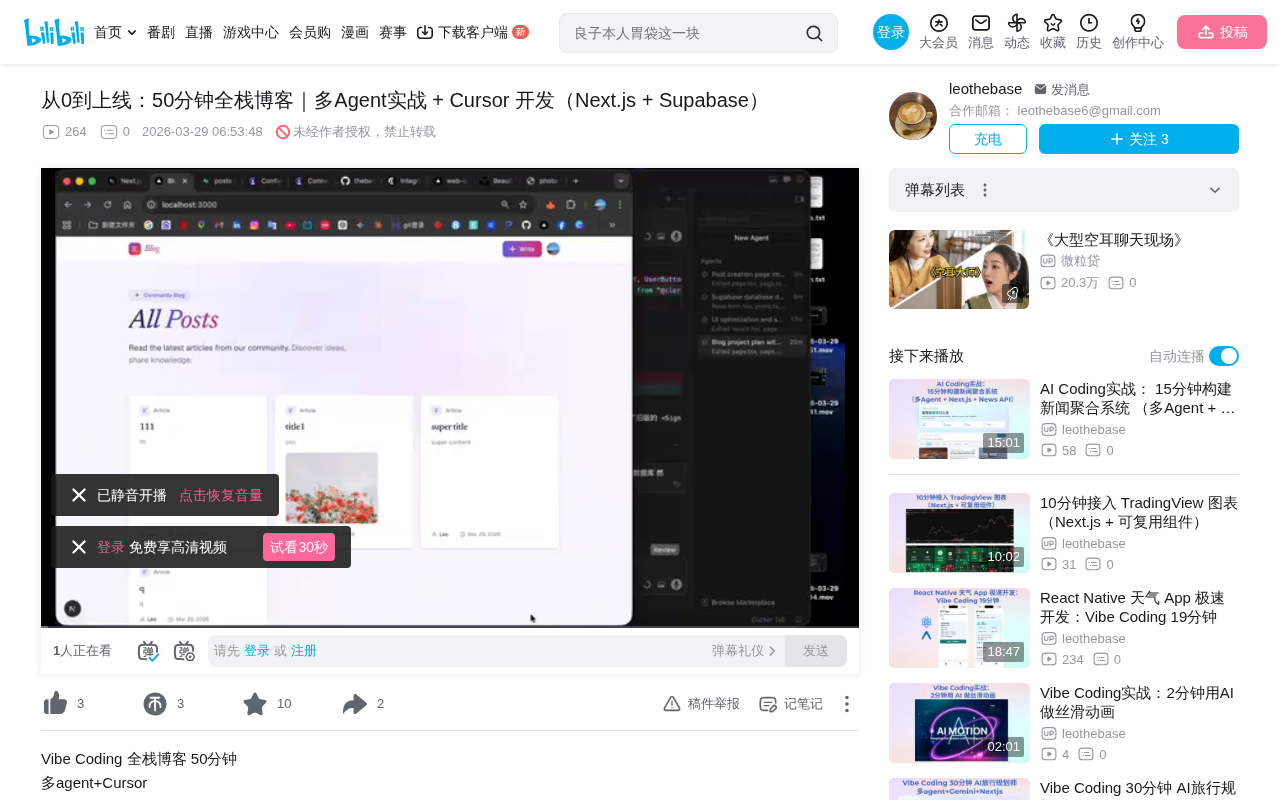
Cursor Multi-Agent in Practice: Building a Full-Stack Next.js Blog in 50 Minutes
Build a full-stack blog in 50 minutes using Cursor IDE's multi-Agent mode with Next.js, Clerk auth, and Supabase. Learn the 4-phase AI Agent workflow and key integration pitfalls.
 Tutorials
Building an AI Software Factory from Scratch: A Cursor Engineer's Hands-On Experience with Multi-Agent Collaboration
Cursor engineer Eric shares practical insights on building an AI software factory: automation levels, guardrail design, parallel Agent management, and scaling to 1000+ Agents for 24/7 development.