Complete Guide to Coze Platform: Building AI Agents Without Code
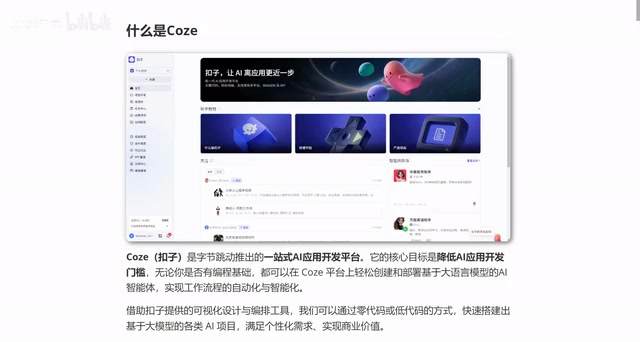
A comprehensive guide to ByteDance's Coze platform for building AI agents and apps without coding.
This guide provides a complete overview of Coze (扣子), ByteDance's no-code AI development platform. It covers Coze's three core advantages (low barrier, plugin ecosystem, enterprise collaboration), compares domestic and international versions, and explains the two development modes — conversational agents (Bots) and interface-based apps. Ideal for non-technical professionals, freelancers, and AI beginners looking to build AI applications quickly.
What is Coze? ByteDance's AI Application Development Platform
Coze is a one-stop AI application development platform launched by ByteDance. Its core mission is to dramatically lower the barrier to AI application development. Unlike traditional software development, Coze uses a visual drag-and-drop approach to build AI applications, enabling even users with zero programming experience to create and deploy AI agents powered by large language models.
A Large Language Model (LLM) is a deep learning model trained on massive amounts of text data that can understand and generate natural language, performing tasks like translation, summarization, Q&A, and code writing. The GPT series behind ChatGPT is the most representative example of large language models. An AI Agent, built on top of large language models, is an AI system with the ability to perceive its environment, make autonomous decisions, and execute tasks — it can not only "talk" but also "act." Coze's core value lies in enabling ordinary people to build their own AI agents using these cutting-edge technologies.
Here's a practical example: Suppose you're a travel consultant who manually writes travel itineraries for clients every day, which might take 10 to 30 minutes per recommendation. With a travel planning agent built on Coze, you simply input the client's destination, number of days, and other parameters, and a complete itinerary is generated in 10 seconds. This is the efficiency revolution Coze brings to everyday professionals.
However, it's important to note that Coze is better suited for developing small-scale, rapidly iterating AI applications rather than large enterprise-level systems. For programmers working on large AI projects, more specialized development frameworks like LangChain or Dify may be needed, as they offer finer-grained control and more flexible architecture design. But for everyday professionals across all industries, Coze is arguably the most user-friendly AI application building tool available today.
Three Core Advantages of the Coze Platform
Extremely Low Development Barrier: Zero Code Required
Coze's most outstanding feature is the combination of visual drag-and-drop and a natural language development paradigm. Natural language development means that when you need code at certain steps, you simply tell Coze in Chinese or English what functionality you want to achieve, and the platform automatically generates the corresponding code. The entire development process essentially achieves zero-code or extremely low-code operation, making development highly efficient.
This development approach belongs to the rapidly emerging "Low-Code/No-Code" development paradigm. Traditional software development requires developers to master programming languages, frameworks, databases, and a whole technology stack, resulting in long development cycles and high barriers to entry. Low-code platforms use pre-built components and visual orchestration to abstract the development process into "building block" style operations. Coze takes this a step further by introducing natural language programming capabilities — users describe their requirements in everyday language, and AI automatically converts them into executable logic or code. This marks a shift in software development from "humans adapting to machines" toward "machines understanding humans," and Coze is a prime example of this trend in the AI application domain.
Powerful Plugin Ecosystem and Integration Capabilities
Coze's platform includes a rich built-in plugin system that easily connects to external APIs. For example, you can integrate Feishu's collaboration features or Amap's location services directly into your AI agent. The platform also supports multiple mainstream large language models and provides convenient knowledge base (RAG) functionality, enabling agents to deliver precise answers based on domain-specific knowledge.
RAG (Retrieval-Augmented Generation) is one of the most important technical architectures in current AI application development. While large language models have broad knowledge, they face two key problems: first, their training data has a cutoff date, making them unable to access the latest information; second, they lack deep expertise in specific domains and are prone to "hallucinations" (generating content that sounds plausible but is actually incorrect). RAG's solution is: when a user asks a question, the system first retrieves the most relevant document fragments from an external knowledge base, then provides these fragments as context to the large model, allowing it to generate answers based on real materials. In Coze, users simply upload PDFs, Word documents, or web links, and the platform automatically handles the entire pipeline of document chunking, vector storage, and semantic retrieval, greatly simplifying the process of building a RAG system.
An API (Application Programming Interface) serves as a bridge for communication between different software systems. Coze's plugins are essentially wrappers around various external APIs, allowing users to enable their AI agents to call external services like weather queries, map navigation, and email sending through simple configuration — without needing to understand the underlying HTTP requests, data formats, or other technical details.
Enterprise-Level Collaboration Support (Continuously Improving)
Coze supports team collaboration, permission management, and version control, providing end-to-end services from development, testing, to deployment and monitoring. However, it should be objectively noted that Coze still has certain limitations in supporting enterprise-level large AI projects and is currently better suited for rapid development and iteration of small to medium-sized application scenarios.
The "end-to-end services" mentioned here encompass the DevOps philosophy in software engineering — integrating Development and Operations to form a continuous integration and continuous deployment loop. For AI applications, this means developers can complete agent design, debugging, publishing, and performance monitoring all on the same platform, without switching between multiple tools. Version control ensures that team members can develop in parallel, with every modification tracked and traceable, reducing communication costs and error risks in collaboration.
Coze Domestic vs. International Version: Which Should You Choose?
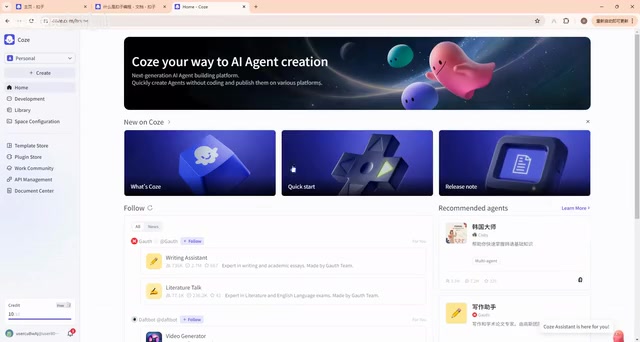
Coze is available in two versions — Domestic and International — with core differences mainly in language interface and available models:
| Comparison | Domestic Version (coze.cn) | International Version (coze.com) |
|---|---|---|
| Interface Language | Chinese | English |
| Available Models | Doubao, DeepSeek, Kimi, StepFun, etc. | GPT-4o, GPT-5, Gemini, DeepSeek, etc. |
| Access Method | Direct access | Requires VPN |
| Capabilities | Meets most domestic scenarios | Stronger model capabilities, suitable for international scenarios |
From a model capability perspective, the international version has an advantage in complex task processing since it can access GPT-5, GPT-4o, and other top-tier models. However, for domestic users, the Chinese interface and VPN-free access of the domestic version are equally important, and domestic models like DeepSeek continue to improve.
To help readers better understand the differences between these models, here's a brief introduction to several key ones: GPT-4o is OpenAI's multimodal flagship model, where "o" stands for "omni," capable of simultaneously processing text, image, and audio inputs with excellent reasoning and instruction-following abilities; GPT-5 is OpenAI's latest generation model with significant improvements in complex reasoning, long-text comprehension, and multi-step task execution. DeepSeek is an open-source large model developed by China's DeepSeek company, whose DeepSeek-V3 and DeepSeek-R1 have achieved world-class performance in mathematical reasoning and code generation, known for exceptional cost-effectiveness. Doubao is ByteDance's self-developed large model, deeply integrated with the Coze platform, with natural advantages in Chinese understanding and generation. Kimi, developed by Moonshot AI, features an ultra-long context window (supporting hundreds of thousands of characters of input), making it particularly suitable for long document processing. Each model has its strengths, and Coze's multi-model switching design allows users to choose the most appropriate model for specific tasks.
Recommendation: If you work domestically in everyday roles, the domestic version is more than sufficient; if you work at a foreign company or have international needs, consider using the international version for stronger model support.
Agents vs. Apps: Coze's Two Development Modes Explained
Coze currently supports two core development modes, and understanding their differences is crucial for choosing the right development path.
Agent (Bot): Conversation-Based AI Interaction
The agent is Coze's most classic product form, essentially a conversational AI system. Users interact with agents through natural language; the agent receives input, automatically invokes large models, plugins, or workflows to execute tasks, and ultimately generates a response. On the Coze platform, agents are called Bots, but they are essentially AI Agents.
From a technical architecture perspective, AI Agents are fundamentally different from simple chatbots. Traditional chatbots typically respond to users based on preset rules or keyword matching, with limited capabilities and lack of flexibility. AI Agents possess three core abilities: Perception (understanding user intent and context), Planning (decomposing complex tasks into multiple steps), and Action (calling tools and external services to execute tasks). For example, when you tell a travel planning agent "Help me plan a three-day trip to Chengdu with a budget of 5,000 yuan," it must not only understand your needs but also autonomously decide to first query attraction information, then check hotel prices, and finally synthesize an itinerary — this ability for autonomous decision-making and multi-step execution is what distinguishes Agents from ordinary chatbots. Coze's Workflow orchestration feature allows users to visually define these decision and execution steps.
Suitable scenarios: Customer service Q&A, knowledge consulting, content generation, schedule planning, and other tasks where conversation is the core interaction method.
App: AI Programs with Complete Interfaces
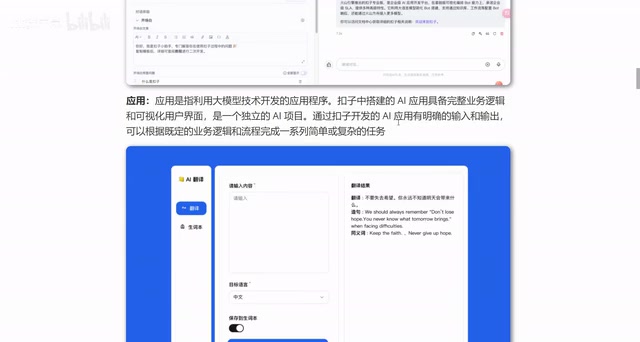
Apps are a newer feature from Coze (currently still in Beta), allowing users to build standalone AI applications with complete front-end interfaces and back-end logic. Unlike agents, apps have visual user interfaces with clear input/output flows, and users don't need to trigger functions through conversation.
For example, a translation app can directly provide an input box and a translate button. Users enter content, click translate, and the backend calls a large model to complete the translation and output the result — all without conversational interaction.
This expansion from "conversational interaction" to "interface-based interaction" reflects an important trend in AI application development. While conversational interaction is natural and intuitive, not all scenarios are suited for it — tasks like data dashboards, form filling, and batch processing are often more efficient with traditional graphical user interfaces (GUI). Coze's app mode essentially embeds AI capabilities into traditional front-end/back-end architecture: the front end handles UI display and interaction, while the back end uses workflows to call large models and various plugins for data processing. The Beta stage means this feature is still rapidly iterating, and some capabilities may not be fully stable or complete, but it also indicates that Coze is evolving from a single agent platform toward a more general-purpose AI application development platform.
Recommendation: If your need is to complete tasks through conversation, choose the agent mode; if you need a tool-like product with a specific interface and clear input/output, choose the app mode.
Who Should Learn Coze?
Coze's positioning means its audience is very broad:
- Non-technical professionals: Those in marketing, operations, sales, administration, and other roles can use Coze to quickly build small AI tools that boost work efficiency
- Freelancers: Travel consultants, content creators, educators, and others can build dedicated AI assistants to support their daily work
- AI development beginners: Learners who want to understand AI application development but lack programming skills will find Coze an ideal entry-level platform
- Programmers and developers: While not suitable for large projects, Coze remains efficient and time-saving for rapid prototyping and small tool development
It's worth noting that Coze's emergence aligns perfectly with the global trend of "AI Democratization." In the past, AI application development was the exclusive domain of a technical elite, requiring mastery of Python programming, machine learning frameworks, model fine-tuning, and other specialized skills. Low-code AI platforms like Coze are dramatically expanding this capability boundary — just as Excel enabled everyone to do data analysis and WordPress enabled everyone to build websites, Coze is enabling everyone to build AI applications. This means future competitiveness will no longer depend solely on "whether you can write code" but increasingly on "whether you can use AI to solve real problems."
Summary: Why Coze Deserves Your Attention
As ByteDance's AI application development platform, Coze is making cutting-edge AI capabilities accessible and democratized. Its core value lies in enabling everyone to build AI applications with an extremely low barrier — whether conversational agents or applications with complete interfaces. While it still has limitations for enterprise-level large projects, for personal productivity enhancement and small AI tool development, Coze is undoubtedly one of the most worthwhile AI platforms to master today.
From an industry landscape perspective, Coze is not the only AI application development platform. Similar products domestically and internationally include Baidu's AppBuilder, Dify (open source), FastGPT (open source), and overseas options like Zapier AI. However, Coze has established clear advantages in usability and ecosystem completeness through ByteDance's technical expertise and ecosystem resources (such as deep integration with the Doubao model and seamless connection with office tools like Feishu). As competition intensifies in the AI application development platform space, users ultimately benefit from lower costs and stronger platform capabilities.
For beginners, it's recommended to start with the domestic version, first familiarize yourself with the agent creation process, and then gradually explore advanced features like app development and workflow orchestration.
Related articles

Five Common Claude Code Mistakes — How Many Are You Making?
Five common Claude Code mistakes developers make: copy-pasting code, skipping CLAUDE.md, inefficient prompting, ignoring docs, and poor context management — with fixes.
Andrew Ng's New Course Explained: A Practical Guide to Using OpenAI's O1 Reasoning Model
Deep dive into Andrew Ng and OpenAI's Reasoning with O1 course covering test-time scaling, new prompting paradigms, multi-model orchestration, and practical applications for developers.

Learning AI After College Entrance Exams: A Complete Path from Zero to Freelancing
How to efficiently learn AI skills during summer break after exams? A complete path from mastering prompts and hands-on projects to freelancing on platforms.