From Copilot to Agentic AI: A Complete Guide to Multi-Agent Collaboration Architectures
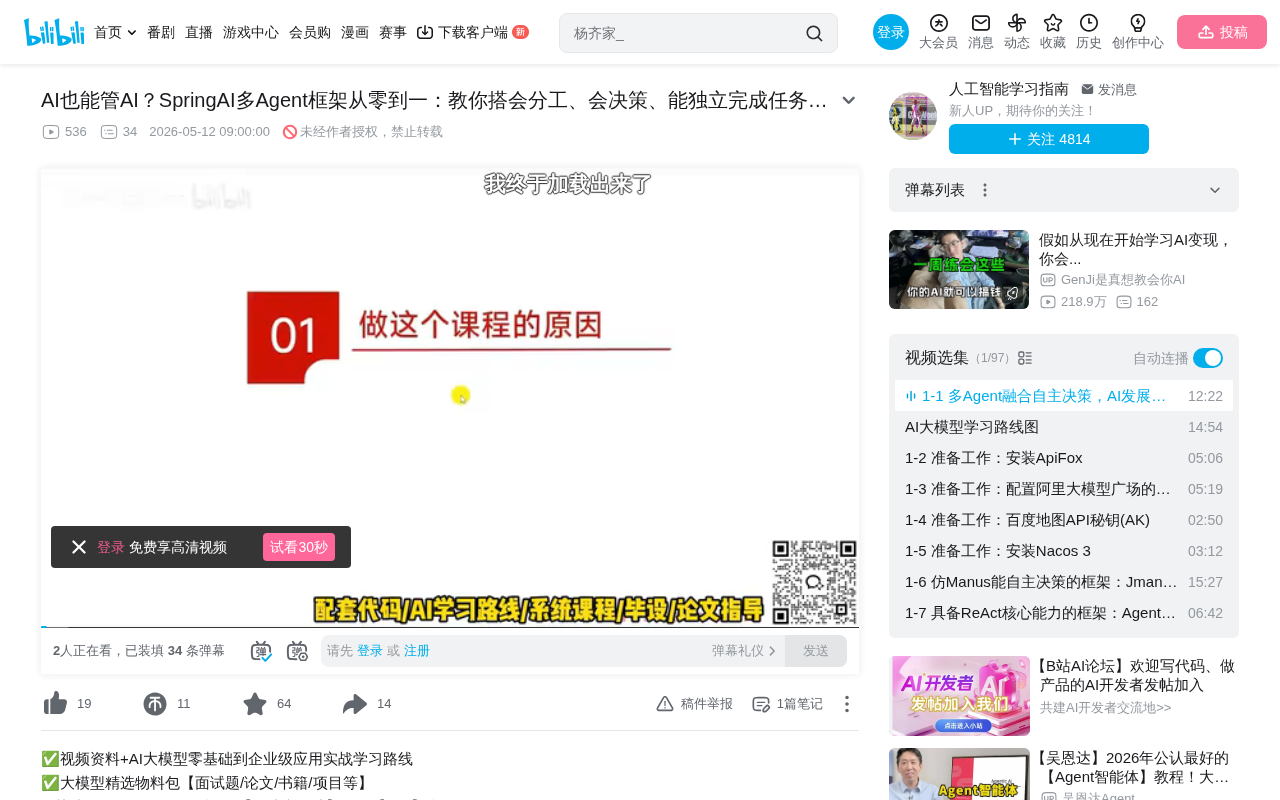
AI is evolving from chat tools to autonomous multi-Agent systems—a trend that's here to stay.
AI has progressed through four stages—Chat, Copilot, Agent, and Agentic AI—with its role shifting from assistive tool to primary autonomous operator. Agentic AI's core lies in multi-Agent collaboration and autonomous decision-making, powered by key technologies like the ReAct framework and MCP protocol. With 75% of enterprises already deploying AI Agents, multi-agent architectures and autonomous decision-making capabilities represent the enduring foundational logic of AI evolution and the most worthwhile technology investment.
Introduction: The Inevitable Trajectory of AI Evolution
The pace of AI innovation is breathtaking. Prompt engineering, RAG knowledge bases, local LLM deployment, and fine-tuning—all red-hot topics just a couple of years ago—are already fading from the mainstream spotlight. In the face of such rapid technological change, every practitioner faces a core question: What AI technologies should we learn to stay relevant?
The answer lies in the trajectory of AI's evolution. From chat mode to Copilot mode to today's Agentic AI mode, AI is evolving from an "assistive tool" into an "autonomous operator." The key term along this evolutionary path is Agent—or more precisely, multi-Agent collaboration.
The Four Stages of AI Development: From Chat to Autonomous Decision-Making
Stage 1: Chat Mode (2023)
In 2023, OpenAI's ChatGPT burst onto the scene, bringing AI into the public consciousness through a conversational interface. Users typed questions into a dialog box, and the large language model interpreted their intent and returned information. But at its core, AI at this stage was just a "supercharged search engine"—to actually get work done, users still had to open Excel or PowerPoint themselves, manually copying, pasting, and organizing the information AI provided.
From a technical perspective, ChatGPT is built on the GPT-3.5/GPT-4 large language models, trained using the Transformer architecture and RLHF (Reinforcement Learning from Human Feedback). It is fundamentally an autoregressive language model that generates text by predicting the next token. While it demonstrated remarkable language understanding and generation capabilities, it lacked the ability to interact with external systems—it couldn't access real-time data, manipulate file systems, or execute code. This confined it to the role of "information provider."
At this stage, AI contributed only a tiny fraction of productivity. Humans remained the ones doing the actual work.
Stage 2: Copilot Mode (2024)
AI's capabilities expanded beyond providing text-based information to making initial inroads into the production process. The most prominent use case was AI-assisted programming—exemplified by GitHub Copilot, which could directly participate in code writing. Through conversational interaction, developers could have AI help write code snippets.
GitHub Copilot is built on OpenAI's Codex model (a code-specialized variant of the GPT series), trained on massive open-source code repositories to understand code context and generate completion suggestions. It embeds into the development environment as an IDE plugin, analyzing the current file's context, comments, and function signatures to predict the developer's coding intent. However, its scope was limited to single files or localized code snippets—it couldn't understand an entire project's architecture or the dependency relationships between modules.
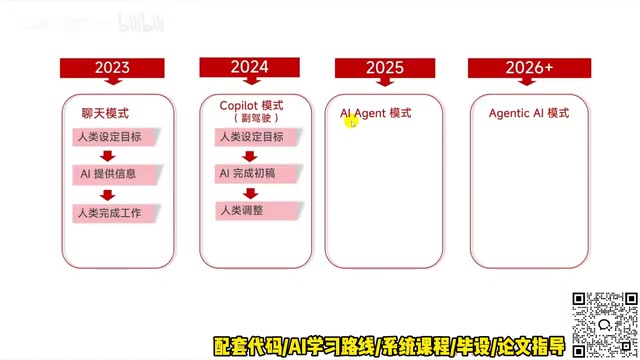
At this point, AI could only handle localized code. Overall project architecture, file creation, debugging, and other tasks still required human involvement. AI handled roughly one-third of the workload, while humans still completed the other two-thirds. This is the essence of "Copilot mode"—AI serves as an assistant, but humans remain the primary operators.
Stage 3: Agent Mode (Early 2025)
Two groundbreaking developments in early 2025 marked the official arrival of the AI Agent era:
First, the emergence of Manus. This software could autonomously complete complex tasks from start to finish. For example, when asked to present a company's Q3 business information, Manus would automatically scrape web data, filter quarterly information, write it into Excel for analysis, and present the results as charts—all without human intervention.
Manus represents a class of "end-to-end task automation Agents." Its core technology stack includes: a task planning module (decomposing complex tasks into executable sub-steps), a tool invocation module (browser automation, file operations, API calls, etc.), and an execution monitoring module (evaluating each step's results in real time and dynamically adjusting the plan). This architecture draws from the "plan-execute-monitor" model in cognitive science, enabling AI to handle complex, goal-oriented tasks much like a human would.
Second, the rise of AI editors like Cursor. Unlike traditional IDEs, users simply describe the desired functionality or project in a dialog box, and AI handles all the code writing, file generation, and project architecture scaffolding.
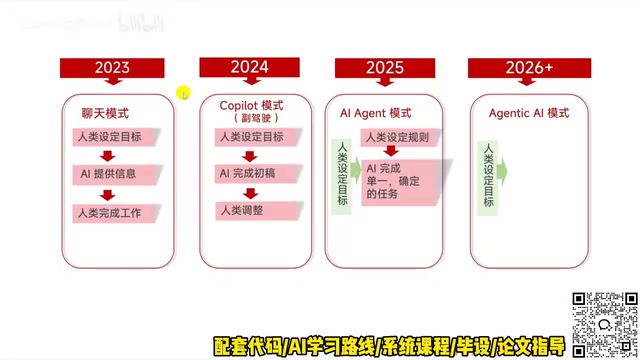
In this mode, AI handles roughly two-thirds of the work, while humans contribute only one-third—primarily setting goals, providing resources, and defining rules. The primary operator in the production process shifted from humans to Agents. This is why "Agent" became the most frequently used term in AI throughout 2025.
Stage 4: Agentic AI Mode (2025 to Present)
By late 2025, Agent mode evolved further into the Agentic AI paradigm, characterized by multi-Agent division of labor and collaboration. Compared to single-Agent systems, Agentic AI's core features include:
- Task decomposition and delegation: When facing complex tasks, the system breaks them into subtasks and assigns each to an Agent with the relevant expertise
- Reflection and adjustment: Agents possess a "reflect-adjust" cognitive loop during execution—they execute a step, evaluate whether it meets the expected goal, and adjust their strategy if it doesn't, iterating until the result aligns with the preset objective
- Autonomous decision-making: Agents can invoke tools and leverage LLMs for logical reasoning, possessing full autonomous decision-making capabilities
This multi-Agent collaboration model resembles team-based division of labor in human organizations: there's a "project manager Agent" responsible for planning, an "engineer Agent" for execution, and a "reviewer Agent" for quality assurance. They coordinate through message passing and shared context to accomplish complex tasks that would be beyond the capability of any single Agent.
Two Core Architectures for Multi-Agent Collaboration
From a technical implementation perspective, multi-agent collaboration follows two main design philosophies, each suited to different scenarios:
Workflow Orchestration: Graph Engine-Driven
The first approach uses a Graph engine as the core of a workflow orchestration framework. This method uses predefined directed graphs to orchestrate collaboration flows between Agents, making it ideal for business scenarios with relatively fixed processes and well-defined steps. Each node represents an Agent or processing step, and edges represent the direction of flow.
The Graph engine concept originates from graph theory and workflow engine technology. In multi-Agent systems, directed acyclic graphs (DAGs) or state machines define the collaboration topology between Agents. A typical implementation is LangGraph, which encapsulates each Agent as a node in the graph and uses Conditional Edges for dynamic routing. This approach is similar to traditional BPM (Business Process Management) systems, except the nodes are no longer simple rule engines but AI-powered intelligent agents with reasoning capabilities. Its advantage lies in auditability and debuggability, making it well-suited for industries like finance and healthcare where compliance requirements are strict.
This architecture's strength is its controllability and predictability, making it ideal for enterprise production environments that demand high stability.
Autonomous Agents: Self-Directed Decision-Making
The second approach represents a more advanced autonomous agent design philosophy. In this architecture, Agents no longer rely on predefined fixed workflows but instead autonomously decide their next action based on task requirements.
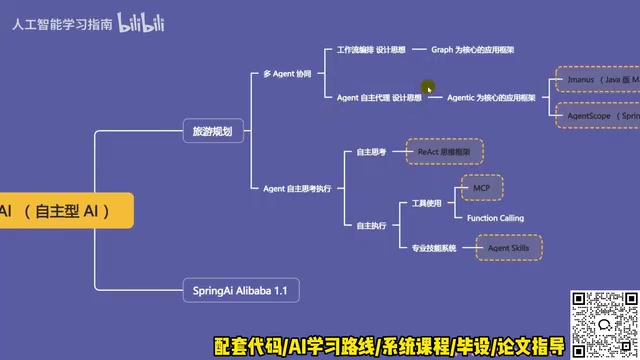
Within the Spring AI ecosystem, two frameworks deserve attention from Java developers:
- Java Manor: Think of it as the Java version of Manor, deeply integrated with Spring AI, offering comprehensive multi-agent orchestration capabilities
- Agent Scope: Part of the Spring AI / Alibaba ecosystem, this is Alibaba's flagship Agent framework, with natural advantages for enterprise adoption in China
Spring AI is the AI integration module introduced by the Spring framework ecosystem in 2024, providing Java developers with a unified abstraction layer for interacting with major LLMs (such as OpenAI, Anthropic, Ollama, etc.). It follows Spring's longstanding design philosophy—reducing development complexity through dependency injection and auto-configuration. For Agent development, Spring AI provides foundational capabilities like Function Calling, Chat Memory, and RAG, while Java Manor and Agent Scope build higher-level multi-agent orchestration capabilities on top, including inter-Agent communication, task distribution, state management, and fault recovery—all enterprise-grade features.
Both frameworks are built around Spring AI, giving Java developers the engineering capabilities to build multi-agent systems while lowering the technical barrier to Agent development.
Key Technologies for Agent Autonomous Thinking and Execution
The ReAct Framework: Teaching Agents to Think
The core of Agent autonomous thinking lies in the ReAct (Reasoning + Acting) framework. This framework gives Agents a "think-act-observe" loop, forming the foundation for autonomous decision-making:
- Reasoning: The Agent analyzes the current state and contextual information, thinking about what to do next
- Acting: Based on the reasoning results, it invokes the appropriate tools or executes specific operations
- Observation: It evaluates the action's results, determines whether expectations were met, and decides whether to adjust its strategy
The ReAct framework was proposed in 2022 by researchers from Princeton University and Google Brain in their paper "ReAct: Synergizing Reasoning and Acting in Language Models." The framework's innovation lies in unifying Chain-of-Thought (CoT) reasoning with external tool interaction within a single loop. Previously, reasoning and acting were separate—CoT only handled thinking without execution, while tool calls only executed without reasoning. ReAct's integration enables Agents to acquire new information during reasoning, reflect on results after acting, and form a closed-loop cognition-action cycle. This closely mirrors the "perception-decision-action" loop in cognitive science.
This cycle iterates continuously until the task is completed or the preset goal is achieved. The ReAct framework represents a critical technical breakthrough in moving Agents from "passively executing instructions" to "autonomously deciding and acting."
Tool Calling and the MCP Protocol
An Agent's autonomous execution capability depends on two core layers:
Tool Calling and the MCP Protocol: Agents need to invoke external tools to complete specific tasks. MCP (Model Context Protocol) provides standardized protocol support for tool invocation, enabling seamless integration between different Agents and tools.
MCP was proposed by Anthropic in late 2024 to address the standardized communication problem between AI models and external tools and data sources. Before MCP, every AI application required custom integration code for different tools, leading to massive duplication of effort and compatibility issues. MCP defines a unified client-server architecture: the AI model acts as an MCP client initiating requests, while tool providers act as MCP servers exposing their capabilities. The protocol standardizes tool descriptions (Schema), invocation methods (Invocation), and result returns (Response) in a standard format—similar to how REST API specifications standardized HTTP communication in the web domain. MCP has already gained support from major AI vendors including OpenAI and Google, and is becoming the de facto standard for Agent tool invocation.
Professional Skill Systems: Agents need more than just tool access—they need to follow complete professional workflows to accomplish their work. This is currently the hottest area in Agentic AI: equipping Agents with domain-specific professional skill systems rather than limiting them to simple tool invocation. Professional skill systems typically include domain knowledge bases, Standard Operating Procedures (SOPs), quality evaluation criteria, and other components that enable Agents to make professional judgments and perform operations like domain experts.
AI Agent Market Outlook and Technology Trends
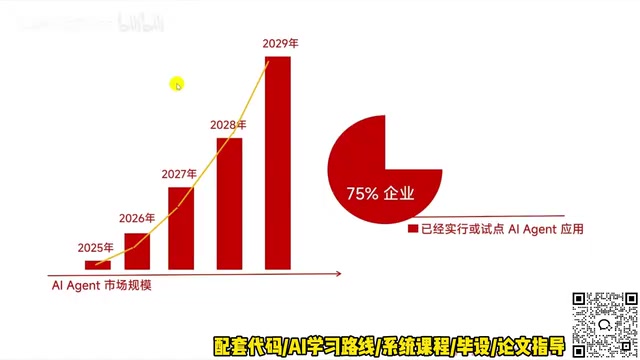
Market data shows that the AI Agent market is projected to grow steadily from 2026 to 2029, with strong momentum. Currently, 75% of enterprises are already deploying or implementing AI Agents, integrating them into actual production workflows. "One person commanding an entire company's digital workforce" is no longer a distant vision—it's happening now.
This trend is driven by multiple factors: the continuous improvement in LLM reasoning capabilities is reducing Agent decision-making error rates; the adoption of standard protocols like MCP is enabling Agents to connect with an ever-growing number of enterprise systems; and the maturity of cloud computing infrastructure provides the computational resources needed for large-scale Agent deployment. At the same time, enterprises are transitioning from an "AI assists humans" to an "AI executes autonomously, humans supervise" operating model, creating the organizational conditions for large-scale Agent adoption.
Key insight: The multi-agent collaboration architecture and the autonomous decision-making cognitive framework are fundamental principles that will not change as AI evolves. Specific frameworks and tools may come and go, but these two core capabilities will continue to evolve and improve.
Conclusion: What AI Technologies Will Stand the Test of Time
From 2023's chat mode to 2025's Agentic AI mode, AI's role has undergone a fundamental transformation—from "search engine" to "copilot" to "primary operator." For technology practitioners, rather than chasing every fleeting trend, it's far more valuable to deeply understand the underlying logic of AI's evolution—multi-Agent collaboration architectures and Agent autonomous decision-making capabilities.
Mastering how to build AI systems based on multi-agent collaboration with autonomous decision-making and professional skills is the most valuable technology investment for the future. Whether you're using Spring AI, LangChain, or any other framework, understanding core concepts like the ReAct framework, the MCP protocol, and multi-Agent orchestration will keep you ahead of the curve in the AI era.
Key Takeaways
- AI development has progressed through four stages: Chat Mode → Copilot Mode → Agent Mode → Agentic AI Mode, with Agents transitioning from assistive roles to primary operators in the production process
- The core of Agentic AI is multi-Agent division of labor and collaboration, capable of decomposing complex tasks and assigning them to specialized agents, with built-in reflection and adjustment cognitive loops
- Multi-Agent collaboration follows two main architectures: Graph engine-driven workflow orchestration and autonomous agent decision-making, with the latter representing the more advanced direction
- The ReAct framework (Reasoning-Acting-Observation loop) is the key technical foundation enabling Agent autonomous decision-making
- 75% of enterprises are already deploying AI Agents; multi-agent collaboration architectures and autonomous decision-making frameworks are the enduring foundational principles of AI development
Related articles
 Deep Dives
Deep Dive into How OpenClaw (Open-Source Crayfish) AI Agent Works
Deep analysis of OpenClaw AI Agent internals: System Prompt, tool calling, SubAgents, Skill system, memory, and Context Engineering explained.
 Deep Dives
Demystifying Transformer: A Word-Continuation Function, Deconstructed
Understand Transformer through the lens of word continuation. Breaking down language generation into Embedding, Transformer Block, and Probability output modules for intuitive understanding.
 Deep Dives
Five Core Differences Between Claude Code and Regular AI Chat
A detailed comparison of Claude Code vs regular AI chat across five dimensions: interaction, context understanding, execution, memory, and tool integration.